 CONTENTS :
Introduction
Types of Night Vision
Working of Technical Night Vision
Night Vision Devises
Generations
Applications
Advantages
Disadvantages
Conclusion
 Introduction
• Night Vision Technology, literally allows one to see in the dark.
• It is originally developed for military use.
• With poor night vision equipment, we can see a person standing over 200
yards(183 m) away on a moonless, cloudy night.
 Types of night vision
It is broadly classified into two types
I. Biological night vision
 Molecules in the rods of the eye undergo a change in shape as a
light.
 Molecules in the human rods is insensitive to the light.
II. Technical night vision
 Image Intensifier
 Thermal imaging
Working of technical night vision
Image intensifier
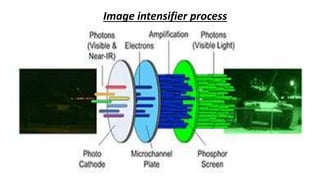
 Night vision amplifies light to achive better vision.
 A conventional lens,captures ambient light.
 The gathered light is sent to the image-intensifier tube.
 The light energy released electron from the cathode and accelerated,
In image-intensifier tube, the electrons hit a screen.
 The energy of the electrons release photons and create green image
on the screen.
 The green phosphor image is viewed through another lens.
Image intensifier process
 Thermal imaging
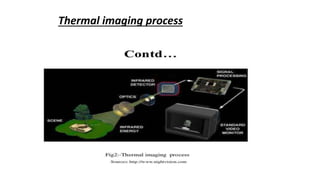
All objects emit infraded energy as a function of their temperature.
 A lens focuses the infraded light.
 A focused light is scanned and create temperature pattern.
 The pattern created is translated into electron impulses.
 The impulses are sent to a circuit board that translate the
information into data for the display.
 Thermal images are black and white in nature.
Thermal imaging process
Night vision devices
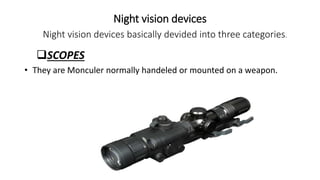
Night vision devices basically devided into three categories.
SCOPES
• They are Monculer normally handeled or mounted on a weapon.
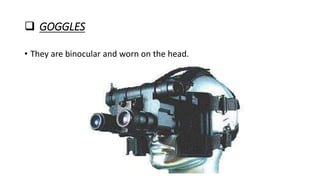
 GOGGLES
• They are binocular and worn on the head.
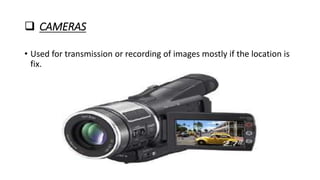
 CAMERAS
• Used for transmission or recording of images mostly if the location is
fix.
Generations
Generation 0:
The earlist (1950’s) Night Vision products were based on image
conversion, rather than intensification.
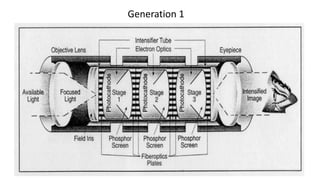
Generation 1
• Vacuum tube
• Full moon operation
• Amplification : 1,000
• Operating life : 2,000 hours
Generation 1
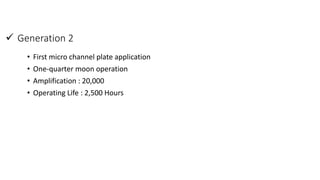
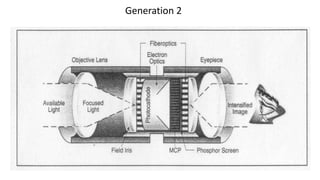
 Generation 2
• First micro channel plate application
• One-quarter moon operation
• Amplification : 20,000
• Operating Life : 2,500 Hours
Generation 2
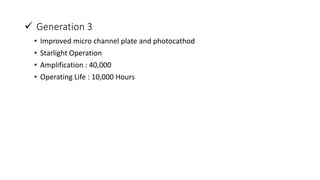
 Generation 3
• Improved micro channel plate and photocathod
• Starlight Operation
• Amplification : 40,000
• Operating Life : 10,000 Hours
Applications
• Military
• Hunting
• Wildlife observation
• Security
• Hidden-object detection
Advanteges
• No particular skill is required.
• Accident cases reduction.
• Compact system
• 3X range visual
Disadvanteges
• The only disadvantages is that the inifial cost too high.
Conclusion
• Today in the 21`st century we have come a long way in the
development of night vision technology
from the early 1940’s.
• Night vision devices are basically designed for utmost
defensive purposes.
• In present scenario the applications of night vision
technology is very essential to combat terrorism which is a
major problem being faced by mankind.
Night vision tech

Night vision tech

  • 2.
     CONTENTS : Introduction Typesof Night Vision Working of Technical Night Vision Night Vision Devises Generations Applications Advantages Disadvantages Conclusion
  • 3.
     Introduction • NightVision Technology, literally allows one to see in the dark. • It is originally developed for military use. • With poor night vision equipment, we can see a person standing over 200 yards(183 m) away on a moonless, cloudy night.
  • 4.
     Types ofnight vision It is broadly classified into two types I. Biological night vision  Molecules in the rods of the eye undergo a change in shape as a light.  Molecules in the human rods is insensitive to the light. II. Technical night vision  Image Intensifier  Thermal imaging
  • 5.
    Working of technicalnight vision Image intensifier  Night vision amplifies light to achive better vision.  A conventional lens,captures ambient light.  The gathered light is sent to the image-intensifier tube.  The light energy released electron from the cathode and accelerated, In image-intensifier tube, the electrons hit a screen.  The energy of the electrons release photons and create green image on the screen.  The green phosphor image is viewed through another lens.
  • 6.
  • 7.
     Thermal imaging Allobjects emit infraded energy as a function of their temperature.  A lens focuses the infraded light.  A focused light is scanned and create temperature pattern.  The pattern created is translated into electron impulses.  The impulses are sent to a circuit board that translate the information into data for the display.  Thermal images are black and white in nature.
  • 8.
  • 9.
    Night vision devices Nightvision devices basically devided into three categories. SCOPES • They are Monculer normally handeled or mounted on a weapon.
  • 10.
     GOGGLES • Theyare binocular and worn on the head.
  • 11.
     CAMERAS • Usedfor transmission or recording of images mostly if the location is fix.
  • 12.
    Generations Generation 0: The earlist(1950’s) Night Vision products were based on image conversion, rather than intensification. Generation 1 • Vacuum tube • Full moon operation • Amplification : 1,000 • Operating life : 2,000 hours
  • 13.
  • 14.
     Generation 2 •First micro channel plate application • One-quarter moon operation • Amplification : 20,000 • Operating Life : 2,500 Hours
  • 15.
  • 16.
     Generation 3 •Improved micro channel plate and photocathod • Starlight Operation • Amplification : 40,000 • Operating Life : 10,000 Hours
  • 17.
    Applications • Military • Hunting •Wildlife observation • Security • Hidden-object detection
  • 18.
    Advanteges • No particularskill is required. • Accident cases reduction. • Compact system • 3X range visual
  • 19.
    Disadvanteges • The onlydisadvantages is that the inifial cost too high.
  • 20.
    Conclusion • Today inthe 21`st century we have come a long way in the development of night vision technology from the early 1940’s. • Night vision devices are basically designed for utmost defensive purposes. • In present scenario the applications of night vision technology is very essential to combat terrorism which is a major problem being faced by mankind.