A Presentation on
NIGHT VISION TECHNOLOGY
Submitted By :-
Name :- Arijit Chakraborty
Roll.No :- BETI1EC16002
Electronic & Communication
2nd year / 4th Semester
Submitted to :-
Mr. Anshul Agarwal
Asst. Professor
Electronic & Communication
TABLE OF CONTENTS :-
 History
 Introduction
 Types of Night Vision
 Working of Technical Night Vision
 Night Vision Devices
 Generations
 Applications
 Conclusion
 Reference
History :-
In 1929, Hungarian physicist Kálmán Tihanyi invented
the infrared-sensitive (night vision) electronic television
camera for anti-aircraft defense in the UK.
The first military night vision devices were introduced by
the German Army as early as 1939, and were used
in World War II. AEG started developing the first devices
in 1935. In mid-1943, the Army began the first tests with
infrared night-vision (Nachtjäger) devices and telescopic
rangefinders mounted on Panther tanks.
INTRODUCTION :-
• Night vision technology, literally allows one to see in the
dark.
• It is originally developed for military use .
• Humans have poor night vision compared to many other
animals.
• With the proper night-vision equipment, we can see a
person standing over 200 yards (183 m) away on a
moonless, cloudy night.
TYPES OF NIGHT VISION :-
It isbroadly classified into two types :-
 Biological Night Vision
• Molecules in the rods of the eye undergo a change in shape as
light.
• Molecules in the human rods is insensitive to the light.
Technical Night Vision
• Image intensifier
• Thermal imaging
WORKING OF TECHNICAL
NIGHT VISION :-
Technical Night vision can work in two very different ways
Image Intensifier
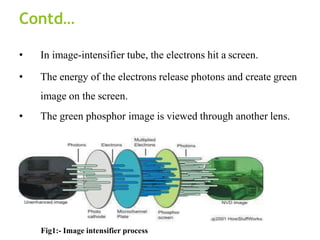
• Night vision amplifies light to achieve better vision .
• A conventional lens, captures ambient light.
• The gathered light is sent to the image-intensifier tube.
• The light energy released electron from the cathode and
accelerated.
Contd…
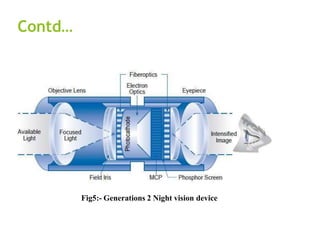
• These electrons enter micro channel plate and bounce off
and generate more electron.
• Thousands of other electrons to be released in each
channel.
• Original electrons collide with the channel,exciting atoms
and causing other electrons.
• New electrons collide with other atoms, creating a chain.
Contd…
• In image-intensifier tube, the electrons hit a screen.
• The energy of the electrons release photons and create green
image on the screen.
• The green phosphor image is viewed through another lens.
Fig1:- Image intensifier process
Contd…
 Thermal Imaging
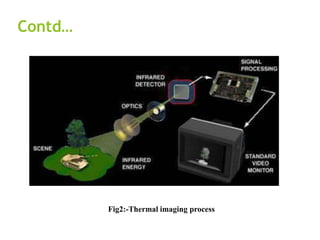
All objects emit infrared energy as a function of their
temperature.
• A lens focuses the infrared light.
• The focused light is scanned and create temperature pattern.
• The pattern created is translated into electric impulses.
Contd…
• The impulses are sent to a circuit board that
translates the information into data for the
display.
• Thesignal-processing unit sends the information
to the display, and appears as various colors.
• Thermal images are black and white in nature.
Contd…
Fig2:-Thermal imaging process
NIGHT VISION DEVICES :-
Night vision devices are basically divided into three categories
 SCOPES
• They are monocular normally
handheld or mounted on a weapon.
 GOGGLES
• They are binocular and worn on the head.
 CAMERAS
• Used for transmission or recording
of images mostly if the location is fixed.
Fig3:- Night vision devices
GENERATIONS :-
Generation 0
The earliest (1950’s) night vision products were based
on image conversion, rather than intensification.
Generation 1
• Vacuum Tube Technology
• Full Moon Operation
• Amplification: 1,000
• Operating Life: 2,000 Hours
Contd…
Fig4:- Generations1 Night vision
Contd…
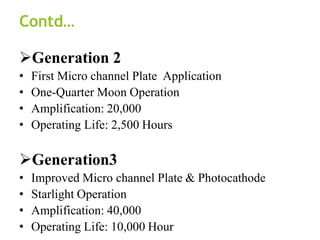
Generation 2
• First Micro channel Plate Application
• One-Quarter Moon Operation
• Amplification: 20,000
• Operating Life: 2,500 Hours
Generation3
• Improved Micro channel Plate & Photocathode
• Starlight Operation
• Amplification: 40,000
• Operating Life: 10,000 Hour
Contd…
Fig5:- Generations 2 Night vision device
APPLICATIONS :-
• Military
• Hunting
• Wildlife observation
• Security
• Hidden-object detection
CONCLUSIONS :-
• Today in the 21st century we have come a long way in the
development of night vision technology, from the early 1940’s.
• Night vision devices are basically designed for utmost defensive
purposes but the application within the scientific or the civilian
range is often prohibited by law.
• In present scenario the applications of night vision technology is
very essential to combat terrorism which is a major problem
being faced by mankind.
REFERENCES :-
• http://www.google.co.in
• http://www.photonis.com/nightvision/products/supergen/super
gen_specifications
• En.Wikipedia.Org/Wiki/Night_vision_device
• Www.Morovision.Com/How_thermal_imaging_works.Htm
• En.Wikipedia.Org/Wiki/Night_vision
Night vision technology

Night vision technology

  • 1.
    A Presentation on NIGHTVISION TECHNOLOGY Submitted By :- Name :- Arijit Chakraborty Roll.No :- BETI1EC16002 Electronic & Communication 2nd year / 4th Semester Submitted to :- Mr. Anshul Agarwal Asst. Professor Electronic & Communication
  • 2.
    TABLE OF CONTENTS:-  History  Introduction  Types of Night Vision  Working of Technical Night Vision  Night Vision Devices  Generations  Applications  Conclusion  Reference
  • 3.
    History :- In 1929,Hungarian physicist Kálmán Tihanyi invented the infrared-sensitive (night vision) electronic television camera for anti-aircraft defense in the UK. The first military night vision devices were introduced by the German Army as early as 1939, and were used in World War II. AEG started developing the first devices in 1935. In mid-1943, the Army began the first tests with infrared night-vision (Nachtjäger) devices and telescopic rangefinders mounted on Panther tanks.
  • 4.
    INTRODUCTION :- • Nightvision technology, literally allows one to see in the dark. • It is originally developed for military use . • Humans have poor night vision compared to many other animals. • With the proper night-vision equipment, we can see a person standing over 200 yards (183 m) away on a moonless, cloudy night.
  • 5.
    TYPES OF NIGHTVISION :- It isbroadly classified into two types :-  Biological Night Vision • Molecules in the rods of the eye undergo a change in shape as light. • Molecules in the human rods is insensitive to the light. Technical Night Vision • Image intensifier • Thermal imaging
  • 6.
    WORKING OF TECHNICAL NIGHTVISION :- Technical Night vision can work in two very different ways Image Intensifier • Night vision amplifies light to achieve better vision . • A conventional lens, captures ambient light. • The gathered light is sent to the image-intensifier tube. • The light energy released electron from the cathode and accelerated.
  • 7.
    Contd… • These electronsenter micro channel plate and bounce off and generate more electron. • Thousands of other electrons to be released in each channel. • Original electrons collide with the channel,exciting atoms and causing other electrons. • New electrons collide with other atoms, creating a chain.
  • 8.
    Contd… • In image-intensifiertube, the electrons hit a screen. • The energy of the electrons release photons and create green image on the screen. • The green phosphor image is viewed through another lens. Fig1:- Image intensifier process
  • 9.
    Contd…  Thermal Imaging Allobjects emit infrared energy as a function of their temperature. • A lens focuses the infrared light. • The focused light is scanned and create temperature pattern. • The pattern created is translated into electric impulses.
  • 10.
    Contd… • The impulsesare sent to a circuit board that translates the information into data for the display. • Thesignal-processing unit sends the information to the display, and appears as various colors. • Thermal images are black and white in nature.
  • 11.
  • 12.
    NIGHT VISION DEVICES:- Night vision devices are basically divided into three categories  SCOPES • They are monocular normally handheld or mounted on a weapon.  GOGGLES • They are binocular and worn on the head.  CAMERAS • Used for transmission or recording of images mostly if the location is fixed. Fig3:- Night vision devices
  • 13.
    GENERATIONS :- Generation 0 Theearliest (1950’s) night vision products were based on image conversion, rather than intensification. Generation 1 • Vacuum Tube Technology • Full Moon Operation • Amplification: 1,000 • Operating Life: 2,000 Hours
  • 14.
  • 15.
    Contd… Generation 2 • FirstMicro channel Plate Application • One-Quarter Moon Operation • Amplification: 20,000 • Operating Life: 2,500 Hours Generation3 • Improved Micro channel Plate & Photocathode • Starlight Operation • Amplification: 40,000 • Operating Life: 10,000 Hour
  • 16.
    Contd… Fig5:- Generations 2Night vision device
  • 17.
    APPLICATIONS :- • Military •Hunting • Wildlife observation • Security • Hidden-object detection
  • 18.
    CONCLUSIONS :- • Todayin the 21st century we have come a long way in the development of night vision technology, from the early 1940’s. • Night vision devices are basically designed for utmost defensive purposes but the application within the scientific or the civilian range is often prohibited by law. • In present scenario the applications of night vision technology is very essential to combat terrorism which is a major problem being faced by mankind.
  • 19.
    REFERENCES :- • http://www.google.co.in •http://www.photonis.com/nightvision/products/supergen/super gen_specifications • En.Wikipedia.Org/Wiki/Night_vision_device • Www.Morovision.Com/How_thermal_imaging_works.Htm • En.Wikipedia.Org/Wiki/Night_vision