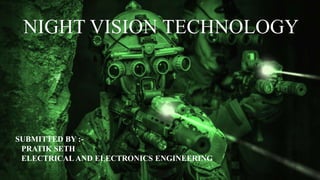

NIGHT VISION TECHNOLOGY
SUBMITTED BY :-
PRATIK SETH
ELECTRICAL AND ELECTRONICS ENGINEERING
CONTENTS
 Introduction
 Type of Night Vision
 The Basics
 Working of Night Vision
 Night Vision Devices
 Application
 Advantage & Disadvantage
 CONCLUSIONS
1
INTRODUCTION
 Night vision is the ability to see in low light conditions. like in
Moonless and cloudy night.
 Humans have poor night vision compared to other animals.
 With the proper night vision equipment, we can see a person
standing over 200 yards (183 m) away on a moonless, cloudy night.
2
Type of night vision
There are two type of night vision
 Thermal Imaging
 Image Intensifier
3
THE BASICs
 In order to understand night-vision, it is important to
understand something about light.
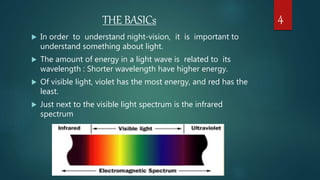
 The amount of energy in a light wave is related to its
wavelength : Shorter wavelength have higher energy.
 Of visible light, violet has the most energy, and red has the
least.
 Just next to the visible light spectrum is the infrared
spectrum
4
5
Infrared light can be split into three categories:-
 Near–Infrared (Near-IR) :- Closest to visible light, near-infrared
has wavelengths that range from 0.7 to 1.3 microns.
 Mid-Infrared (Mid-IR) :- Mid-infrared has wavelengths range
from 1.3 to 3 microns.
 Thermal-Infrared (Thermal-IR) :- Occupying the largest part of
the infrared spectrum, it has wavelengths range from 3 - 30
microns.
WORKING OF NIGHT VISION
Image Intensifier :-
 Night vision amplifies light to achieve better vision.
 A conventional lens, captures ambient light.
 The gathered light is sent to the image-intensifier tube.
 The light energy released electron from the cathode and
accelerated.
 These electrons enter micro channel plate and bounce
and generate more electron.
6
7
 Thousands of other electrons to be released in each channel.
 Original electrons collide with the channel, exciting atoms and
causing other electrons.
 New electrons collide with other atoms, creating a chain.
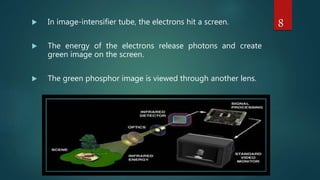
8 In image-intensifier tube, the electrons hit a screen.
 The energy of the electrons release photons and create
green image on the screen.
 The green phosphor image is viewed through another lens.
NIGHT VISION DEVICEs
Night vision devices are basically divided into three
categories
SCOPES
 They are monocular normally.
 handheld or mounted on a weapon.
9
10
GOGGLES :-
 They are binocular and worn on the head.
11CAMERAS :-
 Used for transmission or recording of images mostly if the
location is fixed.
APPLICATIONS
 Military
 Hunting
 Security
 Navigation
 Hidden-Object Detection
12
ADVANTAGES
 No particular skill required
 Accidents cases reduction
 Detection of object in absolute darkness
 Less affected by temperature variation
DISADVANTAGEs
 The only disadvantage is that the Initial cost too high.
13
CONCLUSIONS
 Night vision is used to locate an object which is 200 yards
away even in moonless, cloudy night.
 The main purpose of night-vision was to locate enemy
targets at night.
 It is mainly used in military purpose as well as navigation,
surveillance and targeting.
14
THANK YOU

Night vision technology

  • 1.
    NIGHT VISION TECHNOLOGY SUBMITTEDBY :- PRATIK SETH ELECTRICAL AND ELECTRONICS ENGINEERING
  • 2.
    CONTENTS  Introduction  Typeof Night Vision  The Basics  Working of Night Vision  Night Vision Devices  Application  Advantage & Disadvantage  CONCLUSIONS 1
  • 3.
    INTRODUCTION  Night visionis the ability to see in low light conditions. like in Moonless and cloudy night.  Humans have poor night vision compared to other animals.  With the proper night vision equipment, we can see a person standing over 200 yards (183 m) away on a moonless, cloudy night. 2
  • 4.
    Type of nightvision There are two type of night vision  Thermal Imaging  Image Intensifier 3
  • 5.
    THE BASICs  Inorder to understand night-vision, it is important to understand something about light.  The amount of energy in a light wave is related to its wavelength : Shorter wavelength have higher energy.  Of visible light, violet has the most energy, and red has the least.  Just next to the visible light spectrum is the infrared spectrum 4
  • 6.
    5 Infrared light canbe split into three categories:-  Near–Infrared (Near-IR) :- Closest to visible light, near-infrared has wavelengths that range from 0.7 to 1.3 microns.  Mid-Infrared (Mid-IR) :- Mid-infrared has wavelengths range from 1.3 to 3 microns.  Thermal-Infrared (Thermal-IR) :- Occupying the largest part of the infrared spectrum, it has wavelengths range from 3 - 30 microns.
  • 7.
    WORKING OF NIGHTVISION Image Intensifier :-  Night vision amplifies light to achieve better vision.  A conventional lens, captures ambient light.  The gathered light is sent to the image-intensifier tube.  The light energy released electron from the cathode and accelerated.  These electrons enter micro channel plate and bounce and generate more electron. 6
  • 8.
    7  Thousands ofother electrons to be released in each channel.  Original electrons collide with the channel, exciting atoms and causing other electrons.  New electrons collide with other atoms, creating a chain.
  • 9.
    8 In image-intensifiertube, the electrons hit a screen.  The energy of the electrons release photons and create green image on the screen.  The green phosphor image is viewed through another lens.
  • 10.
    NIGHT VISION DEVICEs Nightvision devices are basically divided into three categories SCOPES  They are monocular normally.  handheld or mounted on a weapon. 9
  • 11.
    10 GOGGLES :-  Theyare binocular and worn on the head.
  • 12.
    11CAMERAS :-  Usedfor transmission or recording of images mostly if the location is fixed.
  • 13.
    APPLICATIONS  Military  Hunting Security  Navigation  Hidden-Object Detection 12
  • 14.
    ADVANTAGES  No particularskill required  Accidents cases reduction  Detection of object in absolute darkness  Less affected by temperature variation DISADVANTAGEs  The only disadvantage is that the Initial cost too high. 13
  • 15.
    CONCLUSIONS  Night visionis used to locate an object which is 200 yards away even in moonless, cloudy night.  The main purpose of night-vision was to locate enemy targets at night.  It is mainly used in military purpose as well as navigation, surveillance and targeting. 14
  • 16.