Intrauterine growth restriction is said to be prsesent in those
babies whose birth weight is below the tength percentile of
the average for gestational age.
• Dysmaturity comprised about one third of low birth weight
babies.
• In developed countries , its overall incidence is about
• 3-10%
• Term babies (5%)
• Post term babies (15%)
The causes of IUGR can be grouped as
• Maternal causes
• Fetal causes
• Placental causes
• Uterine and Environmental causes.
• Pregnancy weight of mother influences the fetal size
• Chronic maternal disease condition
• Renal disease condition
• Malnutrition
• Multiple pregnancy
• Hypertensive disorders of pregnancy
• Severe anemia
• Previous baby suffered iugr etc.
• Chromosomal anomalies
• Exposure to an infection
German measles (rubella), cytomegalovirus, herpes
simplex, tuberculosis, syphilis, or toxoplasmosis, TB,
Malaria, Parvo virus
• Birth defects
(cardiovascular, renal, anencephally, limb defect, etc).
• Placenta or umbilical cord defects.
• Uteroplacental Insufficiency
• Fetoplacetal Insufficiency
• Abruptio placenta
• Placenta previa
• Post term pregnancy
• Septate uterus
• Fibroid/ myoma uterus
• High altitude - lower environmental oxygen saturation
• Toxins
Due to maternal and placental causes
Decrease in placental transfer of nutrients and oxygen to the fetus
Resulting in reduced fetal body store of lipids, glycogen
Causes neonatal hypoglycemia
Lack of oxygen
Chronic hypoxia that leads to erythropoietin production
Polycythemia etc
• Based On Pathological Processes
I)Type I- Symmetrical
II)Type II- Asymmetrical
• Symmetric IUGR: (33 % of IUGR Infants)
• height, weight, head circumference proportional
early pregnancy insult:
• commonly due to congenital infection, genetic disorder,
or intrinsic factors
• reduced no of cells in fetus
• normal ponderal index
• low risk of perinatal asphyxia
• low risk of hypoglycemia
• later in pregnancy:
• commonly due to utero placental insufficiency, maternal
malnutrition, hypoxia, or extrinsic factors
• low ponderal index
• cell number remains same but size is small
• increased risk of asphyxia
• increased risk of hypoglycemia
• Weight deficit
• Large head circumference
• Old man look
• Cartilaginous ridges on pinna
• Dry wrinkled skin
• Length remain unaffected
• Open eyes
• Well defined creases
• Alert and active
• Normal reflexes Normal cry
• Thin umbilical
• Scaphoid abdomen
• Signs of recent wasting
- soft tissue wasting - diminished skin fold thickness -
decrease breast tissue - reduced thigh circumference
• Signs of long term growth failure
- Widened skull sutures, large fontanelles -
-shortened crown – heel length - delayed development of
epiphyses
Diagnosis of IUGR is made by assessing the following
Maternal history may have history of
• chronic hypertension
• severe eclampsia
• chronic renal disease
• diabetes mellitus
• multiple gestation or prior delivery of IUGR
-Less Than The Period Of Gestation
-Doesn’t Correspond With The Period Of Gestation .
It Is Less Than Normal
-Fluid Volume Is Diminished
-Reveals The Presence Of Congenital Anomalies,
Dereased Amniotic Fluid Volume, And Laeger Ratio Of
Head - To - Abdominal
The aims of management of a pregnant women with IUGR
are as follows:-
• Identification of pregnant women at high risk of iugr
• Identification of fetuses wh are malnourished or
SGA(small for gestational age)
• Fetal surveillance for those pregnancied with IUGR
Management of IUGR can be described as :-
• Antepartum management
• Intrapartum management
• Immediate management
Monitor the mother carefully for fetal kicks counts, fetal
biophysical profile, NST(non stress test) and Doppler
velocimetry.
- mother can be prepared for spontaneous vaginal delivery.
- NST can be repeated twice a daily.
- before 48 hours prior to delivery, steroids are administered
to the mother to improve fetal lung maturity.
- depend upon cervical dilatation.
ARM (artificial rupture of membrane) is
done , followed by oxytocin as advised.
cervical ripening agents to be used
as per institutional policy.
If there is Fetal distress, Malpresentation, Induction failure and
history of Cesarean section
Delivery must be well equipped for delivering IUGR
babies.
An obstetrician and neonatologist should be
available during delivery
• intrapartum monitoring for hypoxia is to be done.
• fetal blood sampling is to be taken for further
action
• Infant should be transferred to the NICU for further
care.
• Babies admitted for care at NICU.
fetal distress and intrauterine
fetal death may occur
hypoxia and acidosis are common.
:- Immediately after birth, respirtory
distress syndrome, asphyxia, hypoglycemia,
meconium aspiration syndrome and infection etc.
can occur.
THANK YOU

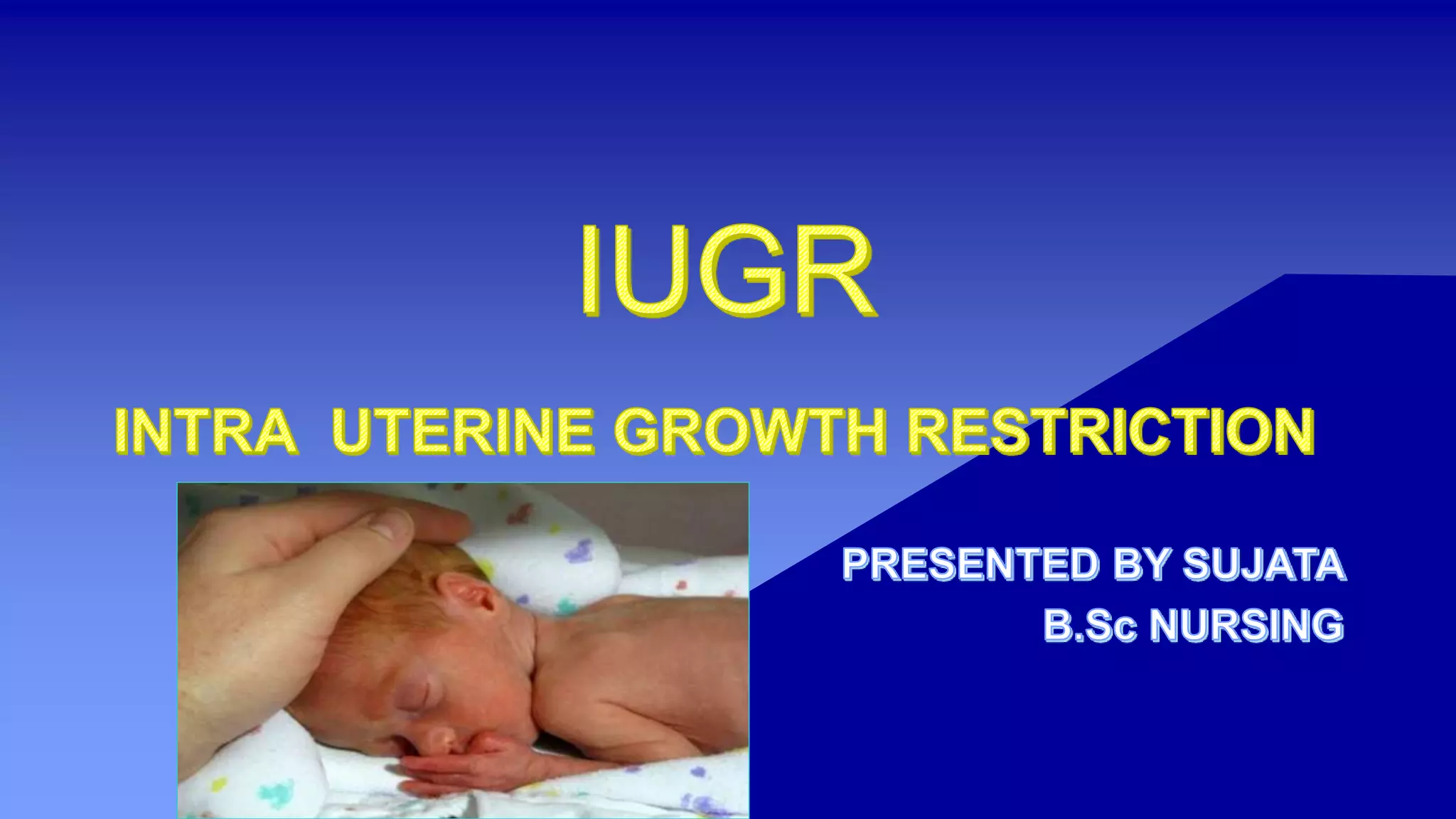
IUGR (intra uterine growth restrictions )

  • 2.
    Intrauterine growth restrictionis said to be prsesent in those babies whose birth weight is below the tength percentile of the average for gestational age.
  • 3.
    • Dysmaturity comprisedabout one third of low birth weight babies. • In developed countries , its overall incidence is about • 3-10% • Term babies (5%) • Post term babies (15%)
  • 4.
    The causes ofIUGR can be grouped as • Maternal causes • Fetal causes • Placental causes • Uterine and Environmental causes.
  • 5.
    • Pregnancy weightof mother influences the fetal size • Chronic maternal disease condition • Renal disease condition • Malnutrition • Multiple pregnancy • Hypertensive disorders of pregnancy • Severe anemia • Previous baby suffered iugr etc.
  • 6.
    • Chromosomal anomalies •Exposure to an infection German measles (rubella), cytomegalovirus, herpes simplex, tuberculosis, syphilis, or toxoplasmosis, TB, Malaria, Parvo virus • Birth defects (cardiovascular, renal, anencephally, limb defect, etc). • Placenta or umbilical cord defects.
  • 7.
    • Uteroplacental Insufficiency •Fetoplacetal Insufficiency • Abruptio placenta • Placenta previa • Post term pregnancy
  • 8.
    • Septate uterus •Fibroid/ myoma uterus
  • 9.
    • High altitude- lower environmental oxygen saturation • Toxins
  • 10.
    Due to maternaland placental causes Decrease in placental transfer of nutrients and oxygen to the fetus Resulting in reduced fetal body store of lipids, glycogen Causes neonatal hypoglycemia Lack of oxygen
  • 11.
    Chronic hypoxia thatleads to erythropoietin production Polycythemia etc
  • 12.
    • Based OnPathological Processes I)Type I- Symmetrical II)Type II- Asymmetrical
  • 13.
    • Symmetric IUGR:(33 % of IUGR Infants) • height, weight, head circumference proportional early pregnancy insult: • commonly due to congenital infection, genetic disorder, or intrinsic factors • reduced no of cells in fetus • normal ponderal index • low risk of perinatal asphyxia • low risk of hypoglycemia
  • 14.
    • later inpregnancy: • commonly due to utero placental insufficiency, maternal malnutrition, hypoxia, or extrinsic factors • low ponderal index • cell number remains same but size is small • increased risk of asphyxia • increased risk of hypoglycemia
  • 15.
    • Weight deficit •Large head circumference • Old man look • Cartilaginous ridges on pinna • Dry wrinkled skin • Length remain unaffected • Open eyes • Well defined creases • Alert and active
  • 16.
    • Normal reflexesNormal cry • Thin umbilical • Scaphoid abdomen • Signs of recent wasting - soft tissue wasting - diminished skin fold thickness - decrease breast tissue - reduced thigh circumference • Signs of long term growth failure - Widened skull sutures, large fontanelles - -shortened crown – heel length - delayed development of epiphyses
  • 17.
    Diagnosis of IUGRis made by assessing the following Maternal history may have history of • chronic hypertension • severe eclampsia • chronic renal disease • diabetes mellitus • multiple gestation or prior delivery of IUGR
  • 18.
    -Less Than ThePeriod Of Gestation -Doesn’t Correspond With The Period Of Gestation . It Is Less Than Normal -Fluid Volume Is Diminished
  • 19.
    -Reveals The PresenceOf Congenital Anomalies, Dereased Amniotic Fluid Volume, And Laeger Ratio Of Head - To - Abdominal
  • 20.
    The aims ofmanagement of a pregnant women with IUGR are as follows:- • Identification of pregnant women at high risk of iugr • Identification of fetuses wh are malnourished or SGA(small for gestational age) • Fetal surveillance for those pregnancied with IUGR
  • 21.
    Management of IUGRcan be described as :- • Antepartum management • Intrapartum management • Immediate management
  • 22.
    Monitor the mothercarefully for fetal kicks counts, fetal biophysical profile, NST(non stress test) and Doppler velocimetry. - mother can be prepared for spontaneous vaginal delivery. - NST can be repeated twice a daily.
  • 23.
    - before 48hours prior to delivery, steroids are administered to the mother to improve fetal lung maturity.
  • 24.
    - depend uponcervical dilatation. ARM (artificial rupture of membrane) is done , followed by oxytocin as advised. cervical ripening agents to be used as per institutional policy. If there is Fetal distress, Malpresentation, Induction failure and history of Cesarean section
  • 25.
    Delivery must bewell equipped for delivering IUGR babies. An obstetrician and neonatologist should be available during delivery • intrapartum monitoring for hypoxia is to be done. • fetal blood sampling is to be taken for further action
  • 26.
    • Infant shouldbe transferred to the NICU for further care. • Babies admitted for care at NICU.
  • 27.
    fetal distress andintrauterine fetal death may occur hypoxia and acidosis are common. :- Immediately after birth, respirtory distress syndrome, asphyxia, hypoglycemia, meconium aspiration syndrome and infection etc. can occur.
  • 28.