NEUROGENIC
BLADDER
Dr. Uttam Laudari
JR III
Department of Sugery
Kathmandu Medical college
Outline of the presentation
• Applied physiology
• Symptomatology
• Types according to levels of bladder
dysfunction
• Investigations
• Treatment available
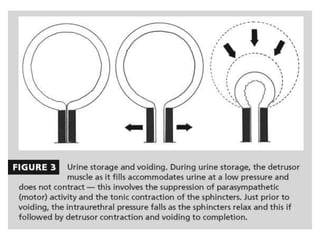
Bladder functions
• Storage - at low pressure until such time as it
is convenient and socially acceptable to void
• Voiding - initiated by inhibition of the striated
sphincter and pelvic floor, followed some
seconds later by a contraction of the detrusor
muscle.
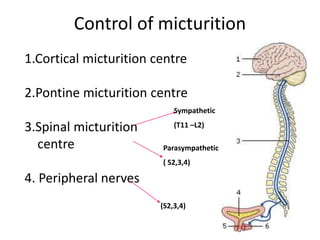
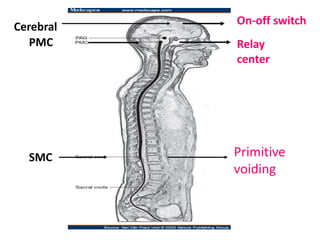
1.Cortical micturition centre
2.Pontine micturition centre
3.Spinal micturition
centre
4. Peripheral nerves
Sympathetic
(T11 –L2)
Parasympathetic
( S2,3,4)
(S2,3,4)
Control of micturition
Cortical micturation centre(CMC)
Location: Paracentral lobule in the medial aspect of the
frontoparietal cotex
Function: Inhibitory to PMC
Dysfunction – loss of social control of bladder
The brain’s control of the PMC is part of the social
training that children experience at age 2 - 4 years
Pontine Micturition Centre (PMC)
Also called Barrington’s nucleus
• Lateral region
Function - continence, storage urine
stimulation results in a powerful contraction
of the urethral sphincter
• Medial region
Function - micturition center
stimulation results in decrease in urethral
pressure and silence of pelvic floor EMG signal,
followed by a rise in detrusor pressure.
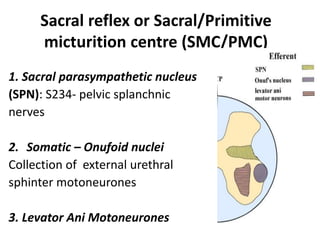
Sacral reflex or Sacral/Primitive
micturition centre (SMC/PMC)
1. Sacral parasympathetic nucleus
(SPN): S234- pelvic splanchnic
nerves
2. Somatic – Onufoid nuclei
Collection of external urethral
sphinter motoneurones
3. Levator Ani Motoneurones
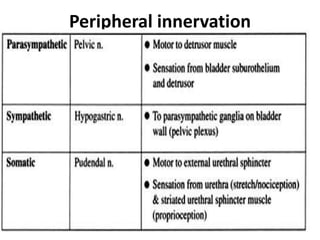
Peripheral innervation
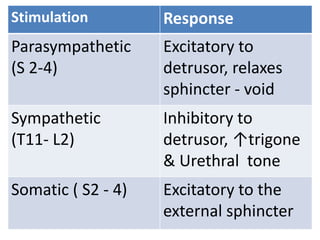
Stimulation Response
Parasympathetic
(S 2-4)
Excitatory to
detrusor, relaxes
sphincter - void
Sympathetic
(T11- L2)
Inhibitory to
detrusor, ↑trigone
& Urethral tone
Somatic ( S2 - 4) Excitatory to the
external sphincter
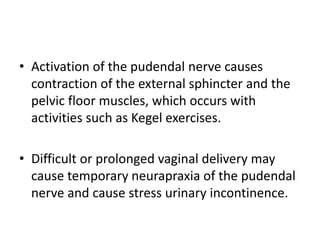
• Activation of the pudendal nerve causes
contraction of the external sphincter and the
pelvic floor muscles, which occurs with
activities such as Kegel exercises.
• Difficult or prolonged vaginal delivery may
cause temporary neurapraxia of the pudendal
nerve and cause stress urinary incontinence.
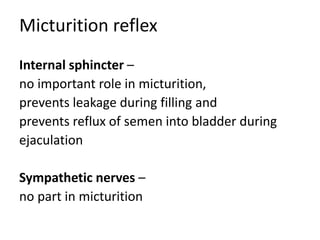
Micturition reflex
Internal sphincter –
no important role in micturition,
prevents leakage during filling and
prevents reflux of semen into bladder during
ejaculation
Sympathetic nerves –
no part in micturition
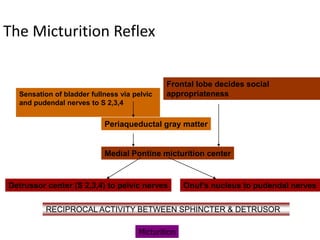
The Micturition Reflex
Sensation of bladder fullness via pelvic
and pudendal nerves to S 2,3,4
Periaqueductal gray matter
Medial Pontine micturition center
Frontal lobe decides social
appropriateness
Onuf’s nucleus to pudendal nervesDetrussor center (S 2,3,4) to pelvic nerves
RECIPROCAL ACTIVITY BETWEEN SPHINCTER & DETRUSOR
Micturition
On-off switch
Relay
center
Primitive
voiding
Cerebral
PMC
SMC
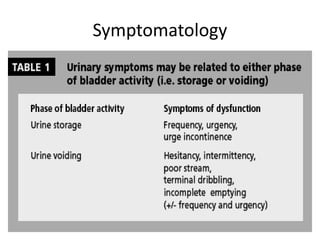
Symptomatology
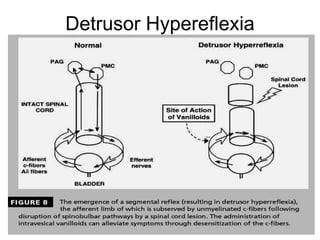
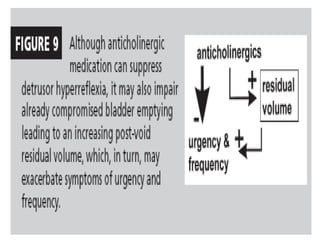
Detrusor Hypereflexia
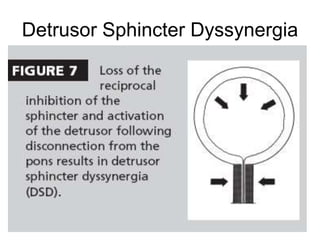
Detrusor Sphincter Dyssynergia
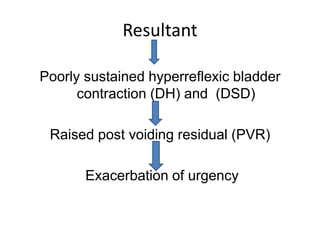
Resultant
Poorly sustained hyperreflexic bladder
contraction (DH) and (DSD)
Raised post voiding residual (PVR)
Exacerbation of urgency
• If spinal cord injury has occurred, the patient will
demonstrate symptoms of urinary frequency,
urgency, and urge incontinence but will be unable
to empty his or her bladder completely.
• This occurs because the urinary bladder and the
sphincter are both overactive, a condition termed
detrusor sphincter dyssynergia with detrusor
hyperreflexia (DSD-DH).
• If the sacral cord becomes severely injured
(eg, spinal tumor, herniated disc), the bladder
may not function.
• Affected patients may develop urinary
retention, termed detrusor areflexia.
• The detrusor will be unable to contract, so the
patient will not be able to urinate and urinary
retention will occur
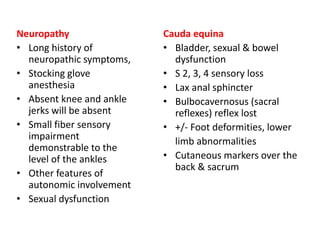
Neuropathy
• Long history of
neuropathic symptoms,
• Stocking glove
anesthesia
• Absent knee and ankle
jerks will be absent
• Small fiber sensory
impairment
demonstrable to the
level of the ankles
• Other features of
autonomic involvement
• Sexual dysfunction
Cauda equina
• Bladder, sexual & bowel
dysfunction
• S 2, 3, 4 sensory loss
• Lax anal sphincter
• Bulbocavernosus (sacral
reflexes) reflex lost
• +/- Foot deformities, lower
limb abnormalities
• Cutaneous markers over the
back & sacrum
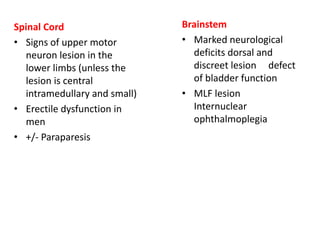
Spinal Cord
• Signs of upper motor
neuron lesion in the
lower limbs (unless the
lesion is central
intramedullary and small)
• Erectile dysfunction in
men
• +/- Paraparesis
Brainstem
• Marked neurological
deficits dorsal and
discreet lesion defect
of bladder function
• MLF lesion
Internuclear
ophthalmoplegia
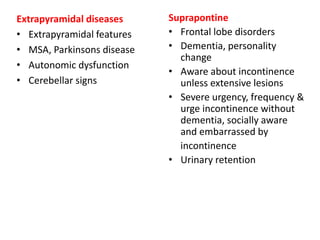
Extrapyramidal diseases
• Extrapyramidal features
• MSA, Parkinsons disease
• Autonomic dysfunction
• Cerebellar signs
Suprapontine
• Frontal lobe disorders
• Dementia, personality
change
• Aware about incontinence
unless extensive lesions
• Severe urgency, frequency &
urge incontinence without
dementia, socially aware
and embarrassed by
incontinence
• Urinary retention
Types according to
the level of bladder
dysfunction
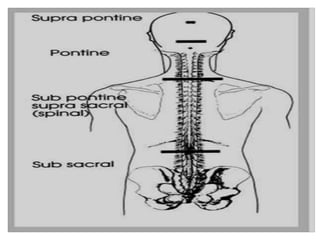
a) Suprapontine/cortical lesion –
“Uninhibited /Cortical bladder”
Severe urgency, frequency & urge incontinence
with dementia – incontinent and inappropriate
voiding
without dementia- socially aware & embarrassed
by their incontinence.
b) Pontine lesion –
“ Reflex / Automatic bladder”
DH,
Arreflexia
c) Spinal (subpontine/suprasacral)
“ Spastic Bladder” ( hyperactive bladder)
Urge incontinence
Disorders of storage and emptying
DSD (true only if above T6 level), DH
c) Spinal (subpontine/suprasacral)
• The bladder empties too quickly and too frequently.
• The voiding disorder is similar to that of the brain
lesion except that the external sphincter may have
paradoxical contractions as well.
• If both the bladder and external sphincter become
spastic at the same time, the affected individual will
sense an overwhelming desire to urinate but only a
small amount of urine may dribble out DSD
d) Sacral and subsacral lesions
I) Afferent fibres involved only –
“Atonic /Areflexic bladder”
Overflow incontinence
Straining for micturition
No DSD, no DH
d) Sacral and subsacral lesions
• prevent the bladder from emptying
• If a sensory neurogenic bladder is present, the affected individual may not be able
to sense when the bladder is full.
• In the case of a motor neurogenic bladder, the individual will sense the bladder is
full and the detrusor may not contract, a condition known as detrusor areflexia.
• These individuals have difficulty eliminating urine and experience overflow
incontinence; the bladder gradually overdistends until the urine spills out.
• Typical causes are a sacral cord tumor, herniated disc, and injuries that crush the
pelvis.
• This condition also may occur after a lumbar laminectomy, radical hysterectomy, or
abdominoperineal resection.
II) Both afferent and efferent involved –
“Autonomous bladder”
Small capacity , acting of its own. No DSD/DH
Peripheral nerve injury
• Diabetes mellitus and AIDS are 2 of the conditions causing peripheral
neuropathy resulting in urinary retention.
• These diseases destroy the nerves to the bladder and may lead to silent,
painless distention of the bladder.
• Patients with chronic diabetes lose the sensation of bladder filling first,
before the bladder decompensates.
• Similar to injury to the sacral cord, affected individuals will have difficulty
urinating. They also may have a hypocontractile bladder.
• Other diseases manifesting this condition are poliomyelitis, Guillain-Barré
syndrome, severe herpes in the genitoanal area, pernicious anemia, and
neurosyphilis (tabes dorsalis).
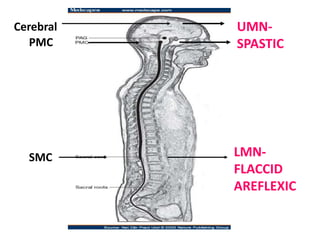
UMN-
SPASTIC
LMN-
FLACCID
AREFLEXIC
Cerebral
PMC
SMC
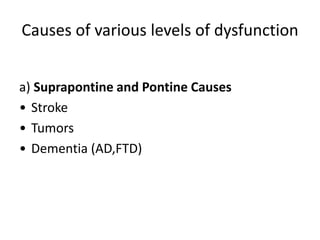
Causes of various levels of dysfunction
a) Suprapontine and Pontine Causes
• Stroke
• Tumors
• Dementia (AD,FTD)
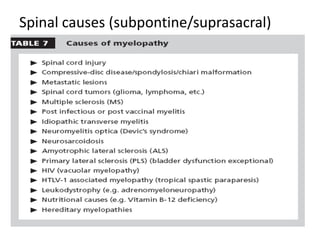
Spinal causes (subpontine/suprasacral)
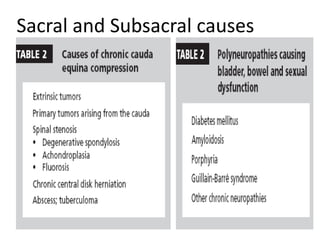
Sacral and Subsacral causes
Management- Investigations
Noninvasive bladder investigations-
Post void residual volume –
• In out catheterization,
• Ultrasound ( N is <100ml)
Uroflowmetry-
• Voided volume ( >100ml)
• Maximal flow, maximal and average flow rate
(M > 20ml/sec and F > 15ml/sec)
Cystometry-
• Measure detrusor pressure
(Intravesical presure – Rectal pressure)
• Bladder infused till 400 to 600ml – Pressure should
not rise to >15cm water (Stable bladder)
• Neurogenic detrusor overactivity – Involutary
detrusor contraction during filling phase
• Voiding phase – Detrusor pressure M < 50cm
water F < 30cm water
Sphincter EMG –
Reinnervation with prolonged duration of
MUAPs
Neuroimaging –
Cauda equina & conus lesions,
spinal,
supra pontine and pontine lesions
treatment
• Stress incontinence
– weak urinary sphincter
– internal sphincter contains high concentrations of alpha-adrenergic receptors.
– Activation of the alpha-receptors results in contraction of the internal urethral
sphincter and increases the urethral resistance to urinary flow.
– stress incontinence and an overactive bladder may be most effective when
combined with a pelvic exercise regimen
– 3 main categories of drugs used to treat urge incontinence include
anticholinergic drugs, antispasmodics, and tricyclic antidepressant agents.
• Propantheline bromide
– decrease incidence of urge incontinence by 13-
17% when 30 mg was used qid.
– When stronger doses were used (60 mg qid), the
cure rate was reported to be over 90%
– Adult dosing is 15 mg PO tid/qid
• Dicyclomine hydrochloride is an anticholinergic agent with smooth
muscle relaxant properties.
• It blocks the action of acetylcholine at parasympathetic sites in
secretory glands and smooth muscle.
• In a medical study, subjective improvement was reported by 62% of
the subjects while taking dicyclomine hydrochloride 10 mg tid.
• The reported cure rate was 90%.
• Adult dosing is 10-20 mg PO tid.
• Hyoscyamine sulfate is an anticholinergic
agent with antispasmodic properties used for
the treatment of urge incontinence.
• It blocks the action of acetylcholine at
parasympathetic sites in smooth muscle,
secretory glands, and the CNS, which in turn
has antispasmodic effects.
• Anitcholinegic contraindication
– Narrow angle glaucoma
– Urinary retention, bowel obstruction, ulcerative
colitis, myasthenia gravis, and severe heart
diseases
• If single therapy fails
– Combination therapy with oxybutinin or imipramine
– Oxybutynin causes direct smooth muscle relaxation of the
urinary bladder and has local anesthetic properties
– Imipramine has a direct inhibitory and local anesthetic effect on
the bladder smooth muscle, like oxybutynin
– imipramine also increases the bladder outlet resistance at the
level of the bladder neck
– Ultimately relax the unstable bladder and holds urine
Estrogen derivatives
• Conjugated estrogen increases the tone of urethral muscle by up-
regulating the alpha-adrenergic receptors in the surrounding area
and enhances alpha-adrenergic contractile response to strengthen
pelvic muscle
• which is important in urethral support (prevents urethral
hypermobility)
• Result is an improved mucosal seal effect, which is important in
urethral function (prevents intrinsic sphincter deficiency)
• postmenopausal women with mild-to-moderate incontinence. Both
types of stress incontinence benefit from estrogen fortification.
Treatment - Detrusor overactivity
• Anticholinergics
- Oxybutynin, tolterodine
- M3 blockers- darifenacin
• Tricyclic antidepressants
- Imipramine
• Desmopressin intranasally – once in 24 hrs
• Botulinum toxin A
• Intravesical capsaicin –
instilled with a balloon catheter
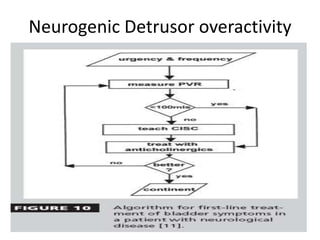
Neurogenic Detrusor overactivity
Treatment
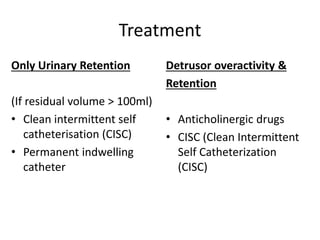
Only Urinary Retention
(If residual volume > 100ml)
• Clean intermittent self
catheterisation (CISC)
• Permanent indwelling
catheter
Detrusor overactivity &
Retention
• Anticholinergic drugs
• CISC (Clean Intermittent
Self Catheterization
(CISC)
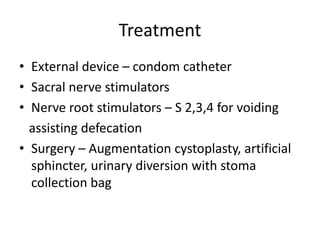
Treatment
• External device – condom catheter
• Sacral nerve stimulators
• Nerve root stimulators – S 2,3,4 for voiding
assisting defecation
• Surgery – Augmentation cystoplasty, artificial
sphincter, urinary diversion with stoma
collection bag
Neurogenic bladder

Neurogenic bladder

  • 1.
    NEUROGENIC BLADDER Dr. Uttam Laudari JRIII Department of Sugery Kathmandu Medical college
  • 2.
    Outline of thepresentation • Applied physiology • Symptomatology • Types according to levels of bladder dysfunction • Investigations • Treatment available
  • 3.
    Bladder functions • Storage- at low pressure until such time as it is convenient and socially acceptable to void • Voiding - initiated by inhibition of the striated sphincter and pelvic floor, followed some seconds later by a contraction of the detrusor muscle.
  • 4.
    1.Cortical micturition centre 2.Pontinemicturition centre 3.Spinal micturition centre 4. Peripheral nerves Sympathetic (T11 –L2) Parasympathetic ( S2,3,4) (S2,3,4) Control of micturition
  • 5.
    Cortical micturation centre(CMC) Location:Paracentral lobule in the medial aspect of the frontoparietal cotex Function: Inhibitory to PMC Dysfunction – loss of social control of bladder The brain’s control of the PMC is part of the social training that children experience at age 2 - 4 years
  • 6.
    Pontine Micturition Centre(PMC) Also called Barrington’s nucleus • Lateral region Function - continence, storage urine stimulation results in a powerful contraction of the urethral sphincter • Medial region Function - micturition center stimulation results in decrease in urethral pressure and silence of pelvic floor EMG signal, followed by a rise in detrusor pressure.
  • 7.
    Sacral reflex orSacral/Primitive micturition centre (SMC/PMC) 1. Sacral parasympathetic nucleus (SPN): S234- pelvic splanchnic nerves 2. Somatic – Onufoid nuclei Collection of external urethral sphinter motoneurones 3. Levator Ani Motoneurones
  • 8.
  • 9.
    Stimulation Response Parasympathetic (S 2-4) Excitatoryto detrusor, relaxes sphincter - void Sympathetic (T11- L2) Inhibitory to detrusor, ↑trigone & Urethral tone Somatic ( S2 - 4) Excitatory to the external sphincter
  • 10.
    • Activation ofthe pudendal nerve causes contraction of the external sphincter and the pelvic floor muscles, which occurs with activities such as Kegel exercises. • Difficult or prolonged vaginal delivery may cause temporary neurapraxia of the pudendal nerve and cause stress urinary incontinence.
  • 11.
    Micturition reflex Internal sphincter– no important role in micturition, prevents leakage during filling and prevents reflux of semen into bladder during ejaculation Sympathetic nerves – no part in micturition
  • 12.
    The Micturition Reflex Sensationof bladder fullness via pelvic and pudendal nerves to S 2,3,4 Periaqueductal gray matter Medial Pontine micturition center Frontal lobe decides social appropriateness Onuf’s nucleus to pudendal nervesDetrussor center (S 2,3,4) to pelvic nerves RECIPROCAL ACTIVITY BETWEEN SPHINCTER & DETRUSOR Micturition
  • 14.
  • 15.
  • 16.
  • 17.
  • 18.
    Resultant Poorly sustained hyperreflexicbladder contraction (DH) and (DSD) Raised post voiding residual (PVR) Exacerbation of urgency
  • 19.
    • If spinalcord injury has occurred, the patient will demonstrate symptoms of urinary frequency, urgency, and urge incontinence but will be unable to empty his or her bladder completely. • This occurs because the urinary bladder and the sphincter are both overactive, a condition termed detrusor sphincter dyssynergia with detrusor hyperreflexia (DSD-DH).
  • 20.
    • If thesacral cord becomes severely injured (eg, spinal tumor, herniated disc), the bladder may not function. • Affected patients may develop urinary retention, termed detrusor areflexia. • The detrusor will be unable to contract, so the patient will not be able to urinate and urinary retention will occur
  • 21.
    Neuropathy • Long historyof neuropathic symptoms, • Stocking glove anesthesia • Absent knee and ankle jerks will be absent • Small fiber sensory impairment demonstrable to the level of the ankles • Other features of autonomic involvement • Sexual dysfunction Cauda equina • Bladder, sexual & bowel dysfunction • S 2, 3, 4 sensory loss • Lax anal sphincter • Bulbocavernosus (sacral reflexes) reflex lost • +/- Foot deformities, lower limb abnormalities • Cutaneous markers over the back & sacrum
  • 22.
    Spinal Cord • Signsof upper motor neuron lesion in the lower limbs (unless the lesion is central intramedullary and small) • Erectile dysfunction in men • +/- Paraparesis Brainstem • Marked neurological deficits dorsal and discreet lesion defect of bladder function • MLF lesion Internuclear ophthalmoplegia
  • 23.
    Extrapyramidal diseases • Extrapyramidalfeatures • MSA, Parkinsons disease • Autonomic dysfunction • Cerebellar signs Suprapontine • Frontal lobe disorders • Dementia, personality change • Aware about incontinence unless extensive lesions • Severe urgency, frequency & urge incontinence without dementia, socially aware and embarrassed by incontinence • Urinary retention
  • 24.
    Types according to thelevel of bladder dysfunction
  • 26.
    a) Suprapontine/cortical lesion– “Uninhibited /Cortical bladder” Severe urgency, frequency & urge incontinence with dementia – incontinent and inappropriate voiding without dementia- socially aware & embarrassed by their incontinence.
  • 27.
    b) Pontine lesion– “ Reflex / Automatic bladder” DH, Arreflexia c) Spinal (subpontine/suprasacral) “ Spastic Bladder” ( hyperactive bladder) Urge incontinence Disorders of storage and emptying DSD (true only if above T6 level), DH
  • 28.
    c) Spinal (subpontine/suprasacral) •The bladder empties too quickly and too frequently. • The voiding disorder is similar to that of the brain lesion except that the external sphincter may have paradoxical contractions as well. • If both the bladder and external sphincter become spastic at the same time, the affected individual will sense an overwhelming desire to urinate but only a small amount of urine may dribble out DSD
  • 29.
    d) Sacral andsubsacral lesions I) Afferent fibres involved only – “Atonic /Areflexic bladder” Overflow incontinence Straining for micturition No DSD, no DH
  • 30.
    d) Sacral andsubsacral lesions • prevent the bladder from emptying • If a sensory neurogenic bladder is present, the affected individual may not be able to sense when the bladder is full. • In the case of a motor neurogenic bladder, the individual will sense the bladder is full and the detrusor may not contract, a condition known as detrusor areflexia. • These individuals have difficulty eliminating urine and experience overflow incontinence; the bladder gradually overdistends until the urine spills out. • Typical causes are a sacral cord tumor, herniated disc, and injuries that crush the pelvis. • This condition also may occur after a lumbar laminectomy, radical hysterectomy, or abdominoperineal resection.
  • 31.
    II) Both afferentand efferent involved – “Autonomous bladder” Small capacity , acting of its own. No DSD/DH
  • 32.
    Peripheral nerve injury •Diabetes mellitus and AIDS are 2 of the conditions causing peripheral neuropathy resulting in urinary retention. • These diseases destroy the nerves to the bladder and may lead to silent, painless distention of the bladder. • Patients with chronic diabetes lose the sensation of bladder filling first, before the bladder decompensates. • Similar to injury to the sacral cord, affected individuals will have difficulty urinating. They also may have a hypocontractile bladder. • Other diseases manifesting this condition are poliomyelitis, Guillain-Barré syndrome, severe herpes in the genitoanal area, pernicious anemia, and neurosyphilis (tabes dorsalis).
  • 33.
  • 34.
    Causes of variouslevels of dysfunction a) Suprapontine and Pontine Causes • Stroke • Tumors • Dementia (AD,FTD)
  • 35.
  • 36.
  • 37.
    Management- Investigations Noninvasive bladderinvestigations- Post void residual volume – • In out catheterization, • Ultrasound ( N is <100ml) Uroflowmetry- • Voided volume ( >100ml) • Maximal flow, maximal and average flow rate (M > 20ml/sec and F > 15ml/sec)
  • 38.
    Cystometry- • Measure detrusorpressure (Intravesical presure – Rectal pressure) • Bladder infused till 400 to 600ml – Pressure should not rise to >15cm water (Stable bladder) • Neurogenic detrusor overactivity – Involutary detrusor contraction during filling phase • Voiding phase – Detrusor pressure M < 50cm water F < 30cm water
  • 39.
    Sphincter EMG – Reinnervationwith prolonged duration of MUAPs Neuroimaging – Cauda equina & conus lesions, spinal, supra pontine and pontine lesions
  • 40.
    treatment • Stress incontinence –weak urinary sphincter – internal sphincter contains high concentrations of alpha-adrenergic receptors. – Activation of the alpha-receptors results in contraction of the internal urethral sphincter and increases the urethral resistance to urinary flow. – stress incontinence and an overactive bladder may be most effective when combined with a pelvic exercise regimen – 3 main categories of drugs used to treat urge incontinence include anticholinergic drugs, antispasmodics, and tricyclic antidepressant agents.
  • 41.
    • Propantheline bromide –decrease incidence of urge incontinence by 13- 17% when 30 mg was used qid. – When stronger doses were used (60 mg qid), the cure rate was reported to be over 90% – Adult dosing is 15 mg PO tid/qid
  • 42.
    • Dicyclomine hydrochlorideis an anticholinergic agent with smooth muscle relaxant properties. • It blocks the action of acetylcholine at parasympathetic sites in secretory glands and smooth muscle. • In a medical study, subjective improvement was reported by 62% of the subjects while taking dicyclomine hydrochloride 10 mg tid. • The reported cure rate was 90%. • Adult dosing is 10-20 mg PO tid.
  • 43.
    • Hyoscyamine sulfateis an anticholinergic agent with antispasmodic properties used for the treatment of urge incontinence. • It blocks the action of acetylcholine at parasympathetic sites in smooth muscle, secretory glands, and the CNS, which in turn has antispasmodic effects.
  • 44.
    • Anitcholinegic contraindication –Narrow angle glaucoma – Urinary retention, bowel obstruction, ulcerative colitis, myasthenia gravis, and severe heart diseases
  • 45.
    • If singletherapy fails – Combination therapy with oxybutinin or imipramine – Oxybutynin causes direct smooth muscle relaxation of the urinary bladder and has local anesthetic properties – Imipramine has a direct inhibitory and local anesthetic effect on the bladder smooth muscle, like oxybutynin – imipramine also increases the bladder outlet resistance at the level of the bladder neck – Ultimately relax the unstable bladder and holds urine
  • 46.
    Estrogen derivatives • Conjugatedestrogen increases the tone of urethral muscle by up- regulating the alpha-adrenergic receptors in the surrounding area and enhances alpha-adrenergic contractile response to strengthen pelvic muscle • which is important in urethral support (prevents urethral hypermobility) • Result is an improved mucosal seal effect, which is important in urethral function (prevents intrinsic sphincter deficiency) • postmenopausal women with mild-to-moderate incontinence. Both types of stress incontinence benefit from estrogen fortification.
  • 47.
    Treatment - Detrusoroveractivity • Anticholinergics - Oxybutynin, tolterodine - M3 blockers- darifenacin • Tricyclic antidepressants - Imipramine • Desmopressin intranasally – once in 24 hrs • Botulinum toxin A • Intravesical capsaicin – instilled with a balloon catheter
  • 48.
  • 50.
    Treatment Only Urinary Retention (Ifresidual volume > 100ml) • Clean intermittent self catheterisation (CISC) • Permanent indwelling catheter Detrusor overactivity & Retention • Anticholinergic drugs • CISC (Clean Intermittent Self Catheterization (CISC)
  • 51.
    Treatment • External device– condom catheter • Sacral nerve stimulators • Nerve root stimulators – S 2,3,4 for voiding assisting defecation • Surgery – Augmentation cystoplasty, artificial sphincter, urinary diversion with stoma collection bag