What is NLP? Neuro:
Nervous system through which
experience is received and processed
through the five senses.
The study of the mind –
in particular how we think
about things & how we
process information
how we experience and
represent the world through
our five senses and our
neurological processes.
What is NLP? Linguistic:
Language and nonverbal
communication systems through
which neural representations are
coded, ordered, and given meaning.
language skills – how we
use language to
communicate & how other
people’s use of language
affects us
the way the language we
use shapes and reflects
our experience of the
world
What is NLP? Programming
The ability to organize our
communication and
neurological systems to
achieve specific desired goals
and results.
“how we plan to react
and how we organise
and store our ideas and
actions .”
training ourselves to think,
speak and act in new and
positive ways, in order to reach
our maximum potential
1
• Know what outcome you want to achieve
2
• Have sufficient sensory
acuity(sharpness) to know if you are
moving towards or away from your
outcome
3
• Have sufficient flexibility of behaviour
so that you can vary your behaviour until
you get your outcome
4 • Take action now
NLP Four Operational Principles
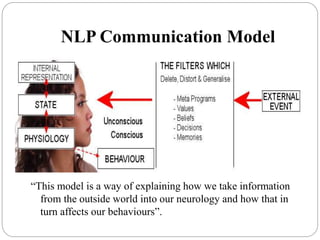
NLP Communication Model
“This model is a way of explaining how we take information
from the outside world into our neurology and how that in
turn affects our behaviours”.
SELF-DEVELOPMENT
LIFE-CHANGING
PRESUPPOSITIONS OF NLP
The meaning of a communication
is the response you get.
PRESUPPOSITIONS OF NLP
Language is representation of
experience.
Beware of the choice of words
PRESUPPOSITIONS OF NLP
Mind and body are parts of the same
cybernetic (governing/controlling)
system and affect each other.
Resistance in a client is a Sign of a la
ck of
rapport(relationship of trust).
PRESUPPOSITIONS OF NLP
People have all the resources they
need to make the changes they
want.
PRESUPPOSITIONS OF NLP
People are not their behaviours. (Accept the person; change
the behaviour.)
Everyone is doing the best they can with the resources they
have available. (Behaviour is adaptable, and the current
behaviour is the best choice available.)
The most important
information about a person is that person’s behaviour.
PRESUPPOSITIONS OF NLP
You are in charge of your mind, and therefore your
results (and I am also in charge of my mind and ther
efore my results).
'Possible in the world' or 'possible for me' is only a
matter of how.
There is Only feedback! (There is no failure,
only feedback.)
What can NLP be used for???
 To help you achieve success more easily.
 To “re-program” bad habits..
 To help you overcome phobias.
 To live a more fulfilled life.
Creating Achievable Outcomes
A goal is, “an aim or an end in mind.” We use SMART
goals to get what we want.
 S- Simple, Specific
 M- Measurable, Meaningful to You
 A - As If Now, Achievable
 R - Realistic/ Responsible
 T - Timed
Four Pillars of NLP
 Rapport
 Self Awareness
 Outcome Thinking
 Behavioural Flexibility
FOUR PILLARS OF NLP
1. Rapport
When people are like each other, they tend to
like each other. Rapport is a process of
responsiveness, and not necessarily
“liking.”
2. Self Awareness
How the world is different when you use all
your senses.
FOUR PILLARS OF NLP
3. Outcome Thinking
How to think about what you want.
4. Behavioural Flexibility
How to do something different when
what you’re currently doing isn’t
working.
Sensory Input Channel
The communication process begins with an
external event which enters our brain through
the five senses that make up our sensory input
channels:-
 Visual - What we see
 Auditory - Sound, the words we hear and how
those words are said to us etc.
Sensory Input Channel
 Kinaesthetic – Sensation of motion
 Olfactory - The sense of smell
 Gustatory - The sense of taste
CAUSE AND EFFECT
 Which side of the Cause and Effect formula are you on?
C > E
 Are you the cause in your life, or are you at the effect side
of things in your life?
Prime Directive of the Unconscious Mind
1. Stores memories
2. It stores all the emotions
3. Organizes all your memories
Prime Directive of the Unconscious Mind
4. Stores, distributes and transmits “energy”
5. Needs repetition until a habit is installed
6. Functions best as a whole integrated unit
Neuro Linguistic Programming

Neuro Linguistic Programming

  • 2.
    What is NLP?Neuro: Nervous system through which experience is received and processed through the five senses. The study of the mind – in particular how we think about things & how we process information how we experience and represent the world through our five senses and our neurological processes.
  • 3.
    What is NLP?Linguistic: Language and nonverbal communication systems through which neural representations are coded, ordered, and given meaning. language skills – how we use language to communicate & how other people’s use of language affects us the way the language we use shapes and reflects our experience of the world
  • 4.
    What is NLP?Programming The ability to organize our communication and neurological systems to achieve specific desired goals and results. “how we plan to react and how we organise and store our ideas and actions .” training ourselves to think, speak and act in new and positive ways, in order to reach our maximum potential
  • 5.
    1 • Know whatoutcome you want to achieve 2 • Have sufficient sensory acuity(sharpness) to know if you are moving towards or away from your outcome 3 • Have sufficient flexibility of behaviour so that you can vary your behaviour until you get your outcome 4 • Take action now NLP Four Operational Principles
  • 6.
    NLP Communication Model “Thismodel is a way of explaining how we take information from the outside world into our neurology and how that in turn affects our behaviours”.
  • 7.
  • 8.
  • 9.
    PRESUPPOSITIONS OF NLP Themeaning of a communication is the response you get.
  • 10.
    PRESUPPOSITIONS OF NLP Languageis representation of experience. Beware of the choice of words
  • 11.
    PRESUPPOSITIONS OF NLP Mindand body are parts of the same cybernetic (governing/controlling) system and affect each other. Resistance in a client is a Sign of a la ck of rapport(relationship of trust).
  • 12.
    PRESUPPOSITIONS OF NLP Peoplehave all the resources they need to make the changes they want.
  • 13.
    PRESUPPOSITIONS OF NLP Peopleare not their behaviours. (Accept the person; change the behaviour.) Everyone is doing the best they can with the resources they have available. (Behaviour is adaptable, and the current behaviour is the best choice available.) The most important information about a person is that person’s behaviour.
  • 14.
    PRESUPPOSITIONS OF NLP Youare in charge of your mind, and therefore your results (and I am also in charge of my mind and ther efore my results). 'Possible in the world' or 'possible for me' is only a matter of how. There is Only feedback! (There is no failure, only feedback.)
  • 15.
    What can NLPbe used for???  To help you achieve success more easily.  To “re-program” bad habits..  To help you overcome phobias.  To live a more fulfilled life.
  • 16.
    Creating Achievable Outcomes Agoal is, “an aim or an end in mind.” We use SMART goals to get what we want.  S- Simple, Specific  M- Measurable, Meaningful to You  A - As If Now, Achievable  R - Realistic/ Responsible  T - Timed
  • 17.
    Four Pillars ofNLP  Rapport  Self Awareness  Outcome Thinking  Behavioural Flexibility
  • 18.
    FOUR PILLARS OFNLP 1. Rapport When people are like each other, they tend to like each other. Rapport is a process of responsiveness, and not necessarily “liking.” 2. Self Awareness How the world is different when you use all your senses.
  • 19.
    FOUR PILLARS OFNLP 3. Outcome Thinking How to think about what you want. 4. Behavioural Flexibility How to do something different when what you’re currently doing isn’t working.
  • 20.
    Sensory Input Channel Thecommunication process begins with an external event which enters our brain through the five senses that make up our sensory input channels:-  Visual - What we see  Auditory - Sound, the words we hear and how those words are said to us etc.
  • 21.
    Sensory Input Channel Kinaesthetic – Sensation of motion  Olfactory - The sense of smell  Gustatory - The sense of taste
  • 23.
    CAUSE AND EFFECT Which side of the Cause and Effect formula are you on? C > E  Are you the cause in your life, or are you at the effect side of things in your life?
  • 24.
    Prime Directive ofthe Unconscious Mind 1. Stores memories 2. It stores all the emotions 3. Organizes all your memories
  • 25.
    Prime Directive ofthe Unconscious Mind 4. Stores, distributes and transmits “energy” 5. Needs repetition until a habit is installed 6. Functions best as a whole integrated unit