FACIAL PAIN
FACIAL PAIN
• A frequently encountered
neurological symptom
• Seldom associated with significant
neurological disease unless
accompanied by other symptoms or
neurological signs
Causes
Trigeminal neuralgia
Migranous neuralgia
Post herpetic neuralgia
Psychogenic (Atypical facial pain)
Tempomandibular arthritis
Malocclusion
PATHPHYSIOLOGY
• Within the skull, the dura(including the
dural sinuses and falx cerebri) and the
proximal parts of large blood vessels are
the main structures sensitive to pain
• Mostly innervated by the branches of the
trigeminal nerve
 This probably accounts for the patterns of pain
referral seen in intracranial disease when
these pain sensitive parts of the intracranial
content are stretched,distended or otherwise
irritated.
Diagnostic approach
• Important points in history
• Over-all pattern
• Tempo of onset
• Time of day of onset of maximal pain
• Effect of posture, coughing and straining
• Location of pain
• Associated symptoms
TRIGEMINAL NEURALGIA
• A disorder of the trigeminal nerve (fifth) that causes
episodes of sharp, stabbing pain in the cheek, lips,
gums, or chin on one side of the face.
• People with this pain often wince or twitch, which is where
trigeminal neuralgia gets itsFrench nickname
‘tic douloureux’, meaning "painful twitch”.
• Commonly in middle aged or elderly people
• F>M
Forms of TN:
1) TYPICAL TN
2) ATYPICAL TN
3) PRE-TN
4) MULTIPLE-SCLEROSIS-RELATED TN
5) SECONDARY TN
6) POST-TRAUMATIC TN (TRIGEMINAL
NEUROPATHY)
7) FAILED TN
Typical Trigeminal Neuralgia
(Tic Douloureux)
 Most common form of TN, that has previously
been termed Classical, Idiopathic and Essential
TN.
 Mostly caused by blood vessels compressing
the trigeminal nerve root as it enters the brain
stem.
 This neurovascular or microvascular
compression at the trigeminal nerve root entry
zone may be caused by arteries of veins, large or
small, that may simply contact or indent the
trigeminal nerve.
Normal people without TN TN sufferers
Irritation of
the nerve
Hyperactivity
of the
nucleus
Pain
1. Degeneration
2. Pressure
3. Irritation of the nerve.
4. Pressure from a nearby abnormally-
formed artery lying too close to the nerve.
ETIOLOGY
Uncertain but may be caused by
Distribution of the trigger zones
TRIGGER FACTORS
Touching
Washing of
face
Shaving
Teeth
cleaning
Cold breeze Eating
Talking
Application of
lotions and
cosmetics
Clinical features
• Pain is a characteristic symptom
• Occurs in bouts or paroxysms, sharp or
lancinating in character
• Radiates to the territory of one or more
divisions of a trigeminal nerve
• Patient is disturbed , feels totally shaken
• The first episodes are usually fairly mild
and brief, and it may be minutes, hours,
or weeks before the next attack.
 However, attacks tend to occur in clumps
that may last for weeks at a time.
 With age, the episodes become more
frequent and painful, until the person
begins to live in constant fear of the next one.
 The momentary bursts of pain usually
begin from the same spot on the face each
time.
• May show simultaneous remissions
in early stages but as the disease
advances, become less frequent.
• No sensory loss over face
 If sensory loss or motor symptoms or
signs accompany , then it’s called the
Secondary neuralgia.
 Secondary to certain neurological disease
such as multiple sclerosis and
meningioma of a trigeminal nerve.
Secondary Trigeminal Neuralgia
Treatment
1. Medical
2. Surgical
SURGICAL
1. Injection of phenol or alcohol
into a trigeminal ganglion
2. Radiofrequency coagulation of
a branch
3. Sectioning of sensory root of
trigeminal ganglion inside the
cranium
4. Microvascular decompression
PREVENTION
While the condition itself can't be prevented, there are
a number of things patients can do to
avoid triggering attacks:
 Wash with cotton pads and warm water over the
face
 Rinse the mouth with water after eating, if tooth-
brushing triggers pain
 Eat and drink food and beverages at room temperature
 Chew on the unaffected side
 Eat soft foods, if eating is becoming a problem
MIGRANOUS NEURALGIA
 An exquisitely painful affliction of the mid face
and upper face, particularly in and around the
eye.
 The name is derived from the fact that the
headache occurs in temporal groups or
‘clusters’ with extended periods of remisssion
between attacks.
TRIGGER FACTORS
Alcohol ,
cigarette
smoking
High
altitudes
Bright light
Exertion
(physical
activity)
Heat (hot
weather,
hot baths)
Foods high
in nitrites
(such as
bacon and
preserved
meats)
Certain
medicine
s
Cocain
e
CLINICAL FEATURES
May occur at any age, although it usually affects
persons in the 3rd and 4th decade of life .
M > F (6:1)
They tend to run in families, passed down through
genes.
The pain is described as paroxysmal ( abrupt
onset) and intense, with a burning or lancinating
quality and without a trigger zone.
 The pain occurs on one side of the head.
 It may be described as:
 Burning
 Sharp
 Steady
 The pain may occur in, behind, and around one
eye.
 May involve one side of the face from neck to
temples.
SIGNS AND SYMPTOMS
Conjunctiv
al injection
Excessive
tearing
Lacrimatio
n
Forehead/
facial
sweating
Rhinorrhe
a
Ptosis
Miosis
Eyelid
edema
Red
flushed
face
TREATMENT
Ergotamine tartarate
Oxygen inhalation
Serotonin antagonists
PROPHYLAXIS
β blockers
Steroids
Methylsergide
Lithium carbonate
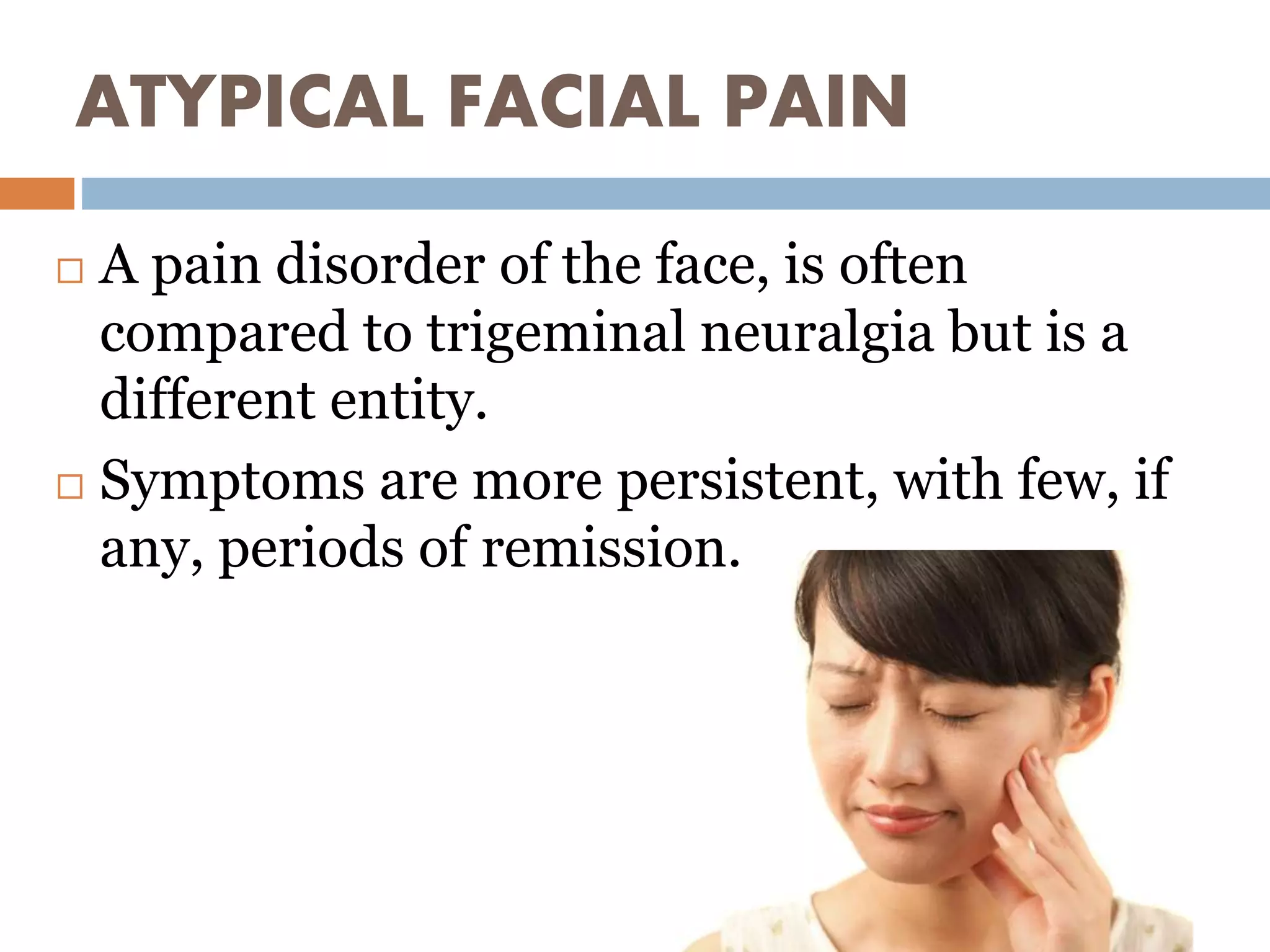
ATYPICAL FACIAL PAIN
 A pain disorder of the face, is often
compared to trigeminal neuralgia but is a
different entity.
 Symptoms are more persistent, with few, if
any, periods of remission.
CAUSES
Once thought to be psychological in origin, now recognized
as a neurological disease with a large number of possible
causes including:
1. Sinus infections
2. Dental infections
3. Ernest Syndrome
4. Temporal tendonitis
5. Vagus nerve tumors
6. Trigeminal ganglia compression
7. Facial trauma
8. Trigeminal nerve trauma
9. Cervical spine disorders
 Symptoms
 Usually localized to one side of the face
 Can be described as sharp, dull, crushing,
aching, burning, pulling or squeezing.
 Often occurs over the region of the trigeminal
nerve, but the pain can also affect the scalp and
neck.
 The condition is different from other facial pain
syndromes by its persistent presence; with no
remissions.
Diagnosis
 The first step in diagnosing atypical facial pain is
a neurological examination.
 The physician will try to rule out similar
conditions such as trigeminal neuralgia,
temporomandibular joint syndrome, migraines
and cluster headaches.
 Finally, imaging may help pinpoint the cause:
 X-Rays of the skull
 MRI/CT scan
Treatment
Medications:
• Amitriptyline (antidepressant)
• Gabapentin (anticonvulsant)
• Carbamazepine
(anticonvulsant)
• Baclofen (muscle
relaxant/antispasmodic)
• Clonazepam (muscle
relaxant/anticonvulsant)
• Valproic (anticonvulsant)
Invasive Procedures:
• Microvascular
decompression
• Glycerol injection
• Balloon compression
• Peripheral nerve stimulation
• Stereotactic radiosurgery
• Percutaneous trigeminal
tractotomy
• Motor cortex stimulation
TEMPOROMANDIBULAR
ARTHRITIS
• KNOWN AS COSTEN’S SYNDROME
• PAIN is severe aching,
• Gets intensified by chewing, movement of jaw
• Occurs at the temporomandibular joint
• Usually unilateral
Includes:
 Loss of dental occlusal support
 Ear symptoms (pain, tininitus)
 Sinus Pain
Causes
 Costen's syndrome arises from faulty
articulation of the temporomandibular
joint caused by one or more of:
 dental malocclusion
 emotional stress producing masseter
spasm
Treatment
 Short term treatment consists of a very
soft diet and simple analgesia, and may be
sufficient for mild symptoms.
 Long term treatment may involve
dental correction or stress relaxation.
 Referral to a specialist clinic may be
needed.
Post herpetic neuralgia
• A nerve pain due to damage caused by
the varicella zoster virus.
• Typically, the neuralgia is confined to
a dermatomic area of the skin and follows an
outbreak of herpes zoster (shingles) in that
same area.
• The neuralgia typically begins when the herpes
zoster vesicles have crusted over and begun to
heal, but it can begin in the absence of herpes
zoster.
Cases of PHN
 Pain for three months or more
 Stabbing or burning pain
 Rashes on the chest, forehead, stomach, or any parts of
the body
 Formation of blisters that eventually will heal but pain
lingers
 People with PostHerpetic Neuralgia are sensitive to
touch because of the sensitivity of the nerves
 People who have this disease are also sensitive to
temperature changes.
 Feeling of numbness if the nerves involved control the
movement of an individual
 Itchiness and headaches
Signs and symptoms
PHN
Treatment
• CARBAMAZEPINE
• PHENYTOIN
• ANTIDEPRESSANTS
Some measures you can take to reduce
pain are described below.
 Wear comfortable clothing
 Cover sensitive areas
 Use cold packs
GENERAL ADVICE
1. Practicing healthy habits healthy diet
2. Maintain a regular sleep routine and good sleep
hygiene (avoiding tea, coffee, etc)
3. Engage in regular exercise
4. Relaxation techniques hypnosis, meditation,
and visualization.
5. Abstain from the triggering foods
6. Stay educated by joining support groups,
speaking with your doctor.
Facial pain

Facial pain

  • 1.
  • 2.
    FACIAL PAIN • Afrequently encountered neurological symptom • Seldom associated with significant neurological disease unless accompanied by other symptoms or neurological signs
  • 3.
    Causes Trigeminal neuralgia Migranous neuralgia Postherpetic neuralgia Psychogenic (Atypical facial pain) Tempomandibular arthritis Malocclusion
  • 4.
    PATHPHYSIOLOGY • Within theskull, the dura(including the dural sinuses and falx cerebri) and the proximal parts of large blood vessels are the main structures sensitive to pain • Mostly innervated by the branches of the trigeminal nerve
  • 5.
     This probablyaccounts for the patterns of pain referral seen in intracranial disease when these pain sensitive parts of the intracranial content are stretched,distended or otherwise irritated.
  • 6.
    Diagnostic approach • Importantpoints in history • Over-all pattern • Tempo of onset • Time of day of onset of maximal pain • Effect of posture, coughing and straining • Location of pain • Associated symptoms
  • 7.
    TRIGEMINAL NEURALGIA • Adisorder of the trigeminal nerve (fifth) that causes episodes of sharp, stabbing pain in the cheek, lips, gums, or chin on one side of the face. • People with this pain often wince or twitch, which is where trigeminal neuralgia gets itsFrench nickname ‘tic douloureux’, meaning "painful twitch”. • Commonly in middle aged or elderly people • F>M
  • 8.
    Forms of TN: 1)TYPICAL TN 2) ATYPICAL TN 3) PRE-TN 4) MULTIPLE-SCLEROSIS-RELATED TN 5) SECONDARY TN 6) POST-TRAUMATIC TN (TRIGEMINAL NEUROPATHY) 7) FAILED TN
  • 10.
    Typical Trigeminal Neuralgia (TicDouloureux)  Most common form of TN, that has previously been termed Classical, Idiopathic and Essential TN.  Mostly caused by blood vessels compressing the trigeminal nerve root as it enters the brain stem.  This neurovascular or microvascular compression at the trigeminal nerve root entry zone may be caused by arteries of veins, large or small, that may simply contact or indent the trigeminal nerve.
  • 11.
    Normal people withoutTN TN sufferers
  • 12.
  • 13.
    1. Degeneration 2. Pressure 3.Irritation of the nerve. 4. Pressure from a nearby abnormally- formed artery lying too close to the nerve. ETIOLOGY Uncertain but may be caused by
  • 14.
    Distribution of thetrigger zones
  • 15.
    TRIGGER FACTORS Touching Washing of face Shaving Teeth cleaning Coldbreeze Eating Talking Application of lotions and cosmetics
  • 16.
    Clinical features • Painis a characteristic symptom • Occurs in bouts or paroxysms, sharp or lancinating in character • Radiates to the territory of one or more divisions of a trigeminal nerve • Patient is disturbed , feels totally shaken • The first episodes are usually fairly mild and brief, and it may be minutes, hours, or weeks before the next attack.
  • 17.
     However, attackstend to occur in clumps that may last for weeks at a time.  With age, the episodes become more frequent and painful, until the person begins to live in constant fear of the next one.  The momentary bursts of pain usually begin from the same spot on the face each time.
  • 18.
    • May showsimultaneous remissions in early stages but as the disease advances, become less frequent. • No sensory loss over face
  • 19.
     If sensoryloss or motor symptoms or signs accompany , then it’s called the Secondary neuralgia.  Secondary to certain neurological disease such as multiple sclerosis and meningioma of a trigeminal nerve. Secondary Trigeminal Neuralgia
  • 20.
  • 23.
    SURGICAL 1. Injection ofphenol or alcohol into a trigeminal ganglion 2. Radiofrequency coagulation of a branch 3. Sectioning of sensory root of trigeminal ganglion inside the cranium 4. Microvascular decompression
  • 24.
    PREVENTION While the conditionitself can't be prevented, there are a number of things patients can do to avoid triggering attacks:  Wash with cotton pads and warm water over the face  Rinse the mouth with water after eating, if tooth- brushing triggers pain  Eat and drink food and beverages at room temperature  Chew on the unaffected side  Eat soft foods, if eating is becoming a problem
  • 25.
    MIGRANOUS NEURALGIA  Anexquisitely painful affliction of the mid face and upper face, particularly in and around the eye.  The name is derived from the fact that the headache occurs in temporal groups or ‘clusters’ with extended periods of remisssion between attacks.
  • 26.
    TRIGGER FACTORS Alcohol , cigarette smoking High altitudes Brightlight Exertion (physical activity) Heat (hot weather, hot baths) Foods high in nitrites (such as bacon and preserved meats) Certain medicine s Cocain e
  • 27.
    CLINICAL FEATURES May occurat any age, although it usually affects persons in the 3rd and 4th decade of life . M > F (6:1) They tend to run in families, passed down through genes. The pain is described as paroxysmal ( abrupt onset) and intense, with a burning or lancinating quality and without a trigger zone.
  • 28.
     The painoccurs on one side of the head.  It may be described as:  Burning  Sharp  Steady  The pain may occur in, behind, and around one eye.  May involve one side of the face from neck to temples.
  • 29.
    SIGNS AND SYMPTOMS Conjunctiv alinjection Excessive tearing Lacrimatio n Forehead/ facial sweating Rhinorrhe a Ptosis Miosis Eyelid edema Red flushed face
  • 31.
  • 32.
  • 33.
    ATYPICAL FACIAL PAIN A pain disorder of the face, is often compared to trigeminal neuralgia but is a different entity.  Symptoms are more persistent, with few, if any, periods of remission.
  • 34.
    CAUSES Once thought tobe psychological in origin, now recognized as a neurological disease with a large number of possible causes including: 1. Sinus infections 2. Dental infections 3. Ernest Syndrome 4. Temporal tendonitis 5. Vagus nerve tumors 6. Trigeminal ganglia compression 7. Facial trauma 8. Trigeminal nerve trauma 9. Cervical spine disorders
  • 35.
     Symptoms  Usuallylocalized to one side of the face  Can be described as sharp, dull, crushing, aching, burning, pulling or squeezing.  Often occurs over the region of the trigeminal nerve, but the pain can also affect the scalp and neck.  The condition is different from other facial pain syndromes by its persistent presence; with no remissions.
  • 36.
    Diagnosis  The firststep in diagnosing atypical facial pain is a neurological examination.  The physician will try to rule out similar conditions such as trigeminal neuralgia, temporomandibular joint syndrome, migraines and cluster headaches.  Finally, imaging may help pinpoint the cause:  X-Rays of the skull  MRI/CT scan
  • 37.
    Treatment Medications: • Amitriptyline (antidepressant) •Gabapentin (anticonvulsant) • Carbamazepine (anticonvulsant) • Baclofen (muscle relaxant/antispasmodic) • Clonazepam (muscle relaxant/anticonvulsant) • Valproic (anticonvulsant) Invasive Procedures: • Microvascular decompression • Glycerol injection • Balloon compression • Peripheral nerve stimulation • Stereotactic radiosurgery • Percutaneous trigeminal tractotomy • Motor cortex stimulation
  • 38.
    TEMPOROMANDIBULAR ARTHRITIS • KNOWN ASCOSTEN’S SYNDROME • PAIN is severe aching, • Gets intensified by chewing, movement of jaw • Occurs at the temporomandibular joint • Usually unilateral
  • 39.
    Includes:  Loss ofdental occlusal support  Ear symptoms (pain, tininitus)  Sinus Pain
  • 40.
    Causes  Costen's syndromearises from faulty articulation of the temporomandibular joint caused by one or more of:  dental malocclusion  emotional stress producing masseter spasm
  • 41.
    Treatment  Short termtreatment consists of a very soft diet and simple analgesia, and may be sufficient for mild symptoms.  Long term treatment may involve dental correction or stress relaxation.  Referral to a specialist clinic may be needed.
  • 42.
    Post herpetic neuralgia •A nerve pain due to damage caused by the varicella zoster virus. • Typically, the neuralgia is confined to a dermatomic area of the skin and follows an outbreak of herpes zoster (shingles) in that same area. • The neuralgia typically begins when the herpes zoster vesicles have crusted over and begun to heal, but it can begin in the absence of herpes zoster.
  • 45.
  • 46.
     Pain forthree months or more  Stabbing or burning pain  Rashes on the chest, forehead, stomach, or any parts of the body  Formation of blisters that eventually will heal but pain lingers  People with PostHerpetic Neuralgia are sensitive to touch because of the sensitivity of the nerves  People who have this disease are also sensitive to temperature changes.  Feeling of numbness if the nerves involved control the movement of an individual  Itchiness and headaches Signs and symptoms
  • 47.
  • 48.
  • 49.
    Some measures youcan take to reduce pain are described below.  Wear comfortable clothing  Cover sensitive areas  Use cold packs
  • 50.
    GENERAL ADVICE 1. Practicinghealthy habits healthy diet 2. Maintain a regular sleep routine and good sleep hygiene (avoiding tea, coffee, etc) 3. Engage in regular exercise 4. Relaxation techniques hypnosis, meditation, and visualization. 5. Abstain from the triggering foods 6. Stay educated by joining support groups, speaking with your doctor.