welcome
Disease
review
Migraine
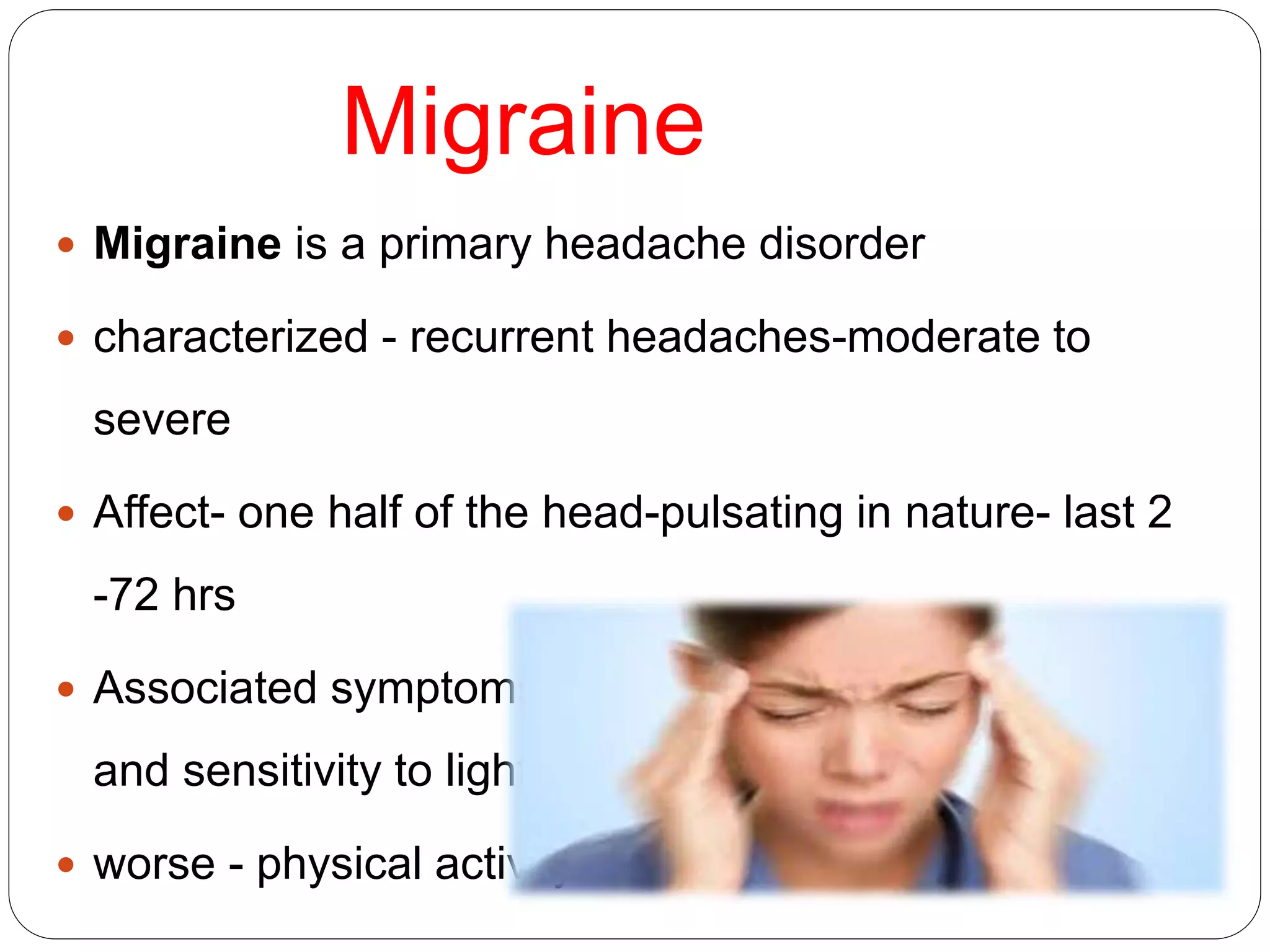
 Migraine is a primary headache disorder
 characterized - recurrent headaches-moderate to
severe
 Affect- one half of the head-pulsating in nature- last 2
-72 hrs
 Associated symptoms -nausea, vomiting,
and sensitivity to light, sound, or smell
 worse - physical activity
 Up to one-third of people have an aura
 Aura - a short period of visual disturbance -
signals that the headache will soon occur.
Cause
 Environmental and genetic factor
 About two-thirds of cases run in families
 Changing hormone levels - as migraines affect slightly
more boys than girls before puberty
 The underlying causes of migraines are unknown.
 psychological conditions-depression, anxiety,
and bipolar disorder
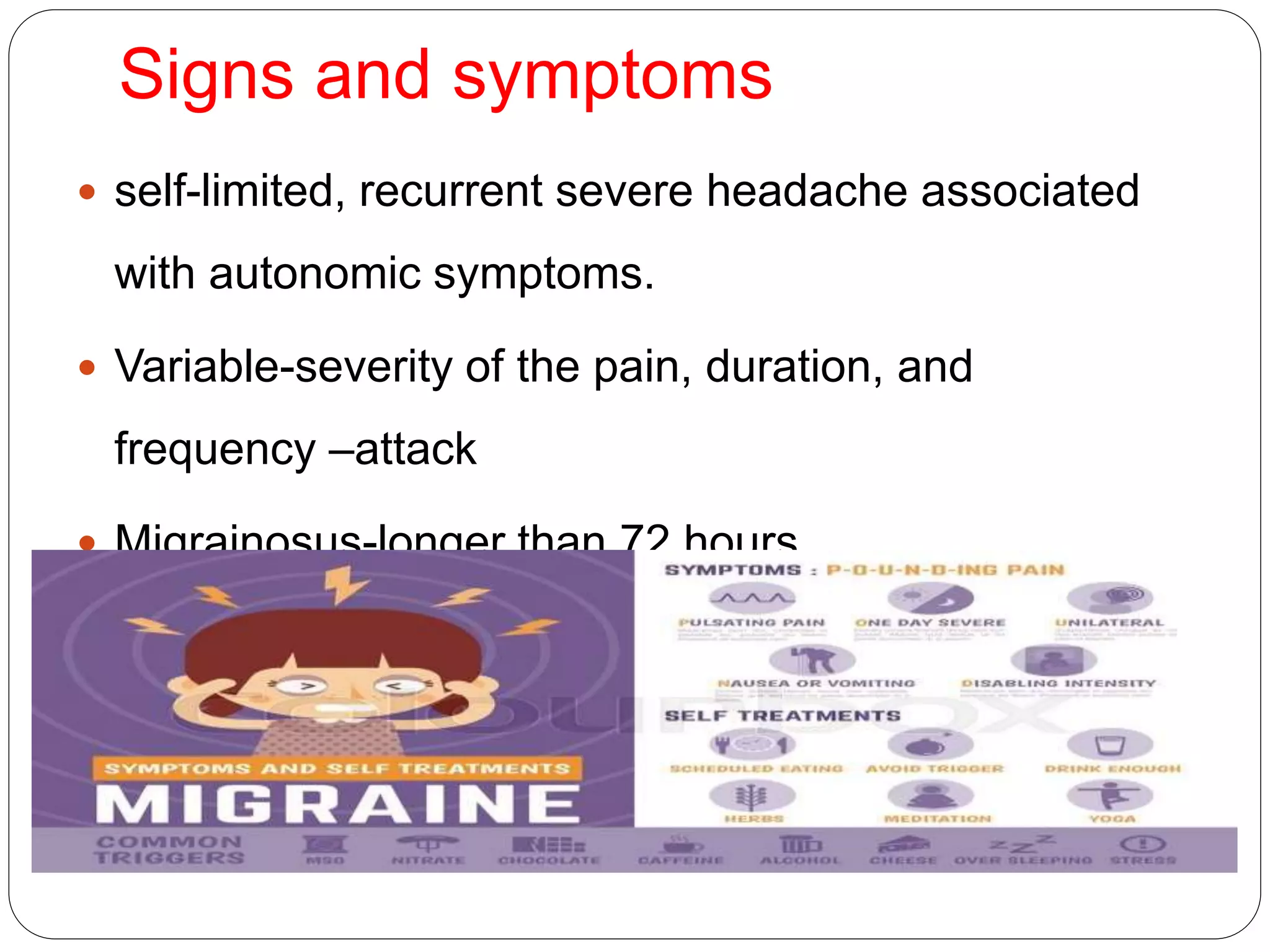
Signs and symptoms
 self-limited, recurrent severe headache associated
with autonomic symptoms.
 Variable-severity of the pain, duration, and
frequency –attack
 Migrainosus-longer than 72 hours.
Phases of migraine
 4 phases
 not all phases are necessarily experienced
1. prodrome - occurs hours or days before the
headache
2. aura - which immediately precedes the headache
3. pain - also known as headache phase
4. postdrome - the effects experienced following the
end of migraine attack
Prodrome phase
 Prodromal- 60% of those with migraines
 2 hrs to 2 days before- pain or the aura.
 symptoms may include- altered mood,
irritability, depression or euphoria, fatigue, craving
for certain food, stiff muscles (especially in the
neck), constipation or diarrhea, and sensitivity to
smells or noise
Aura phase
 Aura- transient focal neurological phenomenon -
occurs before or during the headache
 appear gradually –starts over a number of minutes
and last less than 60 min.
 Symptoms -visual, sensory or motor in nature
 Vision- scintillating scotoma
 Sensory - feeling of pins-and-needles -one side in the
hand and arm-spreads to the nose–mouth area on
the same side.
 Motor symptoms- weakness- lasts longer than one
hour
Pain phase
 headache - unilateral, throbbing, and moderate to
severe intensity.
 comes on gradually --aggravated by physical activity.
 bilateral pain -40% of cases
 neck pain is commonly associated with it
 pain lasts- 4 to 72 hours in adults
 pain- accompanied by nausea, vomiting, sensitivity to
light, sound, smells, fatigue and irritability.
 Other symptoms- blurred vision, nasal stuffiness,
diarrhoea, frequent urination, pallor, or sweating.
Postdrome phase
 symptoms occurring once the acute headache has
settled.
 sore feeling in the area where the migraine was.
 impaired thinking for a few days after the headache
has passed.
 Other symptoms -feel tired, head pain, cognitive
difficulties, gastrointestinal symptoms, mood changes,
and weakness
Triggers
 Migraines may be induced by triggers
Physiological aspects-stress, hunger, and fatigue
 Psychological stress -50 to 80% cause.
Hormonal influences-menarche, oral contraceptive
use, , perimenopause, and menopause
 Migraines typically do not occur during
the second and third trimesters
Diagnosis
 The diagnosis - based on signs and symptoms
 according to International Headache Society- the "5,
4, 3, 2, 1 criteria“
 Five or more attacks.
 Four hours to three days in duration
 Two or more of the following:
 Unilateral (affecting half the head)
 Pulsating
 Moderate or severe pain intensity
 Worsened by or causing avoidance of routine physical activity
 One or more of the following:
 Nausea and/or vomiting;
 Sensitivity to both light and sound
Differential diagnosis
 similar symptoms- temporal arteritis, cluster
headaches, acute
glaucoma, meningitis and subarachnoid hemorrhage
 Temporal arteritis- over 50 years old, tenderness over
the temple
 cluster headaches- one-sided nose stuffiness, tears
and severe pain - orbits
 acute glaucoma is associated with vision problems
 meningitis- with fevers
 subarachnoid hemorrhage- very fast onset
 Tension headaches -typically occur on both sides, are
not pounding, and are less disabling
Prevention
 Preventive - include medications, nutritional
supplements, lifestyle alterations, and surgery.
 The goal - reduce the frequency, painfulness,
duration of migraines, and to increase the
effectiveness of abortive therapy.
Medication
 Guidelines consistent-
topiramate, divalproex/sodium
valproate, propranolol, and metoprolol
Prognosis
 Long term prognosis in people with migraines is
variable.
 There are four main patterns to the disease:
1. symptoms can resolve completely
2. symptoms can continue but become gradually less
with time
3. symptoms may continue at the same frequency and
severity
4. attacks may become worse and more frequent
Epidemiology
 15% affect -Worldwide
 It is more common in women at 19% than men at
11%.
 It most often starts at puberty and is worst during
middle age.
 In some women they become less common
Treatment
 Initial -simple pain medication -
ibuprofen and paracetamol for the headache.
 medication for the nausea, avoidance of triggers
 Specific medications such
as triptans or ergotamines may be used
History
 early description fount in the Ebers papyrus-
written around 1500 BC in ancient Egypt
 The word "migraine" is from the Greek -
hemikrania- "pain on one side of the head"
 (hemi-), "half", and (kranion), "skull".
Ardhavabhedaka causes
Suppression of natural urges
Indigestion
Intake of dry food, Oily and spicy food
Exposure to sunshine for prolonged period,fog,cold
fasting
Anger, jealousy, grief, stress etc
Intake of dry, pungent and salty food etc
Talking loudly
symptoms
 Pakshat kupyati maasat vaa swayameva cha
shamyati
ati vridhastu nayanam sravanam vaa vinashayet [A
H. u 23]
 Yasya uthamaga ardhamateeva jantho: sambhedha
toda bhrama shoolajushtam,
pakshadhashaahad adhava api aakasmaat tasya
ardhavabhedakam tritasyat vyavasthade. [S S. u
25/15]
 Acc to charaka and madhavacharya- vata or vata
kaphaja disease
 Acc to SS-tridoshaja
 Acc to AH-vataja disease
Treatment
 Abhyanga
 Sneha pana
 Nasyam
 Lepa
 Pariseka
 kabala
 Shirovasti
 Dhoomapana
 Raktamoksha
 Agni karma over
bhru,lalata,shangha
Nasya
 Avapeeda nasya- Shireesha beejam, apamarga
moolam ,bala moola triturated in water
 Nasya with sthira rasa
 vamshi moola, vacha and pippalli
 Vamshimoola,karpoora or manassila with honey
 yasti with honey or chandana and honey
 aja ksheera
 Samana nasya-kakolyadi grta, moorvadi grta
,ksheerabala taila, dhanwantara tailam ,anu taila
,satbindhu taila.
Lepa yogas
 Lepa on fore head with prapunnada mixed with
amla dravya
 drugs pacify Pitta Dosha like chandana, karpoora,
Jatamansi
Shiro Dhara
 ksheerabala taila, chandanadi taila-Vata involvement
is high.
- ksheera dhara (cow milk)- is done when Pitta
involvement is more
- Takra Dhara (buttermilk)- is done when there is
Vata involvement.
 Kavala graha – with chandanadi taila, maha
narayana taila
 Shirovasti – Any vata-pitta pacifying oils are
beneficial for this purpose.
Internal medicine
 Pathyadi khwada – used in the treatment of
headache, earache, pain in temporal region,
migraine etc.
 Shirashooladi vajra rasa – used in the Ayurvedic
treatment of headache, migraine, tension
headache, vascular headache etc.
 Mayura ghrita
 Bhoonimbadi khwada – Used in fever, cold,
sinusitis, headache
 Kumaryasava
 Godanthi bhasma – 250 mg of this medicine is
given twice a day. In many occasions, it gives
immediate relief from migraine, within 20 – 30
minutes, much faster than Paracetamol
THANK YOU

Migraine

  • 1.
  • 2.
  • 3.
    Migraine  Migraine isa primary headache disorder  characterized - recurrent headaches-moderate to severe  Affect- one half of the head-pulsating in nature- last 2 -72 hrs  Associated symptoms -nausea, vomiting, and sensitivity to light, sound, or smell  worse - physical activity
  • 4.
     Up toone-third of people have an aura  Aura - a short period of visual disturbance - signals that the headache will soon occur.
  • 5.
    Cause  Environmental andgenetic factor  About two-thirds of cases run in families  Changing hormone levels - as migraines affect slightly more boys than girls before puberty  The underlying causes of migraines are unknown.
  • 6.
     psychological conditions-depression,anxiety, and bipolar disorder
  • 7.
    Signs and symptoms self-limited, recurrent severe headache associated with autonomic symptoms.  Variable-severity of the pain, duration, and frequency –attack  Migrainosus-longer than 72 hours.
  • 8.
    Phases of migraine 4 phases  not all phases are necessarily experienced 1. prodrome - occurs hours or days before the headache 2. aura - which immediately precedes the headache 3. pain - also known as headache phase 4. postdrome - the effects experienced following the end of migraine attack
  • 9.
    Prodrome phase  Prodromal-60% of those with migraines  2 hrs to 2 days before- pain or the aura.  symptoms may include- altered mood, irritability, depression or euphoria, fatigue, craving for certain food, stiff muscles (especially in the neck), constipation or diarrhea, and sensitivity to smells or noise
  • 10.
    Aura phase  Aura-transient focal neurological phenomenon - occurs before or during the headache  appear gradually –starts over a number of minutes and last less than 60 min.  Symptoms -visual, sensory or motor in nature  Vision- scintillating scotoma
  • 11.
     Sensory -feeling of pins-and-needles -one side in the hand and arm-spreads to the nose–mouth area on the same side.  Motor symptoms- weakness- lasts longer than one hour
  • 12.
    Pain phase  headache- unilateral, throbbing, and moderate to severe intensity.  comes on gradually --aggravated by physical activity.  bilateral pain -40% of cases  neck pain is commonly associated with it  pain lasts- 4 to 72 hours in adults
  • 13.
     pain- accompaniedby nausea, vomiting, sensitivity to light, sound, smells, fatigue and irritability.  Other symptoms- blurred vision, nasal stuffiness, diarrhoea, frequent urination, pallor, or sweating.
  • 14.
    Postdrome phase  symptomsoccurring once the acute headache has settled.  sore feeling in the area where the migraine was.  impaired thinking for a few days after the headache has passed.  Other symptoms -feel tired, head pain, cognitive difficulties, gastrointestinal symptoms, mood changes, and weakness
  • 15.
    Triggers  Migraines maybe induced by triggers Physiological aspects-stress, hunger, and fatigue  Psychological stress -50 to 80% cause.
  • 16.
    Hormonal influences-menarche, oralcontraceptive use, , perimenopause, and menopause  Migraines typically do not occur during the second and third trimesters
  • 17.
    Diagnosis  The diagnosis- based on signs and symptoms  according to International Headache Society- the "5, 4, 3, 2, 1 criteria“  Five or more attacks.  Four hours to three days in duration
  • 18.
     Two ormore of the following:  Unilateral (affecting half the head)  Pulsating  Moderate or severe pain intensity  Worsened by or causing avoidance of routine physical activity  One or more of the following:  Nausea and/or vomiting;  Sensitivity to both light and sound
  • 19.
    Differential diagnosis  similarsymptoms- temporal arteritis, cluster headaches, acute glaucoma, meningitis and subarachnoid hemorrhage  Temporal arteritis- over 50 years old, tenderness over the temple  cluster headaches- one-sided nose stuffiness, tears and severe pain - orbits  acute glaucoma is associated with vision problems
  • 20.
     meningitis- withfevers  subarachnoid hemorrhage- very fast onset  Tension headaches -typically occur on both sides, are not pounding, and are less disabling
  • 21.
    Prevention  Preventive -include medications, nutritional supplements, lifestyle alterations, and surgery.  The goal - reduce the frequency, painfulness, duration of migraines, and to increase the effectiveness of abortive therapy.
  • 22.
    Medication  Guidelines consistent- topiramate,divalproex/sodium valproate, propranolol, and metoprolol
  • 23.
    Prognosis  Long termprognosis in people with migraines is variable.  There are four main patterns to the disease: 1. symptoms can resolve completely 2. symptoms can continue but become gradually less with time 3. symptoms may continue at the same frequency and severity 4. attacks may become worse and more frequent
  • 24.
    Epidemiology  15% affect-Worldwide  It is more common in women at 19% than men at 11%.  It most often starts at puberty and is worst during middle age.  In some women they become less common
  • 25.
    Treatment  Initial -simplepain medication - ibuprofen and paracetamol for the headache.  medication for the nausea, avoidance of triggers  Specific medications such as triptans or ergotamines may be used
  • 26.
    History  early descriptionfount in the Ebers papyrus- written around 1500 BC in ancient Egypt  The word "migraine" is from the Greek - hemikrania- "pain on one side of the head"  (hemi-), "half", and (kranion), "skull".
  • 27.
    Ardhavabhedaka causes Suppression ofnatural urges Indigestion Intake of dry food, Oily and spicy food Exposure to sunshine for prolonged period,fog,cold fasting Anger, jealousy, grief, stress etc Intake of dry, pungent and salty food etc Talking loudly
  • 28.
    symptoms  Pakshat kupyatimaasat vaa swayameva cha shamyati ati vridhastu nayanam sravanam vaa vinashayet [A H. u 23]  Yasya uthamaga ardhamateeva jantho: sambhedha toda bhrama shoolajushtam, pakshadhashaahad adhava api aakasmaat tasya ardhavabhedakam tritasyat vyavasthade. [S S. u 25/15]
  • 29.
     Acc tocharaka and madhavacharya- vata or vata kaphaja disease  Acc to SS-tridoshaja  Acc to AH-vataja disease
  • 30.
    Treatment  Abhyanga  Snehapana  Nasyam  Lepa  Pariseka  kabala  Shirovasti  Dhoomapana  Raktamoksha  Agni karma over bhru,lalata,shangha
  • 31.
    Nasya  Avapeeda nasya-Shireesha beejam, apamarga moolam ,bala moola triturated in water  Nasya with sthira rasa  vamshi moola, vacha and pippalli  Vamshimoola,karpoora or manassila with honey  yasti with honey or chandana and honey  aja ksheera  Samana nasya-kakolyadi grta, moorvadi grta ,ksheerabala taila, dhanwantara tailam ,anu taila ,satbindhu taila.
  • 32.
    Lepa yogas  Lepaon fore head with prapunnada mixed with amla dravya  drugs pacify Pitta Dosha like chandana, karpoora, Jatamansi
  • 33.
    Shiro Dhara  ksheerabalataila, chandanadi taila-Vata involvement is high. - ksheera dhara (cow milk)- is done when Pitta involvement is more - Takra Dhara (buttermilk)- is done when there is Vata involvement.
  • 34.
     Kavala graha– with chandanadi taila, maha narayana taila  Shirovasti – Any vata-pitta pacifying oils are beneficial for this purpose.
  • 35.
    Internal medicine  Pathyadikhwada – used in the treatment of headache, earache, pain in temporal region, migraine etc.  Shirashooladi vajra rasa – used in the Ayurvedic treatment of headache, migraine, tension headache, vascular headache etc.  Mayura ghrita  Bhoonimbadi khwada – Used in fever, cold, sinusitis, headache  Kumaryasava
  • 36.
     Godanthi bhasma– 250 mg of this medicine is given twice a day. In many occasions, it gives immediate relief from migraine, within 20 – 30 minutes, much faster than Paracetamol
  • 37.

Editor's Notes

  • #6 two to three times more women than men.
  • #11  (an area of partial alteration in the field of vision which flickers and may interfere with a person's ability to read or drive). Usually the lines are in black and white but some people also see colored lines