NEURAL CONTROL OF
RESPIRATION
DEPARTMENT OF PHYSIOLOGY
SCHOOL OF MEDICAL SCIENCES AND RESEARCH
SHARDA UNIVERSITY
NAME:SANJOG BAM
Msc IIIrd year
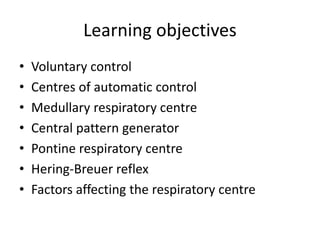
Learning objectives
• Voluntary control
• Centres of automatic control
• Medullary respiratory centre
• Central pattern generator
• Pontine respiratory centre
• Hering-Breuer reflex
• Factors affecting the respiratory centre
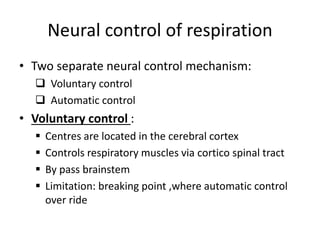
Neural control of respiration
• Two separate neural control mechanism:
 Voluntary control
 Automatic control
• Voluntary control :
 Centres are located in the cerebral cortex
 Controls respiratory muscles via cortico spinal tract
 By pass brainstem
 Limitation: breaking point ,where automatic control
over ride
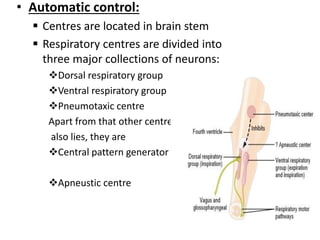
• Automatic control:
 Centres are located in brain stem
 Respiratory centres are divided into
three major collections of neurons:
Dorsal respiratory group
Ventral respiratory group
Pneumotaxic centre
Apart from that other centre
also lies, they are
Central pattern generator
Apneustic centre
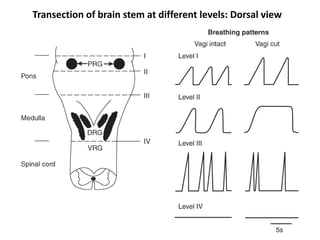
Transection of brain stem at different levels: Dorsal view
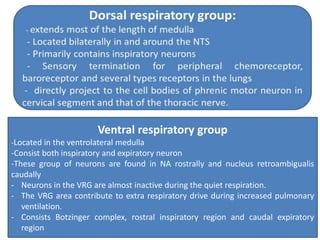
Ventral respiratory group
-Located in the ventrolateral medulla
-Consist both inspiratory and expiratory neuron
-These group of neurons are found in NA rostrally and nucleus retroambigualis
caudally
- Neurons in the VRG are almost inactive during the quiet respiration.
- The VRG area contribute to extra respiratory drive during increased pulmonary
ventilation.
- Consists Botzinger complex, rostral inspiratory region and caudal expiratory
region
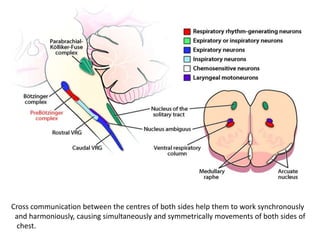
Cross communication between the centres of both sides help them to work synchronously
and harmoniously, causing simultaneously and symmetrically movements of both sides of
chest.
Central pattern generator
• Present in the pre-Botzinger complex
• Synaptically coupled pacemaker cells located
bilaterally between NA and lateral reticular
nucleus
• Responsible for generating normal respiratory
rhythm.
• Rhythmic discharge in the phrenic nerve.
• CPG is also influenced by the integrator
• Integrator controls mainly the frequency and
amplitude of respiratory pattern
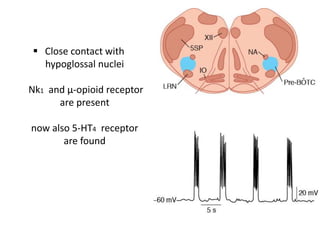
 Close contact with
hypoglossal nuclei
Nk1 and µ-opioid receptor
are present
now also 5-HT4 receptor
are found
Pontine respiratory centre
• Pneumotaxic and apneustic centre
• Modulate output from medullary centre
• Pneumotaxic centre:
Located in nucleus parabrachialis medialis and kolliker fuse
nuclei dorsolateral in rostral pons
May coordinates respiration by switching between inspiration
and expiration
Some neurons active during inspiration and some during
expiration.
Limits duration of inspiration and increases the rate.
Pneumotaxic centre inhibits apneustic centre.
• Apneustic centre
Present in caudal pons
Apneustic centre strongly activates medullary inspiratory
centre
This centre is tonically inhibited by pneumotaxic centre
Hering-Breuer Reflex
• Described by Hering and breuer in 1868
• Volume reflex and operates due to inflation and
deflation
• Safety mechanism
• Stimulates slow adapting receptor which inhibits
inspiration and prolongs expiration.
• Stimulate the inspiratory off-switch.
• Important in adults during exercise and in infants
controls tidal volume during eupnea
Factors affecting respiratory centre
• Impulse from higher centre
• Impulse from stretch receptor
• Impulse from J receptor
• Irritant receptors of lungs
• Impulse from proprioreceptor
• Thermoreceptor
• Pain receptor
• Ondine curse:
Impairment of automatic
respiratory control
Needs volitional breathing for
survival
If preventive measures is not
taken the person can die any
time in sleep
• Stroke can cause destruction
of voluntary control over
respiration.
THANK YOU

Neural regulation of_respiration

  • 1.
    NEURAL CONTROL OF RESPIRATION DEPARTMENTOF PHYSIOLOGY SCHOOL OF MEDICAL SCIENCES AND RESEARCH SHARDA UNIVERSITY NAME:SANJOG BAM Msc IIIrd year
  • 2.
    Learning objectives • Voluntarycontrol • Centres of automatic control • Medullary respiratory centre • Central pattern generator • Pontine respiratory centre • Hering-Breuer reflex • Factors affecting the respiratory centre
  • 3.
    Neural control ofrespiration • Two separate neural control mechanism:  Voluntary control  Automatic control • Voluntary control :  Centres are located in the cerebral cortex  Controls respiratory muscles via cortico spinal tract  By pass brainstem  Limitation: breaking point ,where automatic control over ride
  • 4.
    • Automatic control: Centres are located in brain stem  Respiratory centres are divided into three major collections of neurons: Dorsal respiratory group Ventral respiratory group Pneumotaxic centre Apart from that other centre also lies, they are Central pattern generator Apneustic centre
  • 5.
    Transection of brainstem at different levels: Dorsal view
  • 6.
    Ventral respiratory group -Locatedin the ventrolateral medulla -Consist both inspiratory and expiratory neuron -These group of neurons are found in NA rostrally and nucleus retroambigualis caudally - Neurons in the VRG are almost inactive during the quiet respiration. - The VRG area contribute to extra respiratory drive during increased pulmonary ventilation. - Consists Botzinger complex, rostral inspiratory region and caudal expiratory region
  • 7.
    Cross communication betweenthe centres of both sides help them to work synchronously and harmoniously, causing simultaneously and symmetrically movements of both sides of chest.
  • 8.
    Central pattern generator •Present in the pre-Botzinger complex • Synaptically coupled pacemaker cells located bilaterally between NA and lateral reticular nucleus • Responsible for generating normal respiratory rhythm. • Rhythmic discharge in the phrenic nerve. • CPG is also influenced by the integrator • Integrator controls mainly the frequency and amplitude of respiratory pattern
  • 9.
     Close contactwith hypoglossal nuclei Nk1 and µ-opioid receptor are present now also 5-HT4 receptor are found
  • 10.
    Pontine respiratory centre •Pneumotaxic and apneustic centre • Modulate output from medullary centre • Pneumotaxic centre: Located in nucleus parabrachialis medialis and kolliker fuse nuclei dorsolateral in rostral pons May coordinates respiration by switching between inspiration and expiration Some neurons active during inspiration and some during expiration. Limits duration of inspiration and increases the rate. Pneumotaxic centre inhibits apneustic centre.
  • 11.
    • Apneustic centre Presentin caudal pons Apneustic centre strongly activates medullary inspiratory centre This centre is tonically inhibited by pneumotaxic centre
  • 12.
    Hering-Breuer Reflex • Describedby Hering and breuer in 1868 • Volume reflex and operates due to inflation and deflation • Safety mechanism • Stimulates slow adapting receptor which inhibits inspiration and prolongs expiration. • Stimulate the inspiratory off-switch. • Important in adults during exercise and in infants controls tidal volume during eupnea
  • 13.
    Factors affecting respiratorycentre • Impulse from higher centre • Impulse from stretch receptor • Impulse from J receptor • Irritant receptors of lungs • Impulse from proprioreceptor • Thermoreceptor • Pain receptor
  • 14.
    • Ondine curse: Impairmentof automatic respiratory control Needs volitional breathing for survival If preventive measures is not taken the person can die any time in sleep • Stroke can cause destruction of voluntary control over respiration.
  • 15.