HIGH ALTITUDE PHYSIOLOGY
DEPARTMENT OF PHYSIOLGY
SCHOOL OF MEDICAL SCIENCES AND
RESEARCH
SHARDA UNIVERSITY
Name: Sanjog Bam
Msc IInd year
1
LEARNING OBJECTIVES
• INTRODUCTION
 SUMMARY
 BAROMETERIC PRESSURE
 ALVEOLAR PO2 AND CO2 AT DIFFERENT ALTITUDE
 SATURATION OF Hb WITH O2 AT DIFFERENT ALTITUDE
• ACUTE AND DELAYED EFFECTS OF HIGH ALTITUDE
• ACCLIMATIZATION TO LOW PO2
 DIFFUSING CAPACITY
 PULMONARY VENTILATION
 TISSUE CAPILLARITY
 CELLULAR ACCLIMATIZATION
 WORKING CAPACITY
• CHRONIC MOUNTAIN SICKNESS
• ADAPTATION OF NATIVES AT HIGH ALTITUDES
2
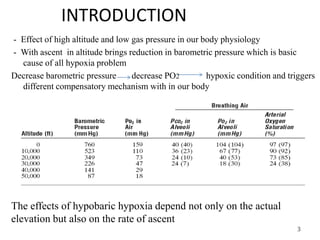
INTRODUCTION
- Effect of high altitude and low gas pressure in our body physiology
- With ascent in altitude brings reduction in barometric pressure which is basic
cause of all hypoxia problem
Decrease barometric pressure decrease PO2 hypoxic condition and triggers
different compensatory mechanism with in our body
3
The effects of hypobaric hypoxia depend not only on the actual
elevation but also on the rate of ascent
ALVEOLAR Po2 AT DIFFERENT ELEVATIONS
 Carbon dioxide and water vapor dilute the oxygen in the alveoli
 In high altitude, alveolar PCo2 falls from 40 mm Hg [sea level] to
lower values[ in acclimatized falls to about 7mm Hg]
4
Mt.EVEREST
8848m 760 mm Hg
253 mm Hg 47 mm Hg[water vapor]
7 mm Hg [PCo2]
40mm Hg[PO2]
159 mm Hg[PN2]
Some alveolar oxygen is continually
absorbed into pulmonary capillaries leaving
35 mm Hg pressure
5
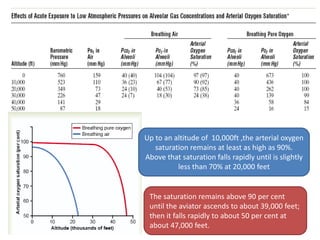
Up to an altitude of 10,000ft ,the arterial oxygen
saturation remains at least as high as 90%.
Above that saturation falls rapidly until is slightly
less than 70% at 20,000 feet
The saturation remains above 90 per cent
until the aviator ascends to about 39,000 feet;
then it falls rapidly to about 50 per cent at
about 47,000 feet.
• ACUTE EFFECT OF HYPOXIA
 At 10000 feet = hyperventilation leading to respiratory alkalosis
 Above 12000 feet = drowsiness, lassitude, mental and muscles
fatigue sometimes headache, occasionally nausea and sometimes
euphoria
 Above 18000 feet = effects progress to a stage of twitching or
seizure
 Above 23000 feet = loss of consciousness [coma] followed
shortly there after by death
6
In 15000 feet, unacclimatized aviator stays
1hr
Mental proficiency
Falls to about 20% of normal
After 18 hrs
Within seconds of ascends increase in SYMPATHETIC ACTIVITIES so increase in HR and BP
High altitude cough
• Dry debilitating cough at higher altitude is more
common
• It may be due to bronchoconstriction or infection and
irritation or airways narrowing.
• Receptors in air ways that provoke cough is more
sensitive at higher altitude
Inflammation increases sensitivity of receptor in bronchities
 Cough frequency was found to depend directly upon
respiratory water loss to respiratory tract.
• High altitude pulmonary edema causes the cough
possibly with distinct colour sputum.
7
• DELAYED EFFECTS OF HIGH ALTITUDE
 ACUTE MOUNTAIN SICKNESS:
- Syndrome develops 8-24 hrs of arrival and last for 4-8 days
- Characterized by headache, irritability ,insomnia
breathlessness, nausea and vomiting
- Associated with cerebral edema
- Symptoms can be reduced if alkalosis and cerebral edema
gets reduced
- Pulmonary edema : individuals ascending quickly above
2500m and engage in heavy physical activity in first 3 days.
- Pulmonary edema occurs in absence of cardiovascular or
pulmonary disease, there is marked pulmonary hypertension
- If no mountain sickness then there can be diuresis at high
altitude
8
Acclimatization to low po2
Altitude tolerance due different compensatory
mechanism
Pulmonary ventilation:
9
Low po2
hyperventilation
Decrease in pco2
40 to 15 mm Hg
Respi.
alkalosis
Metabolic
compensation
kidneys
Optimum [H+] and
[HCO3-] of plasma and
CSF
PH of blood and
CSF Increases
Inhibits respi. Center via
decline chemoreceptor
stimulation
After 2-5 days
inhibitions fades
away
Respiratory
center stimulated
Increase number of RBC
• Endogenous erythropoietin level raises two peak
level [first 48 hrs of altitude]
• Level gets falls after following 4 days as ventilatory
response increases
• Increased Hematocrit =45% to 60%
• Increased hemoglobin concentration=15gm/dl to
20gm/dl
• There is increase 2,3 Diphospho glycerate, shifts
oxygen dissociation curve to right unlike respiratory
alkalosis
The net effect is a small increase P50,lowers affinity
between 02 and Hb
However increase in P50 value is limited
10
 Diffusing capacity:
• Normal value=21 ml/mm Hg/min
• Increases by three fold after acclimatization
• Rise diffusing capacity is due to combine effects of:
i. Increase in pulmonary capillary volume leading to increase in
surface areas of capillaries.
ii. Increase in lung air volume leading more expansions of lung
iii. Increases in pulmonary arterial blood pressure.
 Tissue capillarity:
• Increase in systemic capillaries[Angiogenesis] in non pulmonary
tissues
• Most seen in active tissue exposed to chronic hypoxia
Capillary density in right ventricular increases markedly because of
effects of hypoxia and excess work load on right ventricle.
11
Cellular acclimatization:
Working capacity:
Acclimatized people has more working capacity
12
• Increase in number of
mitochondria
• Increases in oxidative
enzymes
Acclimatized humans also can use
oxygen more effectively
At 17000 feet
Naturally acclimatized work output almost equal to that of low landers at sea level
CHRONIC MOUNTAIN SICKNESS
• Occasionally occurs in persons who stays in high altitude for too
long.
• Causes :
i. Increase viscosity decrease in tissue flow oxygen delivery
decreases gradually
ii. Constriction pulmonary artery pulmonary hypertension increase
work load in right ventricle congestive heart failure
iii. Alveolar arteriolar spasm diverts much blood through non alveolar
pulmonary vessels blood gets poorly oxygenated
13
Further exacerbate the condition
Most of these people recover within days or weeks when they are moved to a lower
altitude
ADAPTATIONOFNATIVESINHIGHALTITUDES
• Many native people in Andes and Himalayan live at above 13000
feet
• One group in Peruvian Andes lives at an altitude of 17500 feet.
• Natives are superior to even the best acclimatized low landers in all
aspect of acclimatization.
• Acclimatization of the natives begins in infancy ,natives are
genetically adapted to encounter the surrounding.
 Barrel-shaped increased chest size and whereas body size is
decreases giving high ratio of ventilatory capacity to body mass
 Their heart from birth onward pumps extra amount of CO output
 At high altitude arterial PO2 is 40 mmHg which is less but
quantity of oxygen in arterial blood is greater than low landers.
 Venous PO2 in high altitude natives is only 15 mmHg[30 mm
Hg] less than low landers [46 mm Hg]
14
15
THANK YOU

High altitude physiology01

  • 1.
    HIGH ALTITUDE PHYSIOLOGY DEPARTMENTOF PHYSIOLGY SCHOOL OF MEDICAL SCIENCES AND RESEARCH SHARDA UNIVERSITY Name: Sanjog Bam Msc IInd year 1
  • 2.
    LEARNING OBJECTIVES • INTRODUCTION SUMMARY  BAROMETERIC PRESSURE  ALVEOLAR PO2 AND CO2 AT DIFFERENT ALTITUDE  SATURATION OF Hb WITH O2 AT DIFFERENT ALTITUDE • ACUTE AND DELAYED EFFECTS OF HIGH ALTITUDE • ACCLIMATIZATION TO LOW PO2  DIFFUSING CAPACITY  PULMONARY VENTILATION  TISSUE CAPILLARITY  CELLULAR ACCLIMATIZATION  WORKING CAPACITY • CHRONIC MOUNTAIN SICKNESS • ADAPTATION OF NATIVES AT HIGH ALTITUDES 2
  • 3.
    INTRODUCTION - Effect ofhigh altitude and low gas pressure in our body physiology - With ascent in altitude brings reduction in barometric pressure which is basic cause of all hypoxia problem Decrease barometric pressure decrease PO2 hypoxic condition and triggers different compensatory mechanism with in our body 3 The effects of hypobaric hypoxia depend not only on the actual elevation but also on the rate of ascent
  • 4.
    ALVEOLAR Po2 ATDIFFERENT ELEVATIONS  Carbon dioxide and water vapor dilute the oxygen in the alveoli  In high altitude, alveolar PCo2 falls from 40 mm Hg [sea level] to lower values[ in acclimatized falls to about 7mm Hg] 4 Mt.EVEREST 8848m 760 mm Hg 253 mm Hg 47 mm Hg[water vapor] 7 mm Hg [PCo2] 40mm Hg[PO2] 159 mm Hg[PN2] Some alveolar oxygen is continually absorbed into pulmonary capillaries leaving 35 mm Hg pressure
  • 5.
    5 Up to analtitude of 10,000ft ,the arterial oxygen saturation remains at least as high as 90%. Above that saturation falls rapidly until is slightly less than 70% at 20,000 feet The saturation remains above 90 per cent until the aviator ascends to about 39,000 feet; then it falls rapidly to about 50 per cent at about 47,000 feet.
  • 6.
    • ACUTE EFFECTOF HYPOXIA  At 10000 feet = hyperventilation leading to respiratory alkalosis  Above 12000 feet = drowsiness, lassitude, mental and muscles fatigue sometimes headache, occasionally nausea and sometimes euphoria  Above 18000 feet = effects progress to a stage of twitching or seizure  Above 23000 feet = loss of consciousness [coma] followed shortly there after by death 6 In 15000 feet, unacclimatized aviator stays 1hr Mental proficiency Falls to about 20% of normal After 18 hrs Within seconds of ascends increase in SYMPATHETIC ACTIVITIES so increase in HR and BP
  • 7.
    High altitude cough •Dry debilitating cough at higher altitude is more common • It may be due to bronchoconstriction or infection and irritation or airways narrowing. • Receptors in air ways that provoke cough is more sensitive at higher altitude Inflammation increases sensitivity of receptor in bronchities  Cough frequency was found to depend directly upon respiratory water loss to respiratory tract. • High altitude pulmonary edema causes the cough possibly with distinct colour sputum. 7
  • 8.
    • DELAYED EFFECTSOF HIGH ALTITUDE  ACUTE MOUNTAIN SICKNESS: - Syndrome develops 8-24 hrs of arrival and last for 4-8 days - Characterized by headache, irritability ,insomnia breathlessness, nausea and vomiting - Associated with cerebral edema - Symptoms can be reduced if alkalosis and cerebral edema gets reduced - Pulmonary edema : individuals ascending quickly above 2500m and engage in heavy physical activity in first 3 days. - Pulmonary edema occurs in absence of cardiovascular or pulmonary disease, there is marked pulmonary hypertension - If no mountain sickness then there can be diuresis at high altitude 8
  • 9.
    Acclimatization to lowpo2 Altitude tolerance due different compensatory mechanism Pulmonary ventilation: 9 Low po2 hyperventilation Decrease in pco2 40 to 15 mm Hg Respi. alkalosis Metabolic compensation kidneys Optimum [H+] and [HCO3-] of plasma and CSF PH of blood and CSF Increases Inhibits respi. Center via decline chemoreceptor stimulation After 2-5 days inhibitions fades away Respiratory center stimulated
  • 10.
    Increase number ofRBC • Endogenous erythropoietin level raises two peak level [first 48 hrs of altitude] • Level gets falls after following 4 days as ventilatory response increases • Increased Hematocrit =45% to 60% • Increased hemoglobin concentration=15gm/dl to 20gm/dl • There is increase 2,3 Diphospho glycerate, shifts oxygen dissociation curve to right unlike respiratory alkalosis The net effect is a small increase P50,lowers affinity between 02 and Hb However increase in P50 value is limited 10
  • 11.
     Diffusing capacity: •Normal value=21 ml/mm Hg/min • Increases by three fold after acclimatization • Rise diffusing capacity is due to combine effects of: i. Increase in pulmonary capillary volume leading to increase in surface areas of capillaries. ii. Increase in lung air volume leading more expansions of lung iii. Increases in pulmonary arterial blood pressure.  Tissue capillarity: • Increase in systemic capillaries[Angiogenesis] in non pulmonary tissues • Most seen in active tissue exposed to chronic hypoxia Capillary density in right ventricular increases markedly because of effects of hypoxia and excess work load on right ventricle. 11
  • 12.
    Cellular acclimatization: Working capacity: Acclimatizedpeople has more working capacity 12 • Increase in number of mitochondria • Increases in oxidative enzymes Acclimatized humans also can use oxygen more effectively At 17000 feet Naturally acclimatized work output almost equal to that of low landers at sea level
  • 13.
    CHRONIC MOUNTAIN SICKNESS •Occasionally occurs in persons who stays in high altitude for too long. • Causes : i. Increase viscosity decrease in tissue flow oxygen delivery decreases gradually ii. Constriction pulmonary artery pulmonary hypertension increase work load in right ventricle congestive heart failure iii. Alveolar arteriolar spasm diverts much blood through non alveolar pulmonary vessels blood gets poorly oxygenated 13 Further exacerbate the condition Most of these people recover within days or weeks when they are moved to a lower altitude
  • 14.
    ADAPTATIONOFNATIVESINHIGHALTITUDES • Many nativepeople in Andes and Himalayan live at above 13000 feet • One group in Peruvian Andes lives at an altitude of 17500 feet. • Natives are superior to even the best acclimatized low landers in all aspect of acclimatization. • Acclimatization of the natives begins in infancy ,natives are genetically adapted to encounter the surrounding.  Barrel-shaped increased chest size and whereas body size is decreases giving high ratio of ventilatory capacity to body mass  Their heart from birth onward pumps extra amount of CO output  At high altitude arterial PO2 is 40 mmHg which is less but quantity of oxygen in arterial blood is greater than low landers.  Venous PO2 in high altitude natives is only 15 mmHg[30 mm Hg] less than low landers [46 mm Hg] 14
  • 15.