REGULATION OF
RESPIRATION
Dr. Aparna Singh
Assistant Professor,
Department of Kriya Sharir,
Faculty of Ayurveda
Institute of Medical Sciences, BHU
Regulation of Respiration
❖Nervous or neural mechanism
❖Chemical mechanism
Nervous Mechanism
1. Respiratory Centers
2. Afferent nerves
3. Efferent nerves
Respiratory Center
Two groups:-
➢ Medullary Centers:-
1. Inspiratory Centers
2. Expiratory Centers
➢ Pontine Centers:-
1.Pneumotaxic Centers
2.Apneustic Centers
Respiratory Center
• Composed of several groups of neurons located
bilaterally in the medulla oblongata and pons. of
the brain stem.
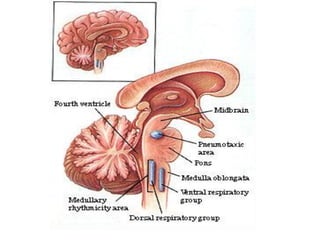
• It is divided into three major collections of
neurons:
• (1) A dorsal respiratory group located in the
dorsal portion of the medulla – inspiration
• (2) A ventral respiratory group, located in the
ventrolateral part of the medulla – expiration
• (3) The pneumotaxic center
• located dorsally in the superior portion of the
pons, which mainly control
- rate and depth of breathing.
Figure 23.27
Respiratory Centers and Reflex Controls
Dorsal Respiratory Group of Neurons
(Inspiratory Centers)
• Group of neurons extends most of the length
of the medulla.
• located within the nucleus of the tractus
solitarius.
• Additional neurons in the adjacent reticular
substance of the medulla also play important
roles in respiratory control.
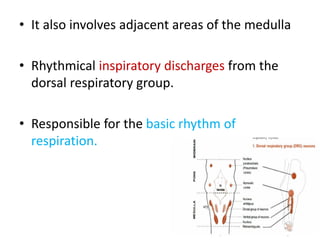
• It also involves adjacent areas of the medulla
• Rhythmical inspiratory discharges from the
dorsal respiratory group.
• Responsible for the basic rhythm of
respiration.
A ventral respiratory group (Expiratory
Centers)
→ located in each side of the medulla 5mm lateral &
anterior to the dorsal group
→functions:
1- inactive during normal quite resp.
2- not involved in the basic rhythmical oscillation
3- provides extra resp. drive when ventilation is
more than normal
4- contributes in both inspiration and respiration
The Hering- Breuer inflation reflux
→ sensory signals from the lungs help in controlling
respiration
→ stretch receptors that are found in the muscular
portion of the bronchi & bronchioles send their
signals with the vagus to the dorsal group→ these
signals inhibit the inspiratory center and inspiration
stops and expiration starts.
• This reflex is a protective reflex because, it
restricts the inspiration & limits the over
stretching of lung tissues.
• activated only when T.V. is reaches above
1000ml
• Reverse of this reflex- Hering- Breuer
deflation reflex.
Inspiratory “Ramp” Signal
• Inspiratory center(I.C) -resp. for normal
respiration
• I.C neurons dischage impulses at regular
intervals – inspiration occur
• The firing of these neurons is not like a sudden
outburst and the discharge is also not uniform
• Starting-----amplitude of action potencial is
low (due to activation of few neurons)
• Later-----more neurons activated---- amplitude
of action potential increases---- ramp fashion
• Impulse produce for 2 sec---Inspiration occur
Significance of Inspiratory “Ramp” Signal
➢Slow and steady inspiration occur so that the
filling of lungs with air is also steady.
• It begins weakly and increases steadily in a ramp
manner for about 2 seconds.
Then it ceases abruptly for approximately the next 3
seconds (during this period expiration occur)
end of 3 seconds inspiratory ramp reaapears
cycle repeats
Pneumotaxic centre
→located dorsally in the nucleus parabrachialis of the upper
pons
→transmits signals to the inspiratory center
→controls the “switch off” point of the inspiratory ramp
to limit inspiration.
→ controlling the duration of the filling phase
Pneumotaxic centre
when weak→ filling takes 5 secs.
when strong→ filling lasts for 0.5 sec.
so the respiratory cycle varies→ 3-40
breaths/min
Chemical control of Respiration
▪ Regulation of respiration is operated through the
chemoreceptors.
▪ The chemoreceptors give responses to changes in
the chemical constitutes of blood.
▪ The chemoreceptors give responses to changes in
blood:-
o Hypoxia
o Hypercapnea
o Increased H⁺ ion conc.
Chemoreceptor's
➢Central Chemoreceptor's
➢Peripheral chemoreceptor's
Central Chemoreceptor's
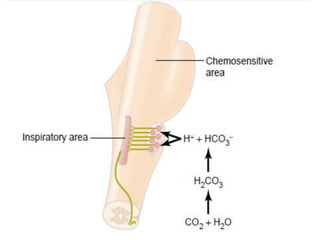
• Situated in deeper part of medulla oblongata
• Close to dorsal group of neuron.
• This area known as Chemoreceptive area.
• The chemoreceptor's are in close contact with
blood and CSF.
Mechanism of action
• H+ conc. main stimulant for central
chemoreceptor's.
• H+ can not cross blood brain barrier.
• CO2 easily cross blood brain barrier and blood
CSF barrier.
Mechanism of action
• CO2 combines with H2O ----- carbonic acid
• It is unstable compound
• It immediately dissociates into H+ and HCO3̅
Peripheral Chemoreceptor's
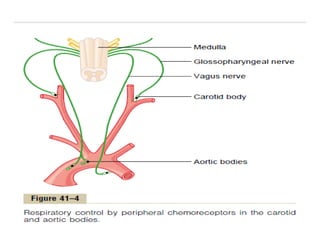
• It are situated in the carotid body and aortic
body
• The chemoreceptor's in the carotid body are
supplied by Hering’s nerve (glossopharyngeal
nerve)
• The chemoreceptor's in the aortic body are
supplied by aortic nerve (Vagus nerve)
Mechanism of action
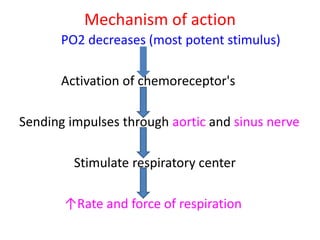
PO2 decreases (most potent stimulus)
Activation of chemoreceptor's
Sending impulses through aortic and sinus nerve
Stimulate respiratory center
↑Rate and force of respiration
T
H Y
A O
N U
K
• Effect of CO2 on chemosensitive neurons:
→the excitation effects peaks the 1st hours after the
increment in blood [CO2]
→after 2 days the effect is decreased because of:
a)- renal adjustment of [H+].
b)- increased bicarbonate ions that enter the CSF
and bind to H+
Acclimatization
• “Chronic breathing of low O2”
→Mountain climbers ascend slowly over a period of
days→ causing deep breathing and withstanding low
PO2
→ because after 2 days 4/5th of the sensitivity of
receptors to CO2 an H+ is lost
→ slow [O2]→ ↑ventilation by 400% whereas acute
exposure of low [O2] will only ↑ventilation by 70%
Regulation during exercise
• → In exercise O2 consumption and CO2
formation is increased 20x
→ the ventilation is increased so PO2, PCO2 and
pH remain Normal
→ when the brain sends its signals to the
muscles it also send collateral signals to the
brain stem to increase ventilation.
→then chemical factors play a significant role
to maintain [O2],[CO2]
Other factors affecting respiration
1- voluntary control : for short period of times
2- irritant receptors: stimulated by many incidents→
coughing & sneezing
3- J receptor in alveolar walls lead to edema where the
patient has dyspnea
4- brain edema causes resp. centre depression
5- anesthesia & narcotic overdose depresses resp.
centre (halothane, morphine, pentobarbital)
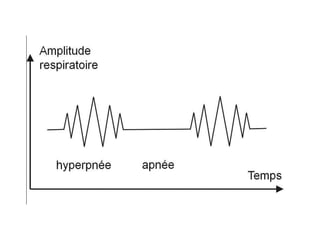
Periodic “Cheyne-Stokes” breathing
→ person over-breathes→ ↑[O2],↓[CO2]
→after seconds these are sensed by the resp.
centre→ inhibition of excess ventilation→
opposite cycle begins→ ↓[O2],↑[CO2]
→after seconds these are sensed by the resp.
centre→ the person is again over-breathing
• Periodic “Cheyne-Stokes” breathing :
→this cycle doesn’t occur normally but can be seen
in these conditions:
1- Brain-damage.
2- Long delay in transporting blood from the lungs
to the brain “severe or chronic heart failure.
T
H Y
A O
N U
K

Regulation of respiration ap-converted

  • 1.
    REGULATION OF RESPIRATION Dr. AparnaSingh Assistant Professor, Department of Kriya Sharir, Faculty of Ayurveda Institute of Medical Sciences, BHU
  • 3.
    Regulation of Respiration ❖Nervousor neural mechanism ❖Chemical mechanism
  • 4.
    Nervous Mechanism 1. RespiratoryCenters 2. Afferent nerves 3. Efferent nerves
  • 5.
    Respiratory Center Two groups:- ➢Medullary Centers:- 1. Inspiratory Centers 2. Expiratory Centers ➢ Pontine Centers:- 1.Pneumotaxic Centers 2.Apneustic Centers
  • 6.
    Respiratory Center • Composedof several groups of neurons located bilaterally in the medulla oblongata and pons. of the brain stem. • It is divided into three major collections of neurons: • (1) A dorsal respiratory group located in the dorsal portion of the medulla – inspiration
  • 7.
    • (2) Aventral respiratory group, located in the ventrolateral part of the medulla – expiration • (3) The pneumotaxic center • located dorsally in the superior portion of the pons, which mainly control - rate and depth of breathing.
  • 8.
  • 9.
    Dorsal Respiratory Groupof Neurons (Inspiratory Centers) • Group of neurons extends most of the length of the medulla. • located within the nucleus of the tractus solitarius. • Additional neurons in the adjacent reticular substance of the medulla also play important roles in respiratory control.
  • 10.
    • It alsoinvolves adjacent areas of the medulla • Rhythmical inspiratory discharges from the dorsal respiratory group. • Responsible for the basic rhythm of respiration.
  • 11.
    A ventral respiratorygroup (Expiratory Centers) → located in each side of the medulla 5mm lateral & anterior to the dorsal group →functions: 1- inactive during normal quite resp. 2- not involved in the basic rhythmical oscillation 3- provides extra resp. drive when ventilation is more than normal 4- contributes in both inspiration and respiration
  • 12.
    The Hering- Breuerinflation reflux → sensory signals from the lungs help in controlling respiration → stretch receptors that are found in the muscular portion of the bronchi & bronchioles send their signals with the vagus to the dorsal group→ these signals inhibit the inspiratory center and inspiration stops and expiration starts.
  • 13.
    • This reflexis a protective reflex because, it restricts the inspiration & limits the over stretching of lung tissues. • activated only when T.V. is reaches above 1000ml • Reverse of this reflex- Hering- Breuer deflation reflex.
  • 14.
    Inspiratory “Ramp” Signal •Inspiratory center(I.C) -resp. for normal respiration • I.C neurons dischage impulses at regular intervals – inspiration occur • The firing of these neurons is not like a sudden outburst and the discharge is also not uniform
  • 15.
    • Starting-----amplitude ofaction potencial is low (due to activation of few neurons) • Later-----more neurons activated---- amplitude of action potential increases---- ramp fashion • Impulse produce for 2 sec---Inspiration occur
  • 16.
    Significance of Inspiratory“Ramp” Signal ➢Slow and steady inspiration occur so that the filling of lungs with air is also steady.
  • 17.
    • It beginsweakly and increases steadily in a ramp manner for about 2 seconds. Then it ceases abruptly for approximately the next 3 seconds (during this period expiration occur) end of 3 seconds inspiratory ramp reaapears cycle repeats
  • 18.
    Pneumotaxic centre →located dorsallyin the nucleus parabrachialis of the upper pons →transmits signals to the inspiratory center →controls the “switch off” point of the inspiratory ramp to limit inspiration. → controlling the duration of the filling phase
  • 19.
    Pneumotaxic centre when weak→filling takes 5 secs. when strong→ filling lasts for 0.5 sec. so the respiratory cycle varies→ 3-40 breaths/min
  • 20.
    Chemical control ofRespiration ▪ Regulation of respiration is operated through the chemoreceptors. ▪ The chemoreceptors give responses to changes in the chemical constitutes of blood. ▪ The chemoreceptors give responses to changes in blood:- o Hypoxia o Hypercapnea o Increased H⁺ ion conc.
  • 21.
  • 22.
    Central Chemoreceptor's • Situatedin deeper part of medulla oblongata • Close to dorsal group of neuron. • This area known as Chemoreceptive area. • The chemoreceptor's are in close contact with blood and CSF.
  • 23.
    Mechanism of action •H+ conc. main stimulant for central chemoreceptor's. • H+ can not cross blood brain barrier. • CO2 easily cross blood brain barrier and blood CSF barrier.
  • 24.
    Mechanism of action •CO2 combines with H2O ----- carbonic acid • It is unstable compound • It immediately dissociates into H+ and HCO3̅
  • 26.
    Peripheral Chemoreceptor's • Itare situated in the carotid body and aortic body • The chemoreceptor's in the carotid body are supplied by Hering’s nerve (glossopharyngeal nerve) • The chemoreceptor's in the aortic body are supplied by aortic nerve (Vagus nerve)
  • 28.
    Mechanism of action PO2decreases (most potent stimulus) Activation of chemoreceptor's Sending impulses through aortic and sinus nerve Stimulate respiratory center ↑Rate and force of respiration
  • 29.
  • 30.
    • Effect ofCO2 on chemosensitive neurons: →the excitation effects peaks the 1st hours after the increment in blood [CO2] →after 2 days the effect is decreased because of: a)- renal adjustment of [H+]. b)- increased bicarbonate ions that enter the CSF and bind to H+
  • 31.
    Acclimatization • “Chronic breathingof low O2” →Mountain climbers ascend slowly over a period of days→ causing deep breathing and withstanding low PO2 → because after 2 days 4/5th of the sensitivity of receptors to CO2 an H+ is lost → slow [O2]→ ↑ventilation by 400% whereas acute exposure of low [O2] will only ↑ventilation by 70%
  • 32.
    Regulation during exercise •→ In exercise O2 consumption and CO2 formation is increased 20x → the ventilation is increased so PO2, PCO2 and pH remain Normal → when the brain sends its signals to the muscles it also send collateral signals to the brain stem to increase ventilation. →then chemical factors play a significant role to maintain [O2],[CO2]
  • 33.
    Other factors affectingrespiration 1- voluntary control : for short period of times 2- irritant receptors: stimulated by many incidents→ coughing & sneezing 3- J receptor in alveolar walls lead to edema where the patient has dyspnea 4- brain edema causes resp. centre depression 5- anesthesia & narcotic overdose depresses resp. centre (halothane, morphine, pentobarbital)
  • 34.
    Periodic “Cheyne-Stokes” breathing →person over-breathes→ ↑[O2],↓[CO2] →after seconds these are sensed by the resp. centre→ inhibition of excess ventilation→ opposite cycle begins→ ↓[O2],↑[CO2] →after seconds these are sensed by the resp. centre→ the person is again over-breathing
  • 36.
    • Periodic “Cheyne-Stokes”breathing : →this cycle doesn’t occur normally but can be seen in these conditions: 1- Brain-damage. 2- Long delay in transporting blood from the lungs to the brain “severe or chronic heart failure.
  • 37.