
APPLICATION
OF
NEURAL NETWORK
APPLICATION OF NEURAL
NETWORKS 1
NIKHIL KANSARI
UE-4345
CSE 4th
YEAR
 Pattern Recognition
 Autonomous Walker & Swimming Eel
 Neural Networks in Medicine
 Neural Networks in Sports
 Forecasting space weather
 Neural networks for computer virus recognition
 Limitations of neural networks
APPLICATION OF NEURAL
NETWORKS 2
 An important application of neural networks
 can be implemented by using a feed-forward
neural network that has been trained accordingly.
 the network is trained to associate outputs with
input patterns.
 it identifies the input pattern and tries to output the
associated output pattern.
APPLICATION OF NEURAL
NETWORKS 3
 The power of neural networks comes to life when
a pattern that has no output associated with it, is
given as an input.
 In this case, the network gives the output that
corresponds to a taught input pattern that is least
different from the given pattern
APPLICATION OF NEURAL
NETWORKS 4
APPLICATION OF NEURAL
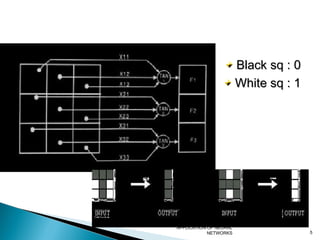
NETWORKS 5
Black sq : 0Black sq : 0
White sq : 1White sq : 1
APPLICATION OF NEURAL
NETWORKS 6
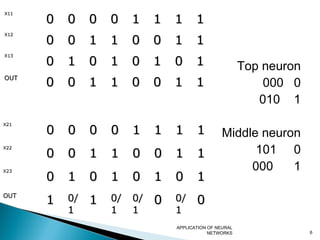
Top neuron
000 0
010 1
Middle neuron
101 0
000 1
X11X11
00 00 00 00 11 11 11 11
X12X12
00 00 11 11 00 00 11 11
X13X13
00 11 00 11 00 11 00 11
OUTOUT
00 00 11 11 00 00 11 11
X21X21
00 00 00 00 11 11 11 11
X22X22
00 00 11 11 00 00 11 11
X23X23
00 11 00 11 00 11 00 11
OUTOUT
11 0/0/
11
11 0/0/
11
0/0/
11
00 0/0/
11
00
APPLICATION OF NEURAL
NETWORKS 7
X31X31
00 00 00 00 11 11 11 11
X32X32
00 00 11 11 00 00 11 11
X33X33
00 11 00 11 00 11 00 11
OUTOUT
11 00 11 11 00 00 11 00
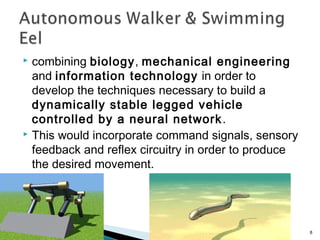
 combining biology, mechanical engineering
and information technology in order to
develop the techniques necessary to build a
dynamically stable legged vehicle
controlled by a neural network.
 This would incorporate command signals, sensory
feedback and reflex circuitry in order to produce
the desired movement.
APPLICATION OF NEURAL
NETWORKS 8
 particularly well suited to problems with a high
degree of complexity for which there is no
algorithmic solution or the solution is too complex
for traditional techniques to determine.
 drug development, patient diagnosis, and image
analysis , detection of coronary artery disease and
the processing of EEG signals.
APPLICATION OF NEURAL
NETWORKS 9
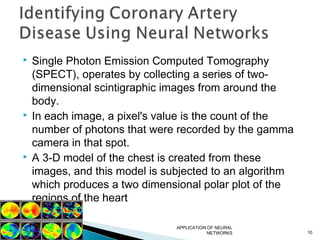
 Single Photon Emission Computed Tomography
(SPECT), operates by collecting a series of two-
dimensional scintigraphic images from around the
body.
 In each image, a pixel's value is the count of the
number of photons that were recorded by the gamma
camera in that spot.
 A 3-D model of the chest is created from these
images, and this model is subjected to an algorithm
which produces a two dimensional polar plot of the
regions of the heart
APPLICATION OF NEURAL
NETWORKS 10
 Networks have been deployed in practice for pre-
screening of patients and deciding those who
need more detailed examinations.
 networks have been found to have equal or better
accuracy and faster convergence than traditional
probabilistic and statistical techniques.
 neural networks to analyze the data obtained from
this process with the goal of improving diagnosis.
APPLICATION OF NEURAL
NETWORKS 11
 effective at predicting the outcomes of sports
events due to they have strong pattern matching
capabilities .
 A neural network is a computerized system that
can learn which combinations of inputs (such as a
team’s performance statistics) lead to a particular
output (such as the probability of the team
winning).
APPLICATION OF NEURAL
NETWORKS 12
 predicting the outcome of thoroughbred horse
races.
 providing a neural network with historical
information on horses -speed, horse position
during previous races, class, earnings, in-the-
money percentages, and postposition in today's
and previous races .
 network can use its advanced pattern matching
capabilities to predict the outcome of future races.
APPLICATION OF NEURAL
NETWORKS 13
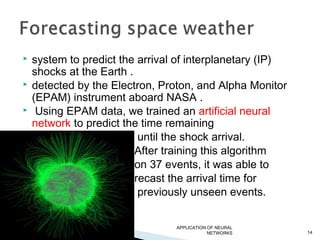
 system to predict the arrival of interplanetary (IP)
shocks at the Earth .
 detected by the Electron, Proton, and Alpha Monitor
(EPAM) instrument aboard NASA .
 Using EPAM data, we trained an artificial neural
network to predict the time remaining
until the shock arrival.
After training this algorithm
on 37 events, it was able to
forecast the arrival time for
19 previously unseen events.
APPLICATION OF NEURAL
NETWORKS 14
 for generic detection of a particular class of computer
viruses-the so called boot sector viruses.
 as part of the IBM Antivirus software package .
 designing an appropriate input representation scheme;
dealing with the scarcity of available training data;
finding an appropriate trade off point between false
positives and false negatives to conform to user
expectations; and making the software conform to
strict constraints on memory and speed of
computation needed to run on PCs.
APPLICATION OF NEURAL
NETWORKS 15
 Neural network learning algorithm are inductive,
requiring large amount of data, whereas strategic
decision making deals with unique and non
routine types of decision making.
 Neural networks do not provide explanations for
their decisions.
 Neural network decisions are not supported by
significant tests, hence low validity.
APPLICATION OF NEURAL
NETWORKS 16
APPLICATION OF NEURAL
NETWORKS 17

Ai and neural networks

  • 1.
    APPLICATION OF NEURAL NETWORK APPLICATION OFNEURAL NETWORKS 1 NIKHIL KANSARI UE-4345 CSE 4th YEAR
  • 2.
     Pattern Recognition Autonomous Walker & Swimming Eel  Neural Networks in Medicine  Neural Networks in Sports  Forecasting space weather  Neural networks for computer virus recognition  Limitations of neural networks APPLICATION OF NEURAL NETWORKS 2
  • 3.
     An importantapplication of neural networks  can be implemented by using a feed-forward neural network that has been trained accordingly.  the network is trained to associate outputs with input patterns.  it identifies the input pattern and tries to output the associated output pattern. APPLICATION OF NEURAL NETWORKS 3
  • 4.
     The powerof neural networks comes to life when a pattern that has no output associated with it, is given as an input.  In this case, the network gives the output that corresponds to a taught input pattern that is least different from the given pattern APPLICATION OF NEURAL NETWORKS 4
  • 5.
    APPLICATION OF NEURAL NETWORKS5 Black sq : 0Black sq : 0 White sq : 1White sq : 1
  • 6.
    APPLICATION OF NEURAL NETWORKS6 Top neuron 000 0 010 1 Middle neuron 101 0 000 1 X11X11 00 00 00 00 11 11 11 11 X12X12 00 00 11 11 00 00 11 11 X13X13 00 11 00 11 00 11 00 11 OUTOUT 00 00 11 11 00 00 11 11 X21X21 00 00 00 00 11 11 11 11 X22X22 00 00 11 11 00 00 11 11 X23X23 00 11 00 11 00 11 00 11 OUTOUT 11 0/0/ 11 11 0/0/ 11 0/0/ 11 00 0/0/ 11 00
  • 7.
    APPLICATION OF NEURAL NETWORKS7 X31X31 00 00 00 00 11 11 11 11 X32X32 00 00 11 11 00 00 11 11 X33X33 00 11 00 11 00 11 00 11 OUTOUT 11 00 11 11 00 00 11 00
  • 8.
     combining biology,mechanical engineering and information technology in order to develop the techniques necessary to build a dynamically stable legged vehicle controlled by a neural network.  This would incorporate command signals, sensory feedback and reflex circuitry in order to produce the desired movement. APPLICATION OF NEURAL NETWORKS 8
  • 9.
     particularly wellsuited to problems with a high degree of complexity for which there is no algorithmic solution or the solution is too complex for traditional techniques to determine.  drug development, patient diagnosis, and image analysis , detection of coronary artery disease and the processing of EEG signals. APPLICATION OF NEURAL NETWORKS 9
  • 10.
     Single PhotonEmission Computed Tomography (SPECT), operates by collecting a series of two- dimensional scintigraphic images from around the body.  In each image, a pixel's value is the count of the number of photons that were recorded by the gamma camera in that spot.  A 3-D model of the chest is created from these images, and this model is subjected to an algorithm which produces a two dimensional polar plot of the regions of the heart APPLICATION OF NEURAL NETWORKS 10
  • 11.
     Networks havebeen deployed in practice for pre- screening of patients and deciding those who need more detailed examinations.  networks have been found to have equal or better accuracy and faster convergence than traditional probabilistic and statistical techniques.  neural networks to analyze the data obtained from this process with the goal of improving diagnosis. APPLICATION OF NEURAL NETWORKS 11
  • 12.
     effective atpredicting the outcomes of sports events due to they have strong pattern matching capabilities .  A neural network is a computerized system that can learn which combinations of inputs (such as a team’s performance statistics) lead to a particular output (such as the probability of the team winning). APPLICATION OF NEURAL NETWORKS 12
  • 13.
     predicting theoutcome of thoroughbred horse races.  providing a neural network with historical information on horses -speed, horse position during previous races, class, earnings, in-the- money percentages, and postposition in today's and previous races .  network can use its advanced pattern matching capabilities to predict the outcome of future races. APPLICATION OF NEURAL NETWORKS 13
  • 14.
     system topredict the arrival of interplanetary (IP) shocks at the Earth .  detected by the Electron, Proton, and Alpha Monitor (EPAM) instrument aboard NASA .  Using EPAM data, we trained an artificial neural network to predict the time remaining until the shock arrival. After training this algorithm on 37 events, it was able to forecast the arrival time for 19 previously unseen events. APPLICATION OF NEURAL NETWORKS 14
  • 15.
     for genericdetection of a particular class of computer viruses-the so called boot sector viruses.  as part of the IBM Antivirus software package .  designing an appropriate input representation scheme; dealing with the scarcity of available training data; finding an appropriate trade off point between false positives and false negatives to conform to user expectations; and making the software conform to strict constraints on memory and speed of computation needed to run on PCs. APPLICATION OF NEURAL NETWORKS 15
  • 16.
     Neural networklearning algorithm are inductive, requiring large amount of data, whereas strategic decision making deals with unique and non routine types of decision making.  Neural networks do not provide explanations for their decisions.  Neural network decisions are not supported by significant tests, hence low validity. APPLICATION OF NEURAL NETWORKS 16
  • 17.