DEEP
LEARNING
WORKSHOP
Dublin City University
27-28 April 2017
Xavier Giro-i-Nieto
xavier.giro@upc.edu
Associate Professor
Universitat Politecnica de Catalunya
Technical University of Catalonia
Neural Machine Translation
Day 2 Lecture 10
#InsightDL2017
2
Acknowledgments
Antonio
Bonafonte
Santiago
Pascual
3
Acknowledgments
Marta R. Costa-jussà
4
Acknowledgments
Kyunghyun Cho
5
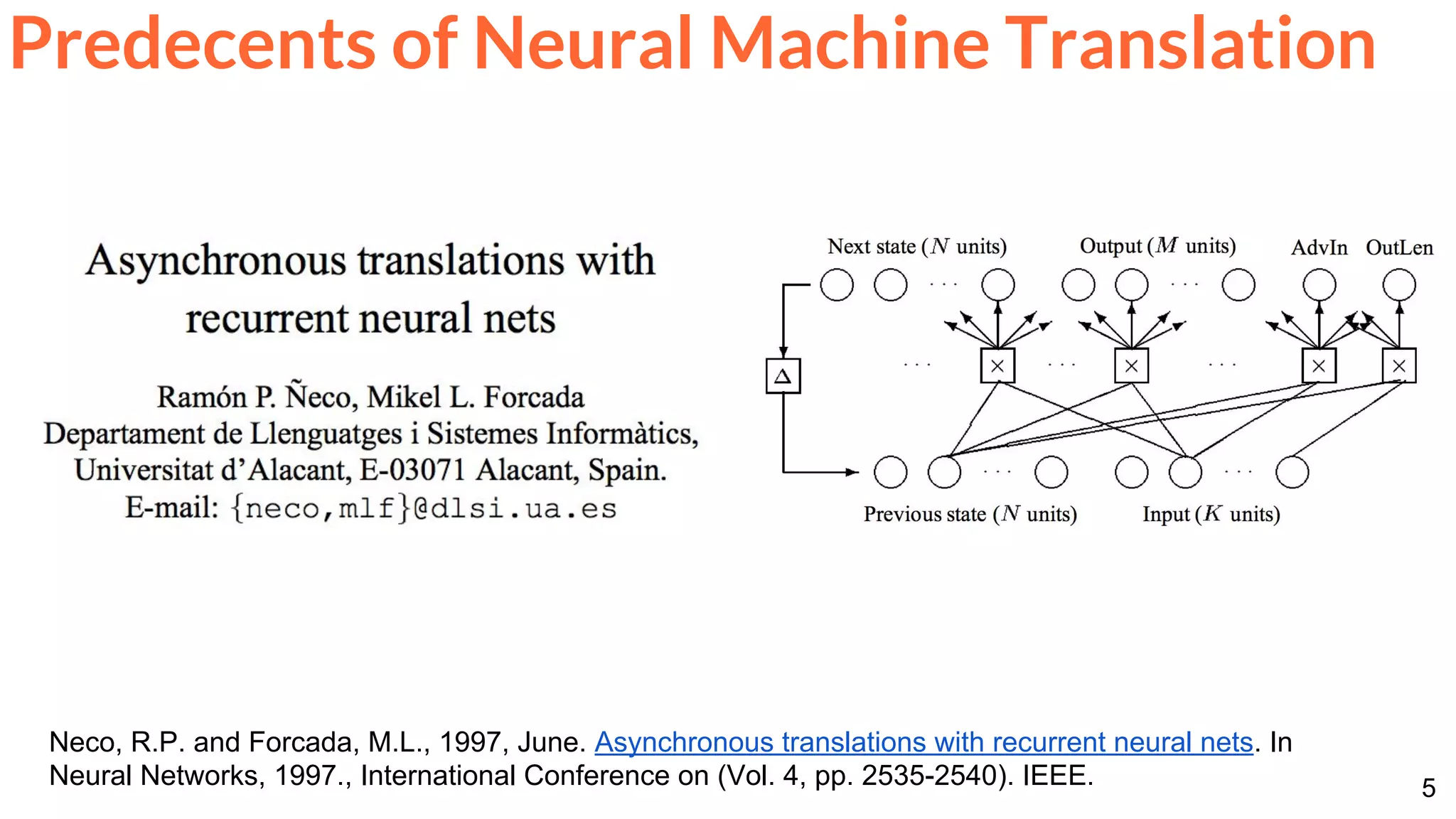
Predecents of Neural Machine Translation
Neco, R.P. and Forcada, M.L., 1997, June. Asynchronous translations with recurrent neural nets. In
Neural Networks, 1997., International Conference on (Vol. 4, pp. 2535-2540). IEEE.
6
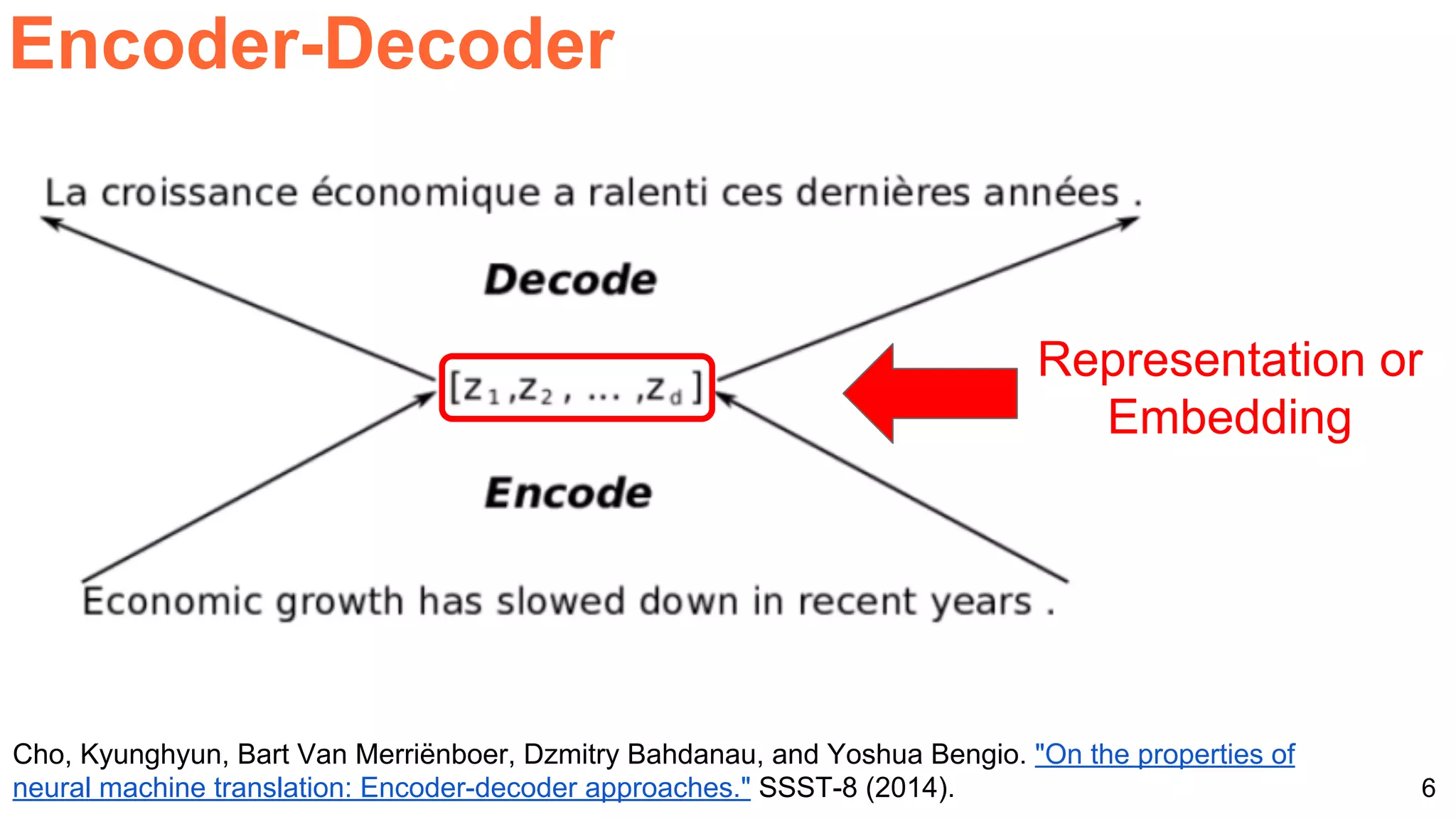
Encoder-Decoder
Representation or
Embedding
Cho, Kyunghyun, Bart Van Merriënboer, Dzmitry Bahdanau, and Yoshua Bengio. "On the properties of
neural machine translation: Encoder-decoder approaches." SSST-8 (2014).
7
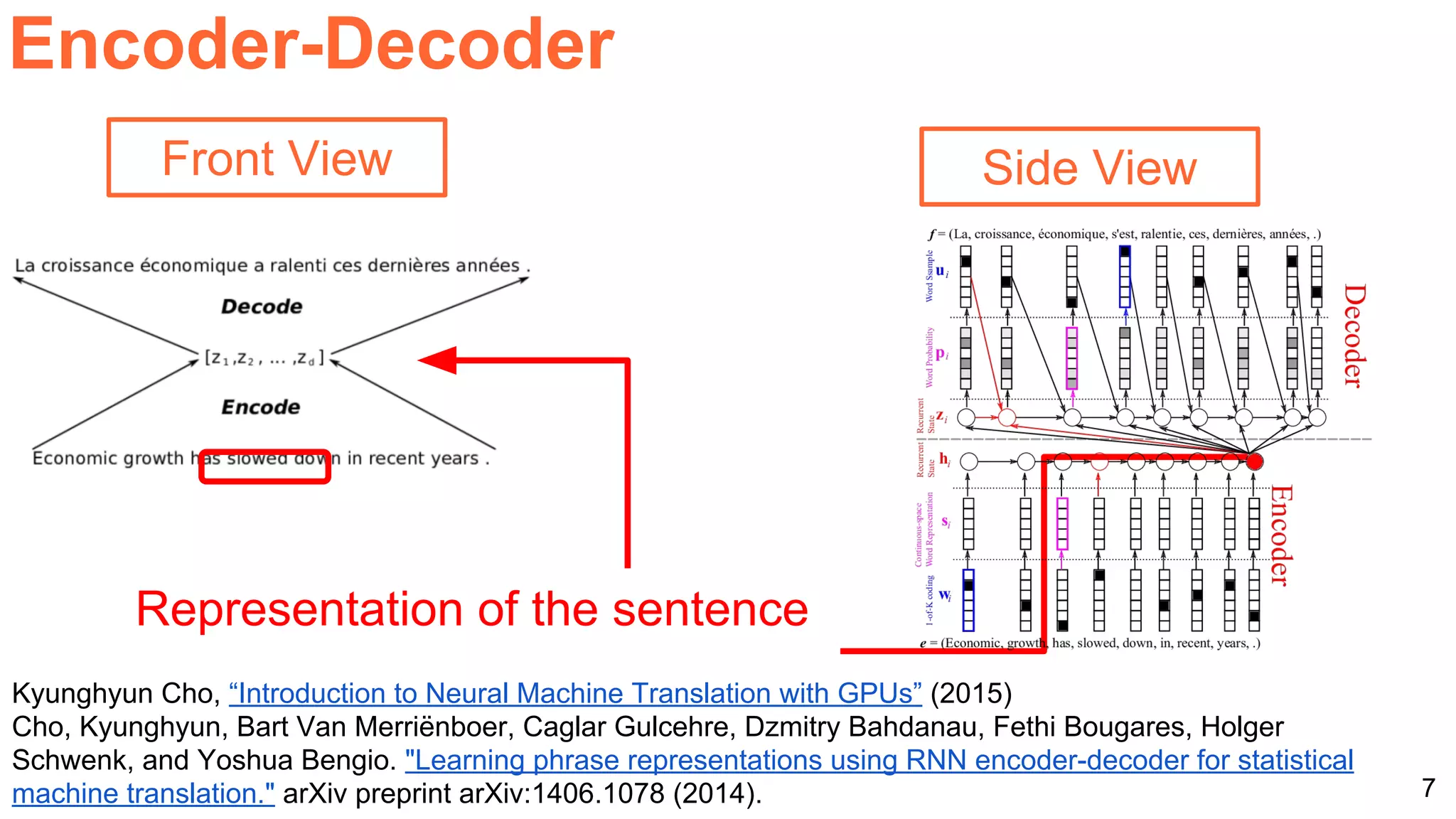
Encoder-Decoder
Front View Side View
Representation of the sentence
Kyunghyun Cho, “Introduction to Neural Machine Translation with GPUs” (2015)
Cho, Kyunghyun, Bart Van Merriënboer, Caglar Gulcehre, Dzmitry Bahdanau, Fethi Bougares, Holger
Schwenk, and Yoshua Bengio. "Learning phrase representations using RNN encoder-decoder for statistical
machine translation." arXiv preprint arXiv:1406.1078 (2014).
Encoder
9
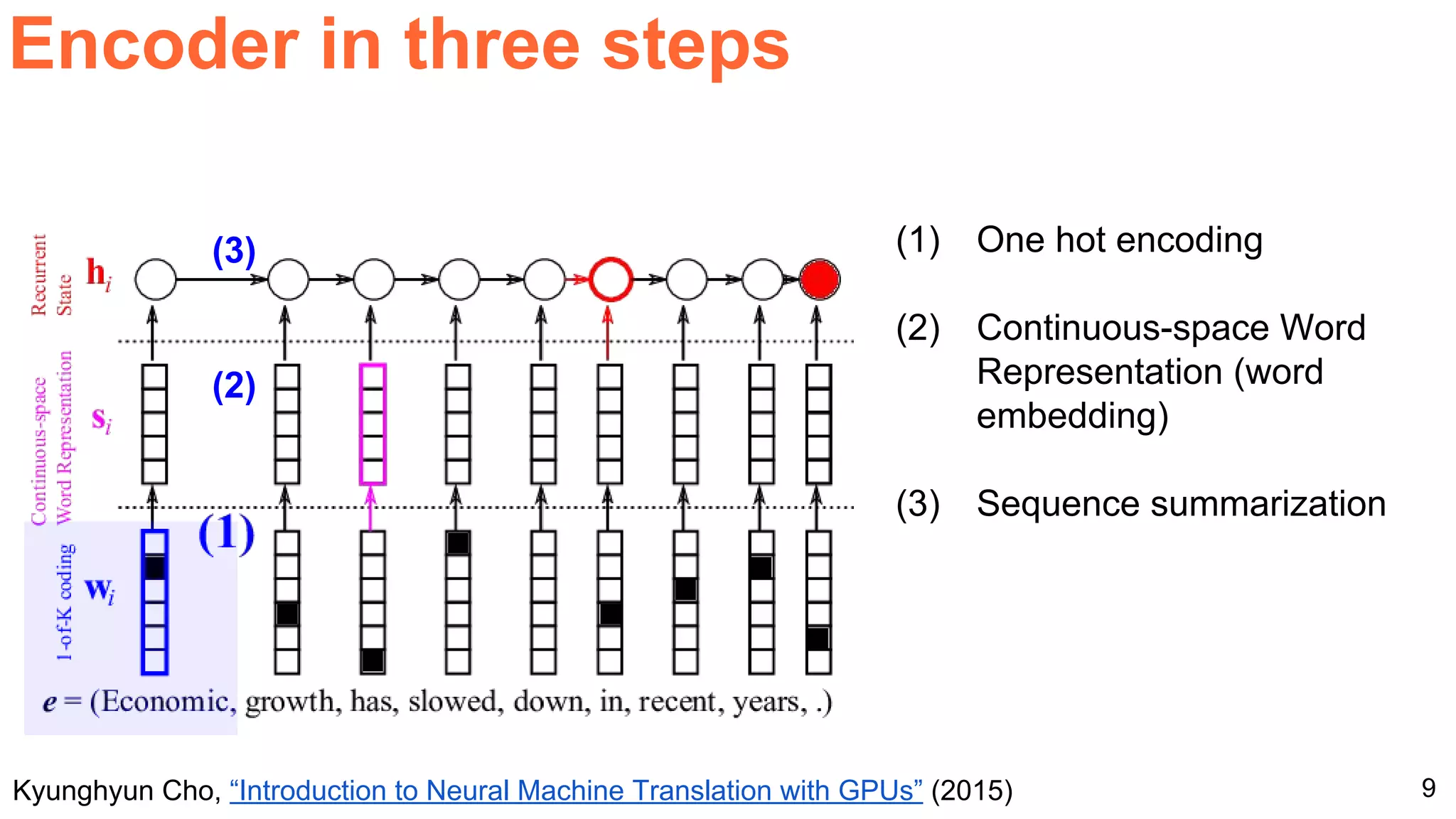
Encoder in three steps
Kyunghyun Cho, “Introduction to Neural Machine Translation with GPUs” (2015)
(2)
(3) (1) One hot encoding
(2) Continuous-space Word
Representation (word
embedding)
(3) Sequence summarization
10
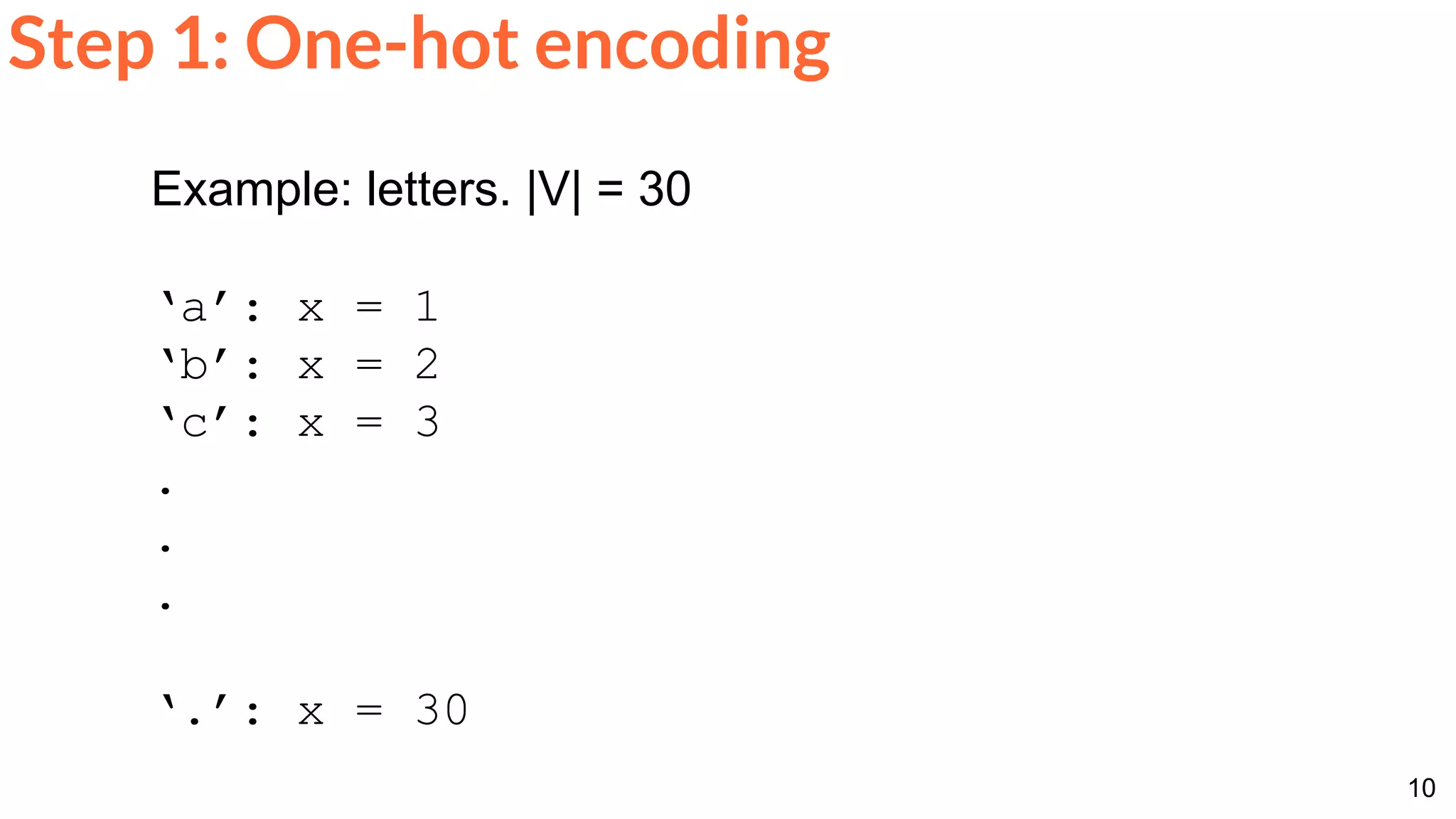
Step 1: One-hot encoding
Example: letters. |V| = 30
‘a’: x = 1
‘b’: x = 2
‘c’: x = 3
.
.
.
‘.’: x = 30
11
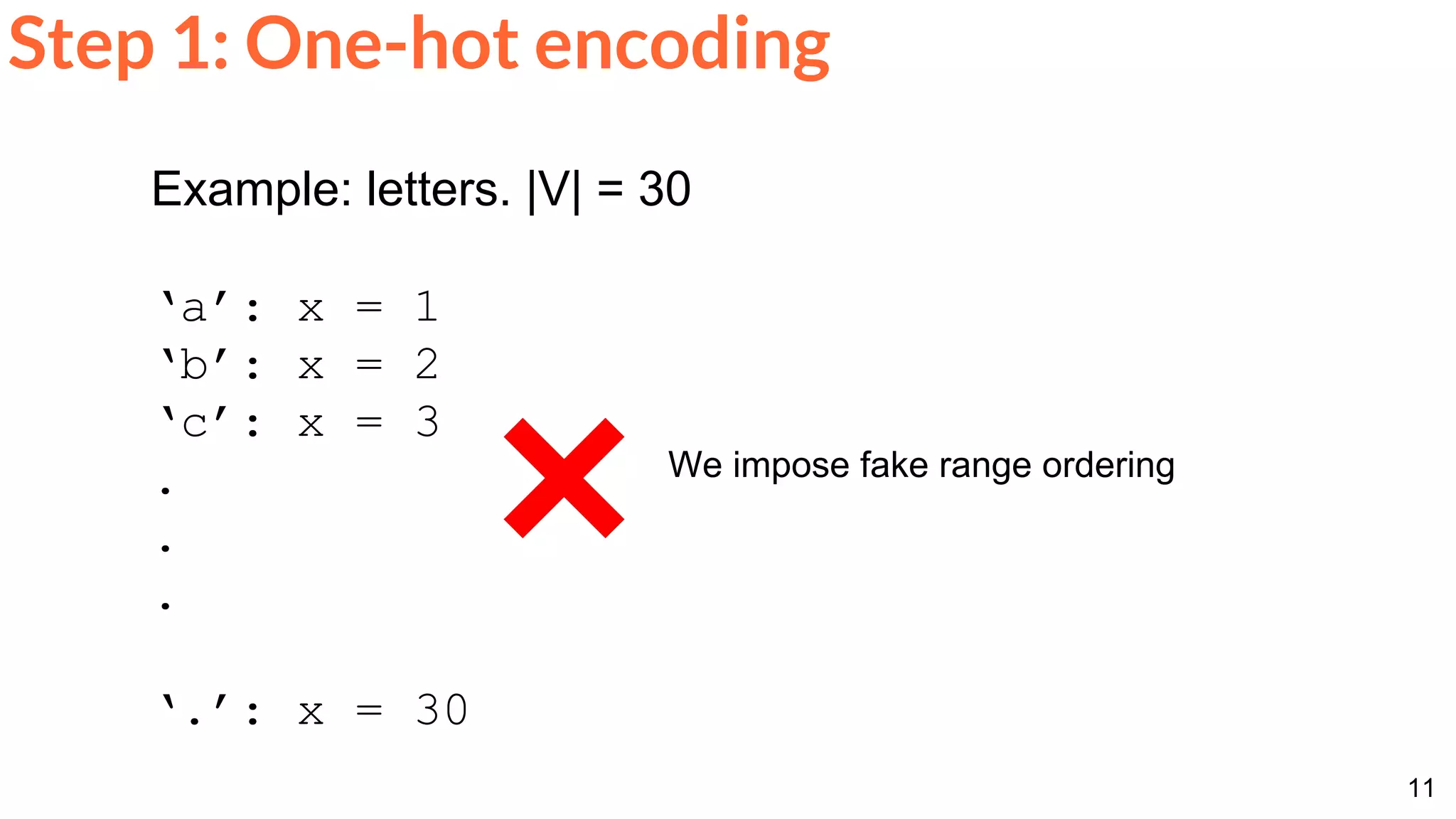
Step 1: One-hot encoding
Example: letters. |V| = 30
‘a’: x = 1
‘b’: x = 2
‘c’: x = 3
.
.
.
‘.’: x = 30
We impose fake range ordering
12
Step 1: One-hot encoding
Example: letters. |V| = 30
‘a’: xT
= [1,0,0, ..., 0]
‘b’: xT
= [0,1,0, ..., 0]
‘c’: xT
= [0,0,1, ..., 0]
.
.
.
‘.’: xT
= [0,0,0, ..., 1]
13
Step 1: One-hot encoding
Example: words.
cat: xT
= [1,0,0, ..., 0]
dog: xT
= [0,1,0, ..., 0]
.
.
house: xT
= [0,0,0, …,0,1,0,...,0]
.
.
.
Number of words, |V| ?
B2: 5K
C2: 18K
LVSR: 50-100K
Wikipedia (1.6B): 400K
Crawl data (42B): 2M
14
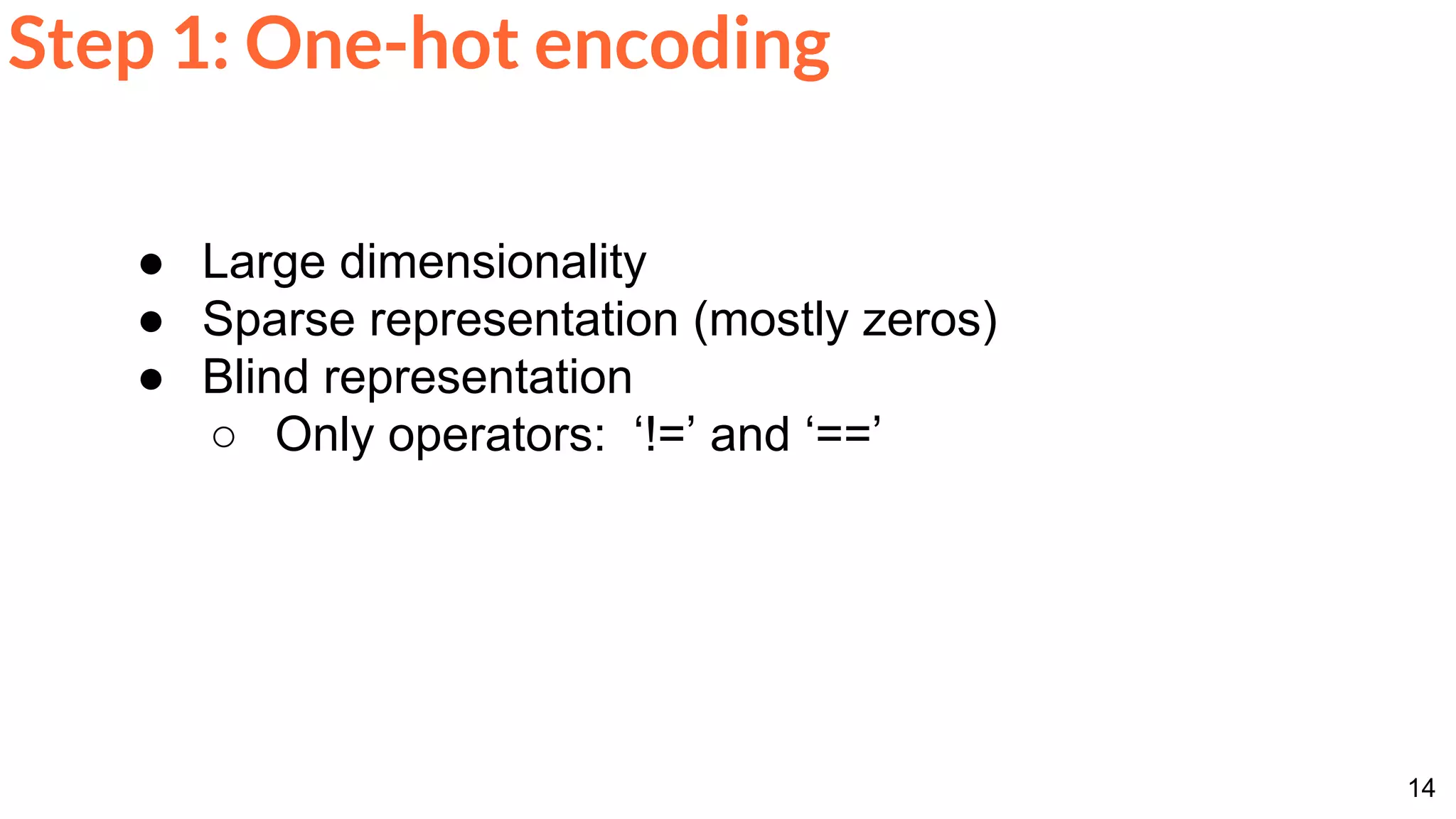
Step 1: One-hot encoding
● Large dimensionality
● Sparse representation (mostly zeros)
● Blind representation
○ Only operators: ‘!=’ and ‘==’
15
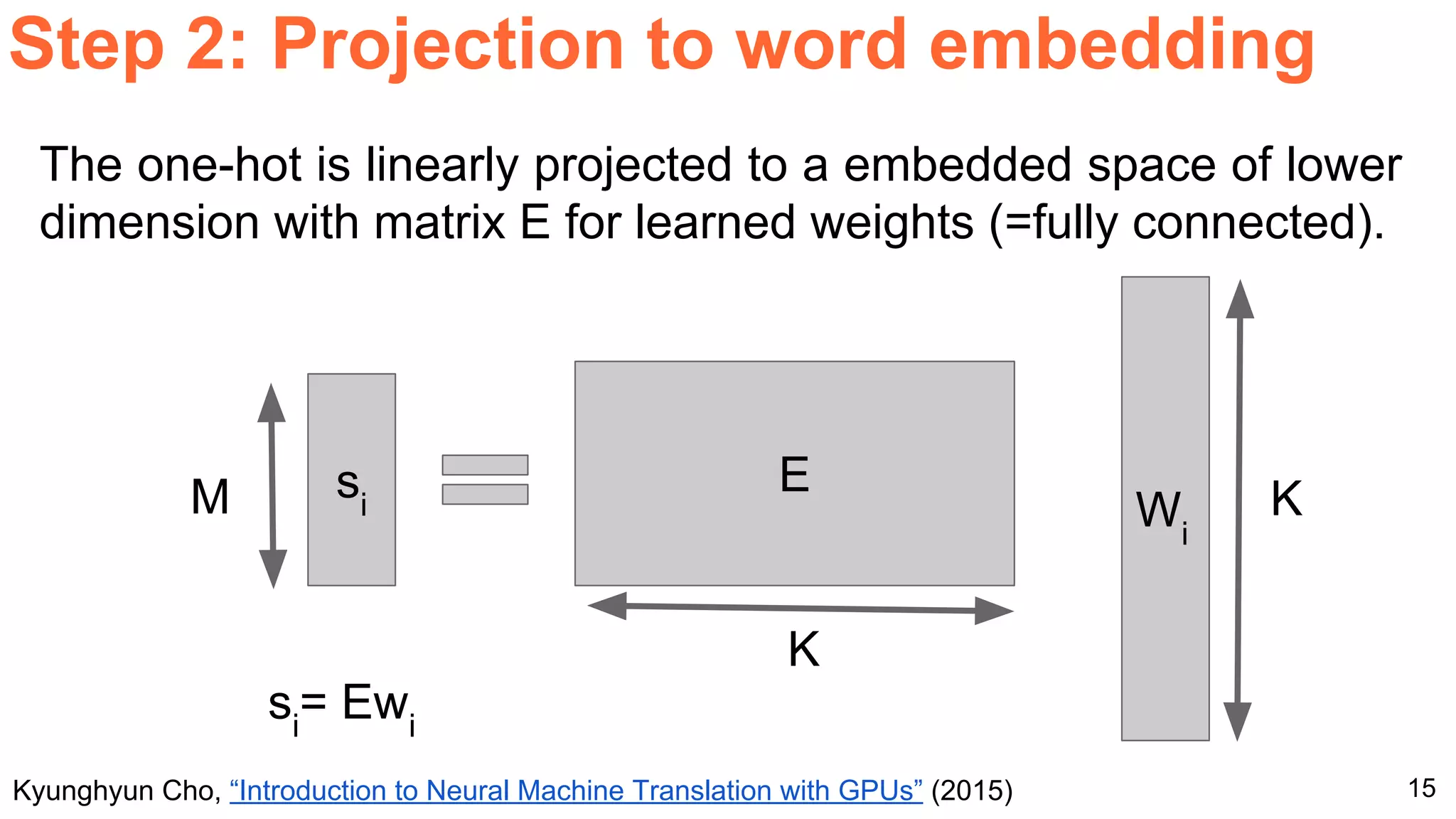
Step 2: Projection to word embedding
Kyunghyun Cho, “Introduction to Neural Machine Translation with GPUs” (2015)
siM Wi
E
The one-hot is linearly projected to a embedded space of lower
dimension with matrix E for learned weights (=fully connected).
K
K
si
= Ewi
16
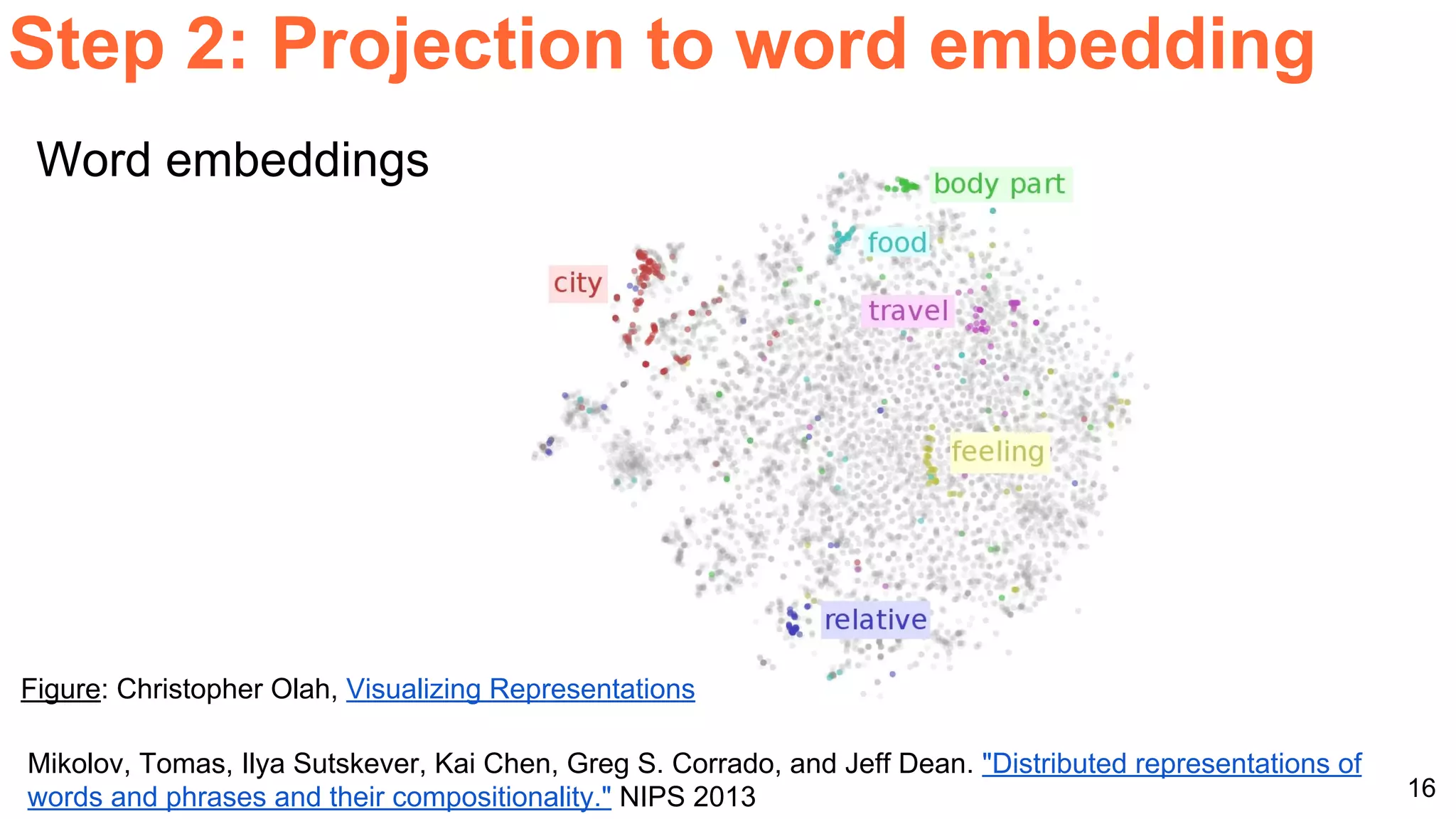
Word embeddings
Figure: Christopher Olah, Visualizing Representations
Mikolov, Tomas, Ilya Sutskever, Kai Chen, Greg S. Corrado, and Jeff Dean. "Distributed representations of
words and phrases and their compositionality." NIPS 2013
Step 2: Projection to word embedding
17
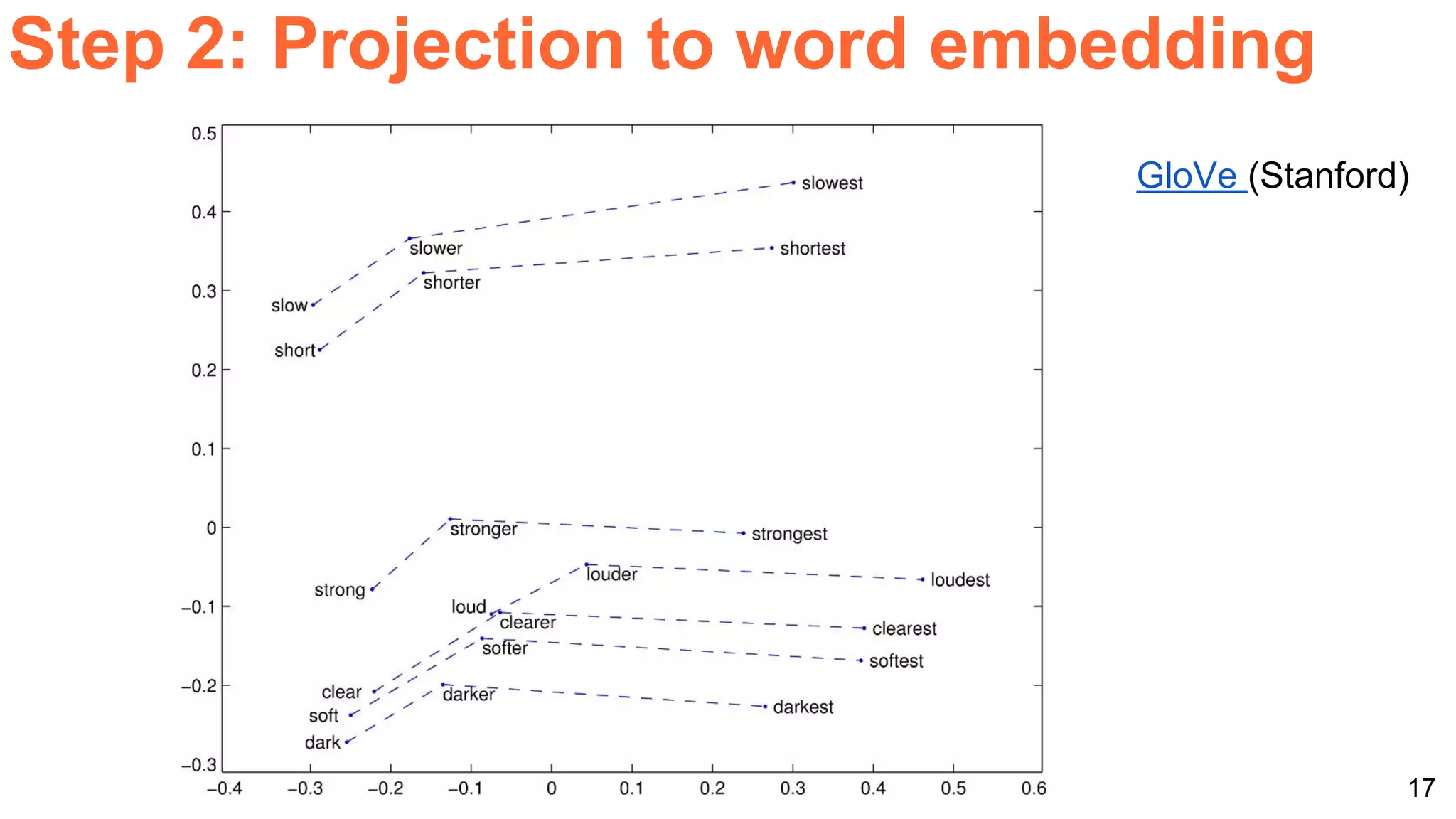
Step 2: Projection to word embedding
GloVe (Stanford)
18
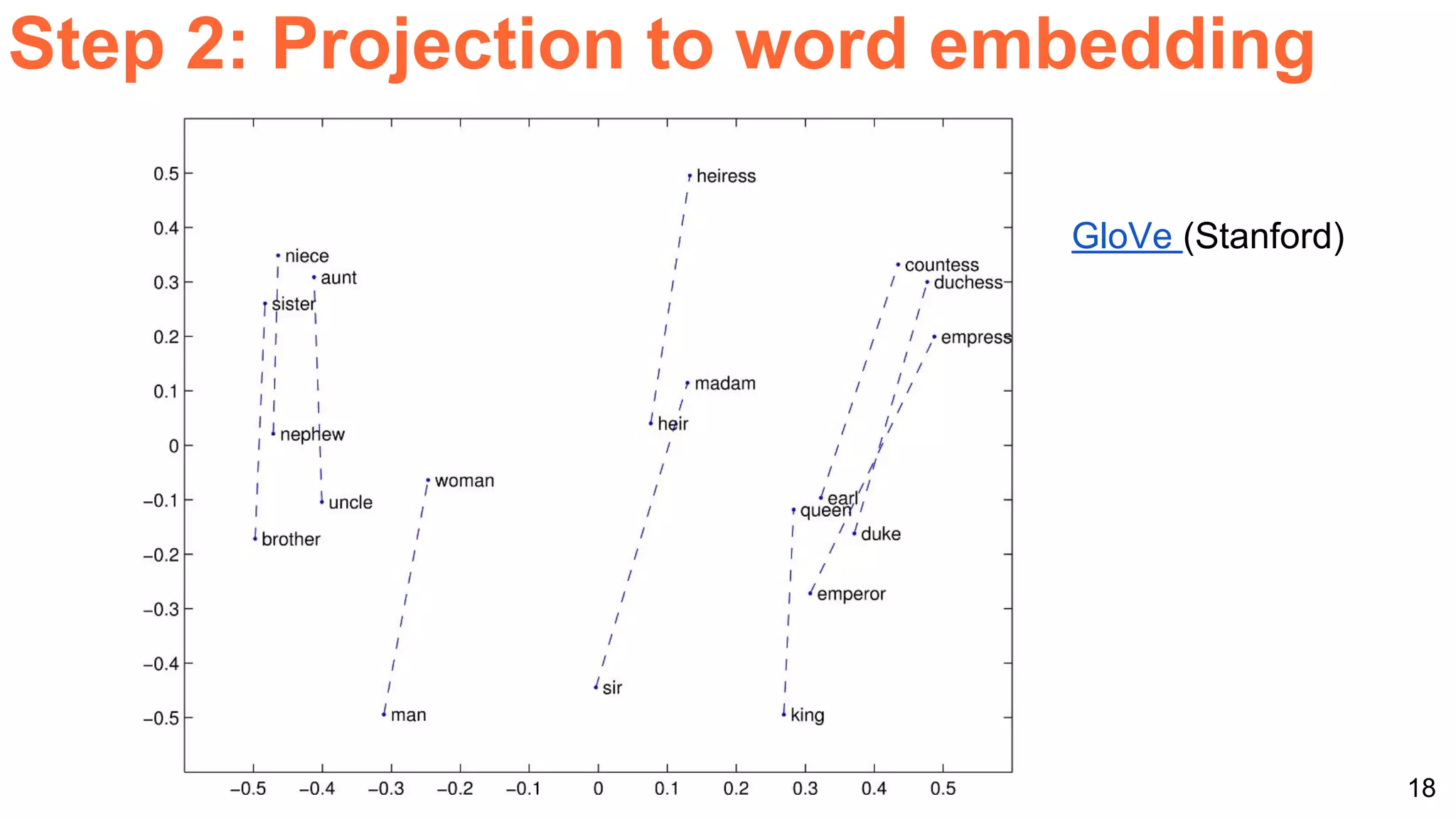
Step 2: Projection to word embedding
GloVe (Stanford)
19
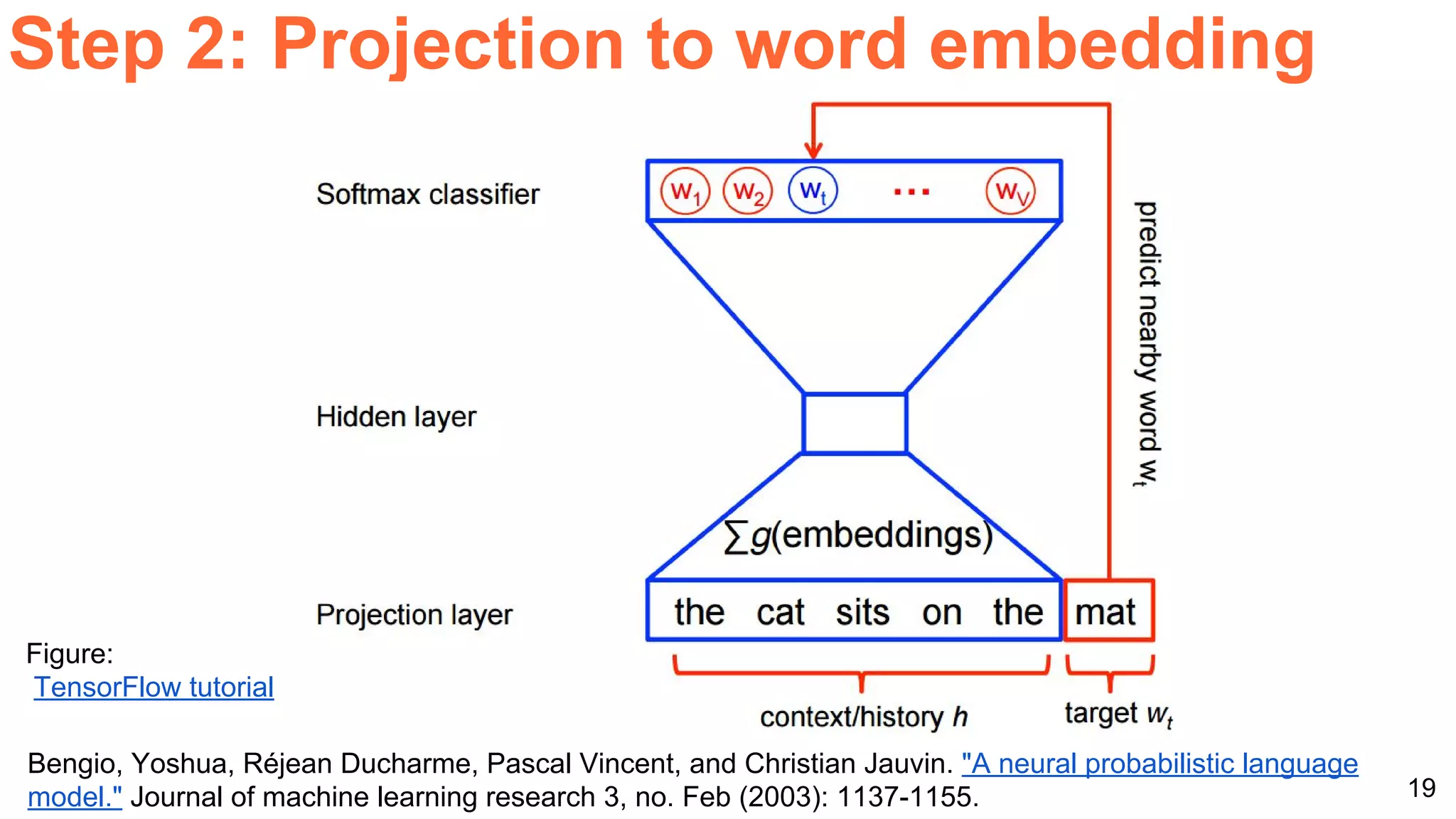
Step 2: Projection to word embedding
Figure:
TensorFlow tutorial
Bengio, Yoshua, Réjean Ducharme, Pascal Vincent, and Christian Jauvin. "A neural probabilistic language
model." Journal of machine learning research 3, no. Feb (2003): 1137-1155.
20
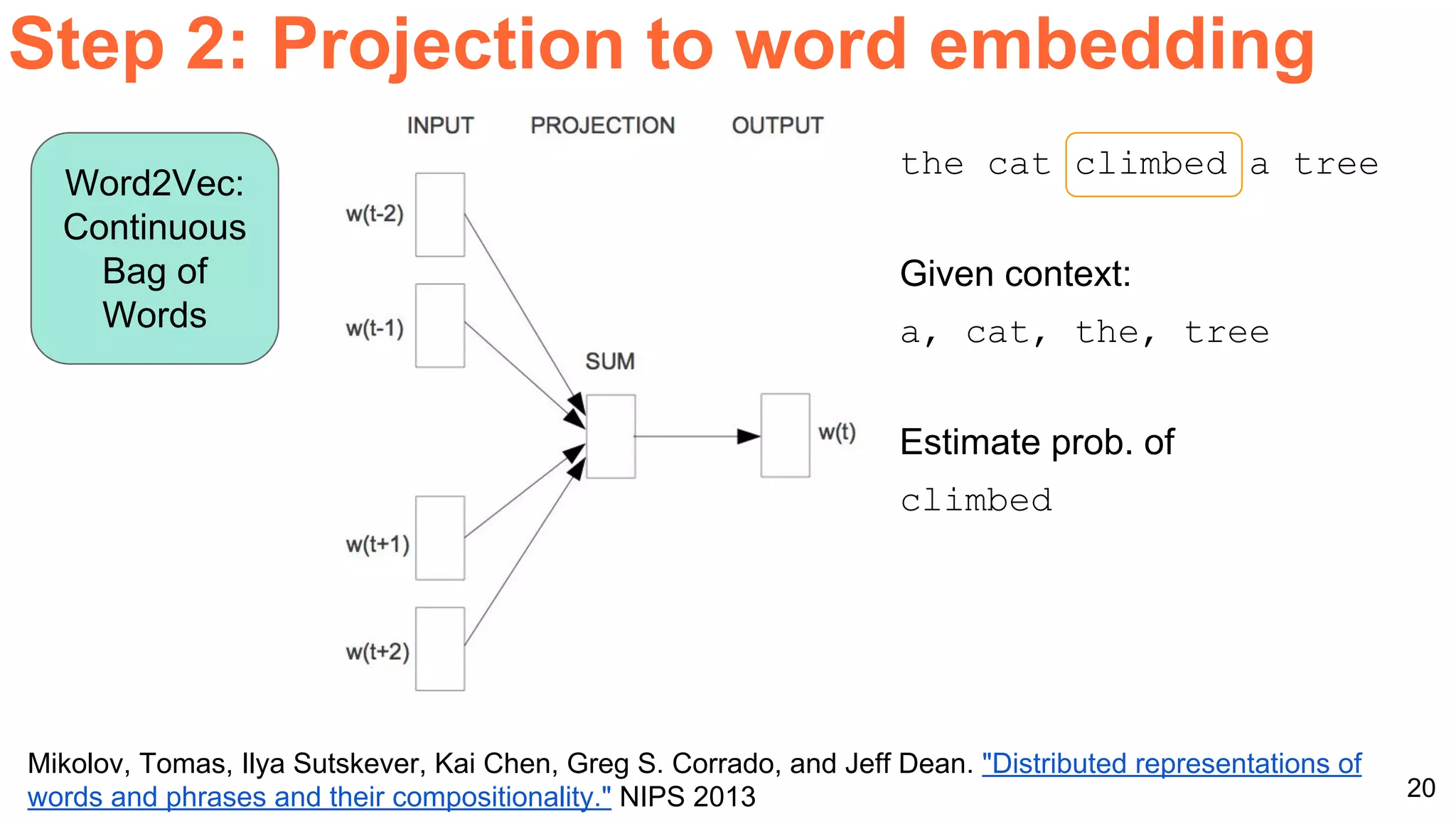
Step 2: Projection to word embedding
Mikolov, Tomas, Ilya Sutskever, Kai Chen, Greg S. Corrado, and Jeff Dean. "Distributed representations of
words and phrases and their compositionality." NIPS 2013
the cat climbed a tree
Given context:
a, cat, the, tree
Estimate prob. of
climbed
Word2Vec:
Continuous
Bag of
Words
21
Step 2: Projection to word embedding
Mikolov, Tomas, Ilya Sutskever, Kai Chen, Greg S. Corrado, and Jeff Dean. "Distributed representations of
words and phrases and their compositionality." NIPS 2013
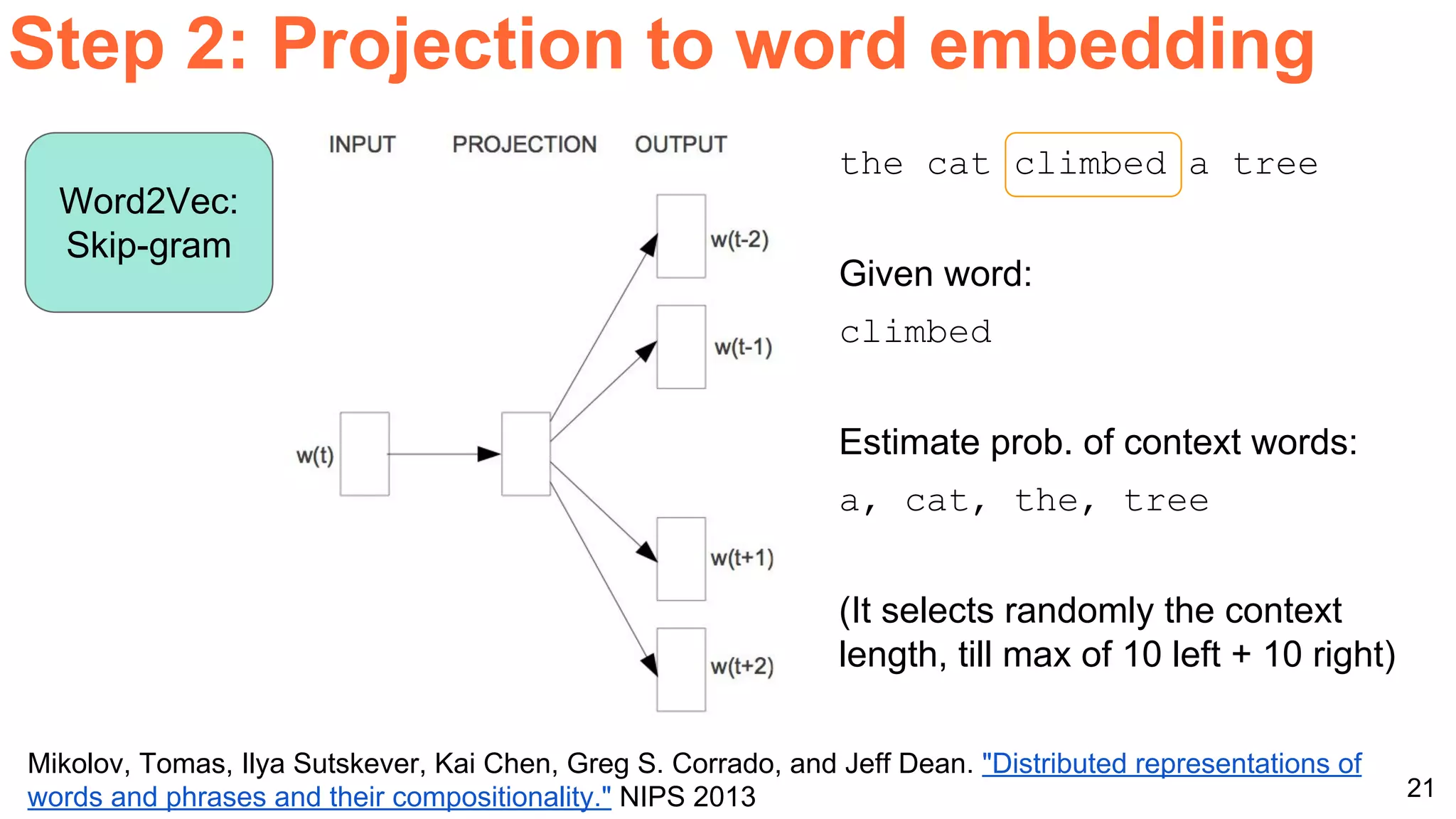
the cat climbed a tree
Given word:
climbed
Estimate prob. of context words:
a, cat, the, tree
(It selects randomly the context
length, till max of 10 left + 10 right)
Word2Vec:
Skip-gram
22
Step 2: Projection to word embedding
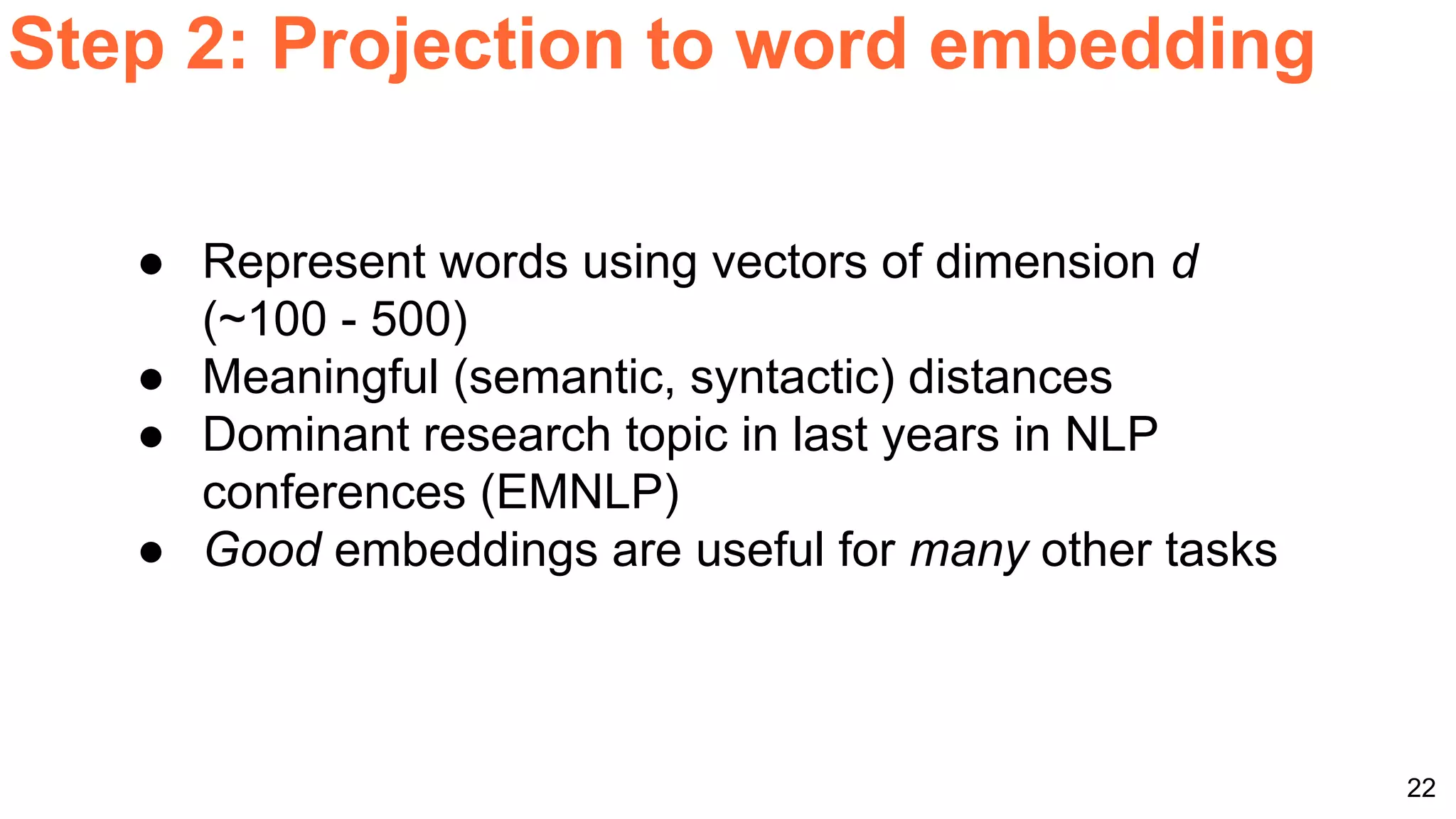
● Represent words using vectors of dimension d
(~100 - 500)
● Meaningful (semantic, syntactic) distances
● Dominant research topic in last years in NLP
conferences (EMNLP)
● Good embeddings are useful for many other tasks
23
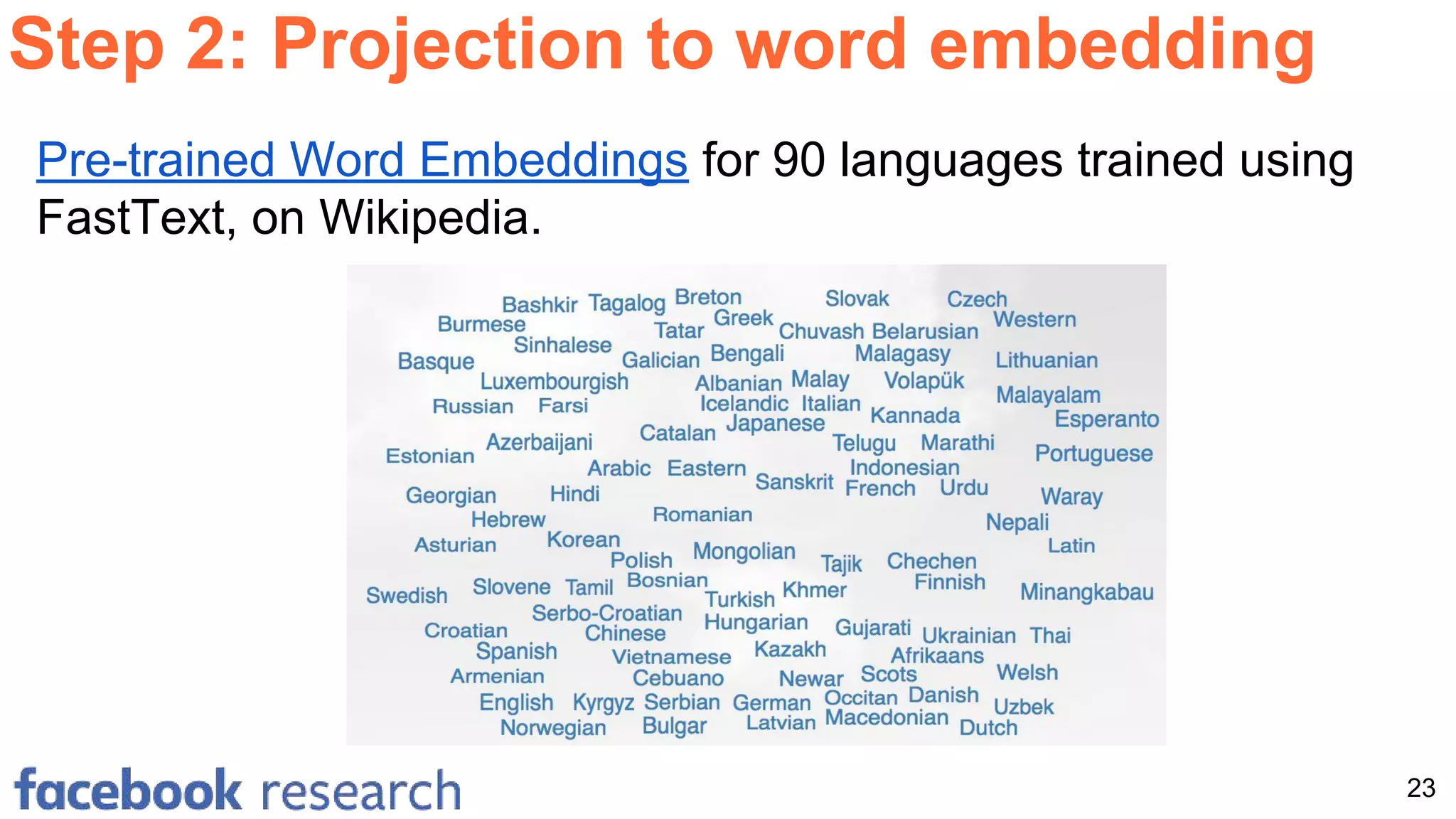
Pre-trained Word Embeddings for 90 languages trained using
FastText, on Wikipedia.
Step 2: Projection to word embedding
24
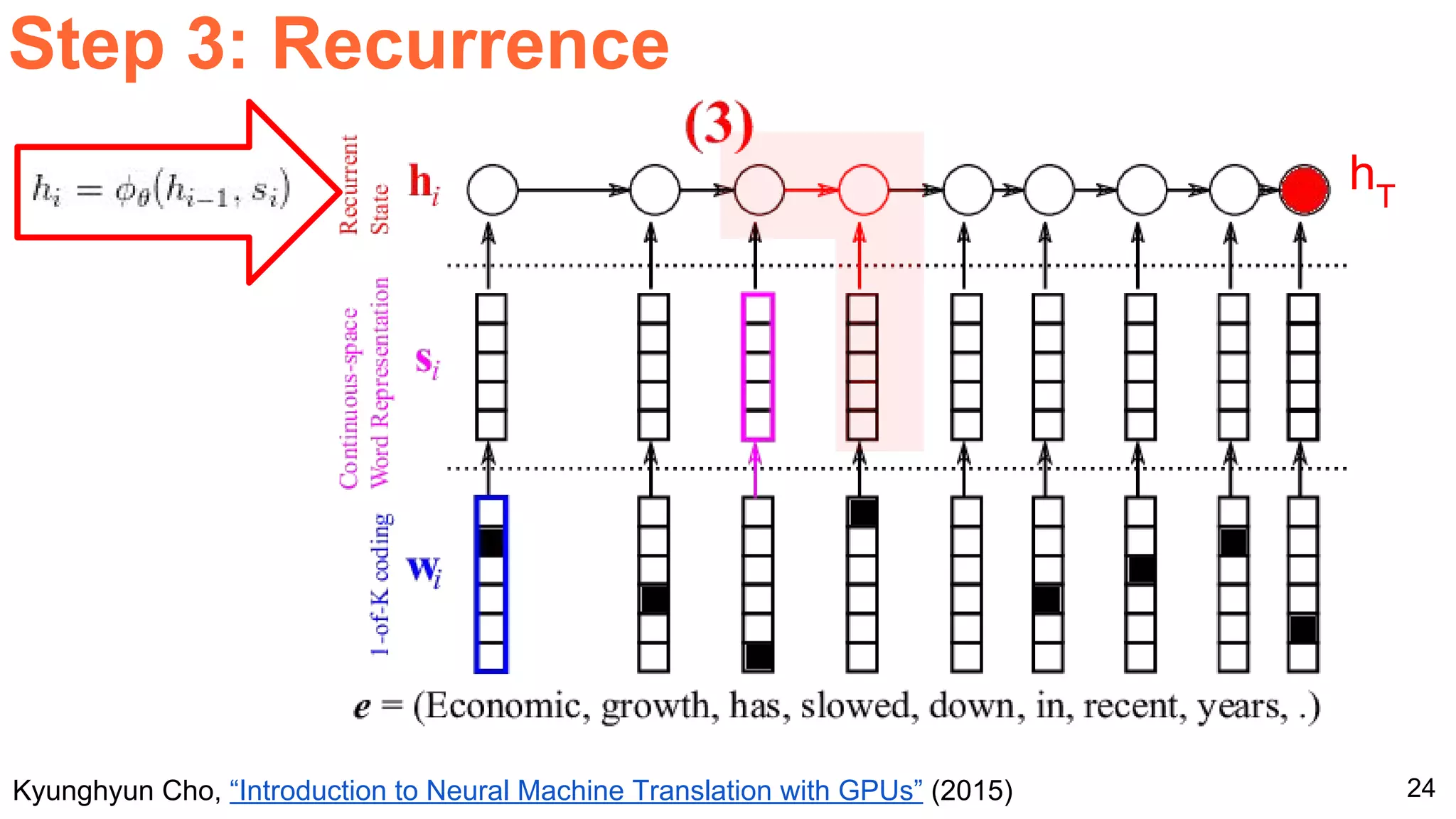
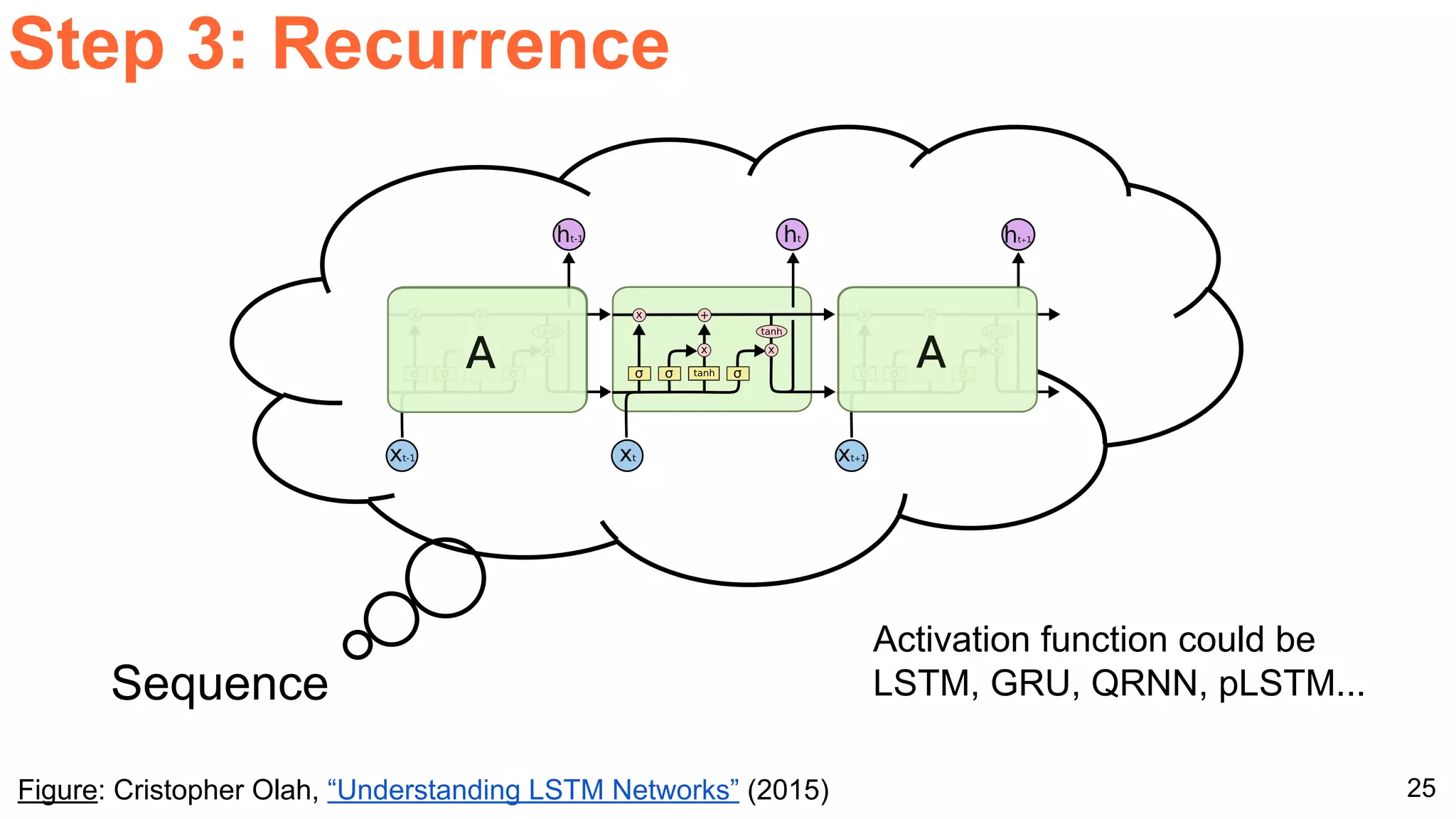
Step 3: Recurrence
Kyunghyun Cho, “Introduction to Neural Machine Translation with GPUs” (2015)
hT
25
Step 3: Recurrence
Sequence
Figure: Cristopher Olah, “Understanding LSTM Networks” (2015)
Activation function could be
LSTM, GRU, QRNN, pLSTM...
Decoder
27
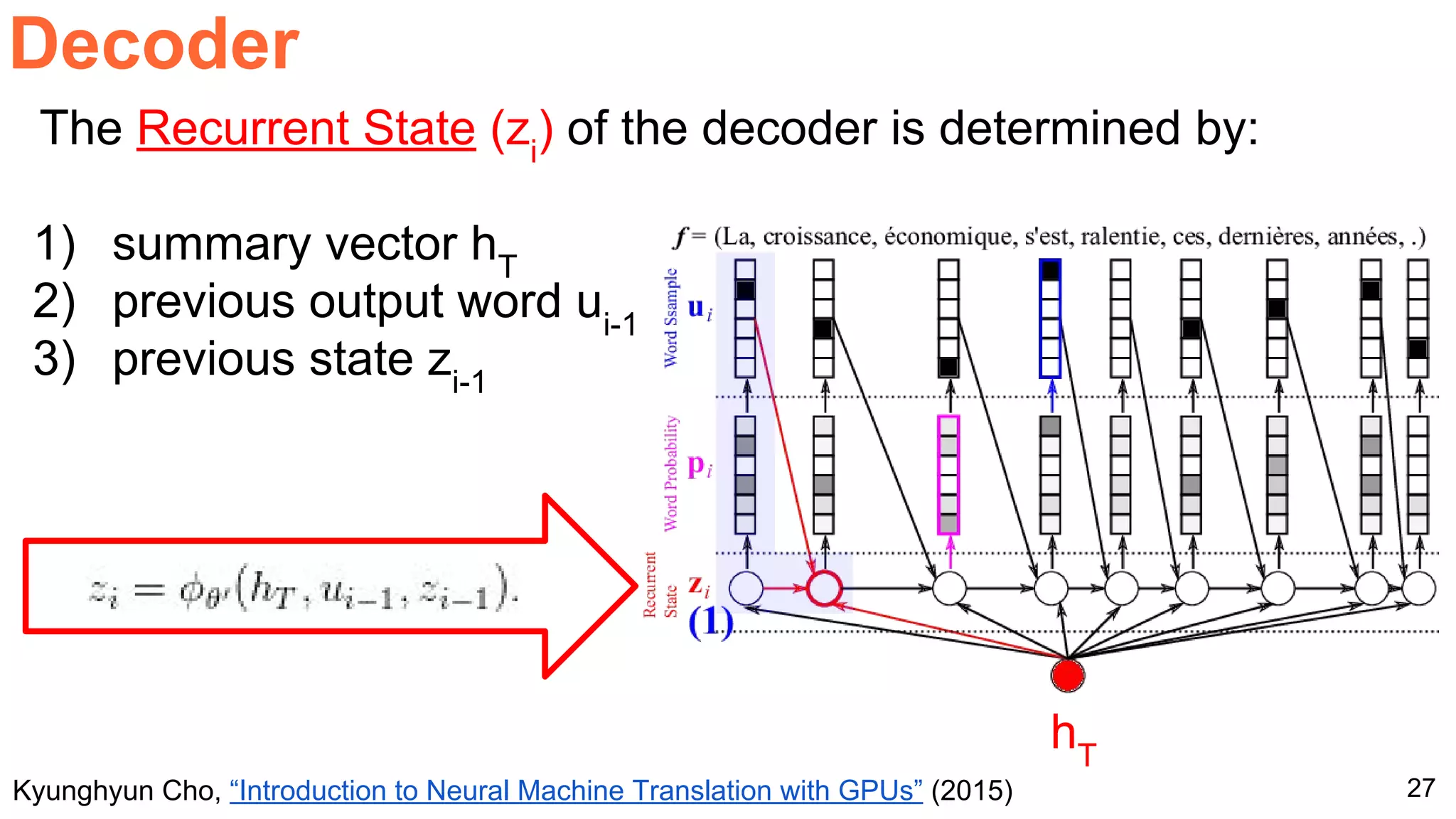
Decoder
Kyunghyun Cho, “Introduction to Neural Machine Translation with GPUs” (2015)
The Recurrent State (zi
) of the decoder is determined by:
1) summary vector hT
2) previous output word ui-1
3) previous state zi-1
hT
28
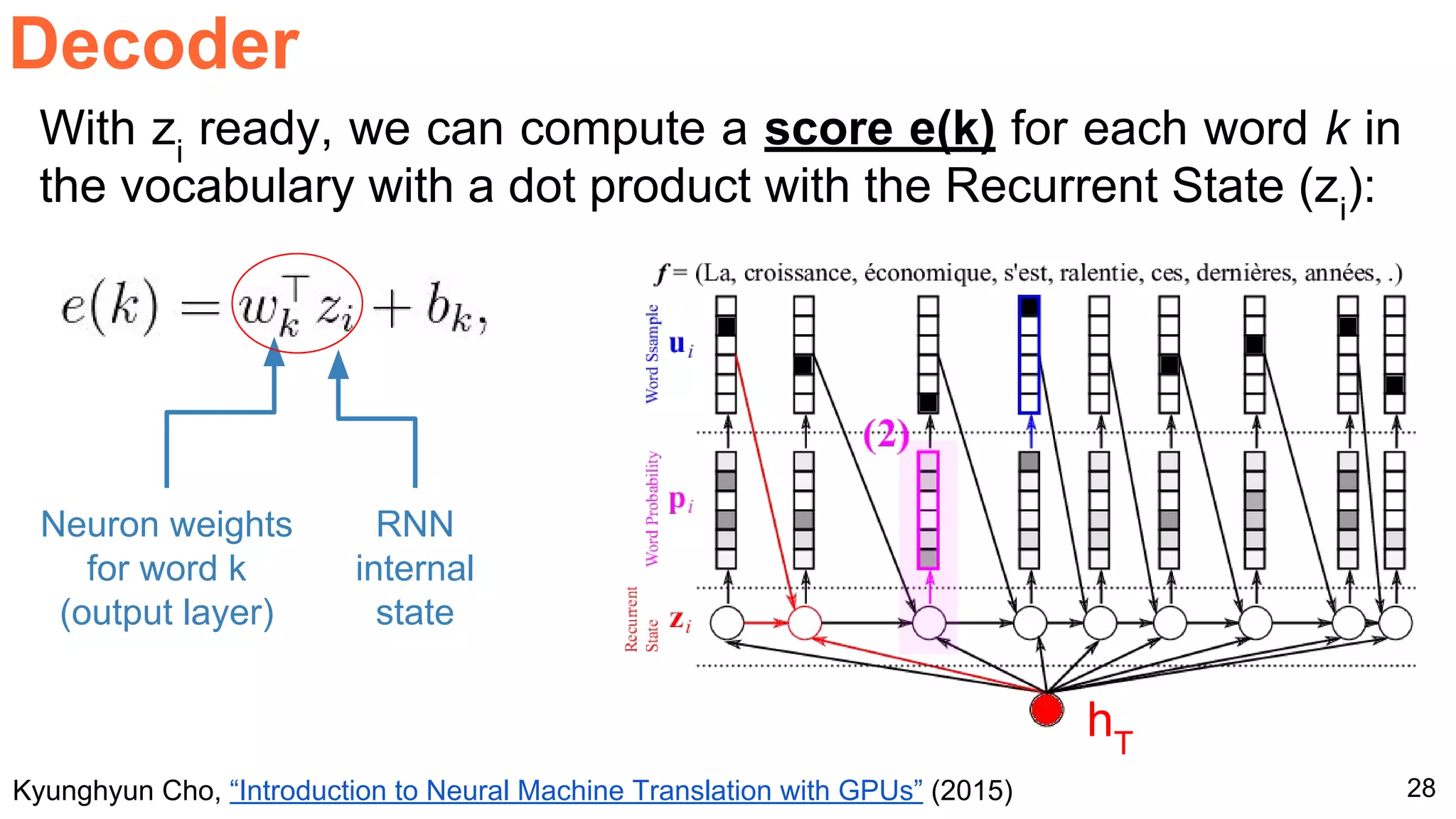
Decoder
Kyunghyun Cho, “Introduction to Neural Machine Translation with GPUs” (2015)
With zi
ready, we can compute a score e(k) for each word k in
the vocabulary with a dot product with the Recurrent State (zi
):
RNN
internal
state
Neuron weights
for word k
(output layer)
hT
29
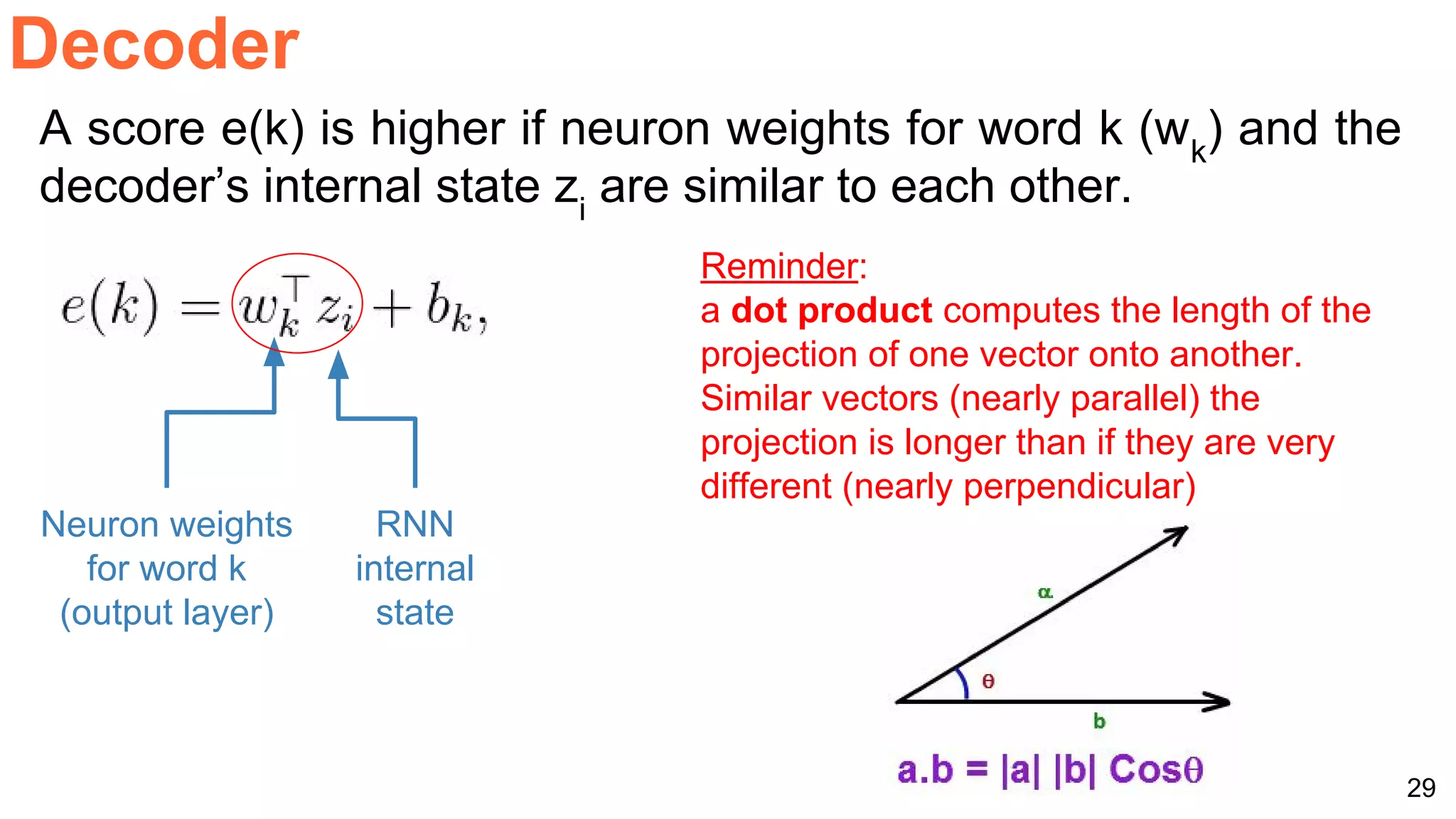
Decoder
A score e(k) is higher if neuron weights for word k (wk
) and the
decoder’s internal state zi
are similar to each other.
Reminder:
a dot product computes the length of the
projection of one vector onto another.
Similar vectors (nearly parallel) the
projection is longer than if they are very
different (nearly perpendicular)
RNN
internal
state
Neuron weights
for word k
(output layer)
30
Decoder
Bridle, John S. "Training Stochastic Model Recognition Algorithms as Networks can Lead to Maximum
Mutual Information Estimation of Parameters." NIPS 1989
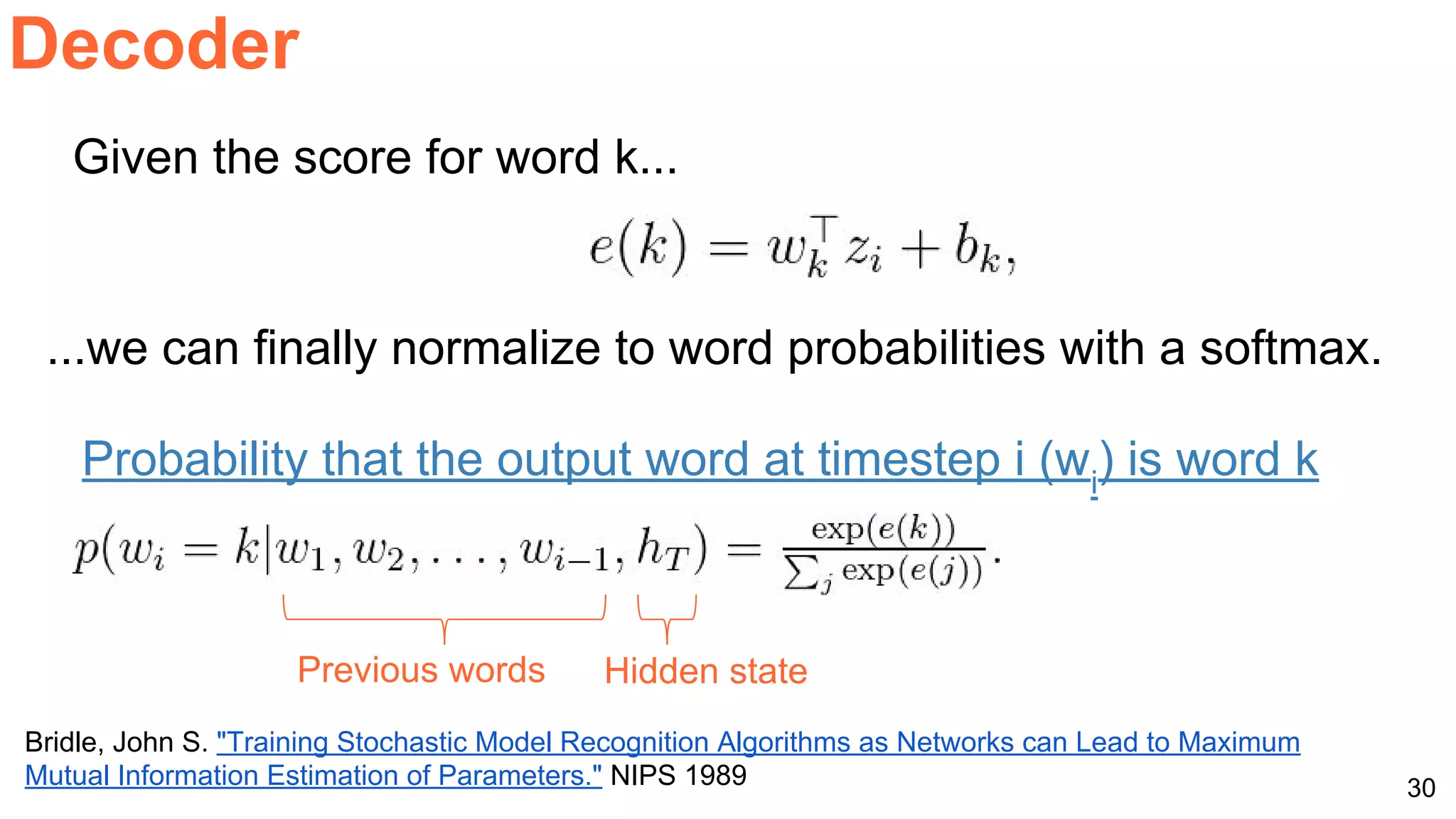
...we can finally normalize to word probabilities with a softmax.
Probability that the output word at timestep i (wi
) is word k
Previous words Hidden state
Given the score for word k...
31
Decoder
Kyunghyun Cho, “Introduction to Neural Machine Translation with GPUs” (2015)
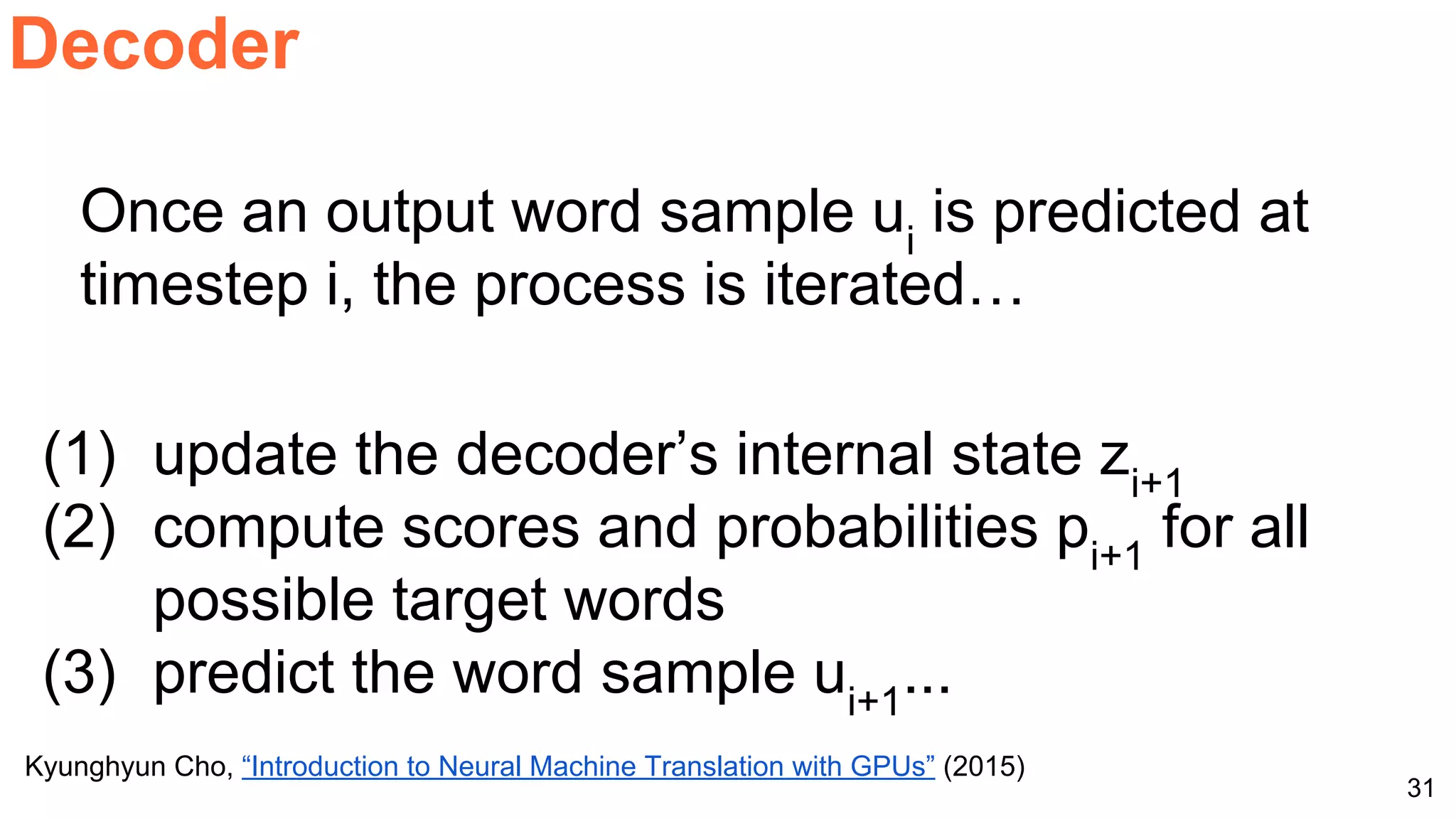
Once an output word sample ui
is predicted at
timestep i, the process is iterated…
(1) update the decoder’s internal state zi+1
(2) compute scores and probabilities pi+1
for all
possible target words
(3) predict the word sample ui+1
...
32
Decoder
Kyunghyun Cho, “Introduction to Neural Machine Translation with GPUs” (2015)
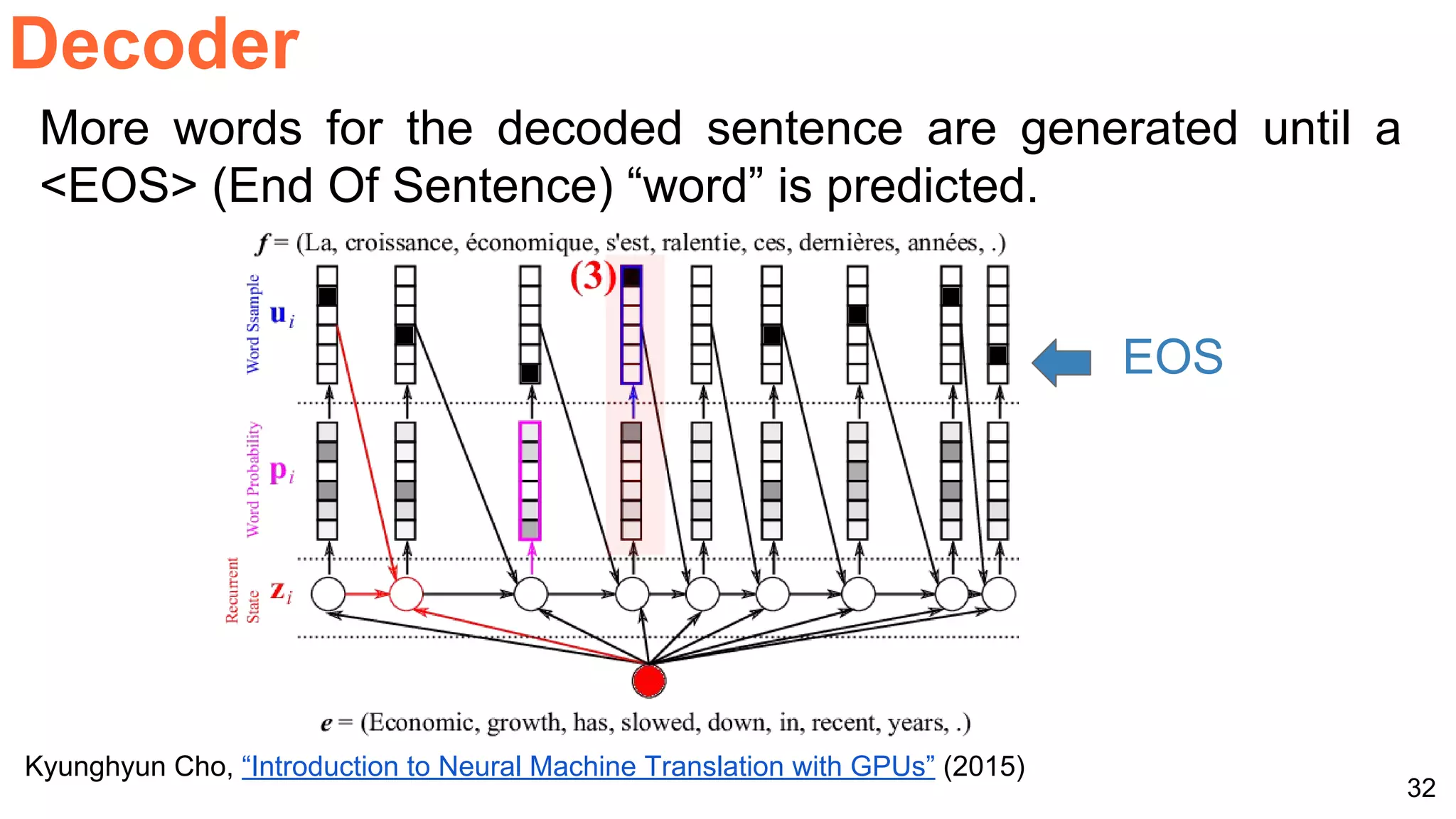
More words for the decoded sentence are generated until a
<EOS> (End Of Sentence) “word” is predicted.
EOS
33
Encoder-Decoder
Kyunghyun Cho, “Introduction to Neural Machine Translation with GPUs” (2015)
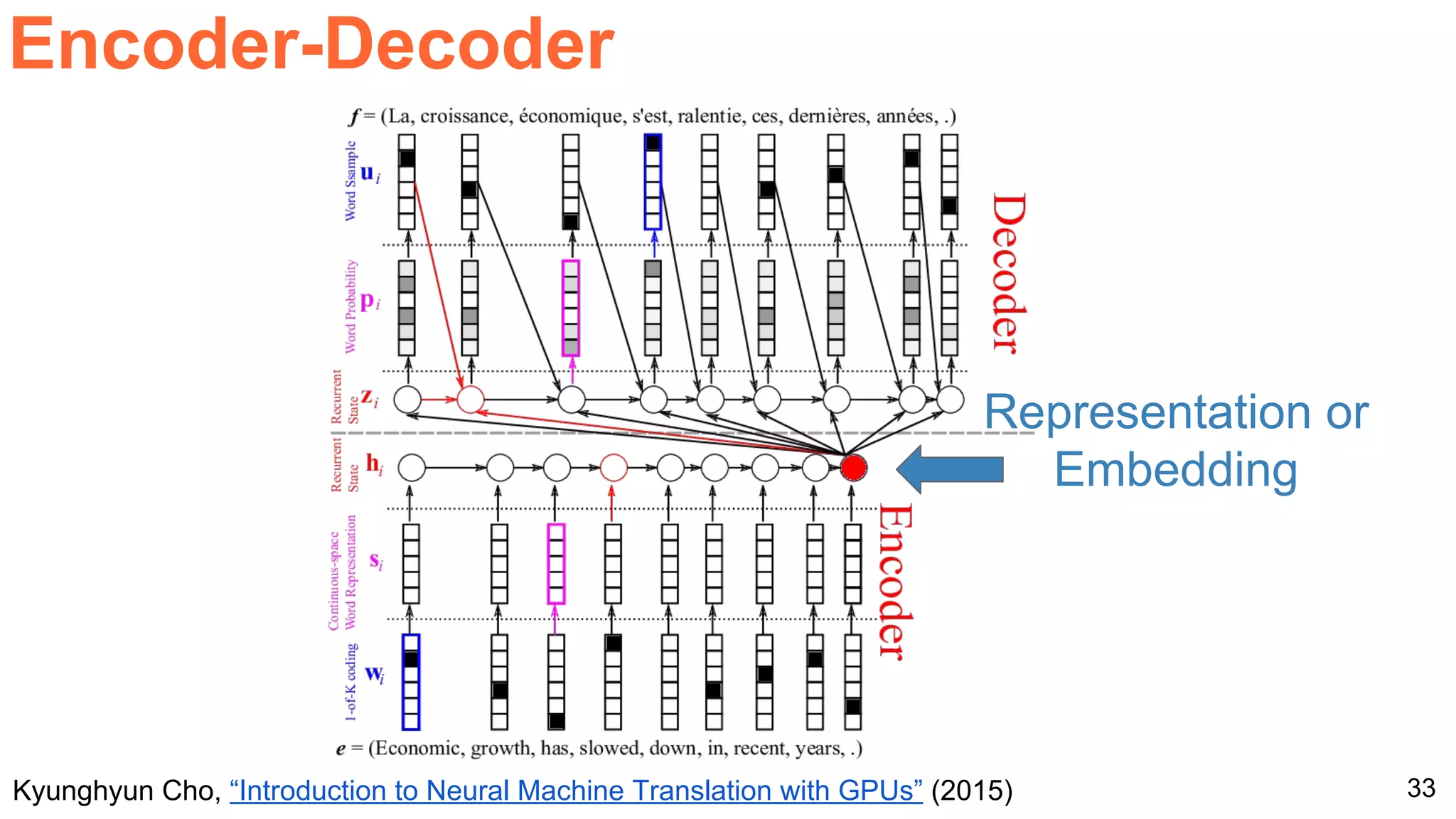
Representation or
Embedding
34
Representation or
Embedding
Encoder Decoder
35
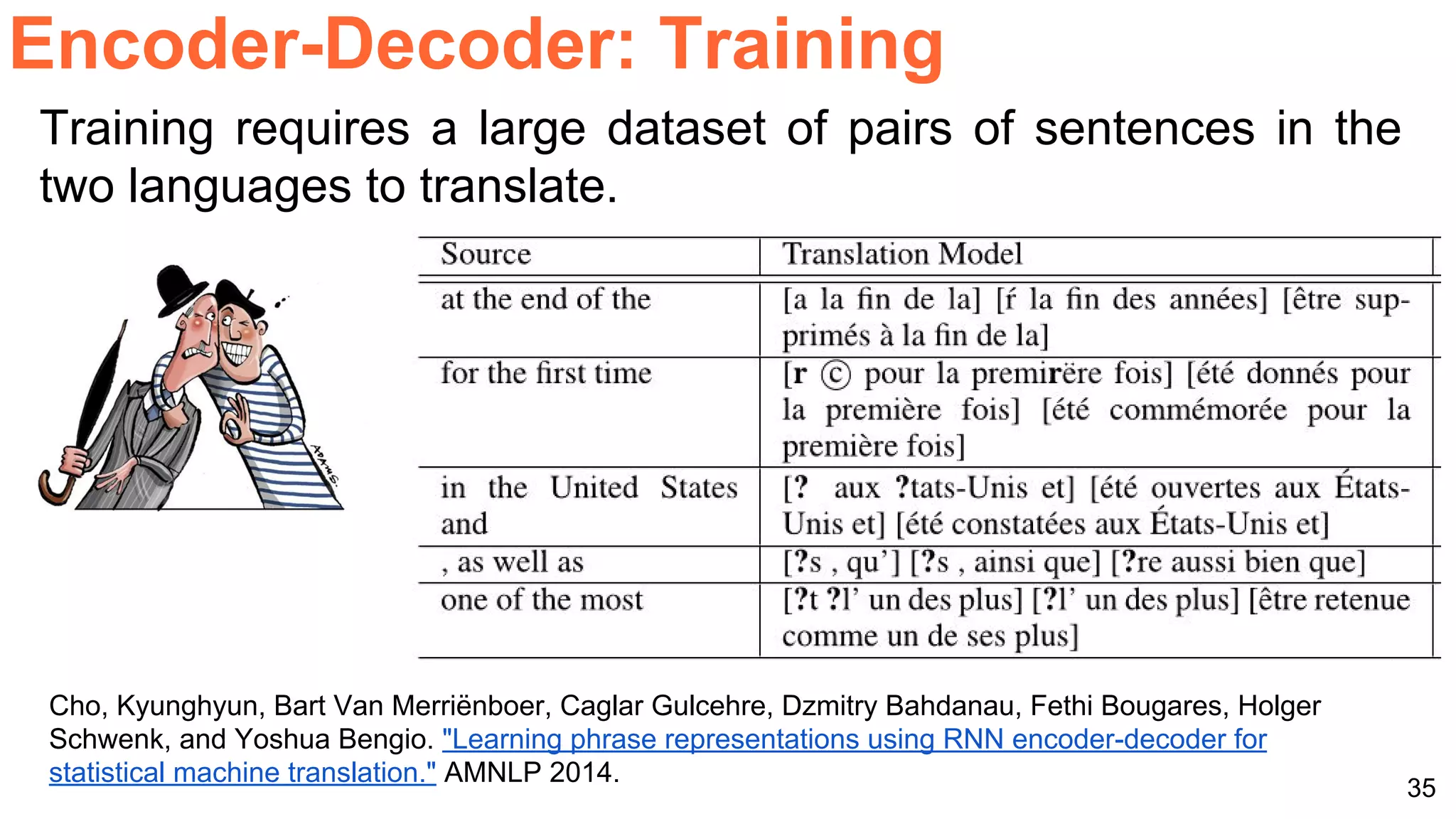
Encoder-Decoder: Training
Training requires a large dataset of pairs of sentences in the
two languages to translate.
Cho, Kyunghyun, Bart Van Merriënboer, Caglar Gulcehre, Dzmitry Bahdanau, Fethi Bougares, Holger
Schwenk, and Yoshua Bengio. "Learning phrase representations using RNN encoder-decoder for
statistical machine translation." AMNLP 2014.
36
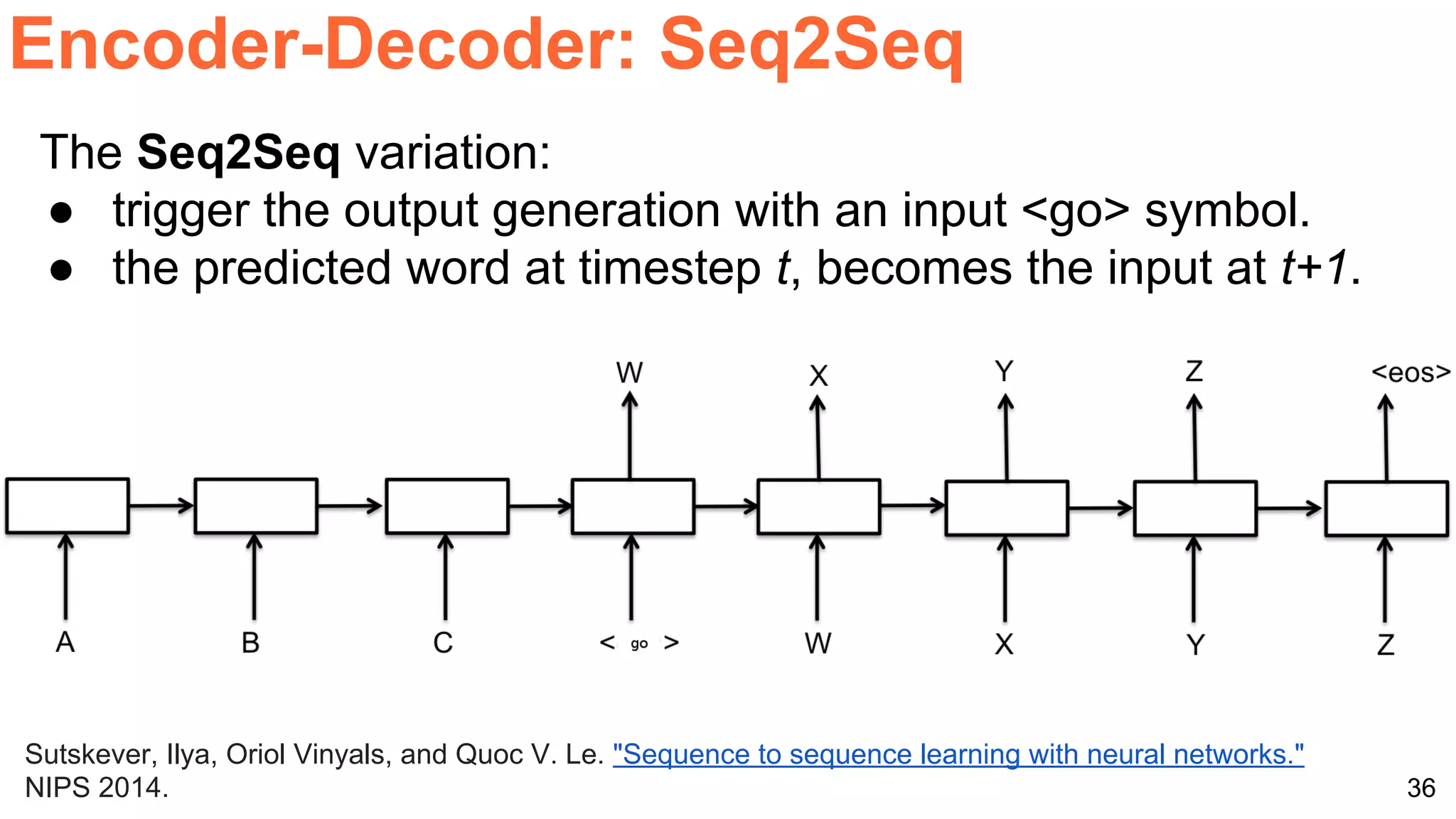
Encoder-Decoder: Seq2Seq
Sutskever, Ilya, Oriol Vinyals, and Quoc V. Le. "Sequence to sequence learning with neural networks."
NIPS 2014.
The Seq2Seq variation:
● trigger the output generation with an input <go> symbol.
● the predicted word at timestep t, becomes the input at t+1.
37
Encoder-Decoder: Seq2Seq
Sutskever, Ilya, Oriol Vinyals, and Quoc V. Le. "Sequence to sequence learning with neural networks."
NIPS 2014.
38
Thanks ! Q&A ?
Follow me at
https://imatge.upc.edu/web/people/xavier-giro
@DocXavi
/ProfessorXavi

Neural Machine Translation (D2L10 Insight@DCU Machine Learning Workshop 2017)

  • 1.
    DEEP LEARNING WORKSHOP Dublin City University 27-28April 2017 Xavier Giro-i-Nieto xavier.giro@upc.edu Associate Professor Universitat Politecnica de Catalunya Technical University of Catalonia Neural Machine Translation Day 2 Lecture 10 #InsightDL2017
  • 2.
  • 3.
  • 4.
  • 5.
    5 Predecents of NeuralMachine Translation Neco, R.P. and Forcada, M.L., 1997, June. Asynchronous translations with recurrent neural nets. In Neural Networks, 1997., International Conference on (Vol. 4, pp. 2535-2540). IEEE.
  • 6.
    6 Encoder-Decoder Representation or Embedding Cho, Kyunghyun,Bart Van Merriënboer, Dzmitry Bahdanau, and Yoshua Bengio. "On the properties of neural machine translation: Encoder-decoder approaches." SSST-8 (2014).
  • 7.
    7 Encoder-Decoder Front View SideView Representation of the sentence Kyunghyun Cho, “Introduction to Neural Machine Translation with GPUs” (2015) Cho, Kyunghyun, Bart Van Merriënboer, Caglar Gulcehre, Dzmitry Bahdanau, Fethi Bougares, Holger Schwenk, and Yoshua Bengio. "Learning phrase representations using RNN encoder-decoder for statistical machine translation." arXiv preprint arXiv:1406.1078 (2014).
  • 8.
  • 9.
    9 Encoder in threesteps Kyunghyun Cho, “Introduction to Neural Machine Translation with GPUs” (2015) (2) (3) (1) One hot encoding (2) Continuous-space Word Representation (word embedding) (3) Sequence summarization
  • 10.
    10 Step 1: One-hotencoding Example: letters. |V| = 30 ‘a’: x = 1 ‘b’: x = 2 ‘c’: x = 3 . . . ‘.’: x = 30
  • 11.
    11 Step 1: One-hotencoding Example: letters. |V| = 30 ‘a’: x = 1 ‘b’: x = 2 ‘c’: x = 3 . . . ‘.’: x = 30 We impose fake range ordering
  • 12.
    12 Step 1: One-hotencoding Example: letters. |V| = 30 ‘a’: xT = [1,0,0, ..., 0] ‘b’: xT = [0,1,0, ..., 0] ‘c’: xT = [0,0,1, ..., 0] . . . ‘.’: xT = [0,0,0, ..., 1]
  • 13.
    13 Step 1: One-hotencoding Example: words. cat: xT = [1,0,0, ..., 0] dog: xT = [0,1,0, ..., 0] . . house: xT = [0,0,0, …,0,1,0,...,0] . . . Number of words, |V| ? B2: 5K C2: 18K LVSR: 50-100K Wikipedia (1.6B): 400K Crawl data (42B): 2M
  • 14.
    14 Step 1: One-hotencoding ● Large dimensionality ● Sparse representation (mostly zeros) ● Blind representation ○ Only operators: ‘!=’ and ‘==’
  • 15.
    15 Step 2: Projectionto word embedding Kyunghyun Cho, “Introduction to Neural Machine Translation with GPUs” (2015) siM Wi E The one-hot is linearly projected to a embedded space of lower dimension with matrix E for learned weights (=fully connected). K K si = Ewi
  • 16.
    16 Word embeddings Figure: ChristopherOlah, Visualizing Representations Mikolov, Tomas, Ilya Sutskever, Kai Chen, Greg S. Corrado, and Jeff Dean. "Distributed representations of words and phrases and their compositionality." NIPS 2013 Step 2: Projection to word embedding
  • 17.
    17 Step 2: Projectionto word embedding GloVe (Stanford)
  • 18.
    18 Step 2: Projectionto word embedding GloVe (Stanford)
  • 19.
    19 Step 2: Projectionto word embedding Figure: TensorFlow tutorial Bengio, Yoshua, Réjean Ducharme, Pascal Vincent, and Christian Jauvin. "A neural probabilistic language model." Journal of machine learning research 3, no. Feb (2003): 1137-1155.
  • 20.
    20 Step 2: Projectionto word embedding Mikolov, Tomas, Ilya Sutskever, Kai Chen, Greg S. Corrado, and Jeff Dean. "Distributed representations of words and phrases and their compositionality." NIPS 2013 the cat climbed a tree Given context: a, cat, the, tree Estimate prob. of climbed Word2Vec: Continuous Bag of Words
  • 21.
    21 Step 2: Projectionto word embedding Mikolov, Tomas, Ilya Sutskever, Kai Chen, Greg S. Corrado, and Jeff Dean. "Distributed representations of words and phrases and their compositionality." NIPS 2013 the cat climbed a tree Given word: climbed Estimate prob. of context words: a, cat, the, tree (It selects randomly the context length, till max of 10 left + 10 right) Word2Vec: Skip-gram
  • 22.
    22 Step 2: Projectionto word embedding ● Represent words using vectors of dimension d (~100 - 500) ● Meaningful (semantic, syntactic) distances ● Dominant research topic in last years in NLP conferences (EMNLP) ● Good embeddings are useful for many other tasks
  • 23.
    23 Pre-trained Word Embeddingsfor 90 languages trained using FastText, on Wikipedia. Step 2: Projection to word embedding
  • 24.
    24 Step 3: Recurrence KyunghyunCho, “Introduction to Neural Machine Translation with GPUs” (2015) hT
  • 25.
    25 Step 3: Recurrence Sequence Figure:Cristopher Olah, “Understanding LSTM Networks” (2015) Activation function could be LSTM, GRU, QRNN, pLSTM...
  • 26.
  • 27.
    27 Decoder Kyunghyun Cho, “Introductionto Neural Machine Translation with GPUs” (2015) The Recurrent State (zi ) of the decoder is determined by: 1) summary vector hT 2) previous output word ui-1 3) previous state zi-1 hT
  • 28.
    28 Decoder Kyunghyun Cho, “Introductionto Neural Machine Translation with GPUs” (2015) With zi ready, we can compute a score e(k) for each word k in the vocabulary with a dot product with the Recurrent State (zi ): RNN internal state Neuron weights for word k (output layer) hT
  • 29.
    29 Decoder A score e(k)is higher if neuron weights for word k (wk ) and the decoder’s internal state zi are similar to each other. Reminder: a dot product computes the length of the projection of one vector onto another. Similar vectors (nearly parallel) the projection is longer than if they are very different (nearly perpendicular) RNN internal state Neuron weights for word k (output layer)
  • 30.
    30 Decoder Bridle, John S."Training Stochastic Model Recognition Algorithms as Networks can Lead to Maximum Mutual Information Estimation of Parameters." NIPS 1989 ...we can finally normalize to word probabilities with a softmax. Probability that the output word at timestep i (wi ) is word k Previous words Hidden state Given the score for word k...
  • 31.
    31 Decoder Kyunghyun Cho, “Introductionto Neural Machine Translation with GPUs” (2015) Once an output word sample ui is predicted at timestep i, the process is iterated… (1) update the decoder’s internal state zi+1 (2) compute scores and probabilities pi+1 for all possible target words (3) predict the word sample ui+1 ...
  • 32.
    32 Decoder Kyunghyun Cho, “Introductionto Neural Machine Translation with GPUs” (2015) More words for the decoded sentence are generated until a <EOS> (End Of Sentence) “word” is predicted. EOS
  • 33.
    33 Encoder-Decoder Kyunghyun Cho, “Introductionto Neural Machine Translation with GPUs” (2015) Representation or Embedding
  • 34.
  • 35.
    35 Encoder-Decoder: Training Training requiresa large dataset of pairs of sentences in the two languages to translate. Cho, Kyunghyun, Bart Van Merriënboer, Caglar Gulcehre, Dzmitry Bahdanau, Fethi Bougares, Holger Schwenk, and Yoshua Bengio. "Learning phrase representations using RNN encoder-decoder for statistical machine translation." AMNLP 2014.
  • 36.
    36 Encoder-Decoder: Seq2Seq Sutskever, Ilya,Oriol Vinyals, and Quoc V. Le. "Sequence to sequence learning with neural networks." NIPS 2014. The Seq2Seq variation: ● trigger the output generation with an input <go> symbol. ● the predicted word at timestep t, becomes the input at t+1.
  • 37.
    37 Encoder-Decoder: Seq2Seq Sutskever, Ilya,Oriol Vinyals, and Quoc V. Le. "Sequence to sequence learning with neural networks." NIPS 2014.
  • 38.
    38 Thanks ! Q&A? Follow me at https://imatge.upc.edu/web/people/xavier-giro @DocXavi /ProfessorXavi