Multi-modal Neural Machine Translation
What is it and why bother?
Iacer Calixto
December 13, 2016
ADAPT Centre
School of Computing
Dublin City University
iacer.calixto@adaptcentre.ie
1
Outline
Introduction
Definitions
Neural MT Architectures
Computer Vision
Multi-modal Neural Machine Translation
Integrating image fully-connected (FC) features
Integrating image convolutional (CONV) features
2
Introduction
Definitions
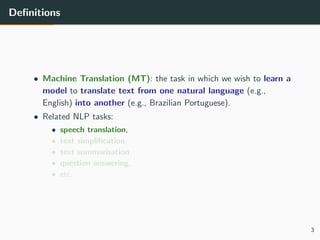
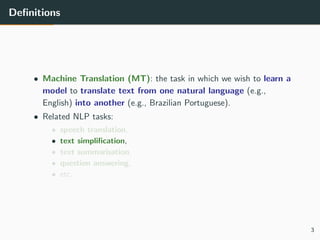
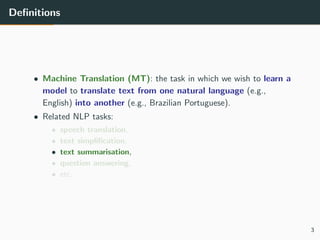
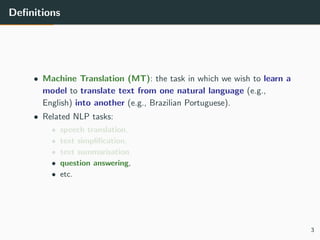
• Machine Translation (MT): the task in which we wish to learn a
model to translate text from one natural language (e.g.,
English) into another (e.g., Brazilian Portuguese).
• Related NLP tasks:
• speech translation,
• text simplification,
• text summarisation,
• question answering,
• etc.
3
Definitions
• Machine Translation (MT): the task in which we wish to learn a
model to translate text from one natural language (e.g.,
English) into another (e.g., Brazilian Portuguese).
• Related NLP tasks:
• speech translation,
• text simplification,
• text summarisation,
• question answering,
• etc.
3
Definitions
• Machine Translation (MT): the task in which we wish to learn a
model to translate text from one natural language (e.g.,
English) into another (e.g., Brazilian Portuguese).
• Related NLP tasks:
• speech translation,
• text simplification,
• text summarisation,
• question answering,
• etc.
3
Definitions
• Machine Translation (MT): the task in which we wish to learn a
model to translate text from one natural language (e.g.,
English) into another (e.g., Brazilian Portuguese).
• Related NLP tasks:
• speech translation,
• text simplification,
• text summarisation,
• question answering,
• etc.
3
Definitions
• Machine Translation (MT): the task in which we wish to learn a
model to translate text from one natural language (e.g.,
English) into another (e.g., Brazilian Portuguese).
• Related NLP tasks:
• speech translation,
• text simplification,
• text summarisation,
• question answering,
• etc.
3
Neural MT Architectures
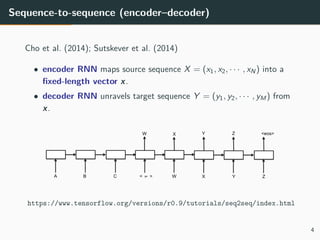
Sequence-to-sequence (encoder–decoder)
Cho et al. (2014); Sutskever et al. (2014)
• encoder RNN maps source sequence X = (x1, x2, · · · , xN ) into a
fixed-length vector x.
• decoder RNN unravels target sequence Y = (y1, y2, · · · , yM ) from
x.
https://www.tensorflow.org/versions/r0.9/tutorials/seq2seq/index.html
4
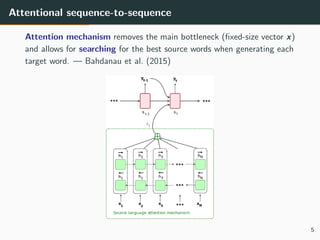
Attentional sequence-to-sequence
Attention mechanism removes the main bottleneck (fixed-size vector x)
and allows for searching for the best source words when generating each
target word. — Bahdanau et al. (2015)
5
Computer Vision
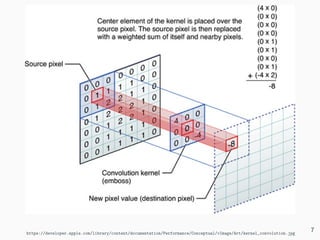
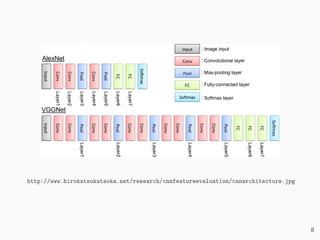
• Computer Vision: how to make machines understand images.
[Krizhevsky,Sutskever,Hinton2012] 6
https://developer.apple.com/library/content/documentation/Performance/Conceptual/vImage/Art/kernel_convolution.jpg
7
http://www.hirokatsukataoka.net/research/cnnfeatureevaluation/cnnarchitecture.jpg
8
Multi-modal Neural Machine
Translation
Use cases?
Few use cases:
• news articles;
• picture captions (Facebook?);
• e-commerce product descriptions;
• etc.
9
Use cases?
Few use cases:
• news articles;
• picture captions (Facebook?);
• e-commerce product descriptions;
• etc.
9
Use cases?
Few use cases:
• news articles;
• picture captions (Facebook?);
• e-commerce product descriptions;
• etc.
9
Use cases?
Few use cases:
• news articles;
• picture captions (Facebook?);
• e-commerce product descriptions;
• etc.
9
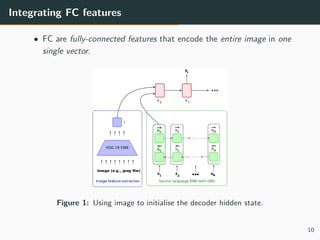
Integrating FC features
• FC are fully-connected features that encode the entire image in one
single vector.
Figure 1: Using image to initialise the decoder hidden state.
10
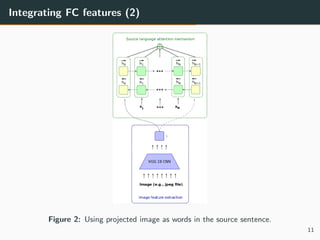
Integrating FC features (2)
Figure 2: Using projected image as words in the source sentence.
11
Integrating FC features (3)
Figure 3: Attention-based Multimodal NMT [Huang et al. (2016)]
12
Integrating FC features (4)
Figure 4: Attention-based Multimodal NMT [Huang et al. (2016)]
13
Integrating CONV features
• CONV are convolutional features that encode different areas (i.e.,
patches) of the image separately.
Figure 5: Doubly-attentive decoder with two independent attention
mechanisms. [Calixto et al. (2016)]
14
Some numbers, why not?
Figure 6: BLEU and METEOR scores. [Huang et al. (2016)]
Model BLEU METEOR
Doubly-attentive decoder 36.2 53.1
15
Conclusions
• broad overview of the possibilities;
• few published results;
• what’s next?
• possible extrapolations of the original formulation:
• translating video subtitles;
• visual question answering;
16
Conclusions
• broad overview of the possibilities;
• few published results;
• what’s next?
• possible extrapolations of the original formulation:
• translating video subtitles;
• visual question answering;
16
Conclusions
• broad overview of the possibilities;
• few published results;
• what’s next?
• possible extrapolations of the original formulation:
• translating video subtitles;
• visual question answering;
16
Conclusions
• broad overview of the possibilities;
• few published results;
• what’s next?
• possible extrapolations of the original formulation:
• translating video subtitles;
• visual question answering;
16
Conclusions
• broad overview of the possibilities;
• few published results;
• what’s next?
• possible extrapolations of the original formulation:
• translating video subtitles;
• visual question answering;
16
References I
References
Bahdanau, D., Cho, K., and Bengio, Y. (2015). Neural machine
translation by jointly learning to align and translate. In International
Conference on Learning Representations. ICLR 2015.
Calixto, I., Elliott, D., and Frank, S. (2016). Dcu-uva multimodal mt
system report. In Proceedings of the First Conference on Machine
Translation, pages 634–638, Berlin, Germany. Association for
Computational Linguistics.
Cho, K., van Merri¨enboer, B., Bahdanau, D., and Bengio, Y. (2014). On
the properties of neural machine translation: Encoder–decoder
approaches. Syntax, Semantics and Structure in Statistical
Translation, page 103.
17
References II
Huang, P.-Y., Liu, F., Shiang, S.-R., Oh, J., and Dyer, C. (2016).
Attention-based multimodal neural machine translation. In
Proceedings of the First Conference on Machine Translation, pages
639–645, Berlin, Germany. Association for Computational Linguistics.
Sutskever, I., Vinyals, O., and Le, Q. V. (2014). Sequence to sequence
learning with neural networks. In Advances in Neural Information
Processing Systems, pages 3104–3112.
18
Questions?
Thank you!
18

Multi-modal Neural Machine Translation - Iacer Calixto

  • 1.
    Multi-modal Neural MachineTranslation What is it and why bother? Iacer Calixto December 13, 2016 ADAPT Centre School of Computing Dublin City University iacer.calixto@adaptcentre.ie 1
  • 2.
    Outline Introduction Definitions Neural MT Architectures ComputerVision Multi-modal Neural Machine Translation Integrating image fully-connected (FC) features Integrating image convolutional (CONV) features 2
  • 3.
  • 4.
    Definitions • Machine Translation(MT): the task in which we wish to learn a model to translate text from one natural language (e.g., English) into another (e.g., Brazilian Portuguese). • Related NLP tasks: • speech translation, • text simplification, • text summarisation, • question answering, • etc. 3
  • 5.
    Definitions • Machine Translation(MT): the task in which we wish to learn a model to translate text from one natural language (e.g., English) into another (e.g., Brazilian Portuguese). • Related NLP tasks: • speech translation, • text simplification, • text summarisation, • question answering, • etc. 3
  • 6.
    Definitions • Machine Translation(MT): the task in which we wish to learn a model to translate text from one natural language (e.g., English) into another (e.g., Brazilian Portuguese). • Related NLP tasks: • speech translation, • text simplification, • text summarisation, • question answering, • etc. 3
  • 7.
    Definitions • Machine Translation(MT): the task in which we wish to learn a model to translate text from one natural language (e.g., English) into another (e.g., Brazilian Portuguese). • Related NLP tasks: • speech translation, • text simplification, • text summarisation, • question answering, • etc. 3
  • 8.
    Definitions • Machine Translation(MT): the task in which we wish to learn a model to translate text from one natural language (e.g., English) into another (e.g., Brazilian Portuguese). • Related NLP tasks: • speech translation, • text simplification, • text summarisation, • question answering, • etc. 3
  • 9.
  • 10.
    Sequence-to-sequence (encoder–decoder) Cho etal. (2014); Sutskever et al. (2014) • encoder RNN maps source sequence X = (x1, x2, · · · , xN ) into a fixed-length vector x. • decoder RNN unravels target sequence Y = (y1, y2, · · · , yM ) from x. https://www.tensorflow.org/versions/r0.9/tutorials/seq2seq/index.html 4
  • 11.
    Attentional sequence-to-sequence Attention mechanismremoves the main bottleneck (fixed-size vector x) and allows for searching for the best source words when generating each target word. — Bahdanau et al. (2015) 5
  • 12.
  • 13.
    • Computer Vision:how to make machines understand images. [Krizhevsky,Sutskever,Hinton2012] 6
  • 14.
  • 15.
  • 16.
  • 17.
    Use cases? Few usecases: • news articles; • picture captions (Facebook?); • e-commerce product descriptions; • etc. 9
  • 18.
    Use cases? Few usecases: • news articles; • picture captions (Facebook?); • e-commerce product descriptions; • etc. 9
  • 19.
    Use cases? Few usecases: • news articles; • picture captions (Facebook?); • e-commerce product descriptions; • etc. 9
  • 20.
    Use cases? Few usecases: • news articles; • picture captions (Facebook?); • e-commerce product descriptions; • etc. 9
  • 21.
    Integrating FC features •FC are fully-connected features that encode the entire image in one single vector. Figure 1: Using image to initialise the decoder hidden state. 10
  • 22.
    Integrating FC features(2) Figure 2: Using projected image as words in the source sentence. 11
  • 23.
    Integrating FC features(3) Figure 3: Attention-based Multimodal NMT [Huang et al. (2016)] 12
  • 24.
    Integrating FC features(4) Figure 4: Attention-based Multimodal NMT [Huang et al. (2016)] 13
  • 25.
    Integrating CONV features •CONV are convolutional features that encode different areas (i.e., patches) of the image separately. Figure 5: Doubly-attentive decoder with two independent attention mechanisms. [Calixto et al. (2016)] 14
  • 26.
    Some numbers, whynot? Figure 6: BLEU and METEOR scores. [Huang et al. (2016)] Model BLEU METEOR Doubly-attentive decoder 36.2 53.1 15
  • 27.
    Conclusions • broad overviewof the possibilities; • few published results; • what’s next? • possible extrapolations of the original formulation: • translating video subtitles; • visual question answering; 16
  • 28.
    Conclusions • broad overviewof the possibilities; • few published results; • what’s next? • possible extrapolations of the original formulation: • translating video subtitles; • visual question answering; 16
  • 29.
    Conclusions • broad overviewof the possibilities; • few published results; • what’s next? • possible extrapolations of the original formulation: • translating video subtitles; • visual question answering; 16
  • 30.
    Conclusions • broad overviewof the possibilities; • few published results; • what’s next? • possible extrapolations of the original formulation: • translating video subtitles; • visual question answering; 16
  • 31.
    Conclusions • broad overviewof the possibilities; • few published results; • what’s next? • possible extrapolations of the original formulation: • translating video subtitles; • visual question answering; 16
  • 32.
    References I References Bahdanau, D.,Cho, K., and Bengio, Y. (2015). Neural machine translation by jointly learning to align and translate. In International Conference on Learning Representations. ICLR 2015. Calixto, I., Elliott, D., and Frank, S. (2016). Dcu-uva multimodal mt system report. In Proceedings of the First Conference on Machine Translation, pages 634–638, Berlin, Germany. Association for Computational Linguistics. Cho, K., van Merri¨enboer, B., Bahdanau, D., and Bengio, Y. (2014). On the properties of neural machine translation: Encoder–decoder approaches. Syntax, Semantics and Structure in Statistical Translation, page 103. 17
  • 33.
    References II Huang, P.-Y.,Liu, F., Shiang, S.-R., Oh, J., and Dyer, C. (2016). Attention-based multimodal neural machine translation. In Proceedings of the First Conference on Machine Translation, pages 639–645, Berlin, Germany. Association for Computational Linguistics. Sutskever, I., Vinyals, O., and Le, Q. V. (2014). Sequence to sequence learning with neural networks. In Advances in Neural Information Processing Systems, pages 3104–3112. 18
  • 34.