Downloaded 22 times
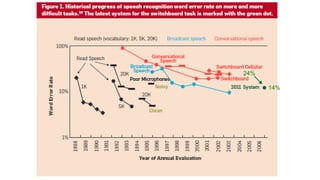
![Microsoft’s historic
speech breakthrough
• Microsoft 2016 research system for
conversational speech recognition
• 5.9% word-error rate
• enabled by CNTK’s multi-server scalability
[W. Xiong, J. Droppo, X. Huang, F. Seide, M. Seltzer, A. Stolcke,
D. Yu, G. Zweig: “Achieving Human Parity in Conversational
Speech Recognition,” https://arxiv.org/abs/1610.05256]](https://image.slidesharecdn.com/20161130cognitivetoolkit-161130233503/85/html5j-7-Microsoft-Cognitive-Toolkit-CNTK-Overview-11-320.jpg)
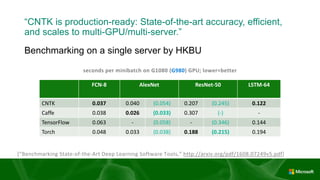
![“CNTK is production-ready: State-of-the-art accuracy, efficient,
and scales to multi-GPU/multi-server.”
Theano only supports 1 GPU
Achieved with 1-bit gradient quantization
algorithm
0
10000
20000
30000
40000
50000
60000
70000
80000
CNTK Theano TensorFlow Torch 7 Caffe
speed comparison (samples/second), higher = better
[note: December 2015]
1 GPU 1 x 4 GPUs 2 x 4 GPUs (8 GPUs)](https://image.slidesharecdn.com/20161130cognitivetoolkit-161130233503/85/html5j-7-Microsoft-Cognitive-Toolkit-CNTK-Overview-26-320.jpg)
![[html5jロボット部 第7回勉強会] Microsoft Cognitive Toolkit (CNTK) Overview](https://image.slidesharecdn.com/20161130cognitivetoolkit-161130233503/85/html5j-7-Microsoft-Cognitive-Toolkit-CNTK-Overview-32-320.jpg)
![[html5jロボット部 第7回勉強会] Microsoft Cognitive Toolkit (CNTK) Overview](https://image.slidesharecdn.com/20161130cognitivetoolkit-161130233503/85/html5j-7-Microsoft-Cognitive-Toolkit-CNTK-Overview-33-320.jpg)

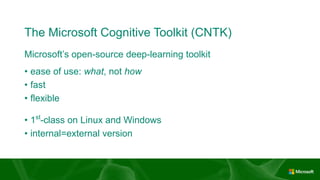
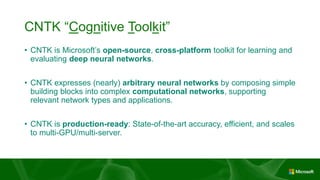
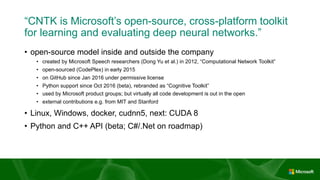
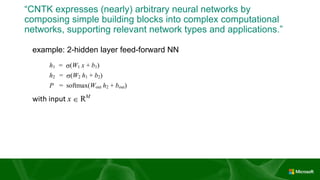
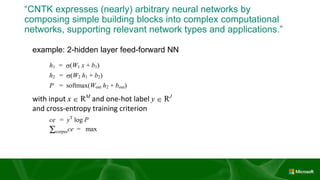
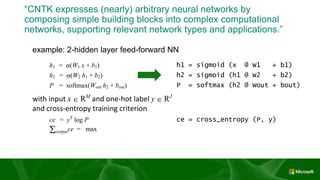
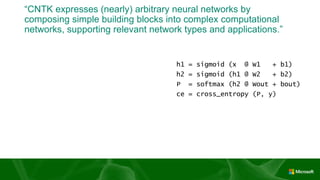
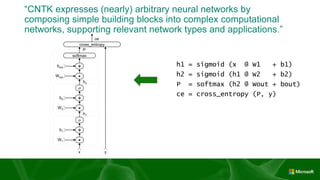
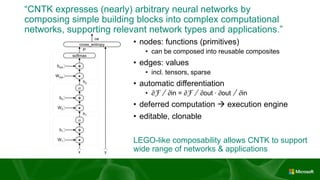
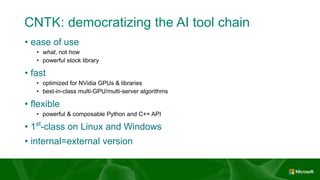
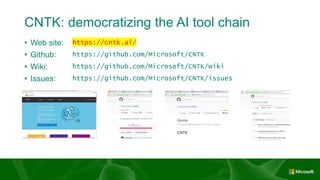
The Microsoft Cognitive Toolkit (CNTK) is Microsoft's open-source deep learning toolkit. It expresses neural networks as computational graphs composed of simple building blocks, supporting various network types and applications. CNTK is production-ready with state-of-the-art accuracy, efficiency, and scalability to multiple GPUs and servers.
![[Connect(); // Japan 2016] Microsoft の AI 開発最新アップデート ~ Cognitive Services からA...](https://cdn.slidesharecdn.com/ss_thumbnails/20161121connectjapanmicrosoftai-161121075407-thumbnail.jpg?width=640&height=640&fit=bounds)
![[AI07] Revolutionizing Image Processing with Cognitive Toolkit](https://cdn.slidesharecdn.com/ss_thumbnails/ai07-170602095346-thumbnail.jpg?width=640&height=640&fit=bounds)


![[teratail Study ~機械学習編#2~] Microsoft AzureのAI関連サービス](https://cdn.slidesharecdn.com/ss_thumbnails/20161219teratail-161219114731-thumbnail.jpg?width=640&height=640&fit=bounds)
![[ビッグデータオールスターズ] クラウドサービス最新情報 機械学習/AIでこんなことまでできるんです! (Microsoft編)](https://cdn.slidesharecdn.com/ss_thumbnails/20161218dotsbigdataazureai-161218054508-thumbnail.jpg?width=640&height=640&fit=bounds)
![[Azure Deep Dive] APIエコノミーに向けて ~Azure API ManagementによるAPIの公開と管理~ (2016/12/16)](https://cdn.slidesharecdn.com/ss_thumbnails/20161216azuredeepdiveazureapimanagement-161216082914-thumbnail.jpg?width=640&height=640&fit=bounds)
![[Azure Council Experts (ACE) 第20回定例会] Microsoft Azureアップデート情報 (2016/10/14-201...](https://cdn.slidesharecdn.com/ss_thumbnails/20161209aceazureupdate-161209114149-thumbnail.jpg?width=640&height=640&fit=bounds)
![[Developers Festa Sapporo 2016] Microsoft Azureでのアプリ開発 ~コンテナー、マイクロサービス、サーバーレス...](https://cdn.slidesharecdn.com/ss_thumbnails/20161111devfestasapporoazure-161111035424-thumbnail.jpg?width=640&height=640&fit=bounds)
![[Azure Council Experts (ACE) 第21回定例会] Microsoft Azureアップデート情報 (2016/12/09-201...](https://cdn.slidesharecdn.com/ss_thumbnails/20170217aceazureupdate-170217102543-thumbnail.jpg?width=640&height=640&fit=bounds)
![[Developers Summit 2017] MicrosoftのAI開発機能/サービス](https://cdn.slidesharecdn.com/ss_thumbnails/20170216devsumiai-170302021003-thumbnail.jpg?width=640&height=640&fit=bounds)


![[Azure Council Experts (ACE) 第10回定例会] Microsoft Azureアップデート情報 (2015/02/19-201...](https://cdn.slidesharecdn.com/ss_thumbnails/20150416aceazureupdate-150416040639-conversion-gate01-thumbnail.jpg?width=640&height=640&fit=bounds)
![[Azure Council Experts (ACE) 第16回定例会] Microsoft Azureアップデート情報 (2016/02/19-201...](https://cdn.slidesharecdn.com/ss_thumbnails/20160415aceazureupdate-160419104338-thumbnail.jpg?width=640&height=640&fit=bounds)
![[Java Festa in 札幌 2012] Windows Azure を活用した Windows 8 アプリケーション開発](https://cdn.slidesharecdn.com/ss_thumbnails/20121005javafestaazurew8v5share-121008214558-phpapp02-thumbnail.jpg?width=640&height=640&fit=bounds)
![[API Meetup Tokyo #7 ~PaaSとAPIスペシャル~] AzureでMobile / Webアプリのサーバー側をAPI化 (Azure...](https://cdn.slidesharecdn.com/ss_thumbnails/20150327apimeetupazureappservice-150405211829-conversion-gate01-thumbnail.jpg?width=640&height=640&fit=bounds)
![[Azure Council Experts (ACE) 第12回定例会] Microsoft Azureアップデート情報 (2015/06/18-201...](https://cdn.slidesharecdn.com/ss_thumbnails/20150820aceazureupdatemin-150820090528-lva1-app6891-thumbnail.jpg?width=640&height=640&fit=bounds)


![[Machine Learning 15minutes! Broadcast #67] Azure AI - Build 2022 Updates and...](https://cdn.slidesharecdn.com/ss_thumbnails/20220625ml15minazureaibuild2022updates-220626102255-c87d66ae-thumbnail.jpg?width=640&height=640&fit=bounds)
![[Machine Learning 15minutes! #61] Azure OpenAI Service](https://cdn.slidesharecdn.com/ss_thumbnails/20211127ml15minazureopenaiservice-211206154233-thumbnail.jpg?width=640&height=640&fit=bounds)
![[第50回 Machine Learning 15minutes! Broadcast] Azure Machine Learning - Ignite ...](https://cdn.slidesharecdn.com/ss_thumbnails/20201205ml15minazuremlignite-201205101214-thumbnail.jpg?width=640&height=640&fit=bounds)
![[Developers Festa Sapporo 2020] Microsoft/GitHubが提供するDeveloper Cloud (Develop...](https://cdn.slidesharecdn.com/ss_thumbnails/20201118devfestamicrosoftgithub-201205093137-thumbnail.jpg?width=640&height=640&fit=bounds)
![[第2回 Azure Cosmos DB 勉強会] Data modelling and partitioning in Azure Cosmos DB ...](https://cdn.slidesharecdn.com/ss_thumbnails/20200913jcdugcosmosdbdatamodeling-200913062051-thumbnail.jpg?width=640&height=640&fit=bounds)
![[第45回 Machine Learning 15minutes! Broadcast] Azure AI - Build 2020 Updates](https://cdn.slidesharecdn.com/ss_thumbnails/20200530ml15minazureai-200602091349-thumbnail.jpg?width=640&height=640&fit=bounds)
![[第43回 Machine Learning 15minutes! × 2] Azure AI Updates](https://cdn.slidesharecdn.com/ss_thumbnails/20200125ml15minazureai-200125062441-thumbnail.jpg?width=640&height=640&fit=bounds)
![[Developers Festa Sapporo 2019] Azure Updates - Ignite 2019](https://cdn.slidesharecdn.com/ss_thumbnails/20191113devfestaazureignite-191114112700-thumbnail.jpg?width=640&height=640&fit=bounds)
![[Serverless OpenHack Tokyo] Azure Serverless (Japanese)](https://cdn.slidesharecdn.com/ss_thumbnails/20191112sohtokyokeynoteja-191114031236-thumbnail.jpg?width=640&height=640&fit=bounds)
![[Serverless OpenHack Tokyo] Azure Serverless (English)](https://cdn.slidesharecdn.com/ss_thumbnails/20191112sohtokyokeynoteen-191114030923-thumbnail.jpg?width=640&height=640&fit=bounds)
![[Azure Council Experts (ACE) 第37回定例会] Microsoft Azureアップデート情報 (2019/08/22-201...](https://cdn.slidesharecdn.com/ss_thumbnails/20191018aceazureupdate-191021072729-thumbnail.jpg?width=640&height=640&fit=bounds)
![[db tech showcase Tokyo 2019] Azure Cosmos DB Deep Dive ~ Partitioning, Globa...](https://cdn.slidesharecdn.com/ss_thumbnails/20190927dbtechcosmosdb-190930083325-thumbnail.jpg?width=640&height=640&fit=bounds)


