NETWORKING
Network
 A Network is an Interconnection of devices
 Networking is the communication between
the interconnected devices basically to
share the network resources.
Types of Networks
 Local Area Network
 Wide Area Network
 Metropolitan Area Network
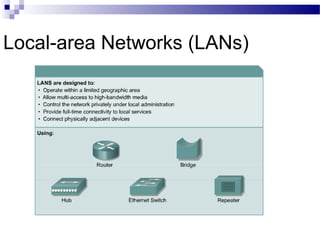
Local-area Networks (LANs)
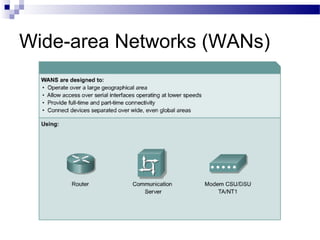
Wide-area Networks (WANs)
Network devices
 Hub
 Switch
 Router
HUB
A hub is a device into which you can connect
all devices on a home network so that they
can talk together.
Hubs physically cross-connect all their ports
with one another which causes all traffic sent
from a server to the hub to be blurted out to
all other servers connected to that hub
whether they are the intended recipient or
not.
Switch
A switch is also a device into which you can
connect all devices on a home network so
that they can talk together.
Unlike a hub, traffic sent from Server A to
Server B will only be received by Server B.
The only exception is broadcast traffic which
is blurted out to all the servers
simultaneously.
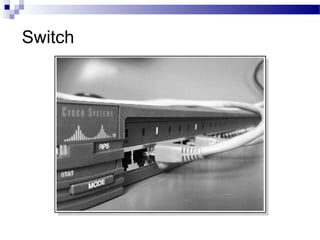
Switch
Router
 Router is device which is used to enable
communication possible between two or
more different networks present in
different geographical locations.
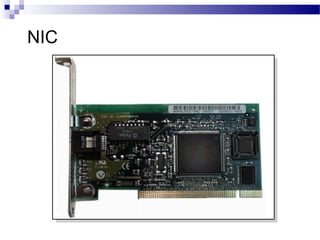
NIC
 The Network interface card is frequently
called a NIC. Currently, the most
common types of NIC used in the home
are Ethernet and wireless Ethernet
cards.
NIC
Types Of Cables
 Coaxial Cable
 Twisted Pair able
 Fiber Optic Cable
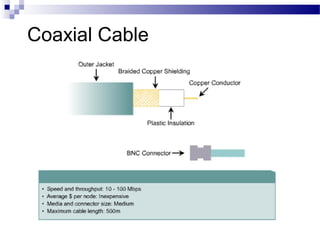
Coaxial Cable
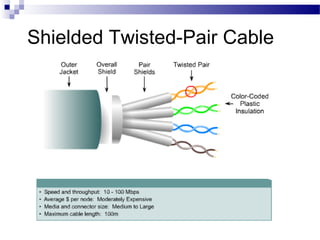
Shielded Twisted-Pair Cable
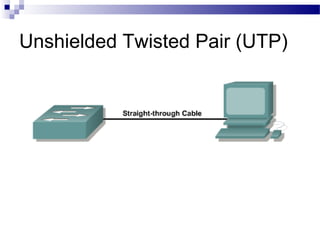
Unshielded Twisted Pair (UTP)
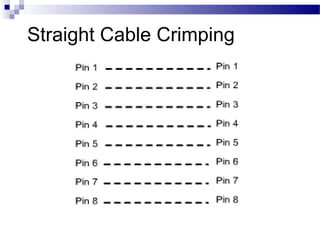
Straight Cable Crimping
Unshielded Twisted Pair (UTP)
Cross Cable Crimping
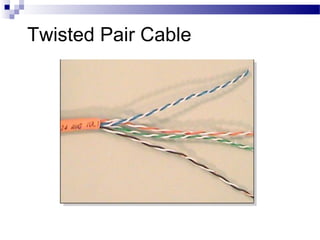
Twisted Pair Cable
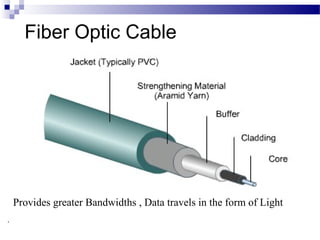
Fiber Optic Cable
Provides greater Bandwidths , Data travels in the form of Light
Network Topologies
 Star
 Bus
 Ring
 Mesh
Network Topology
Logical Topologies
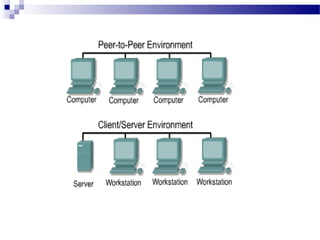
 Workgroup Model or Peer-To-Peer
Model
 Domain Model or Client/Server Model
Advantages
Disadvantages
THAN YOU
 BY :
 MANIROOP.B
 15345A0428

Networking