

VIRTUAL
PRIVATE
NETWORK


PREPARED BY:
Jigar B Navadiya
(D11CE144)
VIRTUAL PRIVATE NETWORK
 Definition
           and introductory notes
     VPN is the network which uses open
 distributed infrastructure of the internet
 to transmit data between corporate sites.
NEED FOR DEVELOPING VPN
 Remote  employees interested to access
  database of corporations.
 Corporate sites developing new relations.
 Increasing growth of the corporation.
VPN RESOLVES THE
PROBLEM
 Itprovides flexibility and scalability
 Cost advantage.
 Makes free from maintenance and training.
WORKING OF VPN
 STEP1…

 STEP2…

 STEP3…
 STEP4…
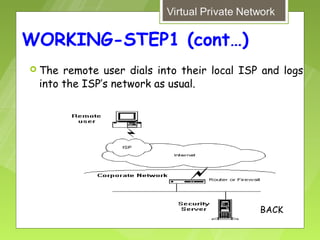
WORKING-STEP1 (cont…)
 The remote user dials into their local ISP and logs
 into the ISP’s network as usual.


                                            BACK
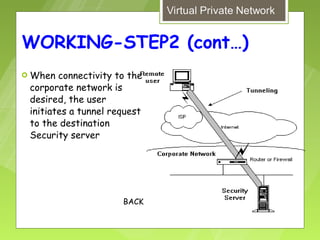
WORKING-STEP2 (cont…)
 When  connectivity to the
 corporate network is
 desired, the user
 initiates a tunnel request
 to the destination
 Security server


                      BACK
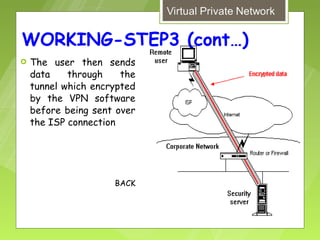
WORKING-STEP3 (cont…)
   The user then sends
    data    through    the
    tunnel which encrypted
    by the VPN software
    before being sent over
    the ISP connection


                     BACK
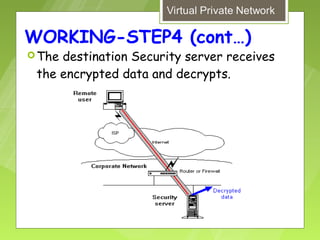
WORKING-STEP4 (cont…)
 Thedestination Security server receives
 the encrypted data and decrypts.
TYPES OF VPN
 VLL-Virtual   leased lines.
 VPRN-virtual   private routed network.
 VPDN-virtual   private dial-up network.
 VPLS-virtual   private LAN segments.
 Intranet   VPN.
 Extranet   VPN.
 Remote   access VPN.
Virtual Private Network


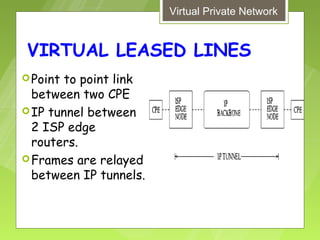
 VIRTUAL LEASED LINES
 Point to point link
  between two CPE
 IP tunnel between
  2 ISP edge
  routers.
 Frames are relayed
  between IP tunnels.
Virtual Private Network

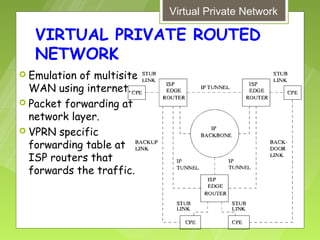
   VIRTUAL PRIVATE ROUTED
   NETWORK
 Emulation of multisite
  WAN using internet.
 Packet forwarding at
  network layer.
 VPRN specific
  forwarding table at
  ISP routers that
  forwards the traffic.
VIRTUAL PRIVATE DIAL-UP
NETWORK
 On demand tunnel between remote user and
  corporate sites.
 There are possible 2 tunnels.

1… compulsory tunnel.
2… voluntary tunnel.
Virtual Private Network


COMPULSORY TUNNEL
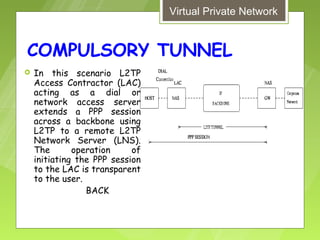
   In this scenario L2TP
    Access Contractor (LAC)
    acting as a dial or
    network access server
    extends a PPP session
    across a backbone using
    L2TP to a remote L2TP
    Network Server (LNS).
    The       operation     of
    initiating the PPP session
    to the LAC is transparent
    to the user.
                 BACK
Virtual Private Network


VOLUNTARY TUNNEL
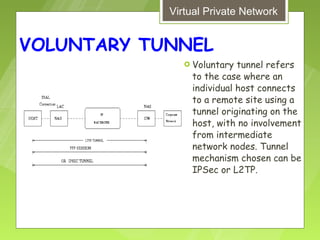
                Voluntary tunnel refers
                to the case where an
                individual host connects
                to a remote site using a
                tunnel originating on the
                host, with no involvement
                from intermediate
                network nodes. Tunnel
                mechanism chosen can be
                IPSec or L2TP.
VIRTUAL PRIVATE LAN
SEGMENTS
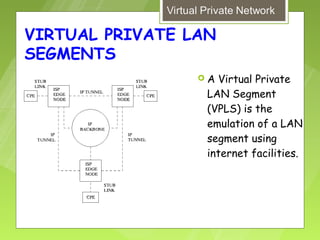
                 A Virtual Private
                  LAN Segment
                  (VPLS) is the
                  emulation of a LAN
                  segment using
                  internet facilities.
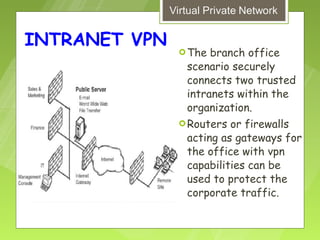
INTRANET VPN
                The branch office
                scenario securely
                connects two trusted
                intranets within the
                organization.
                Routers or firewalls
                acting as gateways for
                the office with vpn
                capabilities can be
                used to protect the
                corporate traffic.
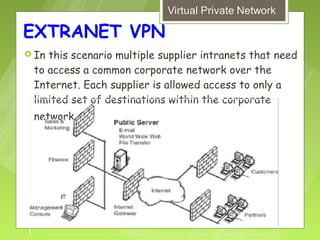
EXTRANET VPN
 Inthis scenario multiple supplier intranets that need
 to access a common corporate network over the
 Internet. Each supplier is allowed access to only a
 limited set of destinations within the corporate
 network.
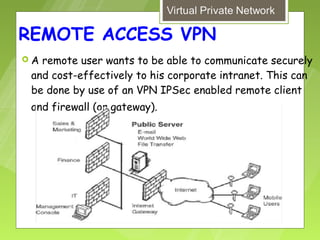
REMOTE ACCESS VPN
A remote user wants to be able to communicate securely
 and cost-effectively to his corporate intranet. This can
 be done by use of an VPN IPSec enabled remote client
 and firewall (or gateway).
VPN PROTOCOLS
 1. PPTP (Point-to-point tunneling
  protocol)
 2.   IPsec (IP security).
 3.   L2TP (layer2 transmission protocol).
LAYER2 TRANSMISSION
PROTOCOL


 What is actually the layer two transmission
 protocol ???


 NEXT
POINT TO POINT
TUNNELING PROTOCOL
 Introduction   to PPTP.
 How   actually PPTP works ???
 Security   provided by PPTP.
 Advantages   of PPTP.
 Disadvantages   of PPTP.


 BACK
INTERNET PROTOCOL
SECURITY
 Introduction   to IP security.
 Features   of IP security.
 Types   of IPsec protocols.
 Types   of modes used in IPsec.


 BACK
SECURITY OF VPN

 Hardware   solution
 Remote   access control.
CERTAIN H/W AND S/W
SPECIFICATIONS…
  Desktop software client for each remote
     user
 Dedicated hardware such as a VPN
  Concentrator or Secure
 PIX Firewall
 Dedicated VPN server for dial-up services
 NAS (Network Access Server) used by
  service provider for
 remote user VPN access
Virtual Private Network


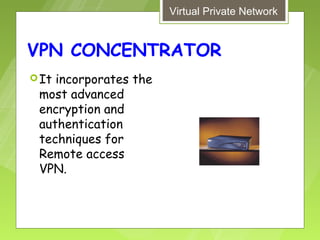
VPN CONCENTRATOR
 Itincorporates the
 most advanced
 encryption and
 authentication
 techniques for
 Remote access
 VPN.
Virtual Private Network


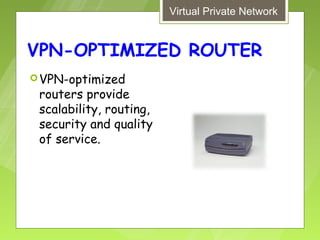
VPN-OPTIMIZED ROUTER
 VPN-optimized
 routers provide
 scalability, routing,
 security and quality
 of service.
Virtual Private Network


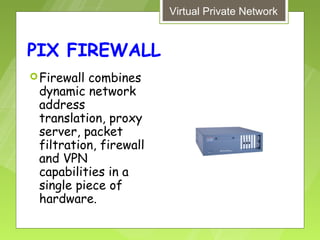
PIX FIREWALL
 Firewallcombines
 dynamic network
 address
 translation, proxy
 server, packet
 filtration, firewall
 and VPN
 capabilities in a
 single piece of
 hardware.
Virtual Private Network


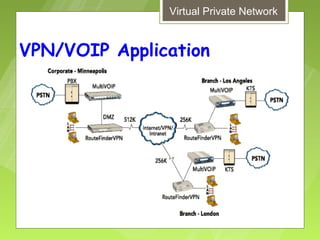
VPN/VOIP Application
ADVANTAGES OF VPN


 Cost saving.
 Reduces the long distance charges of
  electronic transactions.
 Concrete security.
DISADVANTAGES OF VPN
VPNs require an in-depth understanding of public network security
 issues and taking proper precautions in VPN deployment.


 The availability and performance of an organization's wide-area
 VPN (over the Internet in particular) depends on factors largely
 outside of their control.


 VPN technologies from different vendors may not work well
 together due to immature standards.
CONCLUSION

 From this we can conclude that VPN
 provides a very safe , secure and cost-
 effective communication infrastructure.
Virtual Private Network


THANKING YOU !!!

Vpn_NJ ppt

  • 1.
  • 2.
    VIRTUAL PRIVATE NETWORK Definition and introductory notes VPN is the network which uses open distributed infrastructure of the internet to transmit data between corporate sites.
  • 3.
    NEED FOR DEVELOPINGVPN  Remote employees interested to access database of corporations.  Corporate sites developing new relations.  Increasing growth of the corporation.
  • 4.
    VPN RESOLVES THE PROBLEM Itprovides flexibility and scalability  Cost advantage.  Makes free from maintenance and training.
  • 5.
    WORKING OF VPN STEP1…  STEP2…  STEP3…  STEP4…
  • 6.
    WORKING-STEP1 (cont…)  Theremote user dials into their local ISP and logs into the ISP’s network as usual. BACK
  • 7.
    WORKING-STEP2 (cont…)  When connectivity to the corporate network is desired, the user initiates a tunnel request to the destination Security server BACK
  • 8.
    WORKING-STEP3 (cont…)  The user then sends data through the tunnel which encrypted by the VPN software before being sent over the ISP connection BACK
  • 9.
    WORKING-STEP4 (cont…)  ThedestinationSecurity server receives the encrypted data and decrypts.
  • 10.
    TYPES OF VPN VLL-Virtual leased lines.  VPRN-virtual private routed network.  VPDN-virtual private dial-up network.  VPLS-virtual private LAN segments.  Intranet VPN.  Extranet VPN.  Remote access VPN.
  • 11.
    Virtual Private Network VIRTUAL LEASED LINES  Point to point link between two CPE  IP tunnel between 2 ISP edge routers.  Frames are relayed between IP tunnels.
  • 12.
    Virtual Private Network VIRTUAL PRIVATE ROUTED NETWORK  Emulation of multisite WAN using internet.  Packet forwarding at network layer.  VPRN specific forwarding table at ISP routers that forwards the traffic.
  • 13.
    VIRTUAL PRIVATE DIAL-UP NETWORK On demand tunnel between remote user and corporate sites.  There are possible 2 tunnels. 1… compulsory tunnel. 2… voluntary tunnel.
  • 14.
    Virtual Private Network COMPULSORYTUNNEL  In this scenario L2TP Access Contractor (LAC) acting as a dial or network access server extends a PPP session across a backbone using L2TP to a remote L2TP Network Server (LNS). The operation of initiating the PPP session to the LAC is transparent to the user. BACK
  • 15.
    Virtual Private Network VOLUNTARYTUNNEL  Voluntary tunnel refers to the case where an individual host connects to a remote site using a tunnel originating on the host, with no involvement from intermediate network nodes. Tunnel mechanism chosen can be IPSec or L2TP.
  • 16.
    VIRTUAL PRIVATE LAN SEGMENTS A Virtual Private LAN Segment (VPLS) is the emulation of a LAN segment using internet facilities.
  • 17.
    INTRANET VPN  The branch office scenario securely connects two trusted intranets within the organization.  Routers or firewalls acting as gateways for the office with vpn capabilities can be used to protect the corporate traffic.
  • 18.
    EXTRANET VPN  Inthisscenario multiple supplier intranets that need to access a common corporate network over the Internet. Each supplier is allowed access to only a limited set of destinations within the corporate network.
  • 19.
    REMOTE ACCESS VPN Aremote user wants to be able to communicate securely and cost-effectively to his corporate intranet. This can be done by use of an VPN IPSec enabled remote client and firewall (or gateway).
  • 20.
    VPN PROTOCOLS  1.PPTP (Point-to-point tunneling protocol)  2. IPsec (IP security).  3. L2TP (layer2 transmission protocol).
  • 21.
    LAYER2 TRANSMISSION PROTOCOL  Whatis actually the layer two transmission protocol ??? NEXT
  • 22.
    POINT TO POINT TUNNELINGPROTOCOL  Introduction to PPTP.  How actually PPTP works ???  Security provided by PPTP.  Advantages of PPTP.  Disadvantages of PPTP. BACK
  • 23.
    INTERNET PROTOCOL SECURITY  Introduction to IP security.  Features of IP security.  Types of IPsec protocols.  Types of modes used in IPsec. BACK
  • 24.
    SECURITY OF VPN Hardware solution  Remote access control.
  • 25.
    CERTAIN H/W ANDS/W SPECIFICATIONS…  Desktop software client for each remote user  Dedicated hardware such as a VPN Concentrator or Secure  PIX Firewall  Dedicated VPN server for dial-up services  NAS (Network Access Server) used by service provider for  remote user VPN access
  • 26.
    Virtual Private Network VPNCONCENTRATOR  Itincorporates the most advanced encryption and authentication techniques for Remote access VPN.
  • 27.
    Virtual Private Network VPN-OPTIMIZEDROUTER  VPN-optimized routers provide scalability, routing, security and quality of service.
  • 28.
    Virtual Private Network PIXFIREWALL  Firewallcombines dynamic network address translation, proxy server, packet filtration, firewall and VPN capabilities in a single piece of hardware.
  • 29.
  • 30.
    ADVANTAGES OF VPN Cost saving.  Reduces the long distance charges of electronic transactions.  Concrete security.
  • 31.
    DISADVANTAGES OF VPN VPNsrequire an in-depth understanding of public network security issues and taking proper precautions in VPN deployment. The availability and performance of an organization's wide-area VPN (over the Internet in particular) depends on factors largely outside of their control. VPN technologies from different vendors may not work well together due to immature standards.
  • 32.
    CONCLUSION  From thiswe can conclude that VPN provides a very safe , secure and cost- effective communication infrastructure.
  • 33.