Introduction of Web
Development Tools
Who is a web developer?
• A web developer is at heart
an interactive artist. They’re someone
driven by a deep desire to create
things. A web developer’s canvas is a
user’s web browser.
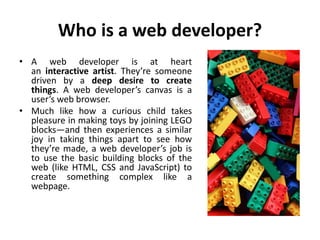
• Much like how a curious child takes
pleasure in making toys by joining LEGO
blocks—and then experiences a similar
joy in taking things apart to see how
they’re made, a web developer’s job is
to use the basic building blocks of the
web (like HTML, CSS and JavaScript) to
create something complex like a
webpage.
Types of web developers
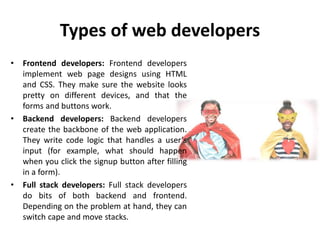
• Frontend developers: Frontend developers
implement web page designs using HTML
and CSS. They make sure the website looks
pretty on different devices, and that the
forms and buttons work.
• Backend developers: Backend developers
create the backbone of the web application.
They write code logic that handles a user’s
input (for example, what should happen
when you click the signup button after filling
in a form).
• Full stack developers: Full stack developers
do bits of both backend and frontend.
Depending on the problem at hand, they can
switch cape and move stacks.
What are the skills required to
become a web developer?
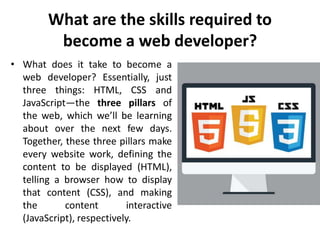
• What does it take to become a
web developer? Essentially, just
three things: HTML, CSS and
JavaScript—the three pillars of
the web, which we’ll be learning
about over the next few days.
Together, these three pillars make
every website work, defining the
content to be displayed (HTML),
telling a browser how to display
that content (CSS), and making
the content interactive
(JavaScript), respectively.
What’s the job outlook like for
web developers?
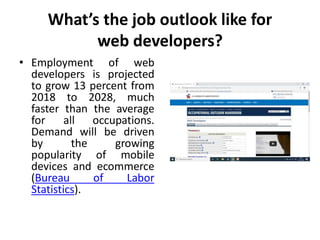
• Employment of web
developers is projected
to grow 13 percent from
2018 to 2028, much
faster than the average
for all occupations.
Demand will be driven
by the growing
popularity of mobile
devices and ecommerce
(Bureau of Labor
Statistics).
Ways to Learn Web Development
• Luckily, there’s plenty
of good quality
coding training
available here on the
Internet. What better
place to learn web
development than
the web itself?
Teach It To Yourself
• You could also learn web
coding by researching it
on your own, tweaking
website templates and
inspecting the source
code of other websites. A
lot of coders learn HTML
and CSS this way, using
website editing software
to tweak a website
template and figuring out
the code.
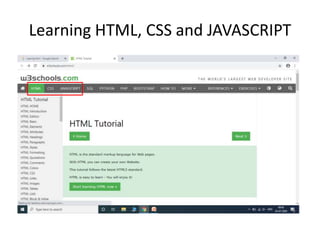
Learning HTML, CSS and JAVASCRIPT
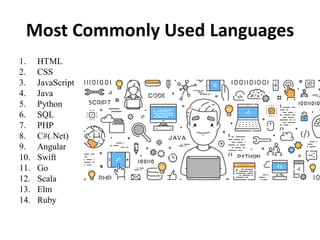
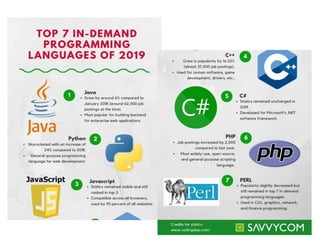
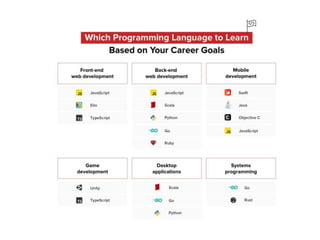
Most Commonly Used Languages
1. HTML
2. CSS
3. JavaScript
4. Java
5. Python
6. SQL
7. PHP
8. C#(.Net)
9. Angular
10. Swift
11. Go
12. Scala
13. Elm
14. Ruby
1. HTML
• HTML makes up the layout and structure for
your website. HTML is used to create a
starting point for the website and is what
most of your static pages start from. A better
way to understand this language is to consider
it as the skeleton that is holding your website
together.
2. CSS
• CSS is the language developers can use to
style a website. The style sheet language
describes how your website is presented and
its layout. CSS is used hand in hand with HTML
to add colors, backgrounds, layouts, font sizes,
and more.
3. JAVASCRIPT
• JavaScript is used in many aspects of web
development. Web developers use this
language to add interactive elements to their
websites. User engagement is important to
your business, and your web developer should
be incorporating JavaScript elements in your
design.
4. JAVA
• Java is the most popular web programming
language. It is used to develop website
content, games, apps, and software. Java is
used in the production of most Android apps.
Studies have shown over 15 billion devices are
using Java in some form or other.
5. PYTHON
• Python is one of the easiest languages to use
and work with. Python can create a
framework for basically any website need. This
language uses simple and straightforward
syntax, making it easy for web developers to
work with and explain to their users. Some
familiar sites that are using this language are
Pinterest and Instagram.
6. SQL
• SQL is a database query language that is used
when your website is computing large
amounts of data. Using SQL allows you to
gather data from different databases and use
it to cater your website to your target
audience.
7. PHP
• PHP is often used on data-heavy websites or
for app development. This is an open-source
language that can be easily modified to meet
the needs of your business or website. Large
websites like WordPress and Facebook use
PHP to manage and process their data.
8. C#(.Net)
• It was originally designed by Microsoft as part
of its .NET framework for building Windows
applications. Additionally, anyone who is
interested in VR development should consider
learning C#. C# is the recommended language
for building 3D and 2D video games using the
popular Unity game engine, which produces
one-third of the top games on the market.
9. ANGULAR
• Angular is a TypeScript-based open-source
front-end application platform led by the
Angular Team at Google and by a community
of individuals and corporations. Angular is a
platform that makes it easy to build
applications with the web. Angular empowers
developers to build applications that live on
the web, mobile, or the desktop.
10. Swift
• If you’re interested in Apple products and
mobile app development, Swift is a good place
to start. First announced by Apple in 2014,
Swift is a relatively new programming
language used to develop iOS and macOS
applications.
11. Go
• One of the core languages favored by Google,
Go is the little language that could. As a low-
level language, Go is ideal for engineers who
want to enter the field of systems
programming. As a compiled language, Go
runs “close to the metal,” allowing for a
blazing-fast runtime.
12. SCALA
• As a functional programming language, Scala
allows engineers to elevate the quality of their
code to resemble pure math. Scala allows for
concurrent programming, allowing complex
procedures to be executed in parallel.
13. Elm
• One of the youngest languages on our list,
what began as a Harvard student’s thesis has
now grown to become a point of passion for
front-end developers around the world. Elm is
a functional programming language, allowing
developers to create client-side interfaces
without the declarative trappings of HTML
and CSS.
14. Ruby
• Ruby is another scripting language that’s
commonly used for web development. In
particular, it’s used as the basis for the popular
Ruby on Rails web application framework.
• Beginners often gravitate toward Ruby because it
has a reputation for having one of the friendliest
and most helpful user communities.
Thank you

Intro to web development

  • 1.
  • 2.
    Who is aweb developer? • A web developer is at heart an interactive artist. They’re someone driven by a deep desire to create things. A web developer’s canvas is a user’s web browser. • Much like how a curious child takes pleasure in making toys by joining LEGO blocks—and then experiences a similar joy in taking things apart to see how they’re made, a web developer’s job is to use the basic building blocks of the web (like HTML, CSS and JavaScript) to create something complex like a webpage.
  • 3.
    Types of webdevelopers • Frontend developers: Frontend developers implement web page designs using HTML and CSS. They make sure the website looks pretty on different devices, and that the forms and buttons work. • Backend developers: Backend developers create the backbone of the web application. They write code logic that handles a user’s input (for example, what should happen when you click the signup button after filling in a form). • Full stack developers: Full stack developers do bits of both backend and frontend. Depending on the problem at hand, they can switch cape and move stacks.
  • 4.
    What are theskills required to become a web developer? • What does it take to become a web developer? Essentially, just three things: HTML, CSS and JavaScript—the three pillars of the web, which we’ll be learning about over the next few days. Together, these three pillars make every website work, defining the content to be displayed (HTML), telling a browser how to display that content (CSS), and making the content interactive (JavaScript), respectively.
  • 5.
    What’s the joboutlook like for web developers? • Employment of web developers is projected to grow 13 percent from 2018 to 2028, much faster than the average for all occupations. Demand will be driven by the growing popularity of mobile devices and ecommerce (Bureau of Labor Statistics).
  • 6.
    Ways to LearnWeb Development • Luckily, there’s plenty of good quality coding training available here on the Internet. What better place to learn web development than the web itself?
  • 7.
    Teach It ToYourself • You could also learn web coding by researching it on your own, tweaking website templates and inspecting the source code of other websites. A lot of coders learn HTML and CSS this way, using website editing software to tweak a website template and figuring out the code.
  • 8.
    Learning HTML, CSSand JAVASCRIPT
  • 9.
    Most Commonly UsedLanguages 1. HTML 2. CSS 3. JavaScript 4. Java 5. Python 6. SQL 7. PHP 8. C#(.Net) 9. Angular 10. Swift 11. Go 12. Scala 13. Elm 14. Ruby
  • 10.
    1. HTML • HTMLmakes up the layout and structure for your website. HTML is used to create a starting point for the website and is what most of your static pages start from. A better way to understand this language is to consider it as the skeleton that is holding your website together.
  • 11.
    2. CSS • CSSis the language developers can use to style a website. The style sheet language describes how your website is presented and its layout. CSS is used hand in hand with HTML to add colors, backgrounds, layouts, font sizes, and more.
  • 12.
    3. JAVASCRIPT • JavaScriptis used in many aspects of web development. Web developers use this language to add interactive elements to their websites. User engagement is important to your business, and your web developer should be incorporating JavaScript elements in your design.
  • 13.
    4. JAVA • Javais the most popular web programming language. It is used to develop website content, games, apps, and software. Java is used in the production of most Android apps. Studies have shown over 15 billion devices are using Java in some form or other.
  • 14.
    5. PYTHON • Pythonis one of the easiest languages to use and work with. Python can create a framework for basically any website need. This language uses simple and straightforward syntax, making it easy for web developers to work with and explain to their users. Some familiar sites that are using this language are Pinterest and Instagram.
  • 15.
    6. SQL • SQLis a database query language that is used when your website is computing large amounts of data. Using SQL allows you to gather data from different databases and use it to cater your website to your target audience.
  • 16.
    7. PHP • PHPis often used on data-heavy websites or for app development. This is an open-source language that can be easily modified to meet the needs of your business or website. Large websites like WordPress and Facebook use PHP to manage and process their data.
  • 17.
    8. C#(.Net) • Itwas originally designed by Microsoft as part of its .NET framework for building Windows applications. Additionally, anyone who is interested in VR development should consider learning C#. C# is the recommended language for building 3D and 2D video games using the popular Unity game engine, which produces one-third of the top games on the market.
  • 18.
    9. ANGULAR • Angularis a TypeScript-based open-source front-end application platform led by the Angular Team at Google and by a community of individuals and corporations. Angular is a platform that makes it easy to build applications with the web. Angular empowers developers to build applications that live on the web, mobile, or the desktop.
  • 19.
    10. Swift • Ifyou’re interested in Apple products and mobile app development, Swift is a good place to start. First announced by Apple in 2014, Swift is a relatively new programming language used to develop iOS and macOS applications.
  • 20.
    11. Go • Oneof the core languages favored by Google, Go is the little language that could. As a low- level language, Go is ideal for engineers who want to enter the field of systems programming. As a compiled language, Go runs “close to the metal,” allowing for a blazing-fast runtime.
  • 21.
    12. SCALA • Asa functional programming language, Scala allows engineers to elevate the quality of their code to resemble pure math. Scala allows for concurrent programming, allowing complex procedures to be executed in parallel.
  • 22.
    13. Elm • Oneof the youngest languages on our list, what began as a Harvard student’s thesis has now grown to become a point of passion for front-end developers around the world. Elm is a functional programming language, allowing developers to create client-side interfaces without the declarative trappings of HTML and CSS.
  • 23.
    14. Ruby • Rubyis another scripting language that’s commonly used for web development. In particular, it’s used as the basis for the popular Ruby on Rails web application framework. • Beginners often gravitate toward Ruby because it has a reputation for having one of the friendliest and most helpful user communities.
  • 26.