Niraj singh
9690703090
CBS College of Managenent ,Agra
Simple Physical Topologies
• Physical topology: physical layout of nodes on a
network
• Three fundamental shapes:
– Bus
– Ring
– Star
• Hybrid topologies
• Topology integral to type of network, cabling
infrastructure, and transmission media used
Bus
• Single cable connects all network nodes
without intervening connectivity devices
• Terminators stop signals after reaching
end of wire
– Prevent signal bounce
– A Bus topology consists of a single cable
—called a bus— connecting all nodes on a
network without intervening connectivity
devices
Bus (continued)
Advantages of Bus Topology
• Works well for small networks
• Relatively inexpensive to implement
• Easy to add to it
Disadvantages of
Bus Topology
• Management costs can be high
• Potential for congestion with network
traffic
• Difficult to troubleshoot, not fault-tolerant
Ring
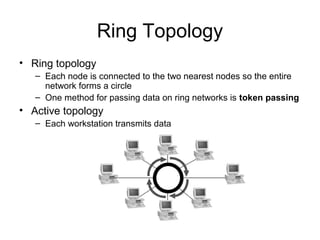
Ring Topology
• Ring topology
– Each node is connected to the two nearest nodes so the entire
network forms a circle
– One method for passing data on ring networks is token passing
• Active topology
– Each workstation transmits data
Advantages of Ring Topology
• Easier to manage; easier to locate a
defective node or cable problem
• Well-suited for transmitting signals over
long distances on a LAN
• Handles high-volume network traffic
• Enables reliable communication
Disadvantages of
Ring Topology
• Expensive
• Requires more cable and network
equipment at the start
• Not used as widely as bus topology
– Fewer equipment options
– Fewer options for expansion to high-speed
communication
Star
Star topology
• Star topology
– Every node on the network is connected through
a central device
Star (continued)
• Any single cable connects only two devices
– Cabling problems affect two nodes at most
• Requires more cabling than ring or bus networks
– More fault-tolerant
• Easily moved, isolated, or interconnected with
other networks
– Scalable
• Supports max of 1024 addressable nodes on
logical network
Advantages of Star Topology
• Good option for modern networks
• Low startup costs
• Easy to manage
• Offers opportunities for expansion
• Most popular topology in use; wide variety
of equipment available
Disadvantages of
Star Topology
• Hub is a single point of failure
• Requires more cable than the bus
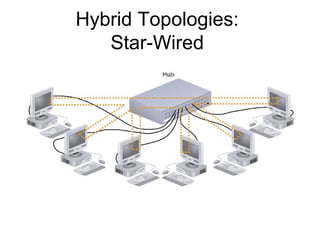
Hybrid Topologies:
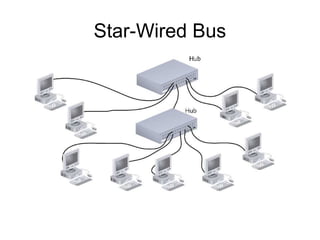
Star-Wired
Star-Wired Bus
Mesh topology
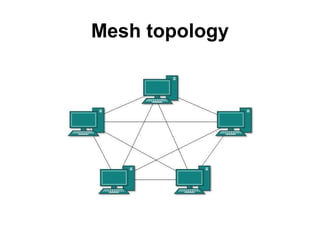
• A mesh network is a network topology in
which each node relays data for the
network.
• All mesh nodes cooperate in the
distribution of data in the network.
• Mesh networks can relay messages using
either a flooding technique or a routing
technique.
Mesh topology
Tree topology
• tree topology combines characteristics of
linear bus and star topologies. It consists
of groups of star-configured workstations
connected to a linear bus backbone
cable . Tree topologies allow for the
expansion of an existing network, and
enable schools to configure a network to
meet their needs.
Tree topology
Backbone Networks: Serial
Backbone
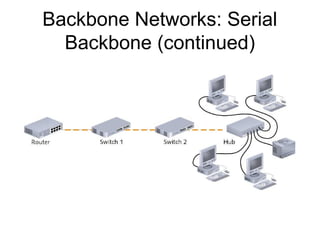
• Daisy chain: linked series of devices
– Hubs and switches often connected in daisy
chain to extend a network
• Hubs, gateways, routers, switches, and
bridges can form part of backbone
• Extent to which hubs can be connected is
limited
Backbone Networks: Serial
Backbone (continued)
Distributed Backbone
Collapsed Backbone
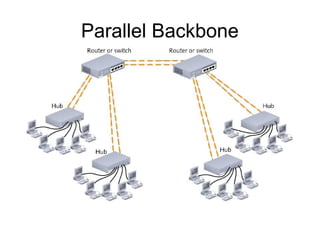
Parallel Backbone

Network topologies

  • 1.
  • 2.
    Simple Physical Topologies •Physical topology: physical layout of nodes on a network • Three fundamental shapes: – Bus – Ring – Star • Hybrid topologies • Topology integral to type of network, cabling infrastructure, and transmission media used
  • 3.
    Bus • Single cableconnects all network nodes without intervening connectivity devices • Terminators stop signals after reaching end of wire – Prevent signal bounce – A Bus topology consists of a single cable —called a bus— connecting all nodes on a network without intervening connectivity devices
  • 4.
  • 5.
    Advantages of BusTopology • Works well for small networks • Relatively inexpensive to implement • Easy to add to it
  • 6.
    Disadvantages of Bus Topology •Management costs can be high • Potential for congestion with network traffic • Difficult to troubleshoot, not fault-tolerant
  • 7.
  • 8.
    Ring Topology • Ringtopology – Each node is connected to the two nearest nodes so the entire network forms a circle – One method for passing data on ring networks is token passing • Active topology – Each workstation transmits data
  • 9.
    Advantages of RingTopology • Easier to manage; easier to locate a defective node or cable problem • Well-suited for transmitting signals over long distances on a LAN • Handles high-volume network traffic • Enables reliable communication
  • 10.
    Disadvantages of Ring Topology •Expensive • Requires more cable and network equipment at the start • Not used as widely as bus topology – Fewer equipment options – Fewer options for expansion to high-speed communication
  • 11.
  • 12.
    Star topology • Startopology – Every node on the network is connected through a central device
  • 13.
    Star (continued) • Anysingle cable connects only two devices – Cabling problems affect two nodes at most • Requires more cabling than ring or bus networks – More fault-tolerant • Easily moved, isolated, or interconnected with other networks – Scalable • Supports max of 1024 addressable nodes on logical network
  • 14.
    Advantages of StarTopology • Good option for modern networks • Low startup costs • Easy to manage • Offers opportunities for expansion • Most popular topology in use; wide variety of equipment available
  • 15.
    Disadvantages of Star Topology •Hub is a single point of failure • Requires more cable than the bus
  • 16.
  • 17.
  • 18.
    Mesh topology • Amesh network is a network topology in which each node relays data for the network. • All mesh nodes cooperate in the distribution of data in the network. • Mesh networks can relay messages using either a flooding technique or a routing technique.
  • 19.
  • 20.
    Tree topology • treetopology combines characteristics of linear bus and star topologies. It consists of groups of star-configured workstations connected to a linear bus backbone cable . Tree topologies allow for the expansion of an existing network, and enable schools to configure a network to meet their needs.
  • 21.
  • 22.
    Backbone Networks: Serial Backbone •Daisy chain: linked series of devices – Hubs and switches often connected in daisy chain to extend a network • Hubs, gateways, routers, switches, and bridges can form part of backbone • Extent to which hubs can be connected is limited
  • 23.
  • 24.
  • 25.
  • 26.