Network
topology
What is topology?
Topology is a style of
network connection based
on the style of network
They are basically divided into two
methods
 Physical topology
 Logical topology
The different types of physical topology
are
 Bus topology
 Ring topology
 Star topology
 Mesh topology
 Tree topology
A style of network used in a
limited area to connect set of
systems .
Each system acts as a work
station to transfer the data
BUS TOPOLOGY
Bus topology
Advantages Disadvantages
 Easy to connect
 Minimum cost of
installation
 Suitable for small
network
 Used to connect 5 to
8 systems only
 If one node fails the
whole network will
shutdown
 Low security
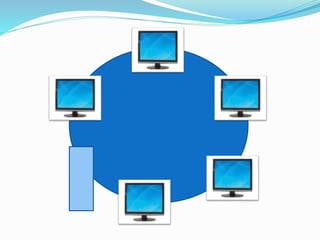
Ring topology
Type of network connection used
to connect multiple client pc.
Each node is interconnect with
more than one system.
advantages
 Implemented with
centralized storage
 Easy to install
 Better performance
compared to bus
topology
disadvantages
 Failure of single node
stops the process of
network.
 Network is highly
dependent on the
wireless of network.
 Used for token ring
process
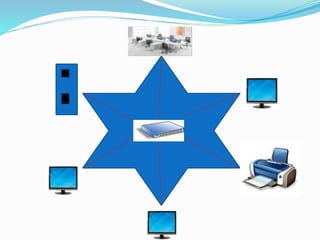
Star topology
A style of physical connection of a
network with the help of HUB AND
SWITCh
This type of topology is a combination
of ring and star connectivity where the
internal connectivity is available under
server connection
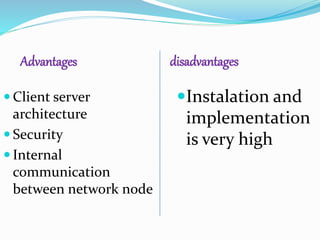
Advantages
 Client server
architecture
 Security
 Internal
communication
between network node
disadvantages
Instalation and
implementation
is very high
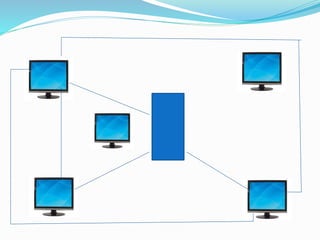
Mesh topology
 A style of connection which is used to
transfer the data for all the systems based on
multiple.
 This is divided in multiple forms as
 One to many
 Many to many
 Partial mesh
 Fully mesh
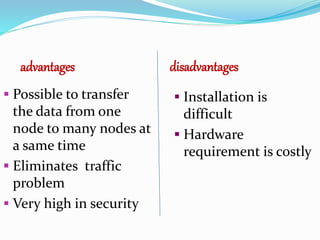
advantages
 Possible to transfer
the data from one
node to many nodes at
a same time
 Eliminates traffic
problem
 Very high in security
disadvantages
 Installation is
difficult
 Hardware
requirement is costly
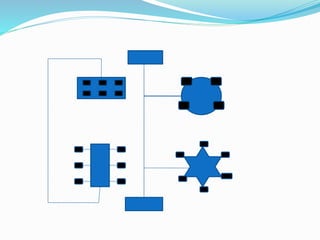
Tree topology
A topology or a style of
connection which is merched
with multiple network style .
The base of the connection is
formed by bus topology.
advantages
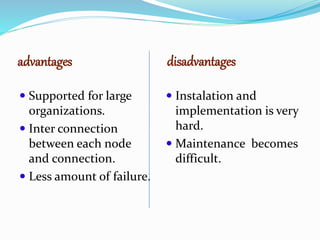
 Supported for large
organizations.
 Inter connection
between each node
and connection.
 Less amount of failure.
disadvantages
 Instalation and
implementation is very
hard.
 Maintenance becomes
difficult.
Network topology

Network topology

  • 1.
  • 2.
    What is topology? Topologyis a style of network connection based on the style of network
  • 3.
    They are basicallydivided into two methods  Physical topology  Logical topology
  • 4.
    The different typesof physical topology are  Bus topology  Ring topology  Star topology  Mesh topology  Tree topology
  • 5.
    A style ofnetwork used in a limited area to connect set of systems . Each system acts as a work station to transfer the data
  • 6.
  • 7.
    Bus topology Advantages Disadvantages Easy to connect  Minimum cost of installation  Suitable for small network  Used to connect 5 to 8 systems only  If one node fails the whole network will shutdown  Low security
  • 8.
    Ring topology Type ofnetwork connection used to connect multiple client pc. Each node is interconnect with more than one system.
  • 10.
    advantages  Implemented with centralizedstorage  Easy to install  Better performance compared to bus topology disadvantages  Failure of single node stops the process of network.  Network is highly dependent on the wireless of network.  Used for token ring process
  • 11.
    Star topology A styleof physical connection of a network with the help of HUB AND SWITCh This type of topology is a combination of ring and star connectivity where the internal connectivity is available under server connection
  • 13.
    Advantages  Client server architecture Security  Internal communication between network node disadvantages Instalation and implementation is very high
  • 14.
    Mesh topology  Astyle of connection which is used to transfer the data for all the systems based on multiple.  This is divided in multiple forms as  One to many  Many to many  Partial mesh  Fully mesh
  • 16.
    advantages  Possible totransfer the data from one node to many nodes at a same time  Eliminates traffic problem  Very high in security disadvantages  Installation is difficult  Hardware requirement is costly
  • 17.
    Tree topology A topologyor a style of connection which is merched with multiple network style . The base of the connection is formed by bus topology.
  • 19.
    advantages  Supported forlarge organizations.  Inter connection between each node and connection.  Less amount of failure. disadvantages  Instalation and implementation is very hard.  Maintenance becomes difficult.