International Research Journal of Engineering and Technology (IRJET) e-ISSN: 2395-0056
Volume: 04 Issue: 11 | Nov -2017 www.irjet.net p-ISSN: 2395-0072
© 2017, IRJET | Impact Factor value: 6.171 | ISO 9001:2008 Certified Journal | Page 1264
Hybrid Encryption for Database Security
Ms. Priyanka Deore1, Mr. Tushar Chaudhari2
1 Lecturer, pursing ME (Computer Engineering) YTCEM, Maharashtra, India
2 Lecturer, S.H. Jondhale Polytechnic, Maharashtra, India
---------------------------------------------------------------------***---------------------------------------------------------------------
Abstract - Database is a collection of organized
information. Data is organized in rows and columns format.
We can perform insert, update, delete operation on database.
Database is used by various areaslikehospital, defense, school,
college, government office, social media etc to store the
sensitive information. As databases contains the sensitive
information, security of such databases is a primary concern.
cryptography is used to secure data. Hybrid encryption
technique is more secure as compare to previoustechniques. It
is a combination of more than one cryptographic algorithms.
It incorporates the combination of asymmetricandsymmetric
encryption. To secure data in databases hybrid encryption
technique plays important role.
Key Words: Introduction1, Cryptography2, Asymmetric
encryption3, Symmetric encryption4, Database System5,
Hybrid Encryption Technique6, Proposed system: Hybrid
Encryption for Database Security7, Advantages8, Conclusion9
1. INTRODUCTION
In database Data is organized in rows and columns format.
Databases are used by many areas to store information so it
is necessary to provide security to data in databases. Hybrid
encryption technique is more secure as compareto previous
techniques. It is a combination of more than one
cryptographic algorithms. This technique uses any one
asymmetric encryption algorithms like Diffie-Hellman, RSA,
ECC, ElGamal, DSAandanysymmetric encryptionalgorithms
like AES, Blowfish, CAST5,Kuznyechik,RC4, 3DES, Skipja etc.
Hybrid encryption is considered as more secure because
public keys and private keys are fully secured.
2. CRYPTOGRAPHY
Cryptography is an art of hiding data. To make secure
communication cryptography plays vital role. It is
the science used to try to keep information secret and safe.
When information is send using cryptography, it is
encrypted before it is sent. The encrypted text is called as
ciphertext. To read the message again it is necessary to
decrypt it.
3. ASYMMETRIC ENCRYPTION
Asymmetric cryptography is public key cryptography, this
system uses pairs of keys public key and private key. Public
key is a key which is publicly known, whereas private key is
a key which is known only to the owner. Public keyisusedto
encrypt the message whereas the pair private key is used to
decrypt the message encrypted by the public key. In this
technique, anybody can encrypt the messagebyusingpublic
key but only receiver can decrypt the message by using
private key as private key is known only to the receiver. It is
necessary to keep private key secure. There are various
asymmetric encryption algorithms are available like Diffie-
Hellman, RSA, ECC, ElGamal, DSA etc.
3.1 RSA
RSA is an algorithm used to encrypt and decrypt messages. I
was first introduced in 1977 by Rivest, ShamirandAdleman.
This is a asymmetric cryptographic algorithm which uses
public key and private keys. RSA involves a public key and
private key. The public key can be known to everyone; it is
used to encrypt messages. Messages encrypted using the
public key can only be decrypted with the private key. The
keys for the RSA algorithm are generated the following way:
1. Select two large prime numbers p and q.
2. Calculate n=p*q. n should be minimum of 512 bits.
3. To find derived number select e. e must be greater
than 1 and less than ( p – 1 )( q - 1 )
4. The pair of numbers (n, e) form the RSA public key
and is made public.
5. Private key d is calculated from p,q and e.
6. Private Key d is calculated from p, q, and e. For
given n and e, there is unique number d.
7. Number d is the inverse of e modulo (p - 1)(q – 1).
This means that d is the number less than (p - 1)(q -
1) such that when multiplied by e, it is equal to 1
modulo (p - 1)(q - 1).
4. SYMMETRIC ENCRYPTION
Symmetric encryption is secret key cryptography. This
technique uses the same key for bothencryptionofplaintext
and decryption of cipher text. The keys, in practice,
represent private communication between twoparties. This
requirement that both parties have access to the secret key
is one of the main drawbacks of symmetric key encryption,
in comparison to public-key encryption ( asymmetric key
encryption). Symmetric key encryption is fasterthanpublic-
key algorithm. There are two types of symmetric key
algorithms stream cipher and block cipher. Stream ciphers
encrypt a message as a stream of bits one at a time. Block
International Research Journal of Engineering and Technology (IRJET) e-ISSN: 2395-0056
Volume: 04 Issue: 11 | Nov -2017 www.irjet.net p-ISSN: 2395-0072
© 2017, IRJET | Impact Factor value: 6.171 | ISO 9001:2008 Certified Journal | Page 1265
ciphers take blocks of bits, encrypt them as a single unit,and
sometimes use the answer later too. Blocks of 64 bits have
been commonly used; though modern ciphers like
the Standard use 128-bit blocks. The risk in this system is
that if either party loses the key or the key is intercepted,the
system is broken and messages cannot be exchanged
securely. There are various symmetric encryption
algorithms are available like Twofish, Serpent, AES,
Blowfish, CAST5, RC4, TDES, and IDEA.
4.1 AES
AES stands for Advanced Encryption Standard. It is more
popular and widely adopted symmetric encryption
algorithm as it is found at least six time faster than triple
DES. AES perform all its computation on bytes rather than
bits. AES treats the 128 bits of a plaintext block as 16 bytes.
These 16 bytes are arranged in four columns and four rows
for processing as a matrix. AES uses 10 rounds for 128-bit
keys, 12 rounds for 192-bit keys and 14 rounds for 256-bit
keys. Each of these rounds uses a different 128-bit round
key, which is calculated from the original AES key.
AES performs following steps for encryption / decryption:
 First step is to generate round keys, round keys are
generated using Rijndael’s key schedule.
 The plaintext is converted to 4 x 4 state matrix.
 Each byte of the state is combined with the round
key using bitwise xor.
 This is followed by ten rounds. In each of the first
nine rounds, it performs four steps.
 Byte substitution in which each byte of state is
replaced with the byte of S-Box in case of
encryption and with the byte of Inverse S-Box in
case of decryption depending upon its value.
 Shift rows in which first row ofstatematrixremains
unchanged, second row shifts by 1 bit to the left,
third row shifts by 2 bits to the left and fourth row
shifts by 3 bits to the left. In case of decryption,
shifting is to the right.
 Mix Columns in which each byte is replaced by a
value dependent on all 4 bytes in the column.
 Fourth step is Add Round Key in which each byte of
the state is combined with the round key using
bitwise xor.
 In last round, it performs three steps only, the
mixcolumns step is not performed in last step.
5. DATABASE SYSTEM
A database is organized set of information. Datain database
is organized so it can be easily accessed, manage and
updated. This data is organized into rows and columns.
Database is used to store important information of various
fields like education, military, government, industry etc.
security of such a database is important. It is necessary to
protect data against compromises of their confidentiality,
integrity and availability. Hybrid encryption technique is
more secure as compare to previous techniques. It is a
combination of more than one cryptographic algorithms. It
incorporates the combination of asymmetric andsymmetric
encryption. To secure data in databases hybrid encryption
technique plays important role.
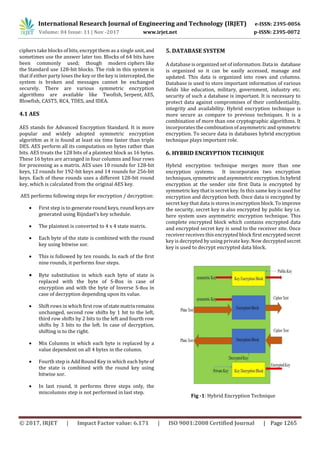
6. HYBRID ENCRYPTION TECHNIQUE
Hybrid encryption technique merges more than one
encryption systems. It incorporates two encryption
techniques,symmetricandasymmetricencryption.Inhybrid
encryption at the sender site first Data is encrypted by
symmetric key that is secret key. In this same key is used for
encryption and decryption both. Once data is encrypted by
secret key that data is stores in encryption block.Toimprove
the security, secret key is also encrypted by public key i.e.
here system uses asymmetric encryption technique. This
complete encrypted block which contains encrypted data
and encrypted secret key is send to the receiver site. Once
receiver receives this encrypted block first encrypted secret
key is decrypted by using private key. Now decrypted secret
key is used to decrypt encrypted data block.
Fig -1: Hybrid Encryption Technique
International Research Journal of Engineering and Technology (IRJET) e-ISSN: 2395-0056
Volume: 04 Issue: 11 | Nov -2017 www.irjet.net p-ISSN: 2395-0072
© 2017, IRJET | Impact Factor value: 6.171 | ISO 9001:2008 Certified Journal | Page 1266
7. Proposed system: Hybrid Encryption for
Database Security
In database data is organized in rows and columns format.
We can perform insert,update,deleteoperationondatabase.
Database is used by various areas like hospital, defense,
school, college, government office, social media etc. to store
the sensitive information. As databases contains the
sensitive information,securityofsuch databasesisa primary
concern. cryptography is used to secure data. Hybrid
encryption technique is more secure as compareto previous
techniques. It is a combination of more than one
cryptographic algorithms.Itincorporatesthecombination of
asymmetric and symmetric encryption. To secure data in
databases hybrid encryption techniqueplaysimportantrole.
In this technique first, we encrypt plain text database by
using symmetric key means secret key and stores that
encrypted database in cipher text database. Then secret key
which we have used to encrypt database now need to make
secure by using public key. So here we are now using
asymmetric encryption technique. This complete encrypted
block which contains encrypted database and encrypted
secret key is send to the receiver site. Once receiver receives
this encrypted block first encrypted secret key is decrypted
by private key. Now decrypted secret key is used to decrypt
encrypted database.
Fig -2: Hybrid Encryption for Database Security
8. ADVANTAGES
There are various advantages of hybrid encryption
technique:
 Provides high level of security Hybrid encryption is
a combination of symmetric encryption and
asymmetric encryption so It provide high security
as compare to other techniques.
 Encrypted data maintains integrity,Integritymeans
manipulation of data by unauthorized user or
hacker. This technique Guarantees Data Integrity
 Transmit Securely Transmission of data become
secure. Just as data security is ensured on all
devices, encrypting data also provides security
benefits during transmission.
 Secure database with hybrid encryption sensitive
data can be stored in secure manner
9. CONCLUSION
As a database is a collection of sensitive data it is necessary
to provide security to such a data. Hereadvanced encryption
technique is used to provide high level of security as
compare to previous techniques i.e. hybrid encryption
technique. Hybrid encryption technique uses symmetric
encryption to encrypt data and then uses asymmetric
encryption to encrypt secret key. This technique provides
two level of protection to the database.
REFERENCES
[1] “Ensuring data storage security in cloud computing
based on hybrid encryption schemes”; by Mrinal Kanti
Sarkar; Sanjay Kumar; Parallel, Distributed and Grid
Computing (PDGC), 2016 FourthInternational Conference
on 22-24 Dec. 2016
[2] “Enhanced Security using Hybrid Encryption
Algorithm” ;by Neha, Mandeep Kaur;International Journal
of Innovative Research in Computer and Communication
Engineering; Vol. 4, Issue 7, July 2016
[3] “A Hybrid Encryption Algorithm Based On AES and
RSA”; by Ch.Vijayalakshmi , L.Lavanya , Ch.Navya;
International Journal of Innovative Research in Computer
and Communication Engineering; Vol. 4, Issue 1, January
2016
[4] “EnhancedSecurityAlgorithmusingHybridEncryption
and ECC” ; by A. P Shaikh , V. kaul; IOSR Journal of
Computer Engineering; Volume 16, Issue 3
[5] “A hybrid encryption model for secure cloud
computing”; by Atewologun Olumide; Abeer Alsadoon; P.
W. C. Prasad; Linh Pham; ICT and Knowledge Engineering
on (ICT & Knowledge Engineering 2015)
[6] “Hybrid Encryption/Decryption Technique UsingNew
Public Key and Symmetric Key Algorithm”; by Prakash
Kuppuswamy , Saeed Q. Y. Al-Khalidi; IS Review; Vol. 19,
No. 2, March (2014)

Hybrid Encryption for Database Security

  • 1.
    International Research Journalof Engineering and Technology (IRJET) e-ISSN: 2395-0056 Volume: 04 Issue: 11 | Nov -2017 www.irjet.net p-ISSN: 2395-0072 © 2017, IRJET | Impact Factor value: 6.171 | ISO 9001:2008 Certified Journal | Page 1264 Hybrid Encryption for Database Security Ms. Priyanka Deore1, Mr. Tushar Chaudhari2 1 Lecturer, pursing ME (Computer Engineering) YTCEM, Maharashtra, India 2 Lecturer, S.H. Jondhale Polytechnic, Maharashtra, India ---------------------------------------------------------------------***--------------------------------------------------------------------- Abstract - Database is a collection of organized information. Data is organized in rows and columns format. We can perform insert, update, delete operation on database. Database is used by various areaslikehospital, defense, school, college, government office, social media etc to store the sensitive information. As databases contains the sensitive information, security of such databases is a primary concern. cryptography is used to secure data. Hybrid encryption technique is more secure as compare to previoustechniques. It is a combination of more than one cryptographic algorithms. It incorporates the combination of asymmetricandsymmetric encryption. To secure data in databases hybrid encryption technique plays important role. Key Words: Introduction1, Cryptography2, Asymmetric encryption3, Symmetric encryption4, Database System5, Hybrid Encryption Technique6, Proposed system: Hybrid Encryption for Database Security7, Advantages8, Conclusion9 1. INTRODUCTION In database Data is organized in rows and columns format. Databases are used by many areas to store information so it is necessary to provide security to data in databases. Hybrid encryption technique is more secure as compareto previous techniques. It is a combination of more than one cryptographic algorithms. This technique uses any one asymmetric encryption algorithms like Diffie-Hellman, RSA, ECC, ElGamal, DSAandanysymmetric encryptionalgorithms like AES, Blowfish, CAST5,Kuznyechik,RC4, 3DES, Skipja etc. Hybrid encryption is considered as more secure because public keys and private keys are fully secured. 2. CRYPTOGRAPHY Cryptography is an art of hiding data. To make secure communication cryptography plays vital role. It is the science used to try to keep information secret and safe. When information is send using cryptography, it is encrypted before it is sent. The encrypted text is called as ciphertext. To read the message again it is necessary to decrypt it. 3. ASYMMETRIC ENCRYPTION Asymmetric cryptography is public key cryptography, this system uses pairs of keys public key and private key. Public key is a key which is publicly known, whereas private key is a key which is known only to the owner. Public keyisusedto encrypt the message whereas the pair private key is used to decrypt the message encrypted by the public key. In this technique, anybody can encrypt the messagebyusingpublic key but only receiver can decrypt the message by using private key as private key is known only to the receiver. It is necessary to keep private key secure. There are various asymmetric encryption algorithms are available like Diffie- Hellman, RSA, ECC, ElGamal, DSA etc. 3.1 RSA RSA is an algorithm used to encrypt and decrypt messages. I was first introduced in 1977 by Rivest, ShamirandAdleman. This is a asymmetric cryptographic algorithm which uses public key and private keys. RSA involves a public key and private key. The public key can be known to everyone; it is used to encrypt messages. Messages encrypted using the public key can only be decrypted with the private key. The keys for the RSA algorithm are generated the following way: 1. Select two large prime numbers p and q. 2. Calculate n=p*q. n should be minimum of 512 bits. 3. To find derived number select e. e must be greater than 1 and less than ( p – 1 )( q - 1 ) 4. The pair of numbers (n, e) form the RSA public key and is made public. 5. Private key d is calculated from p,q and e. 6. Private Key d is calculated from p, q, and e. For given n and e, there is unique number d. 7. Number d is the inverse of e modulo (p - 1)(q – 1). This means that d is the number less than (p - 1)(q - 1) such that when multiplied by e, it is equal to 1 modulo (p - 1)(q - 1). 4. SYMMETRIC ENCRYPTION Symmetric encryption is secret key cryptography. This technique uses the same key for bothencryptionofplaintext and decryption of cipher text. The keys, in practice, represent private communication between twoparties. This requirement that both parties have access to the secret key is one of the main drawbacks of symmetric key encryption, in comparison to public-key encryption ( asymmetric key encryption). Symmetric key encryption is fasterthanpublic- key algorithm. There are two types of symmetric key algorithms stream cipher and block cipher. Stream ciphers encrypt a message as a stream of bits one at a time. Block
  • 2.
    International Research Journalof Engineering and Technology (IRJET) e-ISSN: 2395-0056 Volume: 04 Issue: 11 | Nov -2017 www.irjet.net p-ISSN: 2395-0072 © 2017, IRJET | Impact Factor value: 6.171 | ISO 9001:2008 Certified Journal | Page 1265 ciphers take blocks of bits, encrypt them as a single unit,and sometimes use the answer later too. Blocks of 64 bits have been commonly used; though modern ciphers like the Standard use 128-bit blocks. The risk in this system is that if either party loses the key or the key is intercepted,the system is broken and messages cannot be exchanged securely. There are various symmetric encryption algorithms are available like Twofish, Serpent, AES, Blowfish, CAST5, RC4, TDES, and IDEA. 4.1 AES AES stands for Advanced Encryption Standard. It is more popular and widely adopted symmetric encryption algorithm as it is found at least six time faster than triple DES. AES perform all its computation on bytes rather than bits. AES treats the 128 bits of a plaintext block as 16 bytes. These 16 bytes are arranged in four columns and four rows for processing as a matrix. AES uses 10 rounds for 128-bit keys, 12 rounds for 192-bit keys and 14 rounds for 256-bit keys. Each of these rounds uses a different 128-bit round key, which is calculated from the original AES key. AES performs following steps for encryption / decryption:  First step is to generate round keys, round keys are generated using Rijndael’s key schedule.  The plaintext is converted to 4 x 4 state matrix.  Each byte of the state is combined with the round key using bitwise xor.  This is followed by ten rounds. In each of the first nine rounds, it performs four steps.  Byte substitution in which each byte of state is replaced with the byte of S-Box in case of encryption and with the byte of Inverse S-Box in case of decryption depending upon its value.  Shift rows in which first row ofstatematrixremains unchanged, second row shifts by 1 bit to the left, third row shifts by 2 bits to the left and fourth row shifts by 3 bits to the left. In case of decryption, shifting is to the right.  Mix Columns in which each byte is replaced by a value dependent on all 4 bytes in the column.  Fourth step is Add Round Key in which each byte of the state is combined with the round key using bitwise xor.  In last round, it performs three steps only, the mixcolumns step is not performed in last step. 5. DATABASE SYSTEM A database is organized set of information. Datain database is organized so it can be easily accessed, manage and updated. This data is organized into rows and columns. Database is used to store important information of various fields like education, military, government, industry etc. security of such a database is important. It is necessary to protect data against compromises of their confidentiality, integrity and availability. Hybrid encryption technique is more secure as compare to previous techniques. It is a combination of more than one cryptographic algorithms. It incorporates the combination of asymmetric andsymmetric encryption. To secure data in databases hybrid encryption technique plays important role. 6. HYBRID ENCRYPTION TECHNIQUE Hybrid encryption technique merges more than one encryption systems. It incorporates two encryption techniques,symmetricandasymmetricencryption.Inhybrid encryption at the sender site first Data is encrypted by symmetric key that is secret key. In this same key is used for encryption and decryption both. Once data is encrypted by secret key that data is stores in encryption block.Toimprove the security, secret key is also encrypted by public key i.e. here system uses asymmetric encryption technique. This complete encrypted block which contains encrypted data and encrypted secret key is send to the receiver site. Once receiver receives this encrypted block first encrypted secret key is decrypted by using private key. Now decrypted secret key is used to decrypt encrypted data block. Fig -1: Hybrid Encryption Technique
  • 3.
    International Research Journalof Engineering and Technology (IRJET) e-ISSN: 2395-0056 Volume: 04 Issue: 11 | Nov -2017 www.irjet.net p-ISSN: 2395-0072 © 2017, IRJET | Impact Factor value: 6.171 | ISO 9001:2008 Certified Journal | Page 1266 7. Proposed system: Hybrid Encryption for Database Security In database data is organized in rows and columns format. We can perform insert,update,deleteoperationondatabase. Database is used by various areas like hospital, defense, school, college, government office, social media etc. to store the sensitive information. As databases contains the sensitive information,securityofsuch databasesisa primary concern. cryptography is used to secure data. Hybrid encryption technique is more secure as compareto previous techniques. It is a combination of more than one cryptographic algorithms.Itincorporatesthecombination of asymmetric and symmetric encryption. To secure data in databases hybrid encryption techniqueplaysimportantrole. In this technique first, we encrypt plain text database by using symmetric key means secret key and stores that encrypted database in cipher text database. Then secret key which we have used to encrypt database now need to make secure by using public key. So here we are now using asymmetric encryption technique. This complete encrypted block which contains encrypted database and encrypted secret key is send to the receiver site. Once receiver receives this encrypted block first encrypted secret key is decrypted by private key. Now decrypted secret key is used to decrypt encrypted database. Fig -2: Hybrid Encryption for Database Security 8. ADVANTAGES There are various advantages of hybrid encryption technique:  Provides high level of security Hybrid encryption is a combination of symmetric encryption and asymmetric encryption so It provide high security as compare to other techniques.  Encrypted data maintains integrity,Integritymeans manipulation of data by unauthorized user or hacker. This technique Guarantees Data Integrity  Transmit Securely Transmission of data become secure. Just as data security is ensured on all devices, encrypting data also provides security benefits during transmission.  Secure database with hybrid encryption sensitive data can be stored in secure manner 9. CONCLUSION As a database is a collection of sensitive data it is necessary to provide security to such a data. Hereadvanced encryption technique is used to provide high level of security as compare to previous techniques i.e. hybrid encryption technique. Hybrid encryption technique uses symmetric encryption to encrypt data and then uses asymmetric encryption to encrypt secret key. This technique provides two level of protection to the database. REFERENCES [1] “Ensuring data storage security in cloud computing based on hybrid encryption schemes”; by Mrinal Kanti Sarkar; Sanjay Kumar; Parallel, Distributed and Grid Computing (PDGC), 2016 FourthInternational Conference on 22-24 Dec. 2016 [2] “Enhanced Security using Hybrid Encryption Algorithm” ;by Neha, Mandeep Kaur;International Journal of Innovative Research in Computer and Communication Engineering; Vol. 4, Issue 7, July 2016 [3] “A Hybrid Encryption Algorithm Based On AES and RSA”; by Ch.Vijayalakshmi , L.Lavanya , Ch.Navya; International Journal of Innovative Research in Computer and Communication Engineering; Vol. 4, Issue 1, January 2016 [4] “EnhancedSecurityAlgorithmusingHybridEncryption and ECC” ; by A. P Shaikh , V. kaul; IOSR Journal of Computer Engineering; Volume 16, Issue 3 [5] “A hybrid encryption model for secure cloud computing”; by Atewologun Olumide; Abeer Alsadoon; P. W. C. Prasad; Linh Pham; ICT and Knowledge Engineering on (ICT & Knowledge Engineering 2015) [6] “Hybrid Encryption/Decryption Technique UsingNew Public Key and Symmetric Key Algorithm”; by Prakash Kuppuswamy , Saeed Q. Y. Al-Khalidi; IS Review; Vol. 19, No. 2, March (2014)