7.1
Chapter 7
Network Layer:
IPAddress assignment &
Routing
• Computer Networks
• Al-Mustansiryah University
• Elec. Eng. Department College of Engineering
Fourth Year Class
IP Address assignment Methods:
• Manual Host Configuration
• RARP
• BOOTP
• DHCP
7.2
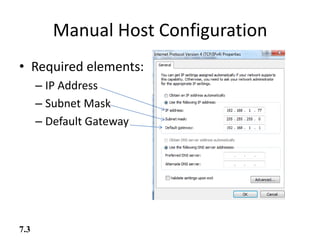
Manual Host Configuration
• Required elements:
– IP Address
– Subnet Mask
– Default Gateway
7.3
RARP
• RARP, or Reverse Address Resolution
Protocol.
• Like ARP, used to map MAC address to IP
addresses.
• Works in reverse - used by devices to find their
own IP address.
7.4
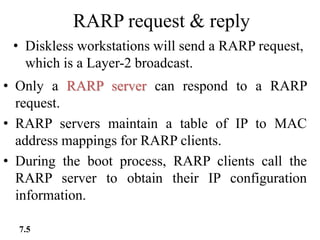
RARP request & reply
• Diskless workstations will send a RARP request,
which is a Layer-2 broadcast.
• Only a RARP server can respond to a RARP
request.
• RARP servers maintain a table of IP to MAC
address mappings for RARP clients.
• During the boot process, RARP clients call the
RARP server to obtain their IP configuration
information.
7.5
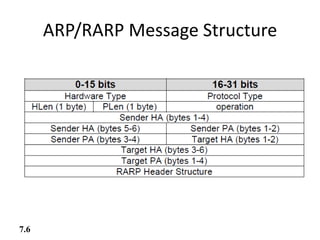
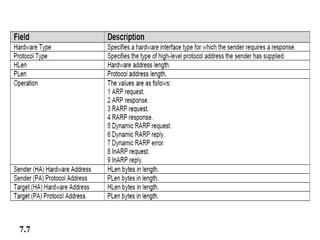
ARP/RARP Message Structure
7.6
7.7
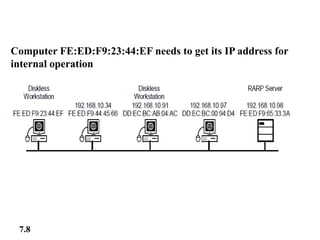
Computer FE:ED:F9:23:44:EF needs to get its IP address for
internal operation
7.8
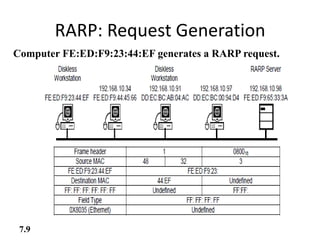
RARP: Request Generation
Computer FE:ED:F9:23:44:EF generates a RARP request.
7.9
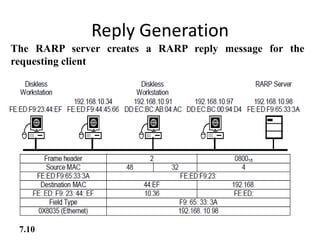
Reply Generation
The RARP server creates a RARP reply message for the
requesting client
7.10
BOOTP
• Client sends a bootrequest packet - a Layer 3
broadcast (255.255.255.255)
• BOOTP server responds with a bootreply
packet containing client’s IP address and
gateway IP address.
7.11
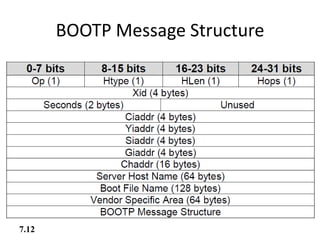
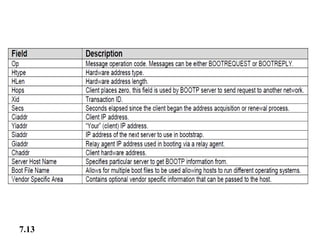
BOOTP Message Structure
7.12
7.13
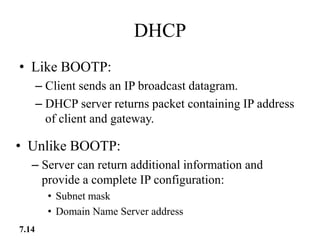
DHCP
• Like BOOTP:
– Client sends an IP broadcast datagram.
– DHCP server returns packet containing IP address
of client and gateway.
• Unlike BOOTP:
– Server can return additional information and
provide a complete IP configuration:
• Subnet mask
• Domain Name Server address
7.14
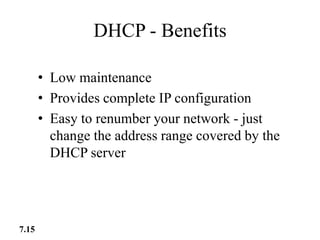
DHCP - Benefits
• Low maintenance
• Provides complete IP configuration
• Easy to renumber your network - just
change the address range covered by the
DHCP server
7.15
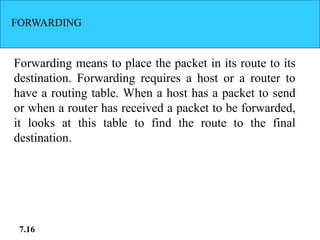
FORWARDING
Forwarding means to place the packet in its route to its
destination. Forwarding requires a host or a router to
have a routing table. When a host has a packet to send
or when a router has received a packet to be forwarded,
it looks at this table to find the route to the final
destination.
7.16
Routing Protocol & Routing Algorithm
A Routing Protocol is a combination of rules and
procedures that lets routers in an internet inform
each other of changes.
A Routing Algorithm is that part of network layer
software responsible for deciding which output
line and incoming packet should be transmitted
on.
7.17
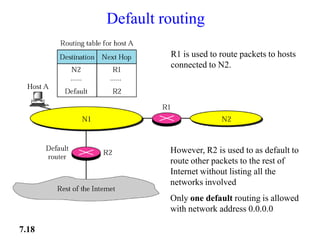
Default routing
R1 is used to route packets to hosts
connected to N2.
However, R2 is used to as default to
route other packets to the rest of
Internet without listing all the
networks involved
Only one default routing is allowed
with network address 0.0.0.0
7.18
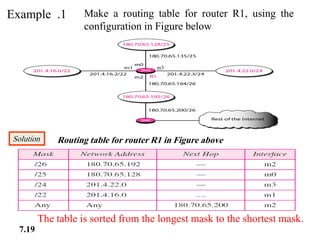
Make a routing table for router R1, using the
configuration in Figure below
Routing table for router R1 in Figure aboveSolution
m3
The table is sorted from the longest mask to the shortest mask.
Example .1
7.19
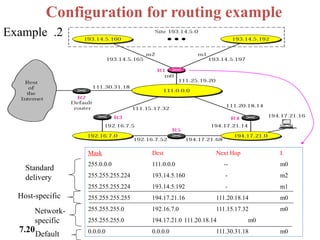
Configuration for routing example
Mask Dest. Next Hop I.
255.0.0.0 111.0.0.0 -- m0
255.255.255.224 193.14.5.160 - m2
255.255.255.224 193.14.5.192 - m1
255.255.255.255 194.17.21.16 111.20.18.14 m0
255.255.255.0 192.16.7.0 111.15.17.32 m0
255.255.255.0 194.17.21.0 111.20.18.14 m0
0.0.0.0 0.0.0.0 111.30.31.18 m0
Standard
delivery
Host-specific
Network-
specific
Default
Example .2
7.20
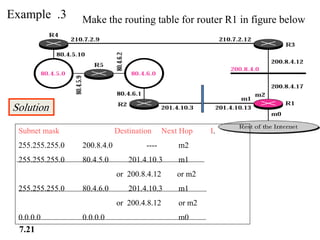
Make the routing table for router R1 in figure below
Subnet mask Destination Next Hop I.
255.255.255.0 200.8.4.0 ---- m2
255.255.255.0 80.4.5.0 201.4.10.3 m1
or 200.8.4.12 or m2
255.255.255.0 80.4.6.0 201.4.10.3 m1
or 200.4.8.12 or m2
0.0.0.0 0.0.0.0 m0
Solution
Example .3
7.21
Routing Protocol:
Interior Vs Exterior
7.22
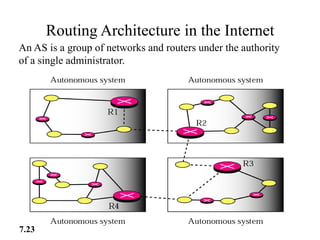
Routing Architecture in the Internet
An AS is a group of networks and routers under the authority
of a single administrator.
7.23
A static routing table
contains information entered manually
Usually remained unchanged.
A dynamic routing table is updated
periodically or whenever necessarily
using one of the dynamic routing protocols
such as RIP, OSPF, or BGP.
Static versus Dynamic Routing
7.24
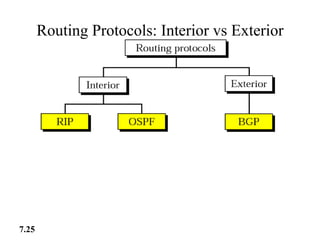
Routing Protocols: Interior vs Exterior
7.25
1)Routing Information Protocol (RIP)
a) RIP is based on distance vector routing
b) RIP treats all network equals; the cost of passing thru a network is
the same: one hop count per network.
c) Each router/node maintains a table of minimum number of hop-
count.
d) Path costs are based on number of hops.
7.26
Distance Vector Routing (DVR)
3 keys to understand how this algorithm works:
• Sharing knowledge about the entire AS. Each
router shares whatever it has.
• Sharing only with immediate neighbours.
• Sharing at regular intervals. e.g. every 30 sec.
7.27
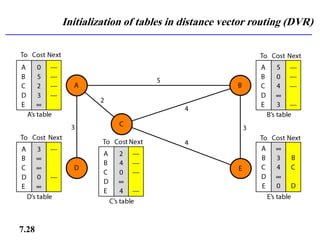
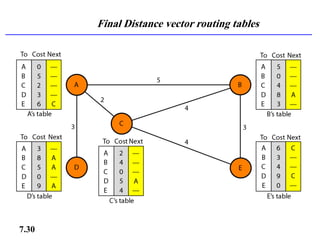
Initialization of tables in distance vector routing (DVR)
7.28
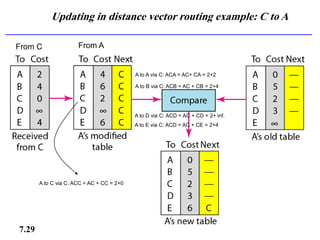
Updating in distance vector routing example: C to A
A to A via C: ACA = AC+ CA = 2+2
A to B via C: ACB = AC + CB = 2+4
From C From A
A to D via C: ACD = AC + CD = 2+ inf.
A to C via C: ACC = AC + CC = 2+0
A to E via C: ACD = AC + CE = 2+4
7.29
Final Distance vector routing tables
7.30
2) Open Shortest Path First (OSPF)
a) OSPF uses link state routing to update the routing table in an area;
(OSPF divides an AS into different areas).
b) Unlike RIP, OSPF treats the entire network with different
philosophy; depending on the types, cost (metric) and condition of
each link: to define the ‘state’ of a link.
7.31
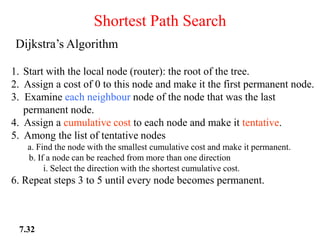
1. Start with the local node (router): the root of the tree.
2. Assign a cost of 0 to this node and make it the first permanent node.
3. Examine each neighbour node of the node that was the last
permanent node.
4. Assign a cumulative cost to each node and make it tentative.
5. Among the list of tentative nodes
a. Find the node with the smallest cumulative cost and make it permanent.
b. If a node can be reached from more than one direction
i. Select the direction with the shortest cumulative cost.
6. Repeat steps 3 to 5 until every node becomes permanent.
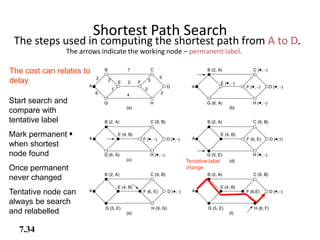
Shortest Path Search
Dijkstra’s Algorithm
7.32
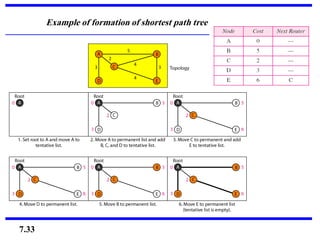
Example of formation of shortest path tree
7.33
Shortest Path Search
The steps used in computing the shortest path from A to D.
The arrows indicate the working node – permanent label.
The cost can relates to
delay
Start search and
compare with
tentative label
Mark permanent
when shortest
node found
Once permanent
never changed
Tentative node can
always be search
and relabelled
Tentative label
change
7.34
3) BGP & Path Vector Routing (PVR)
a) Border Gateway Protocol (BGP) is an inter-domain or inter-
autonomous system routing protocol: routing between different ASs.
b) BGP uses path vector routing to update the routing table in an area.
c) DVR and LSR are not suitable candidates for inter-AS routing :
d) PVR defines the exact paths as an ordered list of ASs that a packet
should travel thru to reach the destination (besides having the
destination network and next router info.) in its routing table.
7.35

Network layer

  • 1.
    7.1 Chapter 7 Network Layer: IPAddressassignment & Routing • Computer Networks • Al-Mustansiryah University • Elec. Eng. Department College of Engineering Fourth Year Class
  • 2.
    IP Address assignmentMethods: • Manual Host Configuration • RARP • BOOTP • DHCP 7.2
  • 3.
    Manual Host Configuration •Required elements: – IP Address – Subnet Mask – Default Gateway 7.3
  • 4.
    RARP • RARP, orReverse Address Resolution Protocol. • Like ARP, used to map MAC address to IP addresses. • Works in reverse - used by devices to find their own IP address. 7.4
  • 5.
    RARP request &reply • Diskless workstations will send a RARP request, which is a Layer-2 broadcast. • Only a RARP server can respond to a RARP request. • RARP servers maintain a table of IP to MAC address mappings for RARP clients. • During the boot process, RARP clients call the RARP server to obtain their IP configuration information. 7.5
  • 6.
  • 7.
  • 8.
    Computer FE:ED:F9:23:44:EF needsto get its IP address for internal operation 7.8
  • 9.
    RARP: Request Generation ComputerFE:ED:F9:23:44:EF generates a RARP request. 7.9
  • 10.
    Reply Generation The RARPserver creates a RARP reply message for the requesting client 7.10
  • 11.
    BOOTP • Client sendsa bootrequest packet - a Layer 3 broadcast (255.255.255.255) • BOOTP server responds with a bootreply packet containing client’s IP address and gateway IP address. 7.11
  • 12.
  • 13.
  • 14.
    DHCP • Like BOOTP: –Client sends an IP broadcast datagram. – DHCP server returns packet containing IP address of client and gateway. • Unlike BOOTP: – Server can return additional information and provide a complete IP configuration: • Subnet mask • Domain Name Server address 7.14
  • 15.
    DHCP - Benefits •Low maintenance • Provides complete IP configuration • Easy to renumber your network - just change the address range covered by the DHCP server 7.15
  • 16.
    FORWARDING Forwarding means toplace the packet in its route to its destination. Forwarding requires a host or a router to have a routing table. When a host has a packet to send or when a router has received a packet to be forwarded, it looks at this table to find the route to the final destination. 7.16
  • 17.
    Routing Protocol &Routing Algorithm A Routing Protocol is a combination of rules and procedures that lets routers in an internet inform each other of changes. A Routing Algorithm is that part of network layer software responsible for deciding which output line and incoming packet should be transmitted on. 7.17
  • 18.
    Default routing R1 isused to route packets to hosts connected to N2. However, R2 is used to as default to route other packets to the rest of Internet without listing all the networks involved Only one default routing is allowed with network address 0.0.0.0 7.18
  • 19.
    Make a routingtable for router R1, using the configuration in Figure below Routing table for router R1 in Figure aboveSolution m3 The table is sorted from the longest mask to the shortest mask. Example .1 7.19
  • 20.
    Configuration for routingexample Mask Dest. Next Hop I. 255.0.0.0 111.0.0.0 -- m0 255.255.255.224 193.14.5.160 - m2 255.255.255.224 193.14.5.192 - m1 255.255.255.255 194.17.21.16 111.20.18.14 m0 255.255.255.0 192.16.7.0 111.15.17.32 m0 255.255.255.0 194.17.21.0 111.20.18.14 m0 0.0.0.0 0.0.0.0 111.30.31.18 m0 Standard delivery Host-specific Network- specific Default Example .2 7.20
  • 21.
    Make the routingtable for router R1 in figure below Subnet mask Destination Next Hop I. 255.255.255.0 200.8.4.0 ---- m2 255.255.255.0 80.4.5.0 201.4.10.3 m1 or 200.8.4.12 or m2 255.255.255.0 80.4.6.0 201.4.10.3 m1 or 200.4.8.12 or m2 0.0.0.0 0.0.0.0 m0 Solution Example .3 7.21
  • 22.
  • 23.
    Routing Architecture inthe Internet An AS is a group of networks and routers under the authority of a single administrator. 7.23
  • 24.
    A static routingtable contains information entered manually Usually remained unchanged. A dynamic routing table is updated periodically or whenever necessarily using one of the dynamic routing protocols such as RIP, OSPF, or BGP. Static versus Dynamic Routing 7.24
  • 25.
  • 26.
    1)Routing Information Protocol(RIP) a) RIP is based on distance vector routing b) RIP treats all network equals; the cost of passing thru a network is the same: one hop count per network. c) Each router/node maintains a table of minimum number of hop- count. d) Path costs are based on number of hops. 7.26
  • 27.
    Distance Vector Routing(DVR) 3 keys to understand how this algorithm works: • Sharing knowledge about the entire AS. Each router shares whatever it has. • Sharing only with immediate neighbours. • Sharing at regular intervals. e.g. every 30 sec. 7.27
  • 28.
    Initialization of tablesin distance vector routing (DVR) 7.28
  • 29.
    Updating in distancevector routing example: C to A A to A via C: ACA = AC+ CA = 2+2 A to B via C: ACB = AC + CB = 2+4 From C From A A to D via C: ACD = AC + CD = 2+ inf. A to C via C: ACC = AC + CC = 2+0 A to E via C: ACD = AC + CE = 2+4 7.29
  • 30.
    Final Distance vectorrouting tables 7.30
  • 31.
    2) Open ShortestPath First (OSPF) a) OSPF uses link state routing to update the routing table in an area; (OSPF divides an AS into different areas). b) Unlike RIP, OSPF treats the entire network with different philosophy; depending on the types, cost (metric) and condition of each link: to define the ‘state’ of a link. 7.31
  • 32.
    1. Start withthe local node (router): the root of the tree. 2. Assign a cost of 0 to this node and make it the first permanent node. 3. Examine each neighbour node of the node that was the last permanent node. 4. Assign a cumulative cost to each node and make it tentative. 5. Among the list of tentative nodes a. Find the node with the smallest cumulative cost and make it permanent. b. If a node can be reached from more than one direction i. Select the direction with the shortest cumulative cost. 6. Repeat steps 3 to 5 until every node becomes permanent. Shortest Path Search Dijkstra’s Algorithm 7.32
  • 33.
    Example of formationof shortest path tree 7.33
  • 34.
    Shortest Path Search Thesteps used in computing the shortest path from A to D. The arrows indicate the working node – permanent label. The cost can relates to delay Start search and compare with tentative label Mark permanent when shortest node found Once permanent never changed Tentative node can always be search and relabelled Tentative label change 7.34
  • 35.
    3) BGP &Path Vector Routing (PVR) a) Border Gateway Protocol (BGP) is an inter-domain or inter- autonomous system routing protocol: routing between different ASs. b) BGP uses path vector routing to update the routing table in an area. c) DVR and LSR are not suitable candidates for inter-AS routing : d) PVR defines the exact paths as an ordered list of ASs that a packet should travel thru to reach the destination (besides having the destination network and next router info.) in its routing table. 7.35