1 DELIVERY
•The networklayer supervises the handling of the
packets by the underlying physical networks. We define
this handling as the delivery of a packet..
2 FORWARDING
•Forwarding meansto place the packet in its route to its
destination. Forwarding requires a host or a router to
have a routing table.. When a host has a packet to send
or when a router has received a packet to be forwarded,
it looks at this table to find the route to the final
destination.
5.
3 UNICAST ROUTING
PROTOCOLS
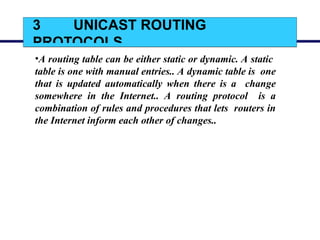
•Arouting table can be either static or dynamic. A static
table is one with manual entries.. A dynamic table is one
that is updated automatically when there is a change
somewhere in the Internet.. A routing protocol is a
combination of rules and procedures that lets routers in
the Internet inform each other of changes..
7
Autonomous Systems
• Anautonomous system is a region of the Internet that is
administered by a single entity.
• Routing is done differently within an autonomous system
(intradomain routing) and between autonomous system
(interdomain routing).
9
Interdomain and IntradomainRouting
Intradomain Routing
• Routing within an AS
• Ignores the Internet outside the
AS
• Protocols for Intradomain routing
are also called Interior Gateway
Protocols or IGP’s.
• Popular protocols are
– RIP (simple, old)
– OSPF (better)
Interdomain Routing
• Routing between AS’s
• Assumes that the Internet
consists of a collection of
interconnected AS’s
• Normally, there is one dedicated
router in each AS that handles
interdomain traffic.
• Protocols for interdomain routing
are also called Exterior Gateway
Protocols or EGP’s.
• Routing protocols:
– EGP
– BGP (more recent)
10.
10
Components of aRouting Algorithm
• A procedure for sending and receiving reachability information
about network to other routers
• A procedure for calculating optimal routes
– Routes are calculated using a shortest path algorithm:
• Goal: Given a network were each link is assigned a
cost. Find the path with the least cost between two
networks with minimum cost.
• A procedure for reacting to and advertising topology changes
12
Approaches to ShortestPath Routing
• There are two basic routing algorithms found on the Internet.
1. Distance Vector Routing
• Each node knows the distance (=cost) to its directly connected neighbors
• A node sends periodically a list of routing updates to its neighbors.
• If all nodes update their distances, the routing tables eventually converge
• New nodes advertise themselves to their neighbors
2. Link State Routing
• Each node knows the distance to its neighbors
• The distance information (=link state) is broadcast to all nodes in the network
• Each node calculates the routing tables independently
13.
13
Routing Algorithms inthe Internet
Distance Vector
• Routing Information Protocol
(RIP)
• Gateway-to-Gateway Protocol
(GGP)
• Exterior Gateway Protocol (EGP)
• Interior Gateway Routing Protocol
(IGRP)
Link State
• Intermediate System -
Intermediate System (IS-IS)
• Open Shortest Path First
(OSPF)
14.
14
A network asa graph
• In the following, networks are represented as a network
graph:
– nodes are connected by networks
– network can be a link or a LAN
– network interface has cost
– networks are destinations
– Net(v,w) is an IP address of a network
• For ease of notation,
we often replace the
clouds between nodes
by simple links. n
v
w
Net
Net(v,w)
Net(v,n)
c(v,w)
c(v,n)
15.
15
Distance Vector Algorithm:Routing Table
Dest
n
v
w
D(v,Net)
n
cost
via
(next hop)
Net
RoutingTable of node v
Net
Net(v,w)
c(v,w)
Net(v,n)
c(v,n)
Net(v,w): Network address of the network between v
and w
The network can be a link, but could also be a LAN
c(v,w): cost to transmit on the
interface to network Net(v,w)
16.
16
Distance Vector Algorithm:Messages
Dest
D(v,Net)
n
cost
via
(next hop)
Net
RoutingTable of node v
• Nodes send messages to their neighbors which contain
routing table entries
• A message has the format: [Net , D(v,Net)] means“My cost
to go to Net is D (v,Net)”
v n
[Net , D(v,Net)]
17.
17
Distance Vector Algorithm:Sending Updates
Dest
D(v,Net 2
)
n
cost
via
(next hop)
Net 2
RoutingTable of node v
D(v,Net 1
)
m
Net 1
D(v,Net N
)
w
Net N
Periodically, each node v
sends the content of its routing
table to its neighbors:
n
v w
m
[Net N,D(v,Net N)]
[Net 1,D(v,Net 1)]
[Net N
,D(v,Net N
)]
[Net 1
,D(v,Net 1
)]
[Net N
,D(v,Net N
)]
[Net 1
,D(v,Net 1
)]
18.
18
Initiating Routing TableI
Dest
c (v,w)
Net(v,w)
0
m
cost
via
(next hop)
Net(v,m)
RoutingTable
c(v,m)
Net(v,m)
c(v,n)
Net(v,n) 0
w
Net(v,w)
0
n
Net(v,n)
n
v w
m
• Suppose a new node v becomes active.
• The cost to access directly connected networks is zero:
– D (v, Net(v,m)) = 0
– D (v, Net(v,w)) = 0
– D (v, Net(v,n)) = 0
19.
19
Initiating Routing TableII
Dest
0
m
cost
via
(next hop)
Net(v,m)
RoutingTable
0
w
Net(v,w)
0
n
Net(v,n)
• New node v sends the routing table entry to all its neighbors:
n
v w
m
[w,0]
[n,0 ] [n,0 ]
[m,0]
[m,0]
[w,0]
n
v w
m
[Net(v,w),0]
[Net(v,n),0] [Net(v,n),0]
[Net(v,m),0]
[Net(v,w),0]
[Net(v,m),0]
n
v w
m
[Net(v,w),0]
[Net(v,n),0] [Net(v,n),0]
[Net(v,m),0]
[Net(v,w),0]
[Net(v,m),0]
20.
20
n
v w
m
[Net N,D(n,NetN)]
[Net 1,D(n,Net 1)]
[Net N,D(m,Net N)]
[Net 1,D(m,Net 1)]
[Net N,D(w,Net N)]
[Net 1,D(w,Net 1)]
Initiating Routing Table III
• Node v receives the routing tables from other nodes and
builds up its routing table
21.
21
Updating Routing TablesI
c(v,m)
Net(v,m)
n
v w
m
Net
[Net,D(m,Net)]
• Suppose node v receives a message from node m: [Net,D(m,Net)]
if ( D(m,Net) + c (v,m) < D (v,Net) ) {
Dnew
(v,Net) := D (m,Net) + c (v,m);
Update routing table;
send message [Net, Dnew
(v,Net)] to all neighbors
}
Node v updates its routing table and sends out further
messages if the message reduces the cost of a route:
22.
22
Updating Routing TablesII
c(v,m)
Net(v,m)
n
v w
m
Net
[Net,D(m,Net)]
• Before receiving the message:
Dest
D(v,Net)
??
cost
via
(next hop)
Net
RoutingTable
c(v,m)
Net(v,m)
n
v w
m
Net
[Net,D new
(v,Net)]
[Net,D new (v,Net)]
Dest
m
cost
via
(next hop)
Net
RoutingTable
Dnew
(v,Net)
• Suppose D (m,Net) + c (v,m) < D (v,Net):
23.
23
Characteristics of DistanceVector Routing
• Periodic Updates: Updates to the routing tables are sent at
the end of a certain time period. A typical value is 90 seconds.
• Triggered Updates: If a metric changes on a link, a router
immediately sends out an update without waiting for the end
of the update period.
• Full Routing Table Update: Most distance vector routing
protocols send their neighbors the entire routing table (not
only entries which change).
• Route invalidation timers: Routing table entries are invalid if
they are not refreshed. A typical value is to invalidate an entry
if no update is received after 3-6 update periods.
24.
24
RIP - RoutingInformation Protocol
• A simple intradomain protocol
• Straightforward implementation of Distance Vector Routing
• Each router advertises its distance vector every 30 seconds
(or whenever its routing table changes) to all of its neighbors
• RIP always uses 1 as link metric
• Maximum hop count is 15, with “16” equal to “”
• Routes are timeout (set to 16) after 3 minutes if they are not
updated
25.
25
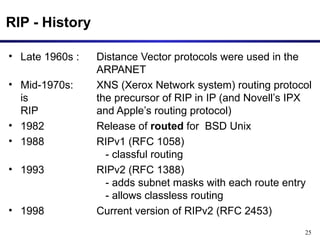
RIP - History
•Late 1960s : Distance Vector protocols were used in the
ARPANET
• Mid-1970s: XNS (Xerox Network system) routing protocol
is the precursor of RIP in IP (and Novell’s IPX
RIP and Apple’s routing protocol)
• 1982 Release of routed for BSD Unix
• 1988 RIPv1 (RFC 1058)
- classful routing
• 1993 RIPv2 (RFC 1388)
- adds subnet masks with each route entry
- allows classless routing
• 1998 Current version of RIPv2 (RFC 2453)
26.
26
RIP Problems
• RIPtakes a long time to stabilize
– Even for a small network, it takes several minutes until the
routing tables have settled after a change




![16
Distance Vector Algorithm: Messages
Dest
D(v,Net)
n
cost
via
(next hop)
Net
RoutingTable of node v
• Nodes send messages to their neighbors which contain
routing table entries
• A message has the format: [Net , D(v,Net)] means“My cost
to go to Net is D (v,Net)”
v n
[Net , D(v,Net)]](https://image.slidesharecdn.com/routing-250306025918-1252e34b/85/Routing-pptbbbbbbbbbbbbbbbbbbbbbnbbnbbbbnbb-16-320.jpg)
![17
Distance Vector Algorithm: Sending Updates
Dest
D(v,Net 2
)
n
cost
via
(next hop)
Net 2
RoutingTable of node v
D(v,Net 1
)
m
Net 1
D(v,Net N
)
w
Net N
Periodically, each node v
sends the content of its routing
table to its neighbors:
n
v w
m
[Net N,D(v,Net N)]
[Net 1,D(v,Net 1)]
[Net N
,D(v,Net N
)]
[Net 1
,D(v,Net 1
)]
[Net N
,D(v,Net N
)]
[Net 1
,D(v,Net 1
)]](https://image.slidesharecdn.com/routing-250306025918-1252e34b/85/Routing-pptbbbbbbbbbbbbbbbbbbbbbnbbnbbbbnbb-17-320.jpg)

![19
Initiating Routing Table II
Dest
0
m
cost
via
(next hop)
Net(v,m)
RoutingTable
0
w
Net(v,w)
0
n
Net(v,n)
• New node v sends the routing table entry to all its neighbors:
n
v w
m
[w,0]
[n,0 ] [n,0 ]
[m,0]
[m,0]
[w,0]
n
v w
m
[Net(v,w),0]
[Net(v,n),0] [Net(v,n),0]
[Net(v,m),0]
[Net(v,w),0]
[Net(v,m),0]
n
v w
m
[Net(v,w),0]
[Net(v,n),0] [Net(v,n),0]
[Net(v,m),0]
[Net(v,w),0]
[Net(v,m),0]](https://image.slidesharecdn.com/routing-250306025918-1252e34b/85/Routing-pptbbbbbbbbbbbbbbbbbbbbbnbbnbbbbnbb-19-320.jpg)
![20
n
v w
m
[Net N,D(n,Net N)]
[Net 1,D(n,Net 1)]
[Net N,D(m,Net N)]
[Net 1,D(m,Net 1)]
[Net N,D(w,Net N)]
[Net 1,D(w,Net 1)]
Initiating Routing Table III
• Node v receives the routing tables from other nodes and
builds up its routing table](https://image.slidesharecdn.com/routing-250306025918-1252e34b/85/Routing-pptbbbbbbbbbbbbbbbbbbbbbnbbnbbbbnbb-20-320.jpg)
![21
Updating Routing Tables I
c(v,m)
Net(v,m)
n
v w
m
Net
[Net,D(m,Net)]
• Suppose node v receives a message from node m: [Net,D(m,Net)]
if ( D(m,Net) + c (v,m) < D (v,Net) ) {
Dnew
(v,Net) := D (m,Net) + c (v,m);
Update routing table;
send message [Net, Dnew
(v,Net)] to all neighbors
}
Node v updates its routing table and sends out further
messages if the message reduces the cost of a route:](https://image.slidesharecdn.com/routing-250306025918-1252e34b/85/Routing-pptbbbbbbbbbbbbbbbbbbbbbnbbnbbbbnbb-21-320.jpg)
![22
Updating Routing Tables II
c(v,m)
Net(v,m)
n
v w
m
Net
[Net,D(m,Net)]
• Before receiving the message:
Dest
D(v,Net)
??
cost
via
(next hop)
Net
RoutingTable
c(v,m)
Net(v,m)
n
v w
m
Net
[Net,D new
(v,Net)]
[Net,D new (v,Net)]
Dest
m
cost
via
(next hop)
Net
RoutingTable
Dnew
(v,Net)
• Suppose D (m,Net) + c (v,m) < D (v,Net):](https://image.slidesharecdn.com/routing-250306025918-1252e34b/85/Routing-pptbbbbbbbbbbbbbbbbbbbbbnbbnbbbbnbb-22-320.jpg)