1
Dynamic Routing Protocols I
RIP
Relates to Lab 4.
The first module on dynamic routing protocols. This module provides an
overview of routing, introduces terminology (interdomain, intradomain,
autonomous system),
2
Routing
• Recall: There are two parts to routing IP packets:
1. How to pass a packet from an input interface to the output
interface of a router (packet forwarding) ?
2. How to find and setup a route ?
• We already discussed the packet forwarding part
• There are two approaches for calculating the routing tables:
– Static Routing
– Dynamic Routing: Routes are calculated by a routing protocol
3
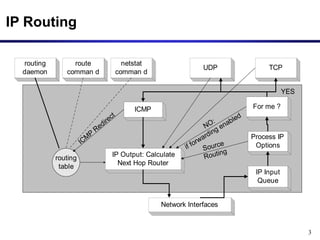
IP Routing
TCP
Network Interfaces
IP Input
Queue
IP Output: Calculate
Next Hop Router
ICMP
routing
daemon
Process IP
Options
IP Layer
For me ?
UDP
route
comman d
netstat
comman d
routing
table
ICM
P
Redirect
Source
Routing
NO:
if forwarding enabled
YES
4
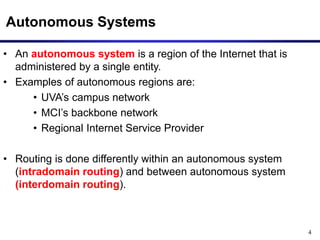
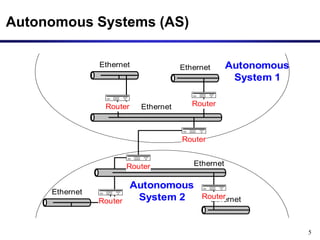
Autonomous Systems
• An autonomous system is a region of the Internet that is
administered by a single entity.
• Examples of autonomous regions are:
• UVA’s campus network
• MCI’s backbone network
• Regional Internet Service Provider
• Routing is done differently within an autonomous system
(intradomain routing) and between autonomous system
(interdomain routing).
5
Autonomous Systems (AS)
Ethernet
Router
Ethernet
Ethernet
Router
Router
Ethernet
Ethernet
Ethernet
Router
Router
Router
Autonomous
System 2
Autonomous
System 1
6
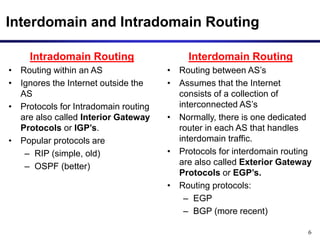
Interdomain and Intradomain Routing
Intradomain Routing
• Routing within an AS
• Ignores the Internet outside the
AS
• Protocols for Intradomain routing
are also called Interior Gateway
Protocols or IGP’s.
• Popular protocols are
– RIP (simple, old)
– OSPF (better)
Interdomain Routing
• Routing between AS’s
• Assumes that the Internet
consists of a collection of
interconnected AS’s
• Normally, there is one dedicated
router in each AS that handles
interdomain traffic.
• Protocols for interdomain routing
are also called Exterior Gateway
Protocols or EGP’s.
• Routing protocols:
– EGP
– BGP (more recent)
7
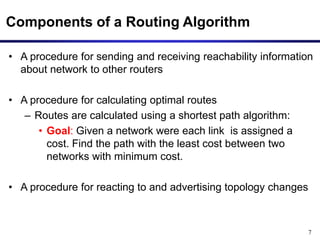
Components of a Routing Algorithm
• A procedure for sending and receiving reachability information
about network to other routers
• A procedure for calculating optimal routes
– Routes are calculated using a shortest path algorithm:
• Goal: Given a network were each link is assigned a
cost. Find the path with the least cost between two
networks with minimum cost.
• A procedure for reacting to and advertising topology changes
8
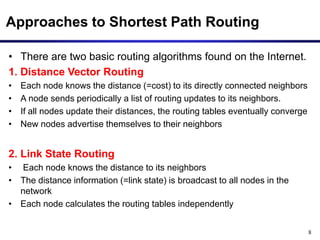
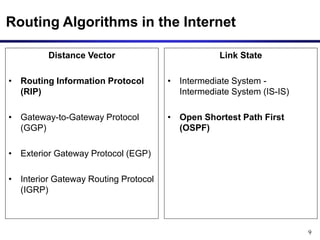
Approaches to Shortest Path Routing
• There are two basic routing algorithms found on the Internet.
1. Distance Vector Routing
• Each node knows the distance (=cost) to its directly connected neighbors
• A node sends periodically a list of routing updates to its neighbors.
• If all nodes update their distances, the routing tables eventually converge
• New nodes advertise themselves to their neighbors
2. Link State Routing
• Each node knows the distance to its neighbors
• The distance information (=link state) is broadcast to all nodes in the
network
• Each node calculates the routing tables independently
9
Routing Algorithms in the Internet
Distance Vector
• Routing Information Protocol
(RIP)
• Gateway-to-Gateway Protocol
(GGP)
• Exterior Gateway Protocol (EGP)
• Interior Gateway Routing Protocol
(IGRP)
Link State
• Intermediate System -
Intermediate System (IS-IS)
• Open Shortest Path First
(OSPF)
10
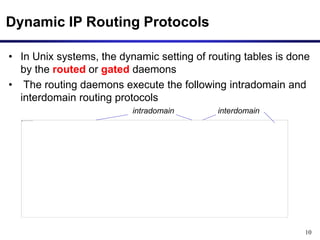
Dynamic IP Routing Protocols
• In Unix systems, the dynamic setting of routing tables is done
by the routed or gated daemons
• The routing daemons execute the following intradomain and
interdomain routing protocols
intradomain interdomain
11
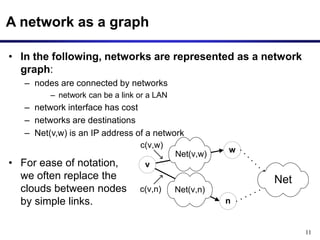
A network as a graph
• In the following, networks are represented as a network
graph:
– nodes are connected by networks
– network can be a link or a LAN
– network interface has cost
– networks are destinations
– Net(v,w) is an IP address of a network
• For ease of notation,
we often replace the
clouds between nodes
by simple links. n
v
w
Net
Net(v,w)
Net(v,n)
c(v,w)
c(v,n)
12
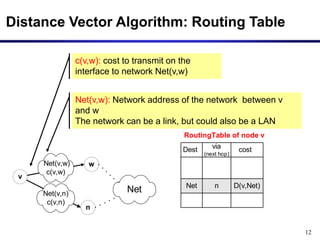
Distance Vector Algorithm: Routing Table
Dest
n
v
w
D(v,Net)
n
cost
via
(next hop)
Net
RoutingTable of node v
Net
Net(v,w)
c(v,w)
Net(v,n)
c(v,n)
Net(v,w): Network address of the network between v
and w
The network can be a link, but could also be a LAN
c(v,w): cost to transmit on the
interface to network Net(v,w)
13
Distance Vector Algorithm: Messages
Dest
D(v,Net)
n
cost
via
(next hop)
Net
RoutingTable of node v
• Nodes send messages to their neighbors which contain
routing table entries
• A message has the format: [Net , D(v,Net)] means“My cost to
go to Net is D (v,Net)”
v n
[Net , D(v,Net)]
14
Distance Vector Algorithm: Sending Updates
Dest
D(v,Net2)
n
cost
via
(next hop)
Net2
RoutingTable of node v
D(v,Net1)
m
Net1
D(v,NetN)
w
NetN
Periodically, each node v
sends the content of its routing
table to its neighbors:
n
v w
m
[NetN,D(v,NetN)]
[Net1,D(v,Net1)]
[NetN,D(v,NetN)]
[Net1,D(v,Net1)]
[NetN,D(v,NetN)]
[Net1,D(v,Net1)]
15
Initiating Routing Table I
Dest
c (v,w)
Net(v,w)
0
m
cost
via
(next hop)
Net(v,m)
RoutingTable
c(v,m)
Net(v,m)
c(v,n)
Net(v,n) 0
w
Net(v,w)
0
n
Net(v,n)
n
v w
m
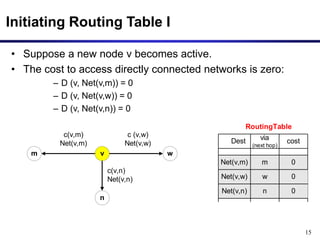
• Suppose a new node v becomes active.
• The cost to access directly connected networks is zero:
– D (v, Net(v,m)) = 0
– D (v, Net(v,w)) = 0
– D (v, Net(v,n)) = 0
16
Initiating Routing Table II
Dest
0
m
cost
via
(next hop)
Net(v,m)
RoutingTable
0
w
Net(v,w)
0
n
Net(v,n)
• New node v sends the routing table entry to all its neighbors:
n
v w
m
[w,0]
[n,0] [n,0]
[m,0]
[m,0]
[w,0]
n
v w
m
[Net(v,w),0]
[Net(v,n),0] [Net(v,n),0]
[Net(v,m),0]
[Net(v,w),0]
[Net(v,m),0]
n
v w
m
[Net(v,w),0]
[Net(v,n),0] [Net(v,n),0]
[Net(v,m),0]
[Net(v,w),0]
[Net(v,m),0]
17
n
v w
m
[NetN,D(n,NetN)]
[Net1,D(n,Net1)]
[NetN,D(m,NetN)]
[Net1,D(m,Net1)]
[NetN,D(w,NetN)]
[Net1,D(w,Net1)]
Initiating Routing Table III
• Node v receives the routing tables from other nodes and
builds up its routing table
18
Updating Routing Tables I
c(v,m)
Net(v,m)
n
v w
m
Net
[Net,D(m,Net)]
• Suppose node v receives a message from node m: [Net,D(m,Net)]
if ( D(m,Net) + c (v,m) < D (v,Net) ) {
Dnew (v,Net) := D (m,Net) + c (v,m);
Update routing table;
send message [Net, Dnew (v,Net)] to all neighbors
}
Node v updates its routing table and sends out further
messages if the message reduces the cost of a route:
19
Updating Routing Tables II
c(v,m)
Net(v,m)
n
v w
m
Net
[Net,D(m,Net)]
• Before receiving the message:
Dest
D(v,Net)
??
cost
via
(next hop)
Net
RoutingTable
c(v,m)
Net(v,m)
n
v w
m
Net
[Net,Dnew (v,Net)]
[Net,Dnew (v,Net)]
Dest
m
cost
via
(next hop)
Net
RoutingTable
Dnew
(v,Net)
• Suppose D (m,Net) + c (v,m) < D (v,Net):
20
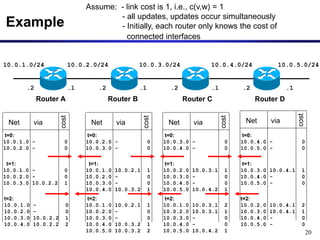
Example
Router A Router B Router C Router D
10.0.2.0/24 10.0.3.0/24 10.0.4.0/24 10.0.5.0/24
10.0.1.0/24
.1
.2
.2
.2
.2 .1
.1
.1
Assume: - link cost is 1, i.e., c(v,w) = 1
- all updates, updates occur simultaneously
- Initially, each router only knows the cost of
connected interfaces
t=0:
10.0.1.0 - 0
10.0.2.0 - 0
Net via
cost
t=0:
10.0.2.0 - 0
10.0.3.0 - 0
Net via
cost
t=0:
10.0.3.0 - 0
10.0.4.0 - 0
Net via
cost
t=0:
10.0.4.0 - 0
10.0.5.0 - 0
Net via
cost
t=1:
10.0.1.0 - 0
10.0.2.0 - 0
10.0.3.0 10.0.2.2 1
t=2:
10.0.1.0 - 0
10.0.2.0 - 0
10.0.3.0 10.0.2.2 1
10.0.4.0 10.0.2.2 2
t=2:
10.0.1.0 10.0.2.1 1
10.0.2.0 - 0
10.0.3.0 - 0
10.0.4.0 10.0.3.2 1
10.0.5.0 10.0.3.2 2
t=1:
10.0.1.0 10.0.2.1 1
10.0.2.0 - 0
10.0.3.0 - 0
10.0.4.0 10.0.3.2 1
t=2:
10.0.1.0 10.0.3.1 2
10.0.2.0 10.0.3.1 1
10.0.3.0 - 0
10.0.4.0 - 0
10.0.5.0 10.0.4.2 1
t=1:
10.0.2.0 10.0.3.1 1
10.0.3.0 - 0
10.0.4.0 - 0
10.0.5.0 10.0.4.2 1
t=2:
10.0.2.0 10.0.4.1 2
10.0.3.0 10.0.4.1 1
10.0.4.0 - 0
10.0.5.0 - 0
t=1:
10.0.3.0 10.0.4.1 1
10.0.4.0 - 0
10.0.5.0 - 0
21
Example
Router A Router B Router C Router D
10.0.2.0/24 10.0.3.0/24 10.0.4.0/24 10.0.5.0/24
10.0.1.0/24
.1
.2
.2
.2
.2 .1
.1
.1
t=3:
10.0.1.0 - 0
10.0.2.0 - 0
10.0.3.0 10.0.2.2 1
10.0.4.0 10.0.2.2 2
10.0.5.0 10.0.2.2 3
Net via
cost
t=3:
10.0.1.0 10.0.2.1 1
10.0.2.0 - 0
10.0.3.0 - 0
10.0.4.0 10.0.3.2 1
10.0.5.0 10.0.3.2 2
Net via
cost
t=3:
10.0.1.0 10.0.3.1 2
10.0.2.0 10.0.3.1 1
10.0.3.0 - 0
10.0.4.0 - 0
10.0.5.0 10.0.4.2 1
Net via
cost
t=3:
10.0.1.0 10.0.4.1 3
10.0.2.0 10.0.4.1 2
10.0.3.0 10.0.4.1 1
10.0.4.0 - 0
10.0.5.0 - 0
Net via
cost
Now, routing tables have converged !
t=2:
10.0.1.0 - 0
10.0.2.0 - 0
10.0.3.0 10.0.2.2 1
10.0.4.0 10.0.2.2 2
t=2:
10.0.1.0 10.0.2.1 1
10.0.2.0 - 0
10.0.3.0 - 0
10.0.4.0 10.0.3.2 1
10.0.5.0 10.0.3.2 2
t=2:
10.0.1.0 10.0.3.1 2
10.0.2.0 10.0.3.1 1
10.0.3.0 - 0
10.0.4.0 - 0
10.0.5.0 10.0.4.2 1
t=2:
10.0.2.0 10.0.4.1 2
10.0.3.0 10.0.4.1 1
10.0.4.0 - 0
10.0.5.0 - 0
22
Characteristics of Distance Vector Routing
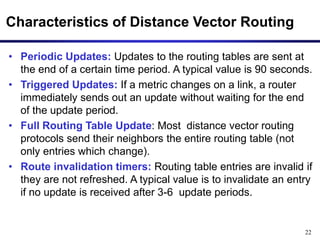
• Periodic Updates: Updates to the routing tables are sent at
the end of a certain time period. A typical value is 90 seconds.
• Triggered Updates: If a metric changes on a link, a router
immediately sends out an update without waiting for the end
of the update period.
• Full Routing Table Update: Most distance vector routing
protocols send their neighbors the entire routing table (not
only entries which change).
• Route invalidation timers: Routing table entries are invalid if
they are not refreshed. A typical value is to invalidate an entry
if no update is received after 3-6 update periods.
23
The Count-to-Infinity Problem
A B C
1 1
A's Routing Table B's Routing Table
C
to cost
via
(next hop)
2
B C
to cost
via
(next hop)
1
C
now link B-C goes down
C 2 C oo
C oo
-
C 2
B
C oo C 3
C 3
A
C oo
-
C 4 C oo
C oo
-
C 4
B
24
Count-to-Infinity
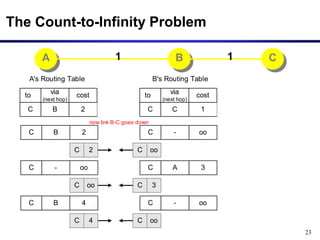
• The reason for the count-to-infinity problem is that each node
only has a “next-hop-view”
• For example, in the first step, A did not advertise that its route
(with cost 2) to C went through node B
• How can the Count-to-Infinity problem be solved?
25
Count-to-Infinity
• The reason for the count-to-infinity problem is that each node
only has a “next-hop-view”
• For example, in the first step, A did not realize that its route
(with cost 2) to C went through node B
• How can the Count-to-Infinity problem be solved?
• Solution 1: Always advertise the entire path in an update
message (Path vectors)
– If routing tables are large, the routing messages
require substantial bandwidth
– BGP uses this solution
26
Count-to-Infinity
• The reason for the count-to-infinity problem is that each node
only has a “next-hop-view”
• For example, in the first step, A did not realize that its route
(with cost 2) to C went through node B
• How can the Count-to-Infinity problem be solved?
• Solution 2: Never advertise the cost to a neighbor if this
neighbor is the next hop on the current path (Split Horizon)
– Example: A would not send the first routing update to B, since B
is the next hop on A’s current route to C
– Split Horizon does not solve count-to-infinity in all cases!
27
RIP - Routing Information Protocol
• A simple intradomain protocol
• Straightforward implementation of Distance Vector Routing
• Each router advertises its distance vector every 30 seconds
(or whenever its routing table changes) to all of its neighbors
• RIP always uses 1 as link metric
• Maximum hop count is 15, with “16” equal to “”
• Routes are timeout (set to 16) after 3 minutes if they are not
updated
28
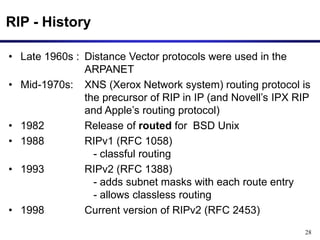
RIP - History
• Late 1960s : Distance Vector protocols were used in the
ARPANET
• Mid-1970s: XNS (Xerox Network system) routing protocol is
the precursor of RIP in IP (and Novell’s IPX RIP
and Apple’s routing protocol)
• 1982 Release of routed for BSD Unix
• 1988 RIPv1 (RFC 1058)
- classful routing
• 1993 RIPv2 (RFC 1388)
- adds subnet masks with each route entry
- allows classless routing
• 1998 Current version of RIPv2 (RFC 2453)
29
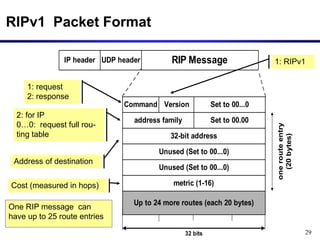
RIPv1 Packet Format
IP header UDP header RIP Message
Command Version Set to 00...0
32-bit address
Unused (Set to 00...0)
address family Set to 00.00
Unused (Set to 00...0)
metric (1-16)
one
route
entry
(20
bytes)
Up to 24 more routes (each 20 bytes)
32 bits
One RIP message can
have up to 25 route entries
1: request
2: response
2: for IP
0…0: request full rou-
ting table
Address of destination
Cost (measured in hops)
1: RIPv1
30
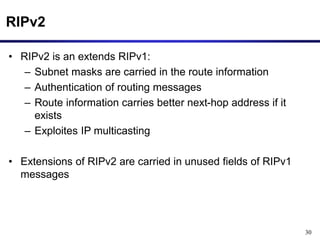
RIPv2
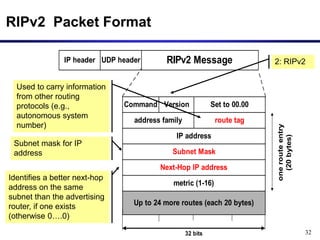
• RIPv2 is an extends RIPv1:
– Subnet masks are carried in the route information
– Authentication of routing messages
– Route information carries better next-hop address if it
exists
– Exploites IP multicasting
• Extensions of RIPv2 are carried in unused fields of RIPv1
messages
31
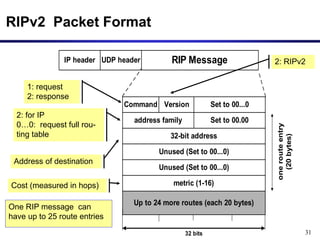
RIPv2 Packet Format
IP header UDP header RIP Message
Command Version Set to 00...0
32-bit address
Unused (Set to 00...0)
address family Set to 00.00
Unused (Set to 00...0)
metric (1-16)
one
route
entry
(20
bytes)
Up to 24 more routes (each 20 bytes)
32 bits
One RIP message can
have up to 25 route entries
1: request
2: response
2: for IP
0…0: request full rou-
ting table
Address of destination
Cost (measured in hops)
2: RIPv2
32
RIPv2 Packet Format
IP header UDP header RIPv2 Message
Command Version Set to 00.00
IP address
Subnet Mask
address family route tag
Next-Hop IP address
metric (1-16)
one
route
entry
(20
bytes)
Up to 24 more routes (each 20 bytes)
32 bits
Used to carry information
from other routing
protocols (e.g.,
autonomous system
number)
Identifies a better next-hop
address on the same
subnet than the advertising
router, if one exists
(otherwise 0….0)
2: RIPv2
Subnet mask for IP
address
33
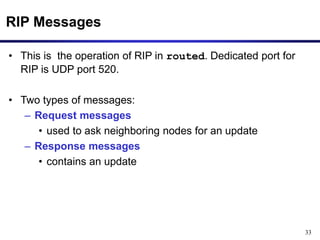
RIP Messages
• This is the operation of RIP in routed. Dedicated port for
RIP is UDP port 520.
• Two types of messages:
– Request messages
• used to ask neighboring nodes for an update
– Response messages
• contains an update
34
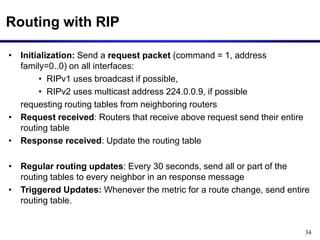
Routing with RIP
• Initialization: Send a request packet (command = 1, address
family=0..0) on all interfaces:
• RIPv1 uses broadcast if possible,
• RIPv2 uses multicast address 224.0.0.9, if possible
requesting routing tables from neighboring routers
• Request received: Routers that receive above request send their entire
routing table
• Response received: Update the routing table
• Regular routing updates: Every 30 seconds, send all or part of the
routing tables to every neighbor in an response message
• Triggered Updates: Whenever the metric for a route change, send entire
routing table.
35
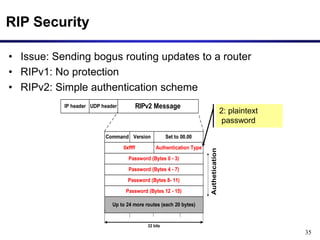
RIP Security
• Issue: Sending bogus routing updates to a router
• RIPv1: No protection
• RIPv2: Simple authentication scheme
IP header UDP header RIPv2 Message
Command Version Set to 00.00
Password (Bytes 0 - 3)
Password (Bytes 4 - 7)
0xffff Authentication Type
Password (Bytes 8- 11)
Password (Bytes 12 - 15)
Authetication
Up to 24 more routes (each 20 bytes)
32 bits
2: plaintext
password
36
RIP Problems
• RIP takes a long time to stabilize
– Even for a small network, it takes several minutes until the
routing tables have settled after a change
• RIP has all the problems of distance vector algorithms, e.g.,
count-to-Infinity
» RIP uses split horizon to avoid count-to-infinity
• The maximum path in RIP is 15 hops

module10-rip (1).ppt

  • 1.
    1 Dynamic Routing ProtocolsI RIP Relates to Lab 4. The first module on dynamic routing protocols. This module provides an overview of routing, introduces terminology (interdomain, intradomain, autonomous system),
  • 2.
    2 Routing • Recall: Thereare two parts to routing IP packets: 1. How to pass a packet from an input interface to the output interface of a router (packet forwarding) ? 2. How to find and setup a route ? • We already discussed the packet forwarding part • There are two approaches for calculating the routing tables: – Static Routing – Dynamic Routing: Routes are calculated by a routing protocol
  • 3.
    3 IP Routing TCP Network Interfaces IPInput Queue IP Output: Calculate Next Hop Router ICMP routing daemon Process IP Options IP Layer For me ? UDP route comman d netstat comman d routing table ICM P Redirect Source Routing NO: if forwarding enabled YES
  • 4.
    4 Autonomous Systems • Anautonomous system is a region of the Internet that is administered by a single entity. • Examples of autonomous regions are: • UVA’s campus network • MCI’s backbone network • Regional Internet Service Provider • Routing is done differently within an autonomous system (intradomain routing) and between autonomous system (interdomain routing).
  • 5.
  • 6.
    6 Interdomain and IntradomainRouting Intradomain Routing • Routing within an AS • Ignores the Internet outside the AS • Protocols for Intradomain routing are also called Interior Gateway Protocols or IGP’s. • Popular protocols are – RIP (simple, old) – OSPF (better) Interdomain Routing • Routing between AS’s • Assumes that the Internet consists of a collection of interconnected AS’s • Normally, there is one dedicated router in each AS that handles interdomain traffic. • Protocols for interdomain routing are also called Exterior Gateway Protocols or EGP’s. • Routing protocols: – EGP – BGP (more recent)
  • 7.
    7 Components of aRouting Algorithm • A procedure for sending and receiving reachability information about network to other routers • A procedure for calculating optimal routes – Routes are calculated using a shortest path algorithm: • Goal: Given a network were each link is assigned a cost. Find the path with the least cost between two networks with minimum cost. • A procedure for reacting to and advertising topology changes
  • 8.
    8 Approaches to ShortestPath Routing • There are two basic routing algorithms found on the Internet. 1. Distance Vector Routing • Each node knows the distance (=cost) to its directly connected neighbors • A node sends periodically a list of routing updates to its neighbors. • If all nodes update their distances, the routing tables eventually converge • New nodes advertise themselves to their neighbors 2. Link State Routing • Each node knows the distance to its neighbors • The distance information (=link state) is broadcast to all nodes in the network • Each node calculates the routing tables independently
  • 9.
    9 Routing Algorithms inthe Internet Distance Vector • Routing Information Protocol (RIP) • Gateway-to-Gateway Protocol (GGP) • Exterior Gateway Protocol (EGP) • Interior Gateway Routing Protocol (IGRP) Link State • Intermediate System - Intermediate System (IS-IS) • Open Shortest Path First (OSPF)
  • 10.
    10 Dynamic IP RoutingProtocols • In Unix systems, the dynamic setting of routing tables is done by the routed or gated daemons • The routing daemons execute the following intradomain and interdomain routing protocols intradomain interdomain
  • 11.
    11 A network asa graph • In the following, networks are represented as a network graph: – nodes are connected by networks – network can be a link or a LAN – network interface has cost – networks are destinations – Net(v,w) is an IP address of a network • For ease of notation, we often replace the clouds between nodes by simple links. n v w Net Net(v,w) Net(v,n) c(v,w) c(v,n)
  • 12.
    12 Distance Vector Algorithm:Routing Table Dest n v w D(v,Net) n cost via (next hop) Net RoutingTable of node v Net Net(v,w) c(v,w) Net(v,n) c(v,n) Net(v,w): Network address of the network between v and w The network can be a link, but could also be a LAN c(v,w): cost to transmit on the interface to network Net(v,w)
  • 13.
    13 Distance Vector Algorithm:Messages Dest D(v,Net) n cost via (next hop) Net RoutingTable of node v • Nodes send messages to their neighbors which contain routing table entries • A message has the format: [Net , D(v,Net)] means“My cost to go to Net is D (v,Net)” v n [Net , D(v,Net)]
  • 14.
    14 Distance Vector Algorithm:Sending Updates Dest D(v,Net2) n cost via (next hop) Net2 RoutingTable of node v D(v,Net1) m Net1 D(v,NetN) w NetN Periodically, each node v sends the content of its routing table to its neighbors: n v w m [NetN,D(v,NetN)] [Net1,D(v,Net1)] [NetN,D(v,NetN)] [Net1,D(v,Net1)] [NetN,D(v,NetN)] [Net1,D(v,Net1)]
  • 15.
    15 Initiating Routing TableI Dest c (v,w) Net(v,w) 0 m cost via (next hop) Net(v,m) RoutingTable c(v,m) Net(v,m) c(v,n) Net(v,n) 0 w Net(v,w) 0 n Net(v,n) n v w m • Suppose a new node v becomes active. • The cost to access directly connected networks is zero: – D (v, Net(v,m)) = 0 – D (v, Net(v,w)) = 0 – D (v, Net(v,n)) = 0
  • 16.
    16 Initiating Routing TableII Dest 0 m cost via (next hop) Net(v,m) RoutingTable 0 w Net(v,w) 0 n Net(v,n) • New node v sends the routing table entry to all its neighbors: n v w m [w,0] [n,0] [n,0] [m,0] [m,0] [w,0] n v w m [Net(v,w),0] [Net(v,n),0] [Net(v,n),0] [Net(v,m),0] [Net(v,w),0] [Net(v,m),0] n v w m [Net(v,w),0] [Net(v,n),0] [Net(v,n),0] [Net(v,m),0] [Net(v,w),0] [Net(v,m),0]
  • 17.
    17 n v w m [NetN,D(n,NetN)] [Net1,D(n,Net1)] [NetN,D(m,NetN)] [Net1,D(m,Net1)] [NetN,D(w,NetN)] [Net1,D(w,Net1)] Initiating RoutingTable III • Node v receives the routing tables from other nodes and builds up its routing table
  • 18.
    18 Updating Routing TablesI c(v,m) Net(v,m) n v w m Net [Net,D(m,Net)] • Suppose node v receives a message from node m: [Net,D(m,Net)] if ( D(m,Net) + c (v,m) < D (v,Net) ) { Dnew (v,Net) := D (m,Net) + c (v,m); Update routing table; send message [Net, Dnew (v,Net)] to all neighbors } Node v updates its routing table and sends out further messages if the message reduces the cost of a route:
  • 19.
    19 Updating Routing TablesII c(v,m) Net(v,m) n v w m Net [Net,D(m,Net)] • Before receiving the message: Dest D(v,Net) ?? cost via (next hop) Net RoutingTable c(v,m) Net(v,m) n v w m Net [Net,Dnew (v,Net)] [Net,Dnew (v,Net)] Dest m cost via (next hop) Net RoutingTable Dnew (v,Net) • Suppose D (m,Net) + c (v,m) < D (v,Net):
  • 20.
    20 Example Router A RouterB Router C Router D 10.0.2.0/24 10.0.3.0/24 10.0.4.0/24 10.0.5.0/24 10.0.1.0/24 .1 .2 .2 .2 .2 .1 .1 .1 Assume: - link cost is 1, i.e., c(v,w) = 1 - all updates, updates occur simultaneously - Initially, each router only knows the cost of connected interfaces t=0: 10.0.1.0 - 0 10.0.2.0 - 0 Net via cost t=0: 10.0.2.0 - 0 10.0.3.0 - 0 Net via cost t=0: 10.0.3.0 - 0 10.0.4.0 - 0 Net via cost t=0: 10.0.4.0 - 0 10.0.5.0 - 0 Net via cost t=1: 10.0.1.0 - 0 10.0.2.0 - 0 10.0.3.0 10.0.2.2 1 t=2: 10.0.1.0 - 0 10.0.2.0 - 0 10.0.3.0 10.0.2.2 1 10.0.4.0 10.0.2.2 2 t=2: 10.0.1.0 10.0.2.1 1 10.0.2.0 - 0 10.0.3.0 - 0 10.0.4.0 10.0.3.2 1 10.0.5.0 10.0.3.2 2 t=1: 10.0.1.0 10.0.2.1 1 10.0.2.0 - 0 10.0.3.0 - 0 10.0.4.0 10.0.3.2 1 t=2: 10.0.1.0 10.0.3.1 2 10.0.2.0 10.0.3.1 1 10.0.3.0 - 0 10.0.4.0 - 0 10.0.5.0 10.0.4.2 1 t=1: 10.0.2.0 10.0.3.1 1 10.0.3.0 - 0 10.0.4.0 - 0 10.0.5.0 10.0.4.2 1 t=2: 10.0.2.0 10.0.4.1 2 10.0.3.0 10.0.4.1 1 10.0.4.0 - 0 10.0.5.0 - 0 t=1: 10.0.3.0 10.0.4.1 1 10.0.4.0 - 0 10.0.5.0 - 0
  • 21.
    21 Example Router A RouterB Router C Router D 10.0.2.0/24 10.0.3.0/24 10.0.4.0/24 10.0.5.0/24 10.0.1.0/24 .1 .2 .2 .2 .2 .1 .1 .1 t=3: 10.0.1.0 - 0 10.0.2.0 - 0 10.0.3.0 10.0.2.2 1 10.0.4.0 10.0.2.2 2 10.0.5.0 10.0.2.2 3 Net via cost t=3: 10.0.1.0 10.0.2.1 1 10.0.2.0 - 0 10.0.3.0 - 0 10.0.4.0 10.0.3.2 1 10.0.5.0 10.0.3.2 2 Net via cost t=3: 10.0.1.0 10.0.3.1 2 10.0.2.0 10.0.3.1 1 10.0.3.0 - 0 10.0.4.0 - 0 10.0.5.0 10.0.4.2 1 Net via cost t=3: 10.0.1.0 10.0.4.1 3 10.0.2.0 10.0.4.1 2 10.0.3.0 10.0.4.1 1 10.0.4.0 - 0 10.0.5.0 - 0 Net via cost Now, routing tables have converged ! t=2: 10.0.1.0 - 0 10.0.2.0 - 0 10.0.3.0 10.0.2.2 1 10.0.4.0 10.0.2.2 2 t=2: 10.0.1.0 10.0.2.1 1 10.0.2.0 - 0 10.0.3.0 - 0 10.0.4.0 10.0.3.2 1 10.0.5.0 10.0.3.2 2 t=2: 10.0.1.0 10.0.3.1 2 10.0.2.0 10.0.3.1 1 10.0.3.0 - 0 10.0.4.0 - 0 10.0.5.0 10.0.4.2 1 t=2: 10.0.2.0 10.0.4.1 2 10.0.3.0 10.0.4.1 1 10.0.4.0 - 0 10.0.5.0 - 0
  • 22.
    22 Characteristics of DistanceVector Routing • Periodic Updates: Updates to the routing tables are sent at the end of a certain time period. A typical value is 90 seconds. • Triggered Updates: If a metric changes on a link, a router immediately sends out an update without waiting for the end of the update period. • Full Routing Table Update: Most distance vector routing protocols send their neighbors the entire routing table (not only entries which change). • Route invalidation timers: Routing table entries are invalid if they are not refreshed. A typical value is to invalidate an entry if no update is received after 3-6 update periods.
  • 23.
    23 The Count-to-Infinity Problem AB C 1 1 A's Routing Table B's Routing Table C to cost via (next hop) 2 B C to cost via (next hop) 1 C now link B-C goes down C 2 C oo C oo - C 2 B C oo C 3 C 3 A C oo - C 4 C oo C oo - C 4 B
  • 24.
    24 Count-to-Infinity • The reasonfor the count-to-infinity problem is that each node only has a “next-hop-view” • For example, in the first step, A did not advertise that its route (with cost 2) to C went through node B • How can the Count-to-Infinity problem be solved?
  • 25.
    25 Count-to-Infinity • The reasonfor the count-to-infinity problem is that each node only has a “next-hop-view” • For example, in the first step, A did not realize that its route (with cost 2) to C went through node B • How can the Count-to-Infinity problem be solved? • Solution 1: Always advertise the entire path in an update message (Path vectors) – If routing tables are large, the routing messages require substantial bandwidth – BGP uses this solution
  • 26.
    26 Count-to-Infinity • The reasonfor the count-to-infinity problem is that each node only has a “next-hop-view” • For example, in the first step, A did not realize that its route (with cost 2) to C went through node B • How can the Count-to-Infinity problem be solved? • Solution 2: Never advertise the cost to a neighbor if this neighbor is the next hop on the current path (Split Horizon) – Example: A would not send the first routing update to B, since B is the next hop on A’s current route to C – Split Horizon does not solve count-to-infinity in all cases!
  • 27.
    27 RIP - RoutingInformation Protocol • A simple intradomain protocol • Straightforward implementation of Distance Vector Routing • Each router advertises its distance vector every 30 seconds (or whenever its routing table changes) to all of its neighbors • RIP always uses 1 as link metric • Maximum hop count is 15, with “16” equal to “” • Routes are timeout (set to 16) after 3 minutes if they are not updated
  • 28.
    28 RIP - History •Late 1960s : Distance Vector protocols were used in the ARPANET • Mid-1970s: XNS (Xerox Network system) routing protocol is the precursor of RIP in IP (and Novell’s IPX RIP and Apple’s routing protocol) • 1982 Release of routed for BSD Unix • 1988 RIPv1 (RFC 1058) - classful routing • 1993 RIPv2 (RFC 1388) - adds subnet masks with each route entry - allows classless routing • 1998 Current version of RIPv2 (RFC 2453)
  • 29.
    29 RIPv1 Packet Format IPheader UDP header RIP Message Command Version Set to 00...0 32-bit address Unused (Set to 00...0) address family Set to 00.00 Unused (Set to 00...0) metric (1-16) one route entry (20 bytes) Up to 24 more routes (each 20 bytes) 32 bits One RIP message can have up to 25 route entries 1: request 2: response 2: for IP 0…0: request full rou- ting table Address of destination Cost (measured in hops) 1: RIPv1
  • 30.
    30 RIPv2 • RIPv2 isan extends RIPv1: – Subnet masks are carried in the route information – Authentication of routing messages – Route information carries better next-hop address if it exists – Exploites IP multicasting • Extensions of RIPv2 are carried in unused fields of RIPv1 messages
  • 31.
    31 RIPv2 Packet Format IPheader UDP header RIP Message Command Version Set to 00...0 32-bit address Unused (Set to 00...0) address family Set to 00.00 Unused (Set to 00...0) metric (1-16) one route entry (20 bytes) Up to 24 more routes (each 20 bytes) 32 bits One RIP message can have up to 25 route entries 1: request 2: response 2: for IP 0…0: request full rou- ting table Address of destination Cost (measured in hops) 2: RIPv2
  • 32.
    32 RIPv2 Packet Format IPheader UDP header RIPv2 Message Command Version Set to 00.00 IP address Subnet Mask address family route tag Next-Hop IP address metric (1-16) one route entry (20 bytes) Up to 24 more routes (each 20 bytes) 32 bits Used to carry information from other routing protocols (e.g., autonomous system number) Identifies a better next-hop address on the same subnet than the advertising router, if one exists (otherwise 0….0) 2: RIPv2 Subnet mask for IP address
  • 33.
    33 RIP Messages • Thisis the operation of RIP in routed. Dedicated port for RIP is UDP port 520. • Two types of messages: – Request messages • used to ask neighboring nodes for an update – Response messages • contains an update
  • 34.
    34 Routing with RIP •Initialization: Send a request packet (command = 1, address family=0..0) on all interfaces: • RIPv1 uses broadcast if possible, • RIPv2 uses multicast address 224.0.0.9, if possible requesting routing tables from neighboring routers • Request received: Routers that receive above request send their entire routing table • Response received: Update the routing table • Regular routing updates: Every 30 seconds, send all or part of the routing tables to every neighbor in an response message • Triggered Updates: Whenever the metric for a route change, send entire routing table.
  • 35.
    35 RIP Security • Issue:Sending bogus routing updates to a router • RIPv1: No protection • RIPv2: Simple authentication scheme IP header UDP header RIPv2 Message Command Version Set to 00.00 Password (Bytes 0 - 3) Password (Bytes 4 - 7) 0xffff Authentication Type Password (Bytes 8- 11) Password (Bytes 12 - 15) Authetication Up to 24 more routes (each 20 bytes) 32 bits 2: plaintext password
  • 36.
    36 RIP Problems • RIPtakes a long time to stabilize – Even for a small network, it takes several minutes until the routing tables have settled after a change • RIP has all the problems of distance vector algorithms, e.g., count-to-Infinity » RIP uses split horizon to avoid count-to-infinity • The maximum path in RIP is 15 hops