NETWORK COMPONENTS
What is a Network?
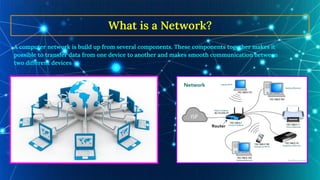
A computer network is build up from several components. These components together makes it
possible to transfer data from one device to another and makes smooth communication between
two different devices
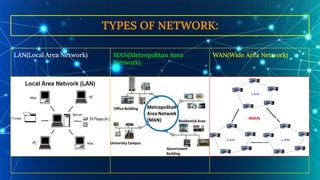
TYPES OF NETWORK:
LAN(Local Area Network) MAN(Metropolitan Area
Network)
WAN(Wide Area Network)
NETWORK COMPONENTS:
There are 3 broad categories of network components:
1)End Device-Computer, Laptop,Printer, IP Phone.
2)Intermediary Device-Repeater, Bridge Hub, Ethernet Switch. Router, Firewall
3)Network Media:Its of 2 types wired and wireless
a)Wired-LAN Cable, Optical Fibre Cable
b)Wireless-Wi-Fi, Satellite Link
NETWORK INTERFACE CARD:
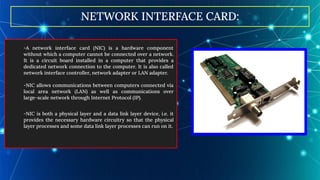
-A network interface card (NIC) is a hardware component
without which a computer cannot be connected over a network.
It is a circuit board installed in a computer that provides a
dedicated network connection to the computer. It is also called
network interface controller, network adapter or LAN adapter.
-NIC allows communications between computers connected via
local area network (LAN) as well as communications over
large-scale network through Internet Protocol (IP).
-NIC is both a physical layer and a data link layer device, i.e. it
provides the necessary hardware circuitry so that the physical
layer processes and some data link layer processes can run on it.
REPEATER:
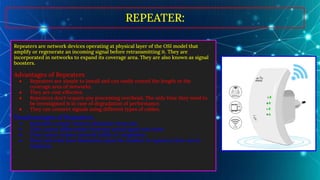
Repeaters are network devices operating at physical layer of the OSI model that
amplify or regenerate an incoming signal before retransmitting it. They are
incorporated in networks to expand its coverage area. They are also known as signal
boosters.
Advantages of Repeaters
● Repeaters are simple to install and can easily extend the length or the
coverage area of networks.
● They are cost effective.
● Repeaters don’t require any processing overhead. The only time they need to
be investigated is in case of degradation of performance.
● They can connect signals using different types of cables.
Disadvantages of Repeaters
● Repeaters cannot connect dissimilar networks.
● They cannot differentiate between actual signal and noise.
● They cannot reduce network traffic or congestion.
● Most networks have limitations upon the number of repeaters that can be
deployed.
HUBS:
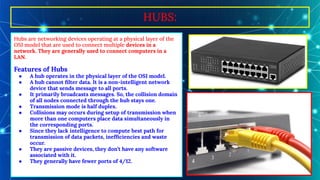
Hubs are networking devices operating at a physical layer of the
OSI model that are used to connect multiple devices in a
network. They are generally used to connect computers in a
LAN.
Features of Hubs
● A hub operates in the physical layer of the OSI model.
● A hub cannot filter data. It is a non-intelligent network
device that sends message to all ports.
● It primarily broadcasts messages. So, the collision domain
of all nodes connected through the hub stays one.
● Transmission mode is half duplex.
● Collisions may occurs during setup of transmission when
more than one computers place data simultaneously in
the corresponding ports.
● Since they lack intelligence to compute best path for
transmission of data packets, inefficiencies and waste
occur.
● They are passive devices, they don’t have any software
associated with it.
● They generally have fewer ports of 4/12.
BRIDGES:
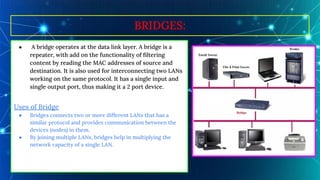
● A bridge operates at the data link layer. A bridge is a
repeater, with add on the functionality of filtering
content by reading the MAC addresses of source and
destination. It is also used for interconnecting two LANs
working on the same protocol. It has a single input and
single output port, thus making it a 2 port device.
Uses of Bridge
● Bridges connects two or more different LANs that has a
similar protocol and provides communication between the
devices (nodes) in them.
● By joining multiple LANs, bridges help in multiplying the
network capacity of a single LAN.
SWITCHES:
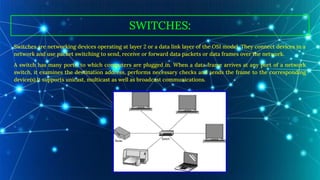
Switches are networking devices operating at layer 2 or a data link layer of the OSI model. They connect devices in a
network and use packet switching to send, receive or forward data packets or data frames over the network.
A switch has many ports, to which computers are plugged in. When a data frame arrives at any port of a network
switch, it examines the destination address, performs necessary checks and sends the frame to the corresponding
device(s).It supports unicast, multicast as well as broadcast communications.
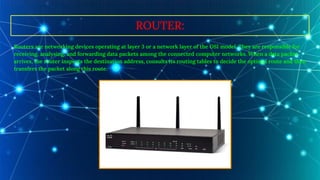
ROUTER:
Routers are networking devices operating at layer 3 or a network layer of the OSI model. They are responsible for
receiving, analysing, and forwarding data packets among the connected computer networks. When a data packet
arrives, the router inspects the destination address, consults its routing tables to decide the optimal route and then
transfers the packet along this route.
GATEWAYS
A gateway is a network node that forms a passage between two
networks operating with different transmission protocols.
Features of Gateways
● Gateway is located at the boundary of a network and
manages all data that inflows or outflows from that
network.
● It forms a passage between two different networks
operating with different transmission protocols.
● A gateway operates as a protocol converter, providing
compatibility between the different protocols used in
the two different networks.
● The feature that differentiates a gateway from other
network devices is that it can operate at any layer of the
OSI model.
NETWORK COMPONENTS AND CABLES.pdf

NETWORK COMPONENTS AND CABLES.pdf

  • 1.
  • 2.
    What is aNetwork? A computer network is build up from several components. These components together makes it possible to transfer data from one device to another and makes smooth communication between two different devices
  • 3.
    TYPES OF NETWORK: LAN(LocalArea Network) MAN(Metropolitan Area Network) WAN(Wide Area Network)
  • 4.
    NETWORK COMPONENTS: There are3 broad categories of network components: 1)End Device-Computer, Laptop,Printer, IP Phone. 2)Intermediary Device-Repeater, Bridge Hub, Ethernet Switch. Router, Firewall 3)Network Media:Its of 2 types wired and wireless a)Wired-LAN Cable, Optical Fibre Cable b)Wireless-Wi-Fi, Satellite Link
  • 5.
    NETWORK INTERFACE CARD: -Anetwork interface card (NIC) is a hardware component without which a computer cannot be connected over a network. It is a circuit board installed in a computer that provides a dedicated network connection to the computer. It is also called network interface controller, network adapter or LAN adapter. -NIC allows communications between computers connected via local area network (LAN) as well as communications over large-scale network through Internet Protocol (IP). -NIC is both a physical layer and a data link layer device, i.e. it provides the necessary hardware circuitry so that the physical layer processes and some data link layer processes can run on it.
  • 6.
    REPEATER: Repeaters are networkdevices operating at physical layer of the OSI model that amplify or regenerate an incoming signal before retransmitting it. They are incorporated in networks to expand its coverage area. They are also known as signal boosters. Advantages of Repeaters ● Repeaters are simple to install and can easily extend the length or the coverage area of networks. ● They are cost effective. ● Repeaters don’t require any processing overhead. The only time they need to be investigated is in case of degradation of performance. ● They can connect signals using different types of cables. Disadvantages of Repeaters ● Repeaters cannot connect dissimilar networks. ● They cannot differentiate between actual signal and noise. ● They cannot reduce network traffic or congestion. ● Most networks have limitations upon the number of repeaters that can be deployed.
  • 7.
    HUBS: Hubs are networkingdevices operating at a physical layer of the OSI model that are used to connect multiple devices in a network. They are generally used to connect computers in a LAN. Features of Hubs ● A hub operates in the physical layer of the OSI model. ● A hub cannot filter data. It is a non-intelligent network device that sends message to all ports. ● It primarily broadcasts messages. So, the collision domain of all nodes connected through the hub stays one. ● Transmission mode is half duplex. ● Collisions may occurs during setup of transmission when more than one computers place data simultaneously in the corresponding ports. ● Since they lack intelligence to compute best path for transmission of data packets, inefficiencies and waste occur. ● They are passive devices, they don’t have any software associated with it. ● They generally have fewer ports of 4/12.
  • 8.
    BRIDGES: ● A bridgeoperates at the data link layer. A bridge is a repeater, with add on the functionality of filtering content by reading the MAC addresses of source and destination. It is also used for interconnecting two LANs working on the same protocol. It has a single input and single output port, thus making it a 2 port device. Uses of Bridge ● Bridges connects two or more different LANs that has a similar protocol and provides communication between the devices (nodes) in them. ● By joining multiple LANs, bridges help in multiplying the network capacity of a single LAN.
  • 9.
    SWITCHES: Switches are networkingdevices operating at layer 2 or a data link layer of the OSI model. They connect devices in a network and use packet switching to send, receive or forward data packets or data frames over the network. A switch has many ports, to which computers are plugged in. When a data frame arrives at any port of a network switch, it examines the destination address, performs necessary checks and sends the frame to the corresponding device(s).It supports unicast, multicast as well as broadcast communications.
  • 10.
    ROUTER: Routers are networkingdevices operating at layer 3 or a network layer of the OSI model. They are responsible for receiving, analysing, and forwarding data packets among the connected computer networks. When a data packet arrives, the router inspects the destination address, consults its routing tables to decide the optimal route and then transfers the packet along this route.
  • 11.
    GATEWAYS A gateway isa network node that forms a passage between two networks operating with different transmission protocols. Features of Gateways ● Gateway is located at the boundary of a network and manages all data that inflows or outflows from that network. ● It forms a passage between two different networks operating with different transmission protocols. ● A gateway operates as a protocol converter, providing compatibility between the different protocols used in the two different networks. ● The feature that differentiates a gateway from other network devices is that it can operate at any layer of the OSI model.