• Many interconnection device are required
in a modern network, from the interface
that allows a single computer to
communicate with other computers via a
LAN cable or a telephone line, to the large
and complex switching devices that
interconnect two or more entire networks.
interconnection device
•
•
•
•
•
•

Network interface card
Repeater
Hub
Bridge
Switch
Router
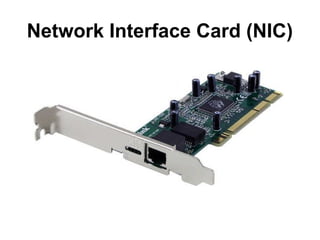
Network Interface Card (NIC)
• Every device on a network that needs to
transmit and receive data must have
a network interface card (NIC) installed.
• They are sometimes callednetwork
adapters, and are usually installed into
one of the computer's expansion slots in
the same way as a sound or graphics
card.
• The NIC includes a transceiver, (a transmitter
and receiver combined).
• The transceiver allows a network device to
transmit and receive data via the transmission
medium.
• Each NIC has a unique 48-bit Media Access
Control (MAC) address burned in to its ROM
during manufacture.
• A MAC address is usually shown in hexadecimal
format, with each octet separated by a dash or
colon, for example: 00-90-47-03-B6-C4.
Repeater
• A repeater is a physical layer (OSI model)
device that amplifies the signal of one
segment onto one or more other
segments.
• Repeaters are used to extend the
maximum possible distance between end
nodes on a segment.
• They are completely transparent to the
sending and receiving nodes.
HUB
• A hub is used in a wired network to
connect Ethernet cables from a number of
devices together.
• The hub allows each device to talk to the
others. Hubs aren’t used in networks with
only wireless connections, since network
devices such as routers and adapters
communicate directly with one another.
• Hubs are such simple devices – they
require no configuration, and have no
manuals – that their function is now
included in other devices such as routers
and modems.
Bridge
•  A bridge device filters data traffic at a
network boundary.
• Bridges reduce the amount of traffic on a
LAN by dividing it into two segments.
• Bridges operate at the data link layer
(Layer 2) of the OSI model
Switch
• A network switch is a small hardware
device that joins multiple computers
together within one local area network
(LAN).
• Network switches operate at layer two
(Data Link Layer) of the OSI model.
• Switches, unlike hubs, are capable of
inspecting data as messages are received
via a method called packet switching.
Router
• Routers are small physical devices that
join multiple networks together.
• Technically, a router is a Layer
3 gateway device, meaning that it
connects two or more networks and that
the router operates at the network layer of
the OSI model.
• By maintaining configuration information in
a piece of storage called the routing table,
wired or wireless routers also have the
ability to filter traffic, either incoming or
outgoing, based on the IP addresses of
senders and receivers.
REPEATER

T
C
H
 

ROUTER 

S
W
I
G
A
T
E
W
A
Y

Network Devices

  • 2.
    • Many interconnectiondevice are required in a modern network, from the interface that allows a single computer to communicate with other computers via a LAN cable or a telephone line, to the large and complex switching devices that interconnect two or more entire networks.
  • 3.
  • 4.
  • 5.
    • Every deviceon a network that needs to transmit and receive data must have a network interface card (NIC) installed. • They are sometimes callednetwork adapters, and are usually installed into one of the computer's expansion slots in the same way as a sound or graphics card.
  • 6.
    • The NICincludes a transceiver, (a transmitter and receiver combined). • The transceiver allows a network device to transmit and receive data via the transmission medium. • Each NIC has a unique 48-bit Media Access Control (MAC) address burned in to its ROM during manufacture. • A MAC address is usually shown in hexadecimal format, with each octet separated by a dash or colon, for example: 00-90-47-03-B6-C4.
  • 7.
  • 8.
    • A repeateris a physical layer (OSI model) device that amplifies the signal of one segment onto one or more other segments. • Repeaters are used to extend the maximum possible distance between end nodes on a segment. • They are completely transparent to the sending and receiving nodes.
  • 9.
    HUB • A hubis used in a wired network to connect Ethernet cables from a number of devices together. • The hub allows each device to talk to the others. Hubs aren’t used in networks with only wireless connections, since network devices such as routers and adapters communicate directly with one another.
  • 10.
    • Hubs aresuch simple devices – they require no configuration, and have no manuals – that their function is now included in other devices such as routers and modems.
  • 11.
  • 12.
    •  A bridgedevice filters data traffic at a network boundary. • Bridges reduce the amount of traffic on a LAN by dividing it into two segments. • Bridges operate at the data link layer (Layer 2) of the OSI model
  • 13.
    Switch • A network switchis a small hardware device that joins multiple computers together within one local area network (LAN). • Network switches operate at layer two (Data Link Layer) of the OSI model. • Switches, unlike hubs, are capable of inspecting data as messages are received via a method called packet switching.
  • 15.
    Router • Routers aresmall physical devices that join multiple networks together. • Technically, a router is a Layer 3 gateway device, meaning that it connects two or more networks and that the router operates at the network layer of the OSI model.
  • 16.
    • By maintainingconfiguration information in a piece of storage called the routing table, wired or wireless routers also have the ability to filter traffic, either incoming or outgoing, based on the IP addresses of senders and receivers.
  • 18.