Kyunghoon Kim
Network Analysis with networkX
Fundamentals of network theory-1
2014. 05. 14.
UNIST Mathematical Sciences
Kyunghoon Kim ( Kyunghoon@unist.ac.kr )
5/14/2014 Fundamentals of network theory-1 1
Kyunghoon Kim
● A NETWORK is, in its simplest form, a collection
of points joined together in pairs by lines.
What is a Network?
Newman, Mark. Networks: an introduction. OUP Oxford, 2009.
5/14/2014 Fundamentals of network theory-1 2
Kyunghoon Kim
● A NETWORK is, in its simplest form, a collection
of points joined together in pairs by lines.
● Network is general, but powerful means of
representing patterns of connections or
interactions between the parts of a system.
What is a Network?
Newman, Mark. Networks: an introduction. OUP Oxford, 2009.
5/14/2014 Fundamentals of network theory-1 3
Kyunghoon Kim
What is a Network?
Shipping (sea) networksTelecommunications networks
Air traffic networkData networks
Source: Britain From Above (http://www.bbc.co.uk/britainfromabove)
5/14/2014 Fundamentals of network theory-1 4
Kyunghoon Kim
● Network thinking can be applied almost
anywhere!
What is a Network?
5/14/2014 Fundamentals of network theory-1 5
Kyunghoon Kim
● Network thinking can be applied almost
anywhere!
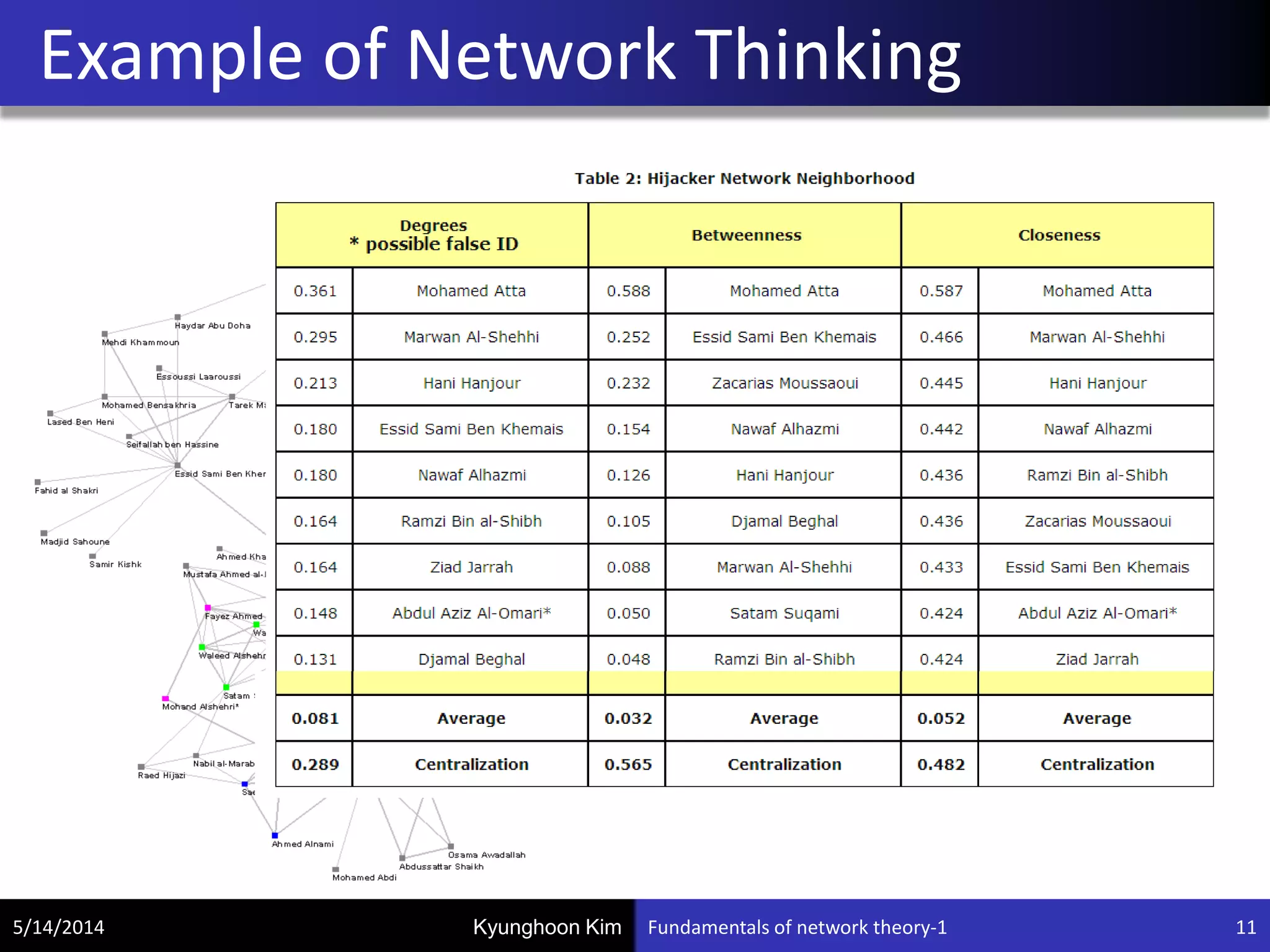
Example of Network Thinking
http://journals.uic.edu/ojs/index.php/fm/article/view/941/863
My data sources were publicly released information reported in major
newspapers such as the New York Times, Wall Street Journal, Washington
Post, and the Los Angeles Times. As I monitored the investigation, it was apparent
that the investigators would not be releasing all pertinent
network/relationship information and actually may be releasing misinformation to
fool the enemy. I soon realized that the data was not going to be as complete and
accurate as I had grown accustomed to in mapping and measuring organizational
networks.
5/14/2014 Fundamentals of network theory-1 6
Kyunghoon Kim
Example of Network Thinking
http://www.orgnet.com/hijackers.html
5/14/2014 Fundamentals of network theory-1 7
Kyunghoon Kim
Example of Network Thinking
5/14/2014 Fundamentals of network theory-1 8
Kyunghoon Kim
Example of Network Thinking
Six (6) shortcuts were added to the
network temporarily in order to
collaborate and coordinate.
These shortcuts reduced the average
path length in the network by over 40%
thus improving the information flow in
the network - see Table 1.
When the network is brought closer
together by these shortcuts, all of the
pilots ended up in a small clique - the
perfect structure to efficiently coordinate
tasks and activities.
There is a constant dynamic
between keeping the network hidden
and actively using it to accomplish
objectives (Baker and Faulkner, 1993).
5/14/2014 Fundamentals of network theory-1 9
Kyunghoon Kim
Example of Network Thinking
5/14/2014 Fundamentals of network theory-1 10
Kyunghoon Kim
Example of Network Thinking
5/14/2014 Fundamentals of network theory-1 11
Kyunghoon Kim
Example of Network Thinking
Saddam Hussein
5/14/2014 Fundamentals of network theory-1 12
Kyunghoon Kim
Example of Network Thinking
5/14/2014 Fundamentals of network theory-1 13
Kyunghoon Kim
Example of Network Thinking
5/14/2014 Fundamentals of network theory-1 14
An Introduction to Network Theory | Kyle Findlay | SAMRA 2010 | 15
Where’s it applied?
Epidemiology (i.e. spread of diseases)
e.g. spread of foot & mouth disease in the UK in 2001 over 75 days
URL: http://www.youtube.com/watch?v=PufTeIBNRJ4
An Introduction to Network Theory | Kyle Findlay | SAMRA 2010 | 16
Physics
e.g. particle interactions, the structure of the universe
Where’s it applied?
URL: http://www.youtube.com/watch?v=8C_dnP2fvxk
An Introduction to Network Theory | Kyle Findlay | SAMRA 2010 | 17
Engineering
e.g. creation of robust infrastructure (e.g. electricity, telecoms), rust formation (natural
growth processes similar to diffusion limited aggregation)
Where’s it applied?
URL: http://www.youtube.com/watch?v=lRZ2iEHFgGo URL: http://www.youtube.com/watch?v=AEoP-XtJueo
An Introduction to Network Theory | Kyle Findlay | SAMRA 2010 | 18
Technology
e.g. mapping the online world, making networks resilient in the face of cyber-terrorism,
optimising cellular networks, controlling air traffic
Where’s it applied?
URL: http://www.youtube.com/watch?v=l-RoDv7c5ok URL: http://www.youtube.com/watch?v=o4g930pm8Ms
Vid not working
An Introduction to Network Theory | Kyle Findlay | SAMRA 2010 | 19
Where’s it applied?
Biology
e.g. fish swimming in schools, ant colonies, birds flying in formation, crickets chirping in
unison, giant honeybees shimmering
URL: http://www.youtube.com/watch?v=Sp8tLPDMUygURL: http://www.youtube.com/watch?v=YadP3w7vkJA
An Introduction to Network Theory | Kyle Findlay | SAMRA 2010 | 20
Medicine
e.g. cell formation, nervous system, neural networks
Where’s it applied?
Source: The Human Brain Book by Rita Carter
An Introduction to Network Theory | Kyle Findlay | SAMRA 2010 | 21
And, most interestingly…society
e.g. interactions between people (e.g. Facebook; group behaviour)
Where’s it applied?
URL: http://www.youtube.com/watch?v=9n9irapdON4 URL: http://www.youtube.com/watch?v=sD2yosZ9qDw
Kyunghoon Kim
● A network – also called a graph in the
mathematical literature – is, as we have said, a
collection of vertices joined by edges.
Networks and their Representation
Area Object Relation
Graph Theory Vertices Edges
Computer Science Nodes Links
Physics Sites Bonds
Sociology Actors Ties
5/14/2014 Fundamentals of network theory-1 22
Kyunghoon Kim
Networks and their Representation
Figure 6.1: Two small networks. (a) A simple graph, i.e., one having no multiedges or self-edges.
(b) A network with both multiedges and self-edges.
Newman, Mark. Networks: an introduction. OUP Oxford, 2009.
5/14/2014 Fundamentals of network theory-1 23
Kyunghoon Kim
Networks and their Representation
𝐴𝐴𝑖𝑖𝑖𝑖 = �
1
0
𝑖𝑖𝑖𝑖 𝑡𝑡 𝑡𝑡𝑡𝑡𝑡𝑡𝑡 𝑖𝑖𝑖𝑖 𝑎𝑎𝑎𝑎 𝑒𝑒𝑒𝑒𝑒𝑒𝑒𝑒 𝑏𝑏𝑏𝑏𝑏𝑏𝑏𝑏𝑏𝑏𝑏𝑏𝑏𝑏 𝑣𝑣𝑣𝑣𝑣𝑣𝑣𝑣𝑣𝑣𝑣𝑣𝑣𝑣𝑣𝑣 𝑖𝑖 𝑎𝑎𝑎𝑎𝑎𝑎 𝑗𝑗,
𝑜𝑜𝑜𝑜𝑜𝑜𝑜𝑜𝑜𝑜𝑜𝑜𝑜𝑜𝑜𝑜𝑜.
5/14/2014 Fundamentals of network theory-1 24
Kyunghoon Kim
● import networkx as nx
G = nx.Graph()
G.add_node(1)
G.add_nodes_from([1,2,3,4,5])
G.nodes()
● >>> [1, 2, 3, 4, 5]
Networks and their Representation
5/14/2014 Fundamentals of network theory-1 25
Kyunghoon Kim
● G.add_edge(1,2)
G.add_edges_from([(1,2),(2,4),(2,5),(3,4)])
G.edges()
● >>> [(1, 2), (2, 4), (2, 5), (3, 4)]
Networks and their Representation
5/14/2014 Fundamentals of network theory-1 26
Kyunghoon Kim
● nx.to_numpy_matrix(G)
● matrix([[ 0., 1., 0., 0., 0.],
[ 1., 0., 0., 1., 1.],
[ 0., 0., 0., 1., 0.],
[ 0., 1., 1., 0., 0.],
[ 0., 1., 0., 0., 0.]])
 nx.draw(G)
Networks and their Representation
5/14/2014 Fundamentals of network theory-1 27
Kyunghoon Kim
Networks and their Representation
5/14/2014 Fundamentals of network theory-1 28
Kyunghoon Kim
Networks and their Representation
= 𝐴𝐴 =
5/14/2014 Fundamentals of network theory-1 29
Kyunghoon Kim
Networks and their Representation
5/14/2014 Fundamentals of network theory-1 30
Kyunghoon Kim
Degree
5/14/2014 Fundamentals of network theory-1 31
Kyunghoon Kim
Degree
5/14/2014 Fundamentals of network theory-1 32
Kyunghoon Kim
Degree
𝑘𝑘𝑖𝑖 = �
𝑗𝑗=1
𝑛𝑛
𝐴𝐴𝑖𝑖𝑖𝑖
𝑘𝑘2 = �
𝑗𝑗=1
5
𝐴𝐴1𝑗𝑗 = 3
5/14/2014 Fundamentals of network theory-1 33
Kyunghoon Kim
Degree
5/14/2014 Fundamentals of network theory-1 34
Kyunghoon Kim
Degree
𝑘𝑘𝑖𝑖 = �
𝑗𝑗=1
𝑛𝑛
𝐴𝐴𝑖𝑖𝑖𝑖
2𝑚𝑚 = �
𝑖𝑖=1
𝑛𝑛
𝑘𝑘𝑖𝑖
5/14/2014 Fundamentals of network theory-1 35
Kyunghoon Kim
Total Degree m
𝑘𝑘𝑖𝑖 = �
𝑗𝑗=1
𝑛𝑛
𝐴𝐴𝑖𝑖𝑖𝑖
2𝑚𝑚 = �
𝑖𝑖=1
𝑛𝑛
𝑘𝑘𝑖𝑖
𝑚𝑚 =
1
2
�
𝑖𝑖=1
𝑛𝑛
𝑘𝑘𝑖𝑖 =
1
2
�
𝑖𝑖𝑖𝑖
𝐴𝐴𝑖𝑖𝑖𝑖
5/14/2014 Fundamentals of network theory-1 36
Kyunghoon Kim
Total Degree m
𝑘𝑘𝑖𝑖 = �
𝑗𝑗=1
𝑛𝑛
𝐴𝐴𝑖𝑖𝑖𝑖
2𝑚𝑚 = �
𝑖𝑖=1
𝑛𝑛
𝑘𝑘𝑖𝑖
𝑚𝑚 =
1
2
�
𝑖𝑖=1
𝑛𝑛
𝑘𝑘𝑖𝑖 =
1
2
�
𝑖𝑖𝑖𝑖
𝐴𝐴𝑖𝑖𝑖𝑖
𝑛𝑛
5/14/2014 Fundamentals of network theory-1 37
Kyunghoon Kim
Mean Degree c
𝑘𝑘𝑖𝑖 = �
𝑗𝑗=1
𝑛𝑛
𝐴𝐴𝑖𝑖𝑖𝑖
2𝑚𝑚 = �
𝑖𝑖=1
𝑛𝑛
𝑘𝑘𝑖𝑖
𝑐𝑐 =
1
𝑛𝑛
�
𝑖𝑖=1
𝑛𝑛
𝑘𝑘𝑖𝑖 =
2𝑚𝑚
𝑛𝑛
5/14/2014 Fundamentals of network theory-1 38
Kyunghoon Kim
Mean Degree c
𝑐𝑐 =
1
𝑛𝑛
�
𝑖𝑖=1
𝑛𝑛
𝑘𝑘𝑖𝑖 =
2𝑚𝑚
𝑛𝑛
>>> G.degree()
{1: 1, 2: 3, 3: 1, 4: 2, 5: 1}
>>> G.degree(2)
3
>>> Degree = G.degree().values()
[1, 3, 1, 2, 1]
>>> sum(Degree)/len(G.nodes())
1.6000000000000001
5/14/2014 Fundamentals of network theory-1 39
Kyunghoon Kim
Density or connectance of a graph
𝑛𝑛
2
=
1
2
𝑛𝑛(𝑛𝑛 − 1)
in a simple graph(i.e., one with no multiedges
or self-edges)
5/14/2014 Fundamentals of network theory-1 40
Kyunghoon Kim
Density or connectance of a graph
𝜌𝜌 =
𝑚𝑚
𝑛𝑛
2
=
2𝑚𝑚
𝑛𝑛(𝑛𝑛 − 1)
=
𝑐𝑐
𝑛𝑛 − 1
𝑛𝑛
2
=
1
2
𝑛𝑛(𝑛𝑛 − 1)
5/14/2014 Fundamentals of network theory-1 41
Kyunghoon Kim
Density or connectance of a graph
𝜌𝜌 =
𝑚𝑚
𝑛𝑛
2
=
2𝑚𝑚
𝑛𝑛(𝑛𝑛 − 1)
=
𝑐𝑐
𝑛𝑛 − 1
>>> total = 0.5*5*(5-1)
>>> 4/total
0.4
>>> nx.density(G)
0.4
5/14/2014 Fundamentals of network theory-1 42
Kyunghoon Kim
● The in-degree is the # of ingoing edges
connected to a vertex.
● The out-degree is the # of outgoing edges
connected to a vertex.
● 𝐴𝐴𝑖𝑖𝑖𝑖 = 1 if there is an edge from 𝑗𝑗 to 𝑖𝑖.
In-degree and out-degree
𝑘𝑘𝑖𝑖
𝑖𝑖 𝑖𝑖
= �
𝑗𝑗=1
𝑛𝑛
𝐴𝐴𝑖𝑖𝑖𝑖 𝑘𝑘𝑖𝑖
𝑜𝑜𝑜𝑜𝑜𝑜
= �
𝑖𝑖=1
𝑛𝑛
𝐴𝐴𝑖𝑖𝑖𝑖
5/14/2014 Fundamentals of network theory-1 43
Kyunghoon Kim
● A path in a network is any sequence of vertices
such that every consecutive pair of vertices in
the sequence is connected by an edge in the
network.
Paths
5/14/2014 Fundamentals of network theory-1 44
Kyunghoon Kim
● A path in a network is any sequence of vertices
such that every consecutive pair of vertices in
the sequence is connected by an edge in the
network.
● A path is a route across the network that runs
from vertex to vertex along the edges of the
network.
Paths
5/14/2014 Fundamentals of network theory-1 45
Kyunghoon Kim
● The length of a path in a network is the # of
edges traversed along the path (not the # of
vertices).
Length of Paths
5/14/2014 Fundamentals of network theory-1 46
Kyunghoon Kim
● The length of a path in a network is the # of
edges traversed along the path (not the # of
vertices).
● 𝐴𝐴𝑖𝑖𝑖𝑖 = 1 if there is an edge from 𝑗𝑗 to 𝑖𝑖,
and 0 otherwise.
Length of Paths
5/14/2014 Fundamentals of network theory-1 47
Kyunghoon Kim
● The length of a path in a network is the # of
edges traversed along the path (not the # of
vertices).
● 𝐴𝐴𝑖𝑖𝑖𝑖 = 1 if there is an edge from 𝑗𝑗 to 𝑖𝑖,
and 0 otherwise.
Length of Paths
𝑁𝑁𝑖𝑖𝑖𝑖
(2)
= �
𝑘𝑘=1
𝑛𝑛
𝐴𝐴𝑖𝑖 𝑖𝑖 𝐴𝐴𝑘𝑘𝑘𝑘 = 𝐀𝐀2
𝑖𝑖𝑖𝑖
5/14/2014 Fundamentals of network theory-1 48
Kyunghoon Kim
● The length of a path in a network is the # of
edges traversed along the path (not the # of
vertices).
● 𝐴𝐴𝑖𝑖𝑖𝑖 = 1 if there is an edge from 𝑗𝑗 to 𝑖𝑖,
and 0 otherwise.
i ← k , k ←j
Length of Paths
𝑁𝑁𝑖𝑖𝑖𝑖
(2)
= �
𝑘𝑘=1
𝑛𝑛
𝐴𝐴𝑖𝑖 𝑖𝑖 𝐴𝐴𝑘𝑘𝑘𝑘 = 𝐀𝐀2
𝑖𝑖𝑖𝑖
5/14/2014 Fundamentals of network theory-1 49
Kyunghoon Kim
● The length of a path in a network is the # of
edges traversed along the path (not the # of
vertices).
● 𝐴𝐴𝑖𝑖𝑖𝑖 = 1 if there is an edge from 𝑗𝑗 to 𝑖𝑖,
and 0 otherwise.
Length of Paths
𝑁𝑁𝑖𝑖𝑖𝑖
(2)
= �
𝑘𝑘=1
𝑛𝑛
𝐴𝐴𝑖𝑖 𝑖𝑖 𝐴𝐴𝑘𝑘𝑘𝑘 = 𝐀𝐀2
𝑖𝑖𝑖𝑖
𝑁𝑁𝑖𝑖𝑖𝑖
(3)
= �
𝑘𝑘,𝑙𝑙=1
𝐴𝐴𝑖𝑖 𝑖𝑖 𝐴𝐴𝑘𝑘𝑙𝑙 𝐴𝐴𝑙𝑙𝑗𝑗 = 𝐀𝐀3
𝑖𝑖𝑖𝑖
5/14/2014 Fundamentals of network theory-1 50
Kyunghoon Kim
● import numpy as np
matrix = nx.to_numpy_matrix(G)
matrix*np.transpose(matrix)
matrix([[ 1., 0., 0., 1., 1.],
[ 0., 3., 1., 0., 0.],
[ 0., 1., 1., 0., 0.],
[ 1., 0., 0., 2., 1.],
[ 1., 0., 0., 1., 1.]])
Length of Paths
𝑁𝑁𝑖𝑖𝑖𝑖
(2)
= �
𝑘𝑘=1
𝑛𝑛
𝐴𝐴𝑖𝑖 𝑖𝑖 𝐴𝐴𝑘𝑘𝑘𝑘 = 𝐀𝐀2
𝑖𝑖𝑖𝑖
5/14/2014 Fundamentals of network theory-1 51
Kyunghoon Kim
Loops
𝑁𝑁𝑖𝑖𝑖𝑖
(2)
=
5/14/2014 Fundamentals of network theory-1 52
Kyunghoon Kim
● A shortest path is a path between two vertices
such that no shorter path exists:
Shortest path (Geodesic path)
Newman, Mark. Networks: an introduction. OUP Oxford, 2009.
5/14/2014 Fundamentals of network theory-1 53
Kyunghoon Kim
● A shortest path is a path between two vertices
such that no shorter path exists:
● Shortest paths are necessarily self-avoiding.
● Shortest paths are not necessarily unique.
Shortest path (Geodesic path)
Newman, Mark. Networks: an introduction. OUP Oxford, 2009.
5/14/2014 Fundamentals of network theory-1 54
Kyunghoon Kim
● The shortest distance between vertices 𝑖𝑖 and 𝑗𝑗
is the smallest value of 𝑟𝑟 such that 𝐀𝐀𝑟𝑟
𝑖𝑖𝑖𝑖 > 0.
Shortest distance (Geodesic distance)
5/14/2014 Fundamentals of network theory-1 55
Kyunghoon Kim
● The shortest distance between vertices 𝑖𝑖 and 𝑗𝑗
is the smallest value of 𝑟𝑟 such that 𝐀𝐀𝑟𝑟
𝑖𝑖𝑖𝑖 > 0.
● However, in practical case we use Dijkstra’s
algorithm. We will study it later.
Shortest distance (Geodesic distance)
5/14/2014 Fundamentals of network theory-1 56
Kyunghoon Kim
● The diameter of a graph is the length of the
longest geodesic path between any pair of
vertices in the network for which a path
actually exists.
Diameter of a graph
5/14/2014 Fundamentals of network theory-1 57
Kyunghoon Kim
● Which are the most important
or central vertices in a network?
Measures and Metrics
5/14/2014 Fundamentals of network theory-1 58
Kyunghoon Kim
● Which are the most important
or central vertices in a network?
● Degree centrality,
Closeness centrality,
Betweenness centrality,
Eigenvector centrality,
Pagerank,
Similarity…
Measures and Metrics
5/14/2014 Fundamentals of network theory-1 59
Kyunghoon Kim
● Degree is sometimes called degree centrality in
the social networks literature.
● In directed networks, vertices have both an in-
degree and an out-degree, and both may be
useful as measures of centrality in the
appropriate circumstances.
Degree Centrality
5/14/2014 Fundamentals of network theory-1 60
Kyunghoon Kim
Degree Centrality
5/14/2014 Fundamentals of network theory-1 61
Kyunghoon Kim
Clustering Coefficient (local)
● For a vertex 𝑖𝑖, we define :
𝐶𝐶𝑖𝑖 =
(𝑛𝑛𝑛𝑛𝑛𝑛𝑛𝑛𝑛𝑛𝑛𝑛 𝑜𝑜𝑜𝑜 𝑝𝑝𝑝𝑝𝑝𝑝𝑝𝑝𝑝𝑝 𝑜𝑜𝑜𝑜 𝑛𝑛𝑛𝑛𝑛𝑛𝑛𝑛𝑛𝑛𝑛𝑛𝑛𝑛𝑛𝑛𝑛 𝑜𝑜𝑜𝑜 𝑖𝑖 𝑡𝑡 𝑡𝑡𝑡𝑡𝑡 𝑎𝑎𝑎𝑎𝑎𝑎 𝑐𝑐𝑐𝑐𝑐𝑐𝑐𝑐𝑐𝑐𝑐𝑐𝑐𝑐𝑐𝑐𝑐𝑐)
(𝑛𝑛𝑛𝑛𝑛𝑛𝑛𝑛𝑛𝑛𝑛𝑛 𝑜𝑜𝑜𝑜 𝑝𝑝𝑝𝑝𝑝𝑝𝑝𝑝𝑝𝑝 𝑜𝑜𝑜𝑜 𝑛𝑛𝑛𝑛𝑛𝑛𝑛𝑛𝑛𝑛𝑛𝑛𝑛𝑛𝑛𝑛𝑛 𝑜𝑜𝑜𝑜 𝑖𝑖)
5/14/2014 Fundamentals of network theory-1 62
Kyunghoon Kim
Clustering Coefficient (local)
● >>> nx.clustering(G)
● {1: 0.0, 2: 0.3333, 3: 0.6666, 4: 1.0, 5: 1.0}
𝐶𝐶2 =
2
4
2
=
1
3
= 0.3333
5/14/2014 Fundamentals of network theory-1 63
Kyunghoon Kim
Clustering Coefficient (local)
5/14/2014 Fundamentals of network theory-1 64
“Unclustered” network “Clustered” network
None of Ego’s friends know each other* All of Ego’s friends know each other
An Introduction to Network Theory | Kyle Findlay | SAMRA 2010
Kyunghoon Kim
Clustering Coefficient (local)
5/14/2014 Fundamentals of network theory-1 65
– A real-world example: CEOs of Fortune 500 companies
• Which companies share directors? Clusters are colour-coded
An Introduction to Network Theory | Kyle Findlay | SAMRA 2010
Kyunghoon Kim
● This measures the mean distance from a vertex
to other vertices.
● Suppose 𝑑𝑑𝑖𝑖𝑖𝑖 is the length of a geodesic path
from 𝑖𝑖 to 𝑗𝑗, meaning the # of edges along the
path.
Closeness Centrality
5/14/2014 Fundamentals of network theory-1 66
Kyunghoon Kim
● This measures the mean distance from a vertex
to other vertices.
● Suppose 𝑑𝑑𝑖𝑖𝑖𝑖 is the length of a geodesic path
from 𝑖𝑖 to 𝑗𝑗, meaning the # of edges along the
path.
● The mean shortest distance from 𝑖𝑖 to 𝑗𝑗,
averaged over all vertices 𝑗𝑗 in the network, is
Closeness Centrality
𝑙𝑙𝑖𝑖 =
1
𝑛𝑛
�
𝑗𝑗
𝑑𝑑𝑖𝑖𝑖𝑖
5/14/2014 Fundamentals of network theory-1 67
Kyunghoon Kim
● Exclude for 𝑗𝑗 = 𝑖𝑖,
Closeness Centrality
𝑙𝑙𝑖𝑖 =
1
𝑛𝑛 − 1
�
𝑗𝑗(≠𝑖𝑖)
𝑑𝑑𝑖𝑖𝑖𝑖
𝑙𝑙𝑖𝑖 =
1
𝑛𝑛
�
𝑗𝑗
𝑑𝑑𝑖𝑖𝑖𝑖
5/14/2014 Fundamentals of network theory-1 68
Kyunghoon Kim
● This quantity takes low values for vertices that
are separated from others by only a short
shortest distance on average.
● which is the opposite of other measures.
● So commonly we take inverse :
Closeness Centrality
𝐶𝐶𝑖𝑖 =
1
𝑙𝑙𝑖𝑖
=
𝑛𝑛
∑𝑗𝑗 𝑑𝑑𝑖𝑖𝑖𝑖
5/14/2014 Fundamentals of network theory-1 69
Kyunghoon Kim
>>> nx.closeness_centrality(G)
{1: 0.5714, 2: 1.0, 3: 0.8, 4: 0.6666, 5: 0.6666}
Closeness Centrality
𝐶𝐶𝑖𝑖 =
1
𝑙𝑙𝑖𝑖
=
𝑛𝑛
∑𝑗𝑗 𝑑𝑑𝑖𝑖𝑖𝑖
𝐶𝐶1 =
4
∑𝑗𝑗 𝑑𝑑1𝑗𝑗
=
4
1 + 2 + 2 + 2
= 0.5714
5/14/2014 Fundamentals of network theory-1 70
Kyunghoon Kim
● This measures the extent to which a vertex lies
on paths between other vertices.
Betweenness Centrality
5/14/2014 Fundamentals of network theory-1 71
Kyunghoon Kim
● This measures the extent to which a vertex lies
on paths between other vertices.
● For example, assume that every pair of vertices
exchanges a message with equal probability
per unit time and that messages always take
the shortest path.
Betweenness Centrality
5/14/2014 Fundamentals of network theory-1 72
Kyunghoon Kim
● For example, assume that every pair of vertices
exchanges a message with equal probability
per unit time and that messages always take
the shortest path.
● Question : if we wait a suitably long time until
many messages have passed between each
pair of vertices, how many messages, on
average, will have passed through each vertex
en route to their destination?
Betweenness Centrality
5/14/2014 Fundamentals of network theory-1 73
Kyunghoon Kim
● Question : if we wait a suitably long time until
many messages have passed between each
pair of vertices, how many messages, on
average, will have passed through each vertex
en route to their destination?
● Answer : since messages are passing down
each shortest path at the same rate, the
number passing through each vertex is simply
proportional to the # of shortest paths the
vertex lies on.
Betweenness Centrality
5/14/2014 Fundamentals of network theory-1 74
Kyunghoon Kim
● Let 𝑛𝑛𝑠𝑠𝑠𝑠
𝑖𝑖
be 1 if vertex 𝑖𝑖 lies on the shortest path
from 𝑠𝑠 to 𝑡𝑡 and 0 if it does not or if there is no
such path.
● The betweenness centrality 𝑥𝑥𝑖𝑖 is given by
Betweenness Centrality
𝑥𝑥𝑖𝑖 = �
𝑠𝑠𝑡𝑡
𝑛𝑛𝑠𝑠𝑠𝑠
𝑖𝑖
5/14/2014 Fundamentals of network theory-1 75
Kyunghoon Kim
● Note that the shortest paths between a pair of
vertices need not be vertex independent,
meaning they may pass through some of the
same vertices.
● Define 𝑔𝑔𝑠𝑠𝑠𝑠 to be the total # of shortest paths
from 𝑠𝑠 to 𝑡𝑡 .
where
𝑛𝑛𝑠𝑠𝑠𝑠
𝑖𝑖
𝑔𝑔𝑠𝑠𝑠𝑠
= 0 if both 𝑛𝑛𝑠𝑠𝑠𝑠
𝑖𝑖
and 𝑔𝑔𝑠𝑠𝑠𝑠 are zero.
Betweenness Centrality
𝑥𝑥𝑖𝑖 = �
𝑠𝑠𝑡𝑡
𝑛𝑛𝑠𝑠𝑠𝑠
𝑖𝑖
𝑔𝑔𝑠𝑠𝑠𝑠
5/14/2014 Fundamentals of network theory-1 76
Kyunghoon Kim
>>> nx.betweenness_centrality(G)
{1: 0.0, 2: 0.5833, 3: 0.0833, 4: 0.0, 5: 0.0}
Betweenness Centrality
𝑥𝑥𝑖𝑖 = �
𝑠𝑠𝑡𝑡
𝑛𝑛𝑠𝑠𝑠𝑠
𝑖𝑖
𝑔𝑔𝑠𝑠𝑠𝑠
𝑥𝑥1 = �
𝑠𝑠𝑡𝑡
𝑛𝑛𝑠𝑠𝑠𝑠
1
𝑔𝑔𝑠𝑠𝑠𝑠
5/14/2014 Fundamentals of network theory-1 77
Kyunghoon Kim
>>> nx.betweenness_centrality(G)
{1: 0.0, 2: 0.5833, 3: 0.0833, 4: 0.0, 5: 0.0}
g = nx.Graph()
g.add_edges_from([(1,2),(2,3),(2,4),(2,5),(3,4),(3,5)])end = 6
for i in range(1,end):
for j in range(1,end):
#print 'from', i, 'to', j
print([p for p in nx.all_shortest_paths(g,i,j) if len(p)>2])
#print nx.dijkstra_path(g,i,j)
#print '=============='
nx.betweenness_centrality(g, normalized=False)
plt.cla()
nx.draw(g)
Betweenness Centrality
𝑥𝑥2 = �
𝑠𝑠𝑡𝑡
𝑛𝑛𝑠𝑠𝑠𝑠
2
𝑔𝑔𝑠𝑠𝑠𝑠
= 3 +
1
2
5/14/2014 Fundamentals of network theory-1 78
Kyunghoon Kim
>>> nx.betweenness_centrality(G)
{1: 0.0, 2: 0.5833, 3: 0.0833, 4: 0.0, 5: 0.0}
[[1, 2, 3]]
[[1, 2, 4]]
[[1, 2, 5]]
[[3, 2, 1]]
[[4, 2, 1]]
[[4, 2, 5], [4, 3, 5]]
[[5, 2, 1]]
[[5, 2, 4], [5, 3, 4]]
Betweenness Centrality
𝑥𝑥2 = �
𝑠𝑠𝑡𝑡
𝑛𝑛𝑠𝑠𝑠𝑠
2
𝑔𝑔𝑠𝑠𝑠𝑠
= 3 +
1
2
5/14/2014 Fundamentals of network theory-1 79
Kyunghoon Kim
>>> nx.betweenness_centrality(G)
{1: 0.0, 2: 0.5833, 3: 0.0833, 4: 0.0, 5: 0.0}
To normalize,
we use the following equation,
2
(𝑛𝑛−1)(𝑛𝑛−2)
Then,
Betweenness Centrality
𝑥𝑥2 =
2
4 × 3
�
𝑠𝑠𝑡𝑡
𝑛𝑛𝑠𝑠𝑠𝑠
2
𝑔𝑔𝑠𝑠𝑠𝑠
=
1
6
3 +
1
2
= 0.5833
5/14/2014 Fundamentals of network theory-1 80
Kyunghoon Kim
Appendix
● G.add_edges_from([
(1,3),(3,6),(3,7),(3,8),(6,8),(7,8),(8,9)])
5/14/2014 Fundamentals of network theory-1 81
Kyunghoon Kim
● nx.draw_spring(G)
● nx.to_numpy_matrix(G)
Appendix
5/14/2014 Fundamentals of network theory-1 82
Kyunghoon Kim
● Newman, Mark. Networks: an introduction.
OUP Oxford, 2009.
● An Introduction to Network Theory | Kyle
Findlay | SAMRA 2010
● http://journals.uic.edu/ojs/index.php/fm/articl
e/view/941/863
● http://www.orgnet.com/hijackers.html
Reference
5/14/2014 Fundamentals of network theory-1 83

Network Analysis with networkX : Fundamentals of network theory-1

  • 1.
    Kyunghoon Kim Network Analysiswith networkX Fundamentals of network theory-1 2014. 05. 14. UNIST Mathematical Sciences Kyunghoon Kim ( Kyunghoon@unist.ac.kr ) 5/14/2014 Fundamentals of network theory-1 1
  • 2.
    Kyunghoon Kim ● ANETWORK is, in its simplest form, a collection of points joined together in pairs by lines. What is a Network? Newman, Mark. Networks: an introduction. OUP Oxford, 2009. 5/14/2014 Fundamentals of network theory-1 2
  • 3.
    Kyunghoon Kim ● ANETWORK is, in its simplest form, a collection of points joined together in pairs by lines. ● Network is general, but powerful means of representing patterns of connections or interactions between the parts of a system. What is a Network? Newman, Mark. Networks: an introduction. OUP Oxford, 2009. 5/14/2014 Fundamentals of network theory-1 3
  • 4.
    Kyunghoon Kim What isa Network? Shipping (sea) networksTelecommunications networks Air traffic networkData networks Source: Britain From Above (http://www.bbc.co.uk/britainfromabove) 5/14/2014 Fundamentals of network theory-1 4
  • 5.
    Kyunghoon Kim ● Networkthinking can be applied almost anywhere! What is a Network? 5/14/2014 Fundamentals of network theory-1 5
  • 6.
    Kyunghoon Kim ● Networkthinking can be applied almost anywhere! Example of Network Thinking http://journals.uic.edu/ojs/index.php/fm/article/view/941/863 My data sources were publicly released information reported in major newspapers such as the New York Times, Wall Street Journal, Washington Post, and the Los Angeles Times. As I monitored the investigation, it was apparent that the investigators would not be releasing all pertinent network/relationship information and actually may be releasing misinformation to fool the enemy. I soon realized that the data was not going to be as complete and accurate as I had grown accustomed to in mapping and measuring organizational networks. 5/14/2014 Fundamentals of network theory-1 6
  • 7.
    Kyunghoon Kim Example ofNetwork Thinking http://www.orgnet.com/hijackers.html 5/14/2014 Fundamentals of network theory-1 7
  • 8.
    Kyunghoon Kim Example ofNetwork Thinking 5/14/2014 Fundamentals of network theory-1 8
  • 9.
    Kyunghoon Kim Example ofNetwork Thinking Six (6) shortcuts were added to the network temporarily in order to collaborate and coordinate. These shortcuts reduced the average path length in the network by over 40% thus improving the information flow in the network - see Table 1. When the network is brought closer together by these shortcuts, all of the pilots ended up in a small clique - the perfect structure to efficiently coordinate tasks and activities. There is a constant dynamic between keeping the network hidden and actively using it to accomplish objectives (Baker and Faulkner, 1993). 5/14/2014 Fundamentals of network theory-1 9
  • 10.
    Kyunghoon Kim Example ofNetwork Thinking 5/14/2014 Fundamentals of network theory-1 10
  • 11.
    Kyunghoon Kim Example ofNetwork Thinking 5/14/2014 Fundamentals of network theory-1 11
  • 12.
    Kyunghoon Kim Example ofNetwork Thinking Saddam Hussein 5/14/2014 Fundamentals of network theory-1 12
  • 13.
    Kyunghoon Kim Example ofNetwork Thinking 5/14/2014 Fundamentals of network theory-1 13
  • 14.
    Kyunghoon Kim Example ofNetwork Thinking 5/14/2014 Fundamentals of network theory-1 14
  • 15.
    An Introduction toNetwork Theory | Kyle Findlay | SAMRA 2010 | 15 Where’s it applied? Epidemiology (i.e. spread of diseases) e.g. spread of foot & mouth disease in the UK in 2001 over 75 days URL: http://www.youtube.com/watch?v=PufTeIBNRJ4
  • 16.
    An Introduction toNetwork Theory | Kyle Findlay | SAMRA 2010 | 16 Physics e.g. particle interactions, the structure of the universe Where’s it applied? URL: http://www.youtube.com/watch?v=8C_dnP2fvxk
  • 17.
    An Introduction toNetwork Theory | Kyle Findlay | SAMRA 2010 | 17 Engineering e.g. creation of robust infrastructure (e.g. electricity, telecoms), rust formation (natural growth processes similar to diffusion limited aggregation) Where’s it applied? URL: http://www.youtube.com/watch?v=lRZ2iEHFgGo URL: http://www.youtube.com/watch?v=AEoP-XtJueo
  • 18.
    An Introduction toNetwork Theory | Kyle Findlay | SAMRA 2010 | 18 Technology e.g. mapping the online world, making networks resilient in the face of cyber-terrorism, optimising cellular networks, controlling air traffic Where’s it applied? URL: http://www.youtube.com/watch?v=l-RoDv7c5ok URL: http://www.youtube.com/watch?v=o4g930pm8Ms Vid not working
  • 19.
    An Introduction toNetwork Theory | Kyle Findlay | SAMRA 2010 | 19 Where’s it applied? Biology e.g. fish swimming in schools, ant colonies, birds flying in formation, crickets chirping in unison, giant honeybees shimmering URL: http://www.youtube.com/watch?v=Sp8tLPDMUygURL: http://www.youtube.com/watch?v=YadP3w7vkJA
  • 20.
    An Introduction toNetwork Theory | Kyle Findlay | SAMRA 2010 | 20 Medicine e.g. cell formation, nervous system, neural networks Where’s it applied? Source: The Human Brain Book by Rita Carter
  • 21.
    An Introduction toNetwork Theory | Kyle Findlay | SAMRA 2010 | 21 And, most interestingly…society e.g. interactions between people (e.g. Facebook; group behaviour) Where’s it applied? URL: http://www.youtube.com/watch?v=9n9irapdON4 URL: http://www.youtube.com/watch?v=sD2yosZ9qDw
  • 22.
    Kyunghoon Kim ● Anetwork – also called a graph in the mathematical literature – is, as we have said, a collection of vertices joined by edges. Networks and their Representation Area Object Relation Graph Theory Vertices Edges Computer Science Nodes Links Physics Sites Bonds Sociology Actors Ties 5/14/2014 Fundamentals of network theory-1 22
  • 23.
    Kyunghoon Kim Networks andtheir Representation Figure 6.1: Two small networks. (a) A simple graph, i.e., one having no multiedges or self-edges. (b) A network with both multiedges and self-edges. Newman, Mark. Networks: an introduction. OUP Oxford, 2009. 5/14/2014 Fundamentals of network theory-1 23
  • 24.
    Kyunghoon Kim Networks andtheir Representation 𝐴𝐴𝑖𝑖𝑖𝑖 = � 1 0 𝑖𝑖𝑖𝑖 𝑡𝑡 𝑡𝑡𝑡𝑡𝑡𝑡𝑡 𝑖𝑖𝑖𝑖 𝑎𝑎𝑎𝑎 𝑒𝑒𝑒𝑒𝑒𝑒𝑒𝑒 𝑏𝑏𝑏𝑏𝑏𝑏𝑏𝑏𝑏𝑏𝑏𝑏𝑏𝑏 𝑣𝑣𝑣𝑣𝑣𝑣𝑣𝑣𝑣𝑣𝑣𝑣𝑣𝑣𝑣𝑣 𝑖𝑖 𝑎𝑎𝑎𝑎𝑎𝑎 𝑗𝑗, 𝑜𝑜𝑜𝑜𝑜𝑜𝑜𝑜𝑜𝑜𝑜𝑜𝑜𝑜𝑜𝑜𝑜. 5/14/2014 Fundamentals of network theory-1 24
  • 25.
    Kyunghoon Kim ● importnetworkx as nx G = nx.Graph() G.add_node(1) G.add_nodes_from([1,2,3,4,5]) G.nodes() ● >>> [1, 2, 3, 4, 5] Networks and their Representation 5/14/2014 Fundamentals of network theory-1 25
  • 26.
    Kyunghoon Kim ● G.add_edge(1,2) G.add_edges_from([(1,2),(2,4),(2,5),(3,4)]) G.edges() ●>>> [(1, 2), (2, 4), (2, 5), (3, 4)] Networks and their Representation 5/14/2014 Fundamentals of network theory-1 26
  • 27.
    Kyunghoon Kim ● nx.to_numpy_matrix(G) ●matrix([[ 0., 1., 0., 0., 0.], [ 1., 0., 0., 1., 1.], [ 0., 0., 0., 1., 0.], [ 0., 1., 1., 0., 0.], [ 0., 1., 0., 0., 0.]])  nx.draw(G) Networks and their Representation 5/14/2014 Fundamentals of network theory-1 27
  • 28.
    Kyunghoon Kim Networks andtheir Representation 5/14/2014 Fundamentals of network theory-1 28
  • 29.
    Kyunghoon Kim Networks andtheir Representation = 𝐴𝐴 = 5/14/2014 Fundamentals of network theory-1 29
  • 30.
    Kyunghoon Kim Networks andtheir Representation 5/14/2014 Fundamentals of network theory-1 30
  • 31.
  • 32.
  • 33.
    Kyunghoon Kim Degree 𝑘𝑘𝑖𝑖 =� 𝑗𝑗=1 𝑛𝑛 𝐴𝐴𝑖𝑖𝑖𝑖 𝑘𝑘2 = � 𝑗𝑗=1 5 𝐴𝐴1𝑗𝑗 = 3 5/14/2014 Fundamentals of network theory-1 33
  • 34.
  • 35.
    Kyunghoon Kim Degree 𝑘𝑘𝑖𝑖 =� 𝑗𝑗=1 𝑛𝑛 𝐴𝐴𝑖𝑖𝑖𝑖 2𝑚𝑚 = � 𝑖𝑖=1 𝑛𝑛 𝑘𝑘𝑖𝑖 5/14/2014 Fundamentals of network theory-1 35
  • 36.
    Kyunghoon Kim Total Degreem 𝑘𝑘𝑖𝑖 = � 𝑗𝑗=1 𝑛𝑛 𝐴𝐴𝑖𝑖𝑖𝑖 2𝑚𝑚 = � 𝑖𝑖=1 𝑛𝑛 𝑘𝑘𝑖𝑖 𝑚𝑚 = 1 2 � 𝑖𝑖=1 𝑛𝑛 𝑘𝑘𝑖𝑖 = 1 2 � 𝑖𝑖𝑖𝑖 𝐴𝐴𝑖𝑖𝑖𝑖 5/14/2014 Fundamentals of network theory-1 36
  • 37.
    Kyunghoon Kim Total Degreem 𝑘𝑘𝑖𝑖 = � 𝑗𝑗=1 𝑛𝑛 𝐴𝐴𝑖𝑖𝑖𝑖 2𝑚𝑚 = � 𝑖𝑖=1 𝑛𝑛 𝑘𝑘𝑖𝑖 𝑚𝑚 = 1 2 � 𝑖𝑖=1 𝑛𝑛 𝑘𝑘𝑖𝑖 = 1 2 � 𝑖𝑖𝑖𝑖 𝐴𝐴𝑖𝑖𝑖𝑖 𝑛𝑛 5/14/2014 Fundamentals of network theory-1 37
  • 38.
    Kyunghoon Kim Mean Degreec 𝑘𝑘𝑖𝑖 = � 𝑗𝑗=1 𝑛𝑛 𝐴𝐴𝑖𝑖𝑖𝑖 2𝑚𝑚 = � 𝑖𝑖=1 𝑛𝑛 𝑘𝑘𝑖𝑖 𝑐𝑐 = 1 𝑛𝑛 � 𝑖𝑖=1 𝑛𝑛 𝑘𝑘𝑖𝑖 = 2𝑚𝑚 𝑛𝑛 5/14/2014 Fundamentals of network theory-1 38
  • 39.
    Kyunghoon Kim Mean Degreec 𝑐𝑐 = 1 𝑛𝑛 � 𝑖𝑖=1 𝑛𝑛 𝑘𝑘𝑖𝑖 = 2𝑚𝑚 𝑛𝑛 >>> G.degree() {1: 1, 2: 3, 3: 1, 4: 2, 5: 1} >>> G.degree(2) 3 >>> Degree = G.degree().values() [1, 3, 1, 2, 1] >>> sum(Degree)/len(G.nodes()) 1.6000000000000001 5/14/2014 Fundamentals of network theory-1 39
  • 40.
    Kyunghoon Kim Density orconnectance of a graph 𝑛𝑛 2 = 1 2 𝑛𝑛(𝑛𝑛 − 1) in a simple graph(i.e., one with no multiedges or self-edges) 5/14/2014 Fundamentals of network theory-1 40
  • 41.
    Kyunghoon Kim Density orconnectance of a graph 𝜌𝜌 = 𝑚𝑚 𝑛𝑛 2 = 2𝑚𝑚 𝑛𝑛(𝑛𝑛 − 1) = 𝑐𝑐 𝑛𝑛 − 1 𝑛𝑛 2 = 1 2 𝑛𝑛(𝑛𝑛 − 1) 5/14/2014 Fundamentals of network theory-1 41
  • 42.
    Kyunghoon Kim Density orconnectance of a graph 𝜌𝜌 = 𝑚𝑚 𝑛𝑛 2 = 2𝑚𝑚 𝑛𝑛(𝑛𝑛 − 1) = 𝑐𝑐 𝑛𝑛 − 1 >>> total = 0.5*5*(5-1) >>> 4/total 0.4 >>> nx.density(G) 0.4 5/14/2014 Fundamentals of network theory-1 42
  • 43.
    Kyunghoon Kim ● Thein-degree is the # of ingoing edges connected to a vertex. ● The out-degree is the # of outgoing edges connected to a vertex. ● 𝐴𝐴𝑖𝑖𝑖𝑖 = 1 if there is an edge from 𝑗𝑗 to 𝑖𝑖. In-degree and out-degree 𝑘𝑘𝑖𝑖 𝑖𝑖 𝑖𝑖 = � 𝑗𝑗=1 𝑛𝑛 𝐴𝐴𝑖𝑖𝑖𝑖 𝑘𝑘𝑖𝑖 𝑜𝑜𝑜𝑜𝑜𝑜 = � 𝑖𝑖=1 𝑛𝑛 𝐴𝐴𝑖𝑖𝑖𝑖 5/14/2014 Fundamentals of network theory-1 43
  • 44.
    Kyunghoon Kim ● Apath in a network is any sequence of vertices such that every consecutive pair of vertices in the sequence is connected by an edge in the network. Paths 5/14/2014 Fundamentals of network theory-1 44
  • 45.
    Kyunghoon Kim ● Apath in a network is any sequence of vertices such that every consecutive pair of vertices in the sequence is connected by an edge in the network. ● A path is a route across the network that runs from vertex to vertex along the edges of the network. Paths 5/14/2014 Fundamentals of network theory-1 45
  • 46.
    Kyunghoon Kim ● Thelength of a path in a network is the # of edges traversed along the path (not the # of vertices). Length of Paths 5/14/2014 Fundamentals of network theory-1 46
  • 47.
    Kyunghoon Kim ● Thelength of a path in a network is the # of edges traversed along the path (not the # of vertices). ● 𝐴𝐴𝑖𝑖𝑖𝑖 = 1 if there is an edge from 𝑗𝑗 to 𝑖𝑖, and 0 otherwise. Length of Paths 5/14/2014 Fundamentals of network theory-1 47
  • 48.
    Kyunghoon Kim ● Thelength of a path in a network is the # of edges traversed along the path (not the # of vertices). ● 𝐴𝐴𝑖𝑖𝑖𝑖 = 1 if there is an edge from 𝑗𝑗 to 𝑖𝑖, and 0 otherwise. Length of Paths 𝑁𝑁𝑖𝑖𝑖𝑖 (2) = � 𝑘𝑘=1 𝑛𝑛 𝐴𝐴𝑖𝑖 𝑖𝑖 𝐴𝐴𝑘𝑘𝑘𝑘 = 𝐀𝐀2 𝑖𝑖𝑖𝑖 5/14/2014 Fundamentals of network theory-1 48
  • 49.
    Kyunghoon Kim ● Thelength of a path in a network is the # of edges traversed along the path (not the # of vertices). ● 𝐴𝐴𝑖𝑖𝑖𝑖 = 1 if there is an edge from 𝑗𝑗 to 𝑖𝑖, and 0 otherwise. i ← k , k ←j Length of Paths 𝑁𝑁𝑖𝑖𝑖𝑖 (2) = � 𝑘𝑘=1 𝑛𝑛 𝐴𝐴𝑖𝑖 𝑖𝑖 𝐴𝐴𝑘𝑘𝑘𝑘 = 𝐀𝐀2 𝑖𝑖𝑖𝑖 5/14/2014 Fundamentals of network theory-1 49
  • 50.
    Kyunghoon Kim ● Thelength of a path in a network is the # of edges traversed along the path (not the # of vertices). ● 𝐴𝐴𝑖𝑖𝑖𝑖 = 1 if there is an edge from 𝑗𝑗 to 𝑖𝑖, and 0 otherwise. Length of Paths 𝑁𝑁𝑖𝑖𝑖𝑖 (2) = � 𝑘𝑘=1 𝑛𝑛 𝐴𝐴𝑖𝑖 𝑖𝑖 𝐴𝐴𝑘𝑘𝑘𝑘 = 𝐀𝐀2 𝑖𝑖𝑖𝑖 𝑁𝑁𝑖𝑖𝑖𝑖 (3) = � 𝑘𝑘,𝑙𝑙=1 𝐴𝐴𝑖𝑖 𝑖𝑖 𝐴𝐴𝑘𝑘𝑙𝑙 𝐴𝐴𝑙𝑙𝑗𝑗 = 𝐀𝐀3 𝑖𝑖𝑖𝑖 5/14/2014 Fundamentals of network theory-1 50
  • 51.
    Kyunghoon Kim ● importnumpy as np matrix = nx.to_numpy_matrix(G) matrix*np.transpose(matrix) matrix([[ 1., 0., 0., 1., 1.], [ 0., 3., 1., 0., 0.], [ 0., 1., 1., 0., 0.], [ 1., 0., 0., 2., 1.], [ 1., 0., 0., 1., 1.]]) Length of Paths 𝑁𝑁𝑖𝑖𝑖𝑖 (2) = � 𝑘𝑘=1 𝑛𝑛 𝐴𝐴𝑖𝑖 𝑖𝑖 𝐴𝐴𝑘𝑘𝑘𝑘 = 𝐀𝐀2 𝑖𝑖𝑖𝑖 5/14/2014 Fundamentals of network theory-1 51
  • 52.
  • 53.
    Kyunghoon Kim ● Ashortest path is a path between two vertices such that no shorter path exists: Shortest path (Geodesic path) Newman, Mark. Networks: an introduction. OUP Oxford, 2009. 5/14/2014 Fundamentals of network theory-1 53
  • 54.
    Kyunghoon Kim ● Ashortest path is a path between two vertices such that no shorter path exists: ● Shortest paths are necessarily self-avoiding. ● Shortest paths are not necessarily unique. Shortest path (Geodesic path) Newman, Mark. Networks: an introduction. OUP Oxford, 2009. 5/14/2014 Fundamentals of network theory-1 54
  • 55.
    Kyunghoon Kim ● Theshortest distance between vertices 𝑖𝑖 and 𝑗𝑗 is the smallest value of 𝑟𝑟 such that 𝐀𝐀𝑟𝑟 𝑖𝑖𝑖𝑖 > 0. Shortest distance (Geodesic distance) 5/14/2014 Fundamentals of network theory-1 55
  • 56.
    Kyunghoon Kim ● Theshortest distance between vertices 𝑖𝑖 and 𝑗𝑗 is the smallest value of 𝑟𝑟 such that 𝐀𝐀𝑟𝑟 𝑖𝑖𝑖𝑖 > 0. ● However, in practical case we use Dijkstra’s algorithm. We will study it later. Shortest distance (Geodesic distance) 5/14/2014 Fundamentals of network theory-1 56
  • 57.
    Kyunghoon Kim ● Thediameter of a graph is the length of the longest geodesic path between any pair of vertices in the network for which a path actually exists. Diameter of a graph 5/14/2014 Fundamentals of network theory-1 57
  • 58.
    Kyunghoon Kim ● Whichare the most important or central vertices in a network? Measures and Metrics 5/14/2014 Fundamentals of network theory-1 58
  • 59.
    Kyunghoon Kim ● Whichare the most important or central vertices in a network? ● Degree centrality, Closeness centrality, Betweenness centrality, Eigenvector centrality, Pagerank, Similarity… Measures and Metrics 5/14/2014 Fundamentals of network theory-1 59
  • 60.
    Kyunghoon Kim ● Degreeis sometimes called degree centrality in the social networks literature. ● In directed networks, vertices have both an in- degree and an out-degree, and both may be useful as measures of centrality in the appropriate circumstances. Degree Centrality 5/14/2014 Fundamentals of network theory-1 60
  • 61.
    Kyunghoon Kim Degree Centrality 5/14/2014Fundamentals of network theory-1 61
  • 62.
    Kyunghoon Kim Clustering Coefficient(local) ● For a vertex 𝑖𝑖, we define : 𝐶𝐶𝑖𝑖 = (𝑛𝑛𝑛𝑛𝑛𝑛𝑛𝑛𝑛𝑛𝑛𝑛 𝑜𝑜𝑜𝑜 𝑝𝑝𝑝𝑝𝑝𝑝𝑝𝑝𝑝𝑝 𝑜𝑜𝑜𝑜 𝑛𝑛𝑛𝑛𝑛𝑛𝑛𝑛𝑛𝑛𝑛𝑛𝑛𝑛𝑛𝑛𝑛 𝑜𝑜𝑜𝑜 𝑖𝑖 𝑡𝑡 𝑡𝑡𝑡𝑡𝑡 𝑎𝑎𝑎𝑎𝑎𝑎 𝑐𝑐𝑐𝑐𝑐𝑐𝑐𝑐𝑐𝑐𝑐𝑐𝑐𝑐𝑐𝑐𝑐𝑐) (𝑛𝑛𝑛𝑛𝑛𝑛𝑛𝑛𝑛𝑛𝑛𝑛 𝑜𝑜𝑜𝑜 𝑝𝑝𝑝𝑝𝑝𝑝𝑝𝑝𝑝𝑝 𝑜𝑜𝑜𝑜 𝑛𝑛𝑛𝑛𝑛𝑛𝑛𝑛𝑛𝑛𝑛𝑛𝑛𝑛𝑛𝑛𝑛 𝑜𝑜𝑜𝑜 𝑖𝑖) 5/14/2014 Fundamentals of network theory-1 62
  • 63.
    Kyunghoon Kim Clustering Coefficient(local) ● >>> nx.clustering(G) ● {1: 0.0, 2: 0.3333, 3: 0.6666, 4: 1.0, 5: 1.0} 𝐶𝐶2 = 2 4 2 = 1 3 = 0.3333 5/14/2014 Fundamentals of network theory-1 63
  • 64.
    Kyunghoon Kim Clustering Coefficient(local) 5/14/2014 Fundamentals of network theory-1 64 “Unclustered” network “Clustered” network None of Ego’s friends know each other* All of Ego’s friends know each other An Introduction to Network Theory | Kyle Findlay | SAMRA 2010
  • 65.
    Kyunghoon Kim Clustering Coefficient(local) 5/14/2014 Fundamentals of network theory-1 65 – A real-world example: CEOs of Fortune 500 companies • Which companies share directors? Clusters are colour-coded An Introduction to Network Theory | Kyle Findlay | SAMRA 2010
  • 66.
    Kyunghoon Kim ● Thismeasures the mean distance from a vertex to other vertices. ● Suppose 𝑑𝑑𝑖𝑖𝑖𝑖 is the length of a geodesic path from 𝑖𝑖 to 𝑗𝑗, meaning the # of edges along the path. Closeness Centrality 5/14/2014 Fundamentals of network theory-1 66
  • 67.
    Kyunghoon Kim ● Thismeasures the mean distance from a vertex to other vertices. ● Suppose 𝑑𝑑𝑖𝑖𝑖𝑖 is the length of a geodesic path from 𝑖𝑖 to 𝑗𝑗, meaning the # of edges along the path. ● The mean shortest distance from 𝑖𝑖 to 𝑗𝑗, averaged over all vertices 𝑗𝑗 in the network, is Closeness Centrality 𝑙𝑙𝑖𝑖 = 1 𝑛𝑛 � 𝑗𝑗 𝑑𝑑𝑖𝑖𝑖𝑖 5/14/2014 Fundamentals of network theory-1 67
  • 68.
    Kyunghoon Kim ● Excludefor 𝑗𝑗 = 𝑖𝑖, Closeness Centrality 𝑙𝑙𝑖𝑖 = 1 𝑛𝑛 − 1 � 𝑗𝑗(≠𝑖𝑖) 𝑑𝑑𝑖𝑖𝑖𝑖 𝑙𝑙𝑖𝑖 = 1 𝑛𝑛 � 𝑗𝑗 𝑑𝑑𝑖𝑖𝑖𝑖 5/14/2014 Fundamentals of network theory-1 68
  • 69.
    Kyunghoon Kim ● Thisquantity takes low values for vertices that are separated from others by only a short shortest distance on average. ● which is the opposite of other measures. ● So commonly we take inverse : Closeness Centrality 𝐶𝐶𝑖𝑖 = 1 𝑙𝑙𝑖𝑖 = 𝑛𝑛 ∑𝑗𝑗 𝑑𝑑𝑖𝑖𝑖𝑖 5/14/2014 Fundamentals of network theory-1 69
  • 70.
    Kyunghoon Kim >>> nx.closeness_centrality(G) {1:0.5714, 2: 1.0, 3: 0.8, 4: 0.6666, 5: 0.6666} Closeness Centrality 𝐶𝐶𝑖𝑖 = 1 𝑙𝑙𝑖𝑖 = 𝑛𝑛 ∑𝑗𝑗 𝑑𝑑𝑖𝑖𝑖𝑖 𝐶𝐶1 = 4 ∑𝑗𝑗 𝑑𝑑1𝑗𝑗 = 4 1 + 2 + 2 + 2 = 0.5714 5/14/2014 Fundamentals of network theory-1 70
  • 71.
    Kyunghoon Kim ● Thismeasures the extent to which a vertex lies on paths between other vertices. Betweenness Centrality 5/14/2014 Fundamentals of network theory-1 71
  • 72.
    Kyunghoon Kim ● Thismeasures the extent to which a vertex lies on paths between other vertices. ● For example, assume that every pair of vertices exchanges a message with equal probability per unit time and that messages always take the shortest path. Betweenness Centrality 5/14/2014 Fundamentals of network theory-1 72
  • 73.
    Kyunghoon Kim ● Forexample, assume that every pair of vertices exchanges a message with equal probability per unit time and that messages always take the shortest path. ● Question : if we wait a suitably long time until many messages have passed between each pair of vertices, how many messages, on average, will have passed through each vertex en route to their destination? Betweenness Centrality 5/14/2014 Fundamentals of network theory-1 73
  • 74.
    Kyunghoon Kim ● Question: if we wait a suitably long time until many messages have passed between each pair of vertices, how many messages, on average, will have passed through each vertex en route to their destination? ● Answer : since messages are passing down each shortest path at the same rate, the number passing through each vertex is simply proportional to the # of shortest paths the vertex lies on. Betweenness Centrality 5/14/2014 Fundamentals of network theory-1 74
  • 75.
    Kyunghoon Kim ● Let𝑛𝑛𝑠𝑠𝑠𝑠 𝑖𝑖 be 1 if vertex 𝑖𝑖 lies on the shortest path from 𝑠𝑠 to 𝑡𝑡 and 0 if it does not or if there is no such path. ● The betweenness centrality 𝑥𝑥𝑖𝑖 is given by Betweenness Centrality 𝑥𝑥𝑖𝑖 = � 𝑠𝑠𝑡𝑡 𝑛𝑛𝑠𝑠𝑠𝑠 𝑖𝑖 5/14/2014 Fundamentals of network theory-1 75
  • 76.
    Kyunghoon Kim ● Notethat the shortest paths between a pair of vertices need not be vertex independent, meaning they may pass through some of the same vertices. ● Define 𝑔𝑔𝑠𝑠𝑠𝑠 to be the total # of shortest paths from 𝑠𝑠 to 𝑡𝑡 . where 𝑛𝑛𝑠𝑠𝑠𝑠 𝑖𝑖 𝑔𝑔𝑠𝑠𝑠𝑠 = 0 if both 𝑛𝑛𝑠𝑠𝑠𝑠 𝑖𝑖 and 𝑔𝑔𝑠𝑠𝑠𝑠 are zero. Betweenness Centrality 𝑥𝑥𝑖𝑖 = � 𝑠𝑠𝑡𝑡 𝑛𝑛𝑠𝑠𝑠𝑠 𝑖𝑖 𝑔𝑔𝑠𝑠𝑠𝑠 5/14/2014 Fundamentals of network theory-1 76
  • 77.
    Kyunghoon Kim >>> nx.betweenness_centrality(G) {1:0.0, 2: 0.5833, 3: 0.0833, 4: 0.0, 5: 0.0} Betweenness Centrality 𝑥𝑥𝑖𝑖 = � 𝑠𝑠𝑡𝑡 𝑛𝑛𝑠𝑠𝑠𝑠 𝑖𝑖 𝑔𝑔𝑠𝑠𝑠𝑠 𝑥𝑥1 = � 𝑠𝑠𝑡𝑡 𝑛𝑛𝑠𝑠𝑠𝑠 1 𝑔𝑔𝑠𝑠𝑠𝑠 5/14/2014 Fundamentals of network theory-1 77
  • 78.
    Kyunghoon Kim >>> nx.betweenness_centrality(G) {1:0.0, 2: 0.5833, 3: 0.0833, 4: 0.0, 5: 0.0} g = nx.Graph() g.add_edges_from([(1,2),(2,3),(2,4),(2,5),(3,4),(3,5)])end = 6 for i in range(1,end): for j in range(1,end): #print 'from', i, 'to', j print([p for p in nx.all_shortest_paths(g,i,j) if len(p)>2]) #print nx.dijkstra_path(g,i,j) #print '==============' nx.betweenness_centrality(g, normalized=False) plt.cla() nx.draw(g) Betweenness Centrality 𝑥𝑥2 = � 𝑠𝑠𝑡𝑡 𝑛𝑛𝑠𝑠𝑠𝑠 2 𝑔𝑔𝑠𝑠𝑠𝑠 = 3 + 1 2 5/14/2014 Fundamentals of network theory-1 78
  • 79.
    Kyunghoon Kim >>> nx.betweenness_centrality(G) {1:0.0, 2: 0.5833, 3: 0.0833, 4: 0.0, 5: 0.0} [[1, 2, 3]] [[1, 2, 4]] [[1, 2, 5]] [[3, 2, 1]] [[4, 2, 1]] [[4, 2, 5], [4, 3, 5]] [[5, 2, 1]] [[5, 2, 4], [5, 3, 4]] Betweenness Centrality 𝑥𝑥2 = � 𝑠𝑠𝑡𝑡 𝑛𝑛𝑠𝑠𝑠𝑠 2 𝑔𝑔𝑠𝑠𝑠𝑠 = 3 + 1 2 5/14/2014 Fundamentals of network theory-1 79
  • 80.
    Kyunghoon Kim >>> nx.betweenness_centrality(G) {1:0.0, 2: 0.5833, 3: 0.0833, 4: 0.0, 5: 0.0} To normalize, we use the following equation, 2 (𝑛𝑛−1)(𝑛𝑛−2) Then, Betweenness Centrality 𝑥𝑥2 = 2 4 × 3 � 𝑠𝑠𝑡𝑡 𝑛𝑛𝑠𝑠𝑠𝑠 2 𝑔𝑔𝑠𝑠𝑠𝑠 = 1 6 3 + 1 2 = 0.5833 5/14/2014 Fundamentals of network theory-1 80
  • 81.
  • 82.
    Kyunghoon Kim ● nx.draw_spring(G) ●nx.to_numpy_matrix(G) Appendix 5/14/2014 Fundamentals of network theory-1 82
  • 83.
    Kyunghoon Kim ● Newman,Mark. Networks: an introduction. OUP Oxford, 2009. ● An Introduction to Network Theory | Kyle Findlay | SAMRA 2010 ● http://journals.uic.edu/ojs/index.php/fm/articl e/view/941/863 ● http://www.orgnet.com/hijackers.html Reference 5/14/2014 Fundamentals of network theory-1 83