Graph
Theory:
Networks
and
Pathfinding
Graph theory is a fundamental branch of mathematics
that studies the properties and applications of graphs,
which are mathematical structures used to model
relationships and interconnections between objects.
This presentation will explore the real-world
applications of graph theory in areas like network
analysis, pathfinding, and optimization.
Introduction to Graph
Theory
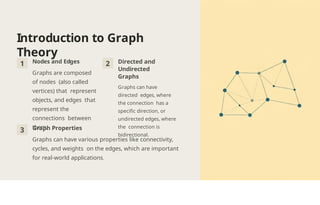
1 Nodes and Edges
Graphs are composed
of nodes (also called
vertices) that represent
objects, and edges that
represent the
connections between
them.
2 Directed and
Undirected
Graphs
Graphs can have
directed edges, where
the connection has a
specific direction, or
undirected edges, where
the connection is
bidirectional.
3 Graph Properties
Graphs can have various properties like connectivity,
cycles, and weights on the edges, which are important
for real-world applications.
Real-World Applications of Graph
Theory
Transportation Networks
Graphs can model road
networks, airline routes, and
subway systems to analyze
traffic patterns and optimize
pathfinding.
Social Networks
Graphs can represent
connections between people
in social media, enabling
analysis of information flow
and community detection.
Computer Networks
Graphs can model the topology
of computer networks, helping
with network design, routing,
and fault tolerance analysis.
Network Modeling and
Analysis
1
Network
Representation
Graphs can represent complex networks,
with nodes representing entities and edges
representing relationships.
2
Centrality Measures
Analyzing node centrality can identify
important or influential nodes within a
network.
3
Community
Detection
Grouping nodes into communities can
reveal underlying structures and
patterns in a network.
Shortest Path
Algorithms
1
Dijkstra's Algorithm
A classic algorithm for finding the shortest
path between two nodes in a weighted graph.
2
A* Search
An informed search algorithm that uses
heuristics to efficiently find the shortest path.
3
Bellman-Ford Algorithm
Useful for finding shortest paths in graphs with
negative edge weights.
Traffic Routing and
Navigation
Road Network Graphs
Graphs can model road
networks, allowing for
efficient routing and
navigation applications.
Traffic Optimization
Graph algorithms can
analyze traffic
patterns and suggest
optimal routes
Real-Time Updates
Dynamic graphs can incorporate live traffic data to
provide accurate and up-to-date navigation.
Conclusion and Key
Takeaways
1 Versatility of
Graph Theory
Graph theory has a
wide range of
applications in various
domains, from
transportation to
social
Networks
2 Pathfinding
and
Optimization
Graph algorithms
excel at finding
optimal paths and
solving complex
optimization
problems.
3
Importance of Network Analysis
Understanding the structure and dynamics of
networks is crucial for making informed decisions.
Thank
You

Discrete mathematics presentation related to application

  • 1.
    Graph Theory: Networks and Pathfinding Graph theory isa fundamental branch of mathematics that studies the properties and applications of graphs, which are mathematical structures used to model relationships and interconnections between objects. This presentation will explore the real-world applications of graph theory in areas like network analysis, pathfinding, and optimization.
  • 2.
    Introduction to Graph Theory 1Nodes and Edges Graphs are composed of nodes (also called vertices) that represent objects, and edges that represent the connections between them. 2 Directed and Undirected Graphs Graphs can have directed edges, where the connection has a specific direction, or undirected edges, where the connection is bidirectional. 3 Graph Properties Graphs can have various properties like connectivity, cycles, and weights on the edges, which are important for real-world applications.
  • 3.
    Real-World Applications ofGraph Theory Transportation Networks Graphs can model road networks, airline routes, and subway systems to analyze traffic patterns and optimize pathfinding. Social Networks Graphs can represent connections between people in social media, enabling analysis of information flow and community detection. Computer Networks Graphs can model the topology of computer networks, helping with network design, routing, and fault tolerance analysis.
  • 4.
    Network Modeling and Analysis 1 Network Representation Graphscan represent complex networks, with nodes representing entities and edges representing relationships. 2 Centrality Measures Analyzing node centrality can identify important or influential nodes within a network. 3 Community Detection Grouping nodes into communities can reveal underlying structures and patterns in a network.
  • 5.
    Shortest Path Algorithms 1 Dijkstra's Algorithm Aclassic algorithm for finding the shortest path between two nodes in a weighted graph. 2 A* Search An informed search algorithm that uses heuristics to efficiently find the shortest path. 3 Bellman-Ford Algorithm Useful for finding shortest paths in graphs with negative edge weights.
  • 6.
    Traffic Routing and Navigation RoadNetwork Graphs Graphs can model road networks, allowing for efficient routing and navigation applications. Traffic Optimization Graph algorithms can analyze traffic patterns and suggest optimal routes Real-Time Updates Dynamic graphs can incorporate live traffic data to provide accurate and up-to-date navigation.
  • 7.
    Conclusion and Key Takeaways 1Versatility of Graph Theory Graph theory has a wide range of applications in various domains, from transportation to social Networks 2 Pathfinding and Optimization Graph algorithms excel at finding optimal paths and solving complex optimization problems. 3 Importance of Network Analysis Understanding the structure and dynamics of networks is crucial for making informed decisions.
  • 8.