“Net Present Value(NPV)Profile”
Ramesh Pant
BBM-18
Fourth Semester
NPV Profile
• A net present value profile is a graphic representation
of the net present value of a project at various discount
rates.
• The net present value profile may be used when
conflicting rankings of projects exist by depicting each
project as a line on the profile and determining the
point of intersection.
• If the intersection occurs at a positive discount rate,
any discount rate below the intersection will cause
conflicting rankings, whereas any discount rates above
the intersection will provide consistent rankings.
• Conflicts in project rankings using NPV and IRR
result from differences in the magnitude and
timing of cash flows.
• Projects with similar-sized investments having
low early-year cash inflows tend to be preferred
at lower discount rates.
• At high discount rates, projects with the higher
early-year cash inflows are favored, as later-year
cash inflows tend to be severely penalized in
present value terms.
• The net present value profile allows for the
graphic representation of the net present
value of a project at different discount rates.
• Net present values are shown along the
vertical axis and discount rates are shown
along the horizontal axis.
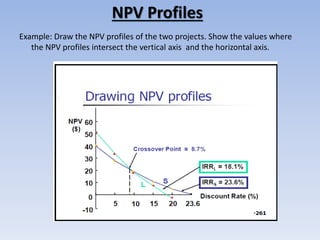
NPV Profiles
Example: Draw the NPV profiles of the two projects. Show the values where
the NPV profiles intersect the vertical axis and the horizontal axis.
Internal Rate of Return (IRR)
• The internal rate of return (IRR) is that discount rate
that causes the NPV of the project to equal zero.
• If IRR > WACC, then the project is acceptable because
it will return a rate of return on invested capital that
is likely to be greater than the cost of funds used to
invest in the project.
IRR versus NPV
• Both methods use the same basic decision inputs.
• The only difference is the assumed discount rate.
• The IRR assumes intermediate cashflows are
reinvested at IRR…NPV assumes they are
reinvested at WACC
– This difference, however, can produce conflicting
decision results under specific conditions
Comparing NPV and IRR
• Both techniques use the same inputs
• NPV measures in absolute terms, the estimated increase in
the value of the firm today the project is expected to produce.
– NPV assumes cash flows are reinvested at WACC
• IRR estimates the rate of return on the project
– IRR assumes cash flows produced by the project are reinvested
by the firm at the project’s IRR.
The reason for the different accept/reject decisions is the
different reinvestment rate assumptions used by the two
techniques.
Net Profile

Net Profile

  • 1.
    “Net Present Value(NPV)Profile” RameshPant BBM-18 Fourth Semester
  • 2.
    NPV Profile • Anet present value profile is a graphic representation of the net present value of a project at various discount rates. • The net present value profile may be used when conflicting rankings of projects exist by depicting each project as a line on the profile and determining the point of intersection. • If the intersection occurs at a positive discount rate, any discount rate below the intersection will cause conflicting rankings, whereas any discount rates above the intersection will provide consistent rankings.
  • 3.
    • Conflicts inproject rankings using NPV and IRR result from differences in the magnitude and timing of cash flows. • Projects with similar-sized investments having low early-year cash inflows tend to be preferred at lower discount rates. • At high discount rates, projects with the higher early-year cash inflows are favored, as later-year cash inflows tend to be severely penalized in present value terms.
  • 4.
    • The netpresent value profile allows for the graphic representation of the net present value of a project at different discount rates. • Net present values are shown along the vertical axis and discount rates are shown along the horizontal axis.
  • 5.
    NPV Profiles Example: Drawthe NPV profiles of the two projects. Show the values where the NPV profiles intersect the vertical axis and the horizontal axis.
  • 6.
    Internal Rate ofReturn (IRR) • The internal rate of return (IRR) is that discount rate that causes the NPV of the project to equal zero. • If IRR > WACC, then the project is acceptable because it will return a rate of return on invested capital that is likely to be greater than the cost of funds used to invest in the project.
  • 7.
    IRR versus NPV •Both methods use the same basic decision inputs. • The only difference is the assumed discount rate. • The IRR assumes intermediate cashflows are reinvested at IRR…NPV assumes they are reinvested at WACC – This difference, however, can produce conflicting decision results under specific conditions
  • 8.
    Comparing NPV andIRR • Both techniques use the same inputs • NPV measures in absolute terms, the estimated increase in the value of the firm today the project is expected to produce. – NPV assumes cash flows are reinvested at WACC • IRR estimates the rate of return on the project – IRR assumes cash flows produced by the project are reinvested by the firm at the project’s IRR. The reason for the different accept/reject decisions is the different reinvestment rate assumptions used by the two techniques.