


Presented to
Dinesh Poudel
The NPV Profile
• The NPV profile is a graph that illustrates
a project's NPV against various discount
rates, with the NPV on the y-axis and the
cost of capital on the x-axis. To begin,
simply calculate a project's NPV using
different cost-of-capital assumptions.
Once these are calculated, plot the values
on the graph.
• The NPV Profile is a graph with the discount rate
on the x-axis and the NPV of the investment on
the y-axis.
• Higher discount rates mean cash flows that occur
sooner are more influential to NPV.
• Since the earlier payments tend to be the
outflows, the NPV profile generally shows an
inverse relationship between the discount rate
and NPV.
• The discount rate at which the NPV equals 0 is
called the internal rate of return (IRR).
Net Preset Value
• NPV and IRR are two methods for making
capital-budget decisions, or choosing between
alternate projects and investments when the
goal is to increase the value of the enterprise
and maximize shareholder wealth. Defining
the NPV method is simple: the present value
of cash inflows minus the present value of
cash outflows, which arrives at a dollar
amount that is the net benefit to the
organization.
The Internal Rate of Return
• The IRR, or internal rate of return, is defined as
the discount rate that makes NPV = 0. Like the
NPV process, it starts by identifying all cash
inflows and outflows. However, instead of relying
on external data (i.e. a discount rate), the IRR is
purely a function of the inflows and outflows of
that project. The IRR rule states that projects or
investments are accepted when the project's IRR
exceeds a hurdle rate. Depending on the
application, the hurdle rate may be defined as the
weighted average cost of capital.
NPV vs. IRR
• Each of the two rules used for making capital-budgeting
decisions has its strengths and weaknesses. The NPV rule
chooses a project in terms of net dollars or net financial
impact on the company, so it can be easier to use when
allocating capital.
• However, it requires an assumed discount rate, and also
assumes that this percentage rate will be stable over the
life of the project, and that cash inflows can be reinvested
at the same discount rate. In the real world, those
assumptions can break down, particularly in periods when
interest rates are fluctuating. The appeal of the IRR rule is
that a discount rate need not be assumed, as the
worthiness of the investment is purely a function of the
internal inflows and outflows of that particular investment.
However, IRR does not assess the financial impact on a
firm; it only requires meeting a minimum return rate.
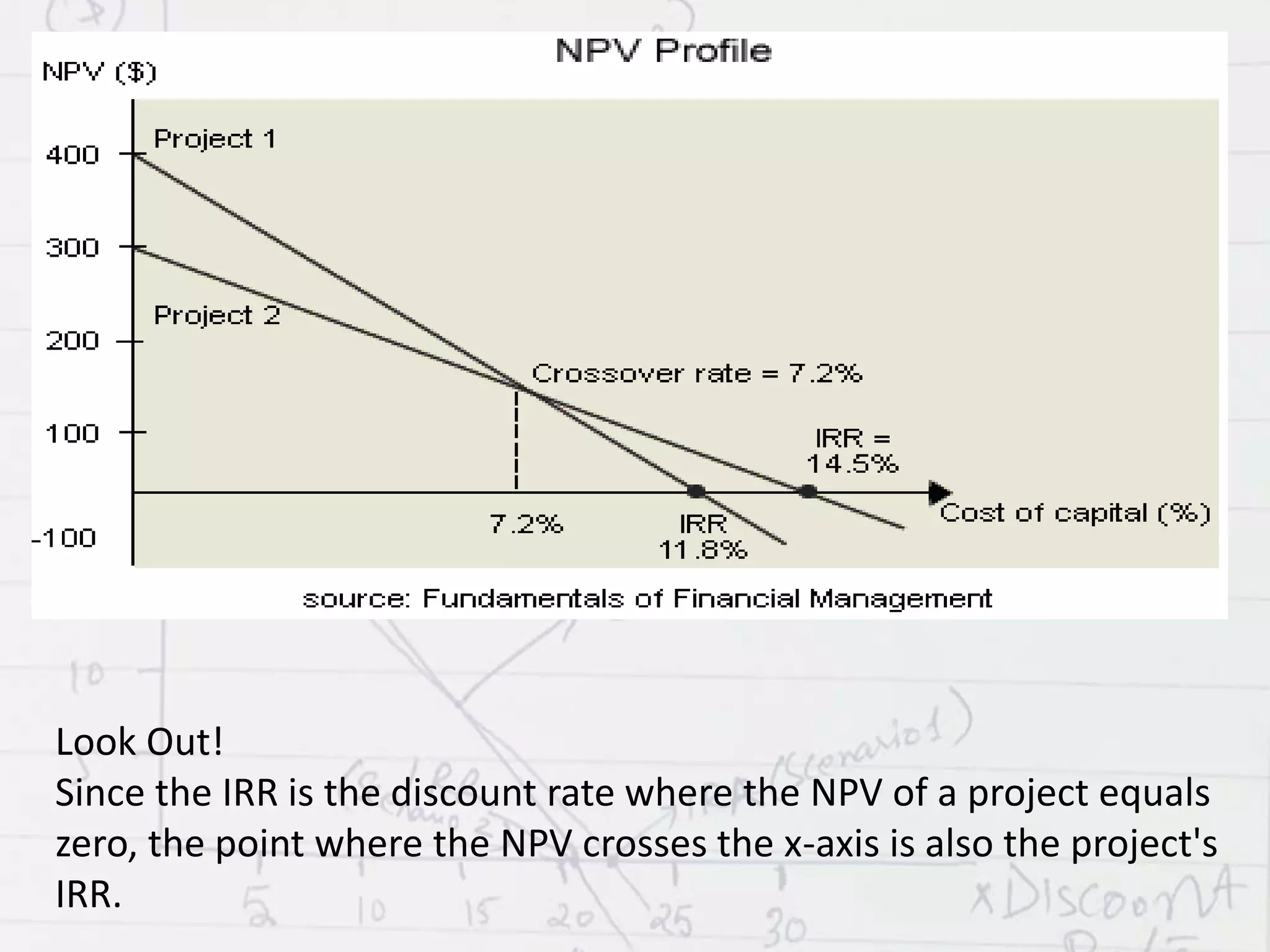
Look Out!
Since the IRR is the discount rate where the NPV of a project equals
zero, the point where the NPV crosses the x-axis is also the project's
IRR.
Cross over rate is the rate at which 2 projects
have the same NPV
• It’s the rate when IRR and NPV start to give
different answers. Say, two investments have
positive IRR’s, IRRa =12%, and IRRb=15%, with
NPVa=$100k, and NPVb=$50k, with both
having a cost of capital of 10%.
Npv profile

Npv profile

  • 1.
  • 2.
    The NPV Profile •The NPV profile is a graph that illustrates a project's NPV against various discount rates, with the NPV on the y-axis and the cost of capital on the x-axis. To begin, simply calculate a project's NPV using different cost-of-capital assumptions. Once these are calculated, plot the values on the graph.
  • 3.
    • The NPVProfile is a graph with the discount rate on the x-axis and the NPV of the investment on the y-axis. • Higher discount rates mean cash flows that occur sooner are more influential to NPV. • Since the earlier payments tend to be the outflows, the NPV profile generally shows an inverse relationship between the discount rate and NPV. • The discount rate at which the NPV equals 0 is called the internal rate of return (IRR).
  • 4.
    Net Preset Value •NPV and IRR are two methods for making capital-budget decisions, or choosing between alternate projects and investments when the goal is to increase the value of the enterprise and maximize shareholder wealth. Defining the NPV method is simple: the present value of cash inflows minus the present value of cash outflows, which arrives at a dollar amount that is the net benefit to the organization.
  • 5.
    The Internal Rateof Return • The IRR, or internal rate of return, is defined as the discount rate that makes NPV = 0. Like the NPV process, it starts by identifying all cash inflows and outflows. However, instead of relying on external data (i.e. a discount rate), the IRR is purely a function of the inflows and outflows of that project. The IRR rule states that projects or investments are accepted when the project's IRR exceeds a hurdle rate. Depending on the application, the hurdle rate may be defined as the weighted average cost of capital.
  • 6.
    NPV vs. IRR •Each of the two rules used for making capital-budgeting decisions has its strengths and weaknesses. The NPV rule chooses a project in terms of net dollars or net financial impact on the company, so it can be easier to use when allocating capital. • However, it requires an assumed discount rate, and also assumes that this percentage rate will be stable over the life of the project, and that cash inflows can be reinvested at the same discount rate. In the real world, those assumptions can break down, particularly in periods when interest rates are fluctuating. The appeal of the IRR rule is that a discount rate need not be assumed, as the worthiness of the investment is purely a function of the internal inflows and outflows of that particular investment. However, IRR does not assess the financial impact on a firm; it only requires meeting a minimum return rate.
  • 7.
    Look Out! Since theIRR is the discount rate where the NPV of a project equals zero, the point where the NPV crosses the x-axis is also the project's IRR.
  • 8.
    Cross over rateis the rate at which 2 projects have the same NPV • It’s the rate when IRR and NPV start to give different answers. Say, two investments have positive IRR’s, IRRa =12%, and IRRb=15%, with NPVa=$100k, and NPVb=$50k, with both having a cost of capital of 10%.