CORPORATE FINANCE
PRESENTED TO:- KASHIF IQBAL SIDDIQUI
PRESENTED BY:-
SAKSHAM KUMAR
SUJATA KUMARI
SHUBHAM KUMAR
ADITYA KASHYAP
RITWIK RAJ
TOPIC
NET PRESENT VALUE (NPV)
• Concept
• Application
• Significance
• Limitation
INTERNAL RATE OF RETURN (IRR)
• Concept
• Application
• Significance
• Limitation
Concept Of NPV
• NPV method is the time value of money approach to evaluate the
return from an investment proposal.
• Under this method , we discount a project using the required return
an the discount factor.
• NPV is the different between the present value of cash inflows and
the present value of cash outflows over a period of time.
• By estimating the net present value , we can improve our financial
management and maximize future gains.
APPLICATION
• NPV is used in capital budgeting and investment planning to analyze the
profitability of a projected investment or project.
• Net present value , or NPV , is used to calculate the current total value of a
future stream of payments.
• To calculate NPOV , you need to estimate future cash flows for each period
and determine the correct discount rate.
• A positive NPV means the investment is worthwhile, an NPV of 0 means
the inflows equal the outflows, and a negative is not good for the investor.
• CASH INFLOW :- Cash that is received by the investor. For example,
dividends paid on a stock owned by the investor is a cash inflow.
• CASH OUTFLOW:- Any cash that is spent or invested by the investor.
Advantage and Disadvantage Of NPV
Advantage
• It recognizes time value of money.
• It also recognizes all cash flows throughout the life of the project.
• It helps to satisfy the objectives for maximizing firm’s value.
Disadvantage
• It is really difficult.
• It does not present a satisfactory answer when there is different
amounts of investments for the purpose of comparison.
• It does not present a correct picture in case of alternative project.
Conversion of Net cash flow (NCF) into
present value (PV)
A. By the use of Discount Table
• Sometimes net cash flows (NCF) can be converted into NPV with the
help of the help of the discount table which reveals the present value
of Re 1 receivable at different intervals of time together with wide
range of interest rates.
• QUESTION:-
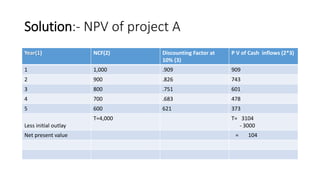
• Calculate the NPV for project ‘A’ which initially cost RS. 3,000 and
generate annual cash inflow of RS.1,000 ,RS. 900, RS.800, RS.700 and
RS. 600 in five years. The discount rate is assumed to @10%.
Solution:- NPV of project A
Year(1) NCF(2) Discounting Factor at
10% (3)
P V of Cash inflows (2*3)
1 1,000 .909 909
2 900 .826 743
3 800 .751 601
4 700 .683 478
5 600 621 373
Less initial outlay
T=4,000 T= 3104
- 3000
Net present value = 104
Concept of IRR
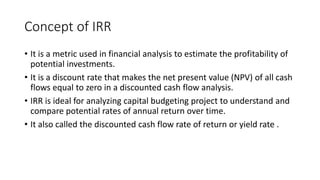
• It is a metric used in financial analysis to estimate the profitability of
potential investments.
• It is a discount rate that makes the net present value (NPV) of all cash
flows equal to zero in a discounted cash flow analysis.
• IRR is ideal for analyzing capital budgeting project to understand and
compare potential rates of annual return over time.
• It also called the discounted cash flow rate of return or yield rate .
APPLICATION:-
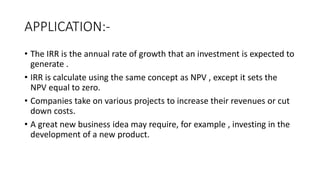
• The IRR is the annual rate of growth that an investment is expected to
generate .
• IRR is calculate using the same concept as NPV , except it sets the
NPV equal to zero.
• Companies take on various projects to increase their revenues or cut
down costs.
• A great new business idea may require, for example , investing in the
development of a new product.
Advantage and Disadvantage of IRR
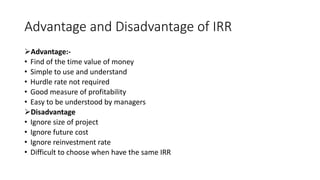
Advantage:-
• Find of the time value of money
• Simple to use and understand
• Hurdle rate not required
• Good measure of profitability
• Easy to be understood by managers
Disadvantage
• Ignore size of project
• Ignore future cost
• Ignore reinvestment rate
• Difficult to choose when have the same IRR
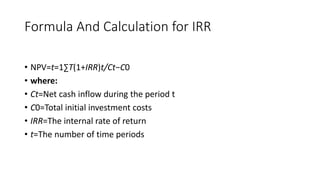
Formula And Calculation for IRR
• NPV=t=1∑T​(1+IRR)t/Ct​​−C0
• where:
• Ct​=Net cash inflow during the period t
• C0​=Total initial investment costs
• IRR=The internal rate of return
• t=The number of time periods​
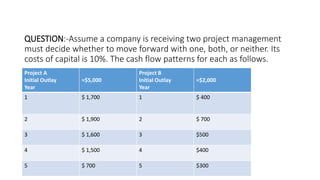
QUESTION:-Assume a company is receiving two project management
must decide whether to move forward with one, both, or neither. Its
costs of capital is 10%. The cash flow patterns for each as follows.
Project A
Initial Outlay
Year
=$5,000
Project B
Initial Outlay
Year
=$2,000
1 $ 1,700 1 $ 400
2 $ 1,900 2 $ 700
3 $ 1,600 3 $500
4 $ 1,500 4 $400
5 $ 700 5 $300
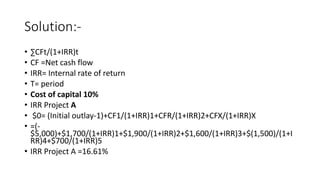
Solution:-
• ∑CFt/(1+IRR)t
• CF =Net cash flow
• IRR= Internal rate of return
• T= period
• Cost of capital 10%
• IRR Project A
• $0= (Initial outlay-1)+CF1/(1+IRR)1+CFR/(1+IRR)2+CFX/(1+IRR)X
• =(-
$5,000)+$1,700/(1+IRR)1+$1,900/(1+IRR)2+$1,600/(1+IRR)3+$(1,500)/(1+I
RR)4+$700/(1+IRR)5
• IRR Project A =16.61%
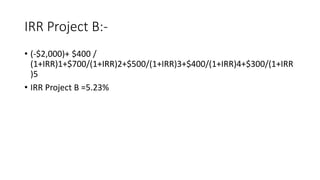
IRR Project B:-
• (-$2,000)+ $400 /
(1+IRR)1+$700/(1+IRR)2+$500/(1+IRR)3+$400/(1+IRR)4+$300/(1+IRR
)5
• IRR Project B =5.23%

CF (GROUP 9) SS.pptx

  • 1.
    CORPORATE FINANCE PRESENTED TO:-KASHIF IQBAL SIDDIQUI PRESENTED BY:- SAKSHAM KUMAR SUJATA KUMARI SHUBHAM KUMAR ADITYA KASHYAP RITWIK RAJ
  • 2.
    TOPIC NET PRESENT VALUE(NPV) • Concept • Application • Significance • Limitation INTERNAL RATE OF RETURN (IRR) • Concept • Application • Significance • Limitation
  • 3.
    Concept Of NPV •NPV method is the time value of money approach to evaluate the return from an investment proposal. • Under this method , we discount a project using the required return an the discount factor. • NPV is the different between the present value of cash inflows and the present value of cash outflows over a period of time. • By estimating the net present value , we can improve our financial management and maximize future gains.
  • 4.
    APPLICATION • NPV isused in capital budgeting and investment planning to analyze the profitability of a projected investment or project. • Net present value , or NPV , is used to calculate the current total value of a future stream of payments. • To calculate NPOV , you need to estimate future cash flows for each period and determine the correct discount rate. • A positive NPV means the investment is worthwhile, an NPV of 0 means the inflows equal the outflows, and a negative is not good for the investor. • CASH INFLOW :- Cash that is received by the investor. For example, dividends paid on a stock owned by the investor is a cash inflow. • CASH OUTFLOW:- Any cash that is spent or invested by the investor.
  • 5.
    Advantage and DisadvantageOf NPV Advantage • It recognizes time value of money. • It also recognizes all cash flows throughout the life of the project. • It helps to satisfy the objectives for maximizing firm’s value. Disadvantage • It is really difficult. • It does not present a satisfactory answer when there is different amounts of investments for the purpose of comparison. • It does not present a correct picture in case of alternative project.
  • 6.
    Conversion of Netcash flow (NCF) into present value (PV) A. By the use of Discount Table • Sometimes net cash flows (NCF) can be converted into NPV with the help of the help of the discount table which reveals the present value of Re 1 receivable at different intervals of time together with wide range of interest rates. • QUESTION:- • Calculate the NPV for project ‘A’ which initially cost RS. 3,000 and generate annual cash inflow of RS.1,000 ,RS. 900, RS.800, RS.700 and RS. 600 in five years. The discount rate is assumed to @10%.
  • 7.
    Solution:- NPV ofproject A Year(1) NCF(2) Discounting Factor at 10% (3) P V of Cash inflows (2*3) 1 1,000 .909 909 2 900 .826 743 3 800 .751 601 4 700 .683 478 5 600 621 373 Less initial outlay T=4,000 T= 3104 - 3000 Net present value = 104
  • 8.
    Concept of IRR •It is a metric used in financial analysis to estimate the profitability of potential investments. • It is a discount rate that makes the net present value (NPV) of all cash flows equal to zero in a discounted cash flow analysis. • IRR is ideal for analyzing capital budgeting project to understand and compare potential rates of annual return over time. • It also called the discounted cash flow rate of return or yield rate .
  • 9.
    APPLICATION:- • The IRRis the annual rate of growth that an investment is expected to generate . • IRR is calculate using the same concept as NPV , except it sets the NPV equal to zero. • Companies take on various projects to increase their revenues or cut down costs. • A great new business idea may require, for example , investing in the development of a new product.
  • 10.
    Advantage and Disadvantageof IRR Advantage:- • Find of the time value of money • Simple to use and understand • Hurdle rate not required • Good measure of profitability • Easy to be understood by managers Disadvantage • Ignore size of project • Ignore future cost • Ignore reinvestment rate • Difficult to choose when have the same IRR
  • 11.
    Formula And Calculationfor IRR • NPV=t=1∑T​(1+IRR)t/Ct​​−C0 • where: • Ct​=Net cash inflow during the period t • C0​=Total initial investment costs • IRR=The internal rate of return • t=The number of time periods​
  • 12.
    QUESTION:-Assume a companyis receiving two project management must decide whether to move forward with one, both, or neither. Its costs of capital is 10%. The cash flow patterns for each as follows. Project A Initial Outlay Year =$5,000 Project B Initial Outlay Year =$2,000 1 $ 1,700 1 $ 400 2 $ 1,900 2 $ 700 3 $ 1,600 3 $500 4 $ 1,500 4 $400 5 $ 700 5 $300
  • 13.
    Solution:- • ∑CFt/(1+IRR)t • CF=Net cash flow • IRR= Internal rate of return • T= period • Cost of capital 10% • IRR Project A • $0= (Initial outlay-1)+CF1/(1+IRR)1+CFR/(1+IRR)2+CFX/(1+IRR)X • =(- $5,000)+$1,700/(1+IRR)1+$1,900/(1+IRR)2+$1,600/(1+IRR)3+$(1,500)/(1+I RR)4+$700/(1+IRR)5 • IRR Project A =16.61%
  • 14.
    IRR Project B:- •(-$2,000)+ $400 / (1+IRR)1+$700/(1+IRR)2+$500/(1+IRR)3+$400/(1+IRR)4+$300/(1+IRR )5 • IRR Project B =5.23%