Rate of Return
Definition
 Accounting rate of return or simple rate of return is the

ratio of the estimated accounting profit of a project to its
average investment.
 It is an investment appraisal technique.
 ARR ignores the time value of money.
Formula
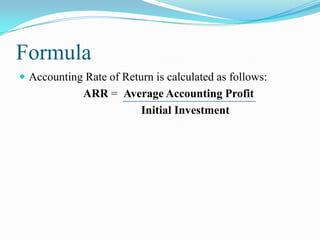
 Accounting Rate of Return is calculated as follows:

ARR = Average Accounting Profit
Initial Investment
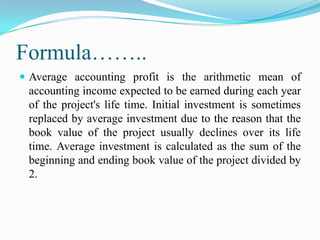
Formula……..
 Average accounting profit is the arithmetic mean of

accounting income expected to be earned during each year
of the project's life time. Initial investment is sometimes
replaced by average investment due to the reason that the
book value of the project usually declines over its life
time. Average investment is calculated as the sum of the
beginning and ending book value of the project divided by
2.
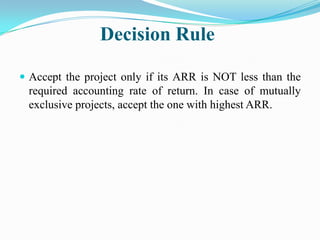
Decision Rule
 Accept the project only if its ARR is NOT less than the

required accounting rate of return. In case of mutually
exclusive projects, accept the one with highest ARR.
Examples
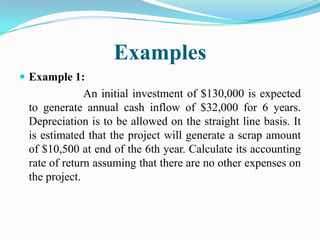
 Example 1:

An initial investment of $130,000 is expected
to generate annual cash inflow of $32,000 for 6 years.
Depreciation is to be allowed on the straight line basis. It
is estimated that the project will generate a scrap amount
of $10,500 at end of the 6th year. Calculate its accounting
rate of return assuming that there are no other expenses on
the project.
Example 1
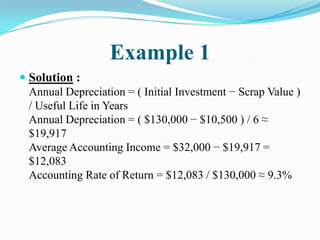
 Solution :
Annual Depreciation = ( Initial Investment − Scrap Value )
/ Useful Life in Years
Annual Depreciation = ( $130,000 − $10,500 ) / 6 ≈
$19,917
Average Accounting Income = $32,000 − $19,917 =
$12,083
Accounting Rate of Return = $12,083 / $130,000 ≈ 9.3%
Example 2
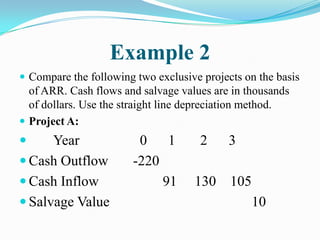
 Compare the following two exclusive projects on the basis

of ARR. Cash flows and salvage values are in thousands
of dollars. Use the straight line depreciation method.
 Project A:



Year
 Cash Outflow
 Cash Inflow
 Salvage Value

0 1
-220
91

2

3

130 105
10
Example 2…….
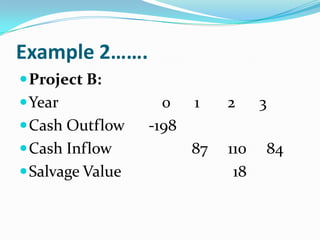
 Project B:
 Year
 Cash Outflow
 Cash Inflow
 Salvage Value

0
-198

1

2

87

110
18

3
84
Example 2…….
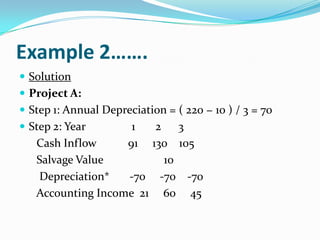
 Solution
 Project A:
 Step 1: Annual Depreciation = ( 220 − 10 ) / 3 = 70
 Step 2: Year

1
91

2
3
Cash Inflow
130 105
Salvage Value
10
Depreciation*
-70 -70 -70
Accounting Income 21 60 45
Example 2…….
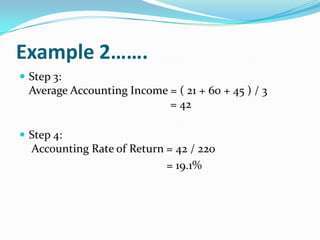
 Step 3:

Average Accounting Income = ( 21 + 60 + 45 ) / 3
= 42
 Step 4:

Accounting Rate of Return = 42 / 220
= 19.1%
Example 2…….
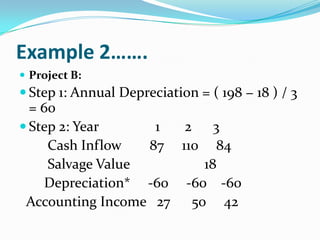
 Project B:

 Step 1: Annual Depreciation = ( 198 − 18 ) / 3

= 60
 Step 2: Year
1
2 3
Cash Inflow
87 110 84
Salvage Value
18
Depreciation* -60 -60 -60
Accounting Income 27 50 42
Example 2
 Step 3:
Average Accounting Income = ( 27 + 50 + 42 ) / 3


= 39.666

 Step 4:
Accounting Rate of Return = 39.666 / 198 ≈ 20.0%
 Since the ARR of the project B is higher, it is more

favorable than the project A.
Advantages and Disadvantages
Advantages
 Like payback period, this method of
investment appraisal is easy to calculate.
 It recognizes the profitability factor of
investment.
Disadvantages
 It ignores time value of money. Suppose, if we use
ARR to compare two projects having equal initial
investments. The project which has higher annual
income in the latter years of its useful life may rank

higher than the one having higher annual income in
the beginning years, even if the present value of the
income generated by the latter project is higher.
 It can be calculated in different ways. Thus there is
problem of consistency.
Disadvantages
 It uses accounting income rather than cash flow
information. Thus it is not suitable for projects which
having high maintenance costs because their viability
also depends upon timely cash inflows.
Thank You

Rate of return

  • 1.
  • 2.
    Definition  Accounting rateof return or simple rate of return is the ratio of the estimated accounting profit of a project to its average investment.  It is an investment appraisal technique.  ARR ignores the time value of money.
  • 3.
    Formula  Accounting Rateof Return is calculated as follows: ARR = Average Accounting Profit Initial Investment
  • 4.
    Formula……..  Average accountingprofit is the arithmetic mean of accounting income expected to be earned during each year of the project's life time. Initial investment is sometimes replaced by average investment due to the reason that the book value of the project usually declines over its life time. Average investment is calculated as the sum of the beginning and ending book value of the project divided by 2.
  • 5.
    Decision Rule  Acceptthe project only if its ARR is NOT less than the required accounting rate of return. In case of mutually exclusive projects, accept the one with highest ARR.
  • 6.
    Examples  Example 1: Aninitial investment of $130,000 is expected to generate annual cash inflow of $32,000 for 6 years. Depreciation is to be allowed on the straight line basis. It is estimated that the project will generate a scrap amount of $10,500 at end of the 6th year. Calculate its accounting rate of return assuming that there are no other expenses on the project.
  • 7.
    Example 1  Solution: Annual Depreciation = ( Initial Investment − Scrap Value ) / Useful Life in Years Annual Depreciation = ( $130,000 − $10,500 ) / 6 ≈ $19,917 Average Accounting Income = $32,000 − $19,917 = $12,083 Accounting Rate of Return = $12,083 / $130,000 ≈ 9.3%
  • 8.
    Example 2  Comparethe following two exclusive projects on the basis of ARR. Cash flows and salvage values are in thousands of dollars. Use the straight line depreciation method.  Project A:  Year  Cash Outflow  Cash Inflow  Salvage Value 0 1 -220 91 2 3 130 105 10
  • 9.
    Example 2…….  ProjectB:  Year  Cash Outflow  Cash Inflow  Salvage Value 0 -198 1 2 87 110 18 3 84
  • 10.
    Example 2…….  Solution Project A:  Step 1: Annual Depreciation = ( 220 − 10 ) / 3 = 70  Step 2: Year 1 91 2 3 Cash Inflow 130 105 Salvage Value 10 Depreciation* -70 -70 -70 Accounting Income 21 60 45
  • 11.
    Example 2…….  Step3: Average Accounting Income = ( 21 + 60 + 45 ) / 3 = 42  Step 4: Accounting Rate of Return = 42 / 220 = 19.1%
  • 12.
    Example 2…….  ProjectB:  Step 1: Annual Depreciation = ( 198 − 18 ) / 3 = 60  Step 2: Year 1 2 3 Cash Inflow 87 110 84 Salvage Value 18 Depreciation* -60 -60 -60 Accounting Income 27 50 42
  • 13.
    Example 2  Step3: Average Accounting Income = ( 27 + 50 + 42 ) / 3  = 39.666  Step 4: Accounting Rate of Return = 39.666 / 198 ≈ 20.0%  Since the ARR of the project B is higher, it is more favorable than the project A.
  • 14.
    Advantages and Disadvantages Advantages Like payback period, this method of investment appraisal is easy to calculate.  It recognizes the profitability factor of investment.
  • 15.
    Disadvantages  It ignorestime value of money. Suppose, if we use ARR to compare two projects having equal initial investments. The project which has higher annual income in the latter years of its useful life may rank higher than the one having higher annual income in the beginning years, even if the present value of the income generated by the latter project is higher.  It can be calculated in different ways. Thus there is problem of consistency.
  • 16.
    Disadvantages  It usesaccounting income rather than cash flow information. Thus it is not suitable for projects which having high maintenance costs because their viability also depends upon timely cash inflows.
  • 17.