By
Dr. Vijay Shankar Pandey
Asst. Professor
IMS- New Campus
University of Lucknow, Lucknow
Capital Structure Decision and
Value of the Firm
Theories of capital structure
• NI approach
• NOI approach
• Traditional Approach
• Modigliani and Miller Approach
Capital structure decision
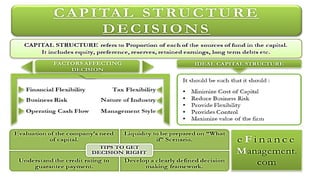
What is capital structure?
Combination of various component of capital is called capital structure.
The over all cost of capital may reduce as the proportion of debt increases
in the capital structure because cost of debt is less than cost of equity,
while on the other hand risk of the firm increases with the increase in the
fixed contractual obligation, which again increases the weighted average
cost of capital.
The firm may use only equity, or only debt, or a combination of equity
+debt, or a combination of equity + debt + preference shares or may use
other similar combinations to form capital structure.
Ideal capital structure
• It minimize cost of capital.
• It reduce risks.
• It give required flexibility.
• It provide required control to the owners.
• It enable the company to have adequate finance.
• It maximize the value of the firm ultimately the wealth
of the shareholders.
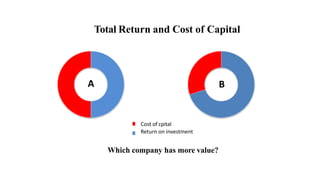
Cost of cpital
Return on investment
Total Return and Cost of Capital
Which company has more value?
A B
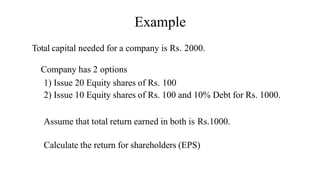
Example
Total capital needed for a company is Rs. 2000.
Company has 2 options
1) Issue 20 Equity shares of Rs. 100
2) Issue 10 Equity shares of Rs. 100 and 10% Debt for Rs. 1000.
Assume that total return earned in both is Rs.1000.
Calculate the return for shareholders (EPS)
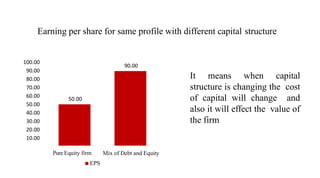
Earning per share for same profile with different capital structure
50.00
90.00
-
100.00
90.00
80.00
70.00
60.00
50.00
40.00
30.00
20.00
10.00
Pure Equity firm Mix of Debt and Equity
EPS
It means when capital
structure is changing the cost
of capital will change and
also it will effect the value of
the firm
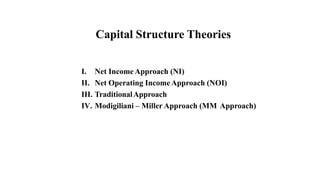
Capital Structure Theories
I. Net Income Approach (NI)
II. Net Operating IncomeApproach (NOI)
III. TraditionalApproach
IV. Modigiliani – Miller Approach (MM Approach)
Net Income Approach (NI Approach)
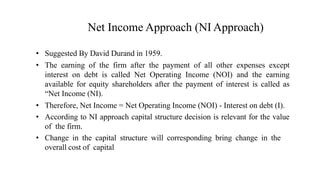
• Suggested By David Durand in 1959.
• The earning of the firm after the payment of all other expenses except
interest on debt is called Net Operating Income (NOI) and the earning
available for equity shareholders after the payment of interest is called as
“Net Income (NI).
• Therefore, Net Income = Net Operating Income (NOI) - Interest on debt (I).
• According to NI approach capital structure decision is relevant for the value
of the firm.
• Change in the capital structure will corresponding bring change in the
overall cost of capital
Contd
…
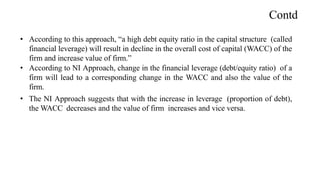
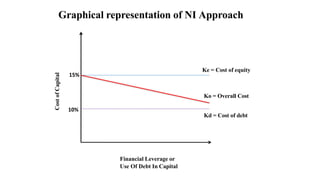
• According to this approach, “a high debt equity ratio in the capital structure (called
financial leverage) will result in decline in the overall cost of capital (WACC) of the
firm and increase value of firm.”
• According to NI Approach, change in the financial leverage (debt/equity ratio) of a
firm will lead to a corresponding change in the WACC and also the value of the
firm.
• The NI Approach suggests that with the increase in leverage (proportion of debt),
the WACC decreases and the value of firm increases and vice versa.
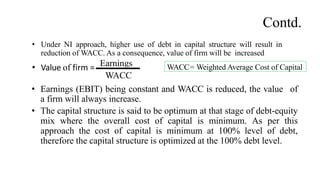
• Under NI approach, higher use of debt in capital structure will result in
reduction of WACC. As a consequence, value of firm will be increased
• Value of firm = Earnings
WACC
• Earnings (EBIT) being constant and WACC is reduced, the value of
a firm will always increase.
• The capital structure is said to be optimum at that stage of debt-equity
mix where the overall cost of capital is minimum. As per this
approach the cost of capital is minimum at 100% level of debt,
therefore the capital structure is optimized at the 100% debt level.
WACC= Weighted Average Cost of Capital
Contd.
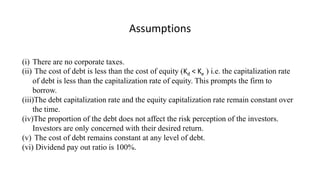
Assumptions
(i) There are no corporate taxes.
(ii) The cost of debt is less than the cost of equity (Kd < Ke ) i.e. the capitalization rate
of debt is less than the capitalization rate of equity. This prompts the firm to
borrow.
(iii)The debt capitalization rate and the equity capitalization rate remain constant over
the time.
(iv)The proportion of the debt does not affect the risk perception of the investors.
Investors are only concerned with their desired return.
(v) The cost of debt remains constant at any level of debt.
(vi) Dividend pay out ratio is 100%.
10%
15%
Ke = Cost of equity
Kd = Cost of debt
Ko = Overall Cost
Financial Leverage or
Use Of Debt In Capital
Cost
of
Capital
Graphical representation of NI Approach
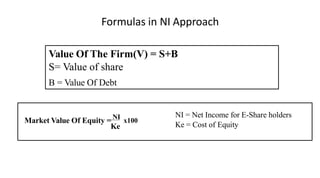
Formulas in NI Approach
S = Market Value Of Equity
NI = Net Income for E-Share holders
Ke = Cost of Equity
Ke
Value Of The Firm(V) = S+B
S= Value of share
B = Value Of Debt
Market Value Of Equity = NI
x100
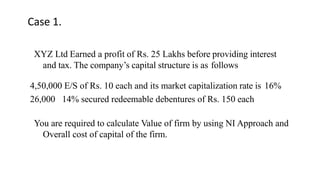
Case 1.
XYZ Ltd Earned a profit of Rs. 25 Lakhs before providing interest
and tax. The company’s capital structure is as follows
You are required to calculate Value of firm by using NI Approach and
Overall cost of capital of the firm.
4,50,000 E/S of Rs. 10 each and its market capitalization rate is 16%
26,000 14% secured redeemable debentures of Rs. 150 each
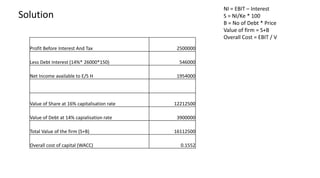
Solution
NI = EBIT – Interest
S = NI/Ke * 100
B = No of Debt * Price
Value of firm = S+B
Overall Cost = EBIT / V
Profit Before Interest And Tax 2500000
Less Debt Interest (14%* 26000*150) 546000
Net Income available to E/S H 1954000
Value of Share at 16% capitalisation rate 12212500
Value of Debt at 14% capialisation rate 3900000
Total Value of the firm (S+B) 16112500
Overall cost of capital (WACC) 0.1552
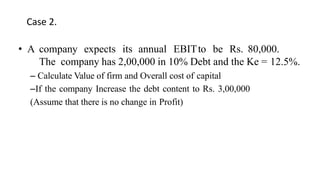
Case 2.
• A company expects its annual EBITto be Rs. 80,000.
The company has 2,00,000 in 10% Debt and the Ke = 12.5%.
– Calculate Value of firm and Overall cost of capital
–If the company Increase the debt content to Rs. 3,00,000
(Assume that there is no change in Profit)
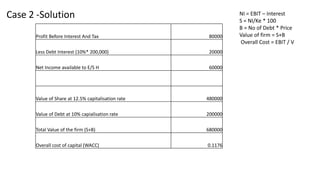
Case 2 -Solution NI = EBIT – Interest
S = NI/Ke * 100
B = No of Debt * Price
Value of firm = S+B
Overall Cost = EBIT / V
Profit Before Interest And Tax 80000
Less Debt Interest (10%* 200,000) 20000
Net Income available to E/S H 60000
Value of Share at 12.5% capitalisation rate 480000
Value of Debt at 10% capialisation rate 200000
Total Value of the firm (S+B) 680000
Overall cost of capital (WACC) 0.1176
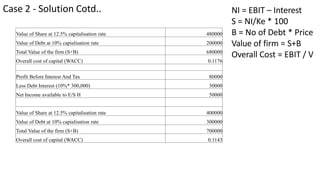
Case 2 - Solution Cotd.. NI = EBIT – Interest
S = NI/Ke * 100
B = No of Debt * Price
Value of firm = S+B
Overall Cost = EBIT / V
Value of Share at 12.5% capitalisation rate 480000
Value of Debt at 10% capialisation rate 200000
Total Value of the firm (S+B) 680000
Overall cost of capital (WACC) 0.1176
Profit Before Interest And Tax 80000
Less Debt Interest (10%* 300,000) 30000
Net Income available to E/S H 50000
Value of Share at 12.5% capitalisation rate 400000
Value of Debt at 10% capialisation rate 300000
Total Value of the firm (S+B) 700000
Overall cost of capital (WACC) 0.1143
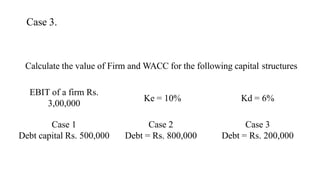
Calculate the value of Firm and WACC for the following capital structures
EBIT of a firm Rs.
3,00,000
Ke = 10% Kd = 6%
Case 1
Debt capital Rs. 500,000
Case 2
Debt = Rs. 800,000
Case 3
Debt = Rs. 200,000
Case 3.
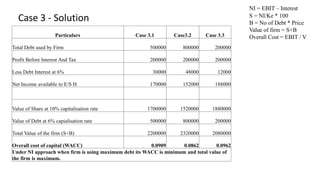
Particulars Case 3.1 Case3.2 Case 3.3
Total Debt used by Firm 500000 800000 200000
Profit Before Interest And Tax 200000 200000 200000
Less Debt Interest at 6% 30000 48000 12000
Net Income available to E/S H 170000 152000 188000
Value of Share at 10% capitalisation rate 1700000 1520000 1880000
Value of Debt at 6% capialisation rate 500000 800000 200000
Total Value of the firm (S+B) 2200000 2320000 2080000
Overall cost of capital (WACC) 0.0909 0.0862 0.0962
Under NI approach when firm is using maximum debt its WACC is minimum and total value of
the firm is maximum.
Case 3 - Solution
NI = EBIT – Interest
S = NI/Ke * 100
B = No of Debt * Price
Value of firm = S+B
Overall Cost = EBIT / V
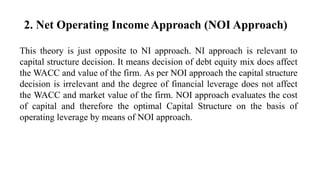
2. Net Operating IncomeApproach (NOI Approach)
This theory is just opposite to NI approach. NI approach is relevant to
capital structure decision. It means decision of debt equity mix does affect
the WACC and value of the firm. As per NOI approach the capital structure
decision is irrelevant and the degree of financial leverage does not affect
the WACC and market value of the firm. NOI approach evaluates the cost
of capital and therefore the optimal Capital Structure on the basis of
operating leverage by means of NOI approach.
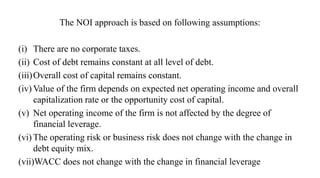
The NOI approach is based on following assumptions:
(i) There are no corporate taxes.
(ii) Cost of debt remains constant at all level of debt.
(iii)Overall cost of capital remains constant.
(iv) Value of the firm depends on expected net operating income and overall
capitalization rate or the opportunity cost of capital.
(v) Net operating income of the firm is not affected by the degree of
financial leverage.
(vi) The operating risk or business risk does not change with the change in
debt equity mix.
(vii)WACC does not change with the change in financial leverage
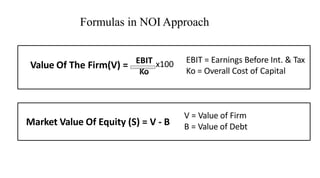
Formulas in NOI Approach
Ko
V = Value of Firm
B = Value of Debt
Market Value Of Equity (S) = V - B
EBIT = Earnings Before Int. & Tax
Ko = Overall Cost of Capital
Value Of The Firm(V) = EBIT x100
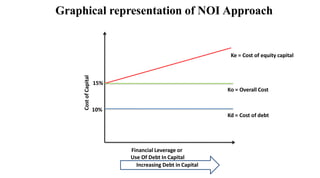
10%
15%
Kd = Cost of debt
Cost
of
Capital
Graphical representation of NOI Approach
Increasing Debt in Capital
Ko = Overall Cost
Financial Leverage or
Use Of Debt In Capital
Ke = Cost of equity capital
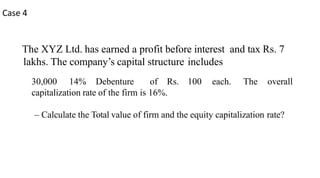
Case 4
The XYZ Ltd. has earned a profit before interest and tax Rs. 7
lakhs. The company’s capital structure includes
30,000 14% Debenture of Rs. 100 each. The overall
capitalization rate of the firm is 16%.
– Calculate the Total value of firm and the equity capitalization rate?
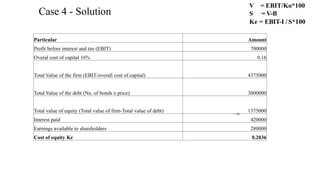
Case 4 - Solution
V = EBIT/Ko*100
S = V-B
Ke = EBIT-I /S*100
=
Particular Amount
Profit before interest and tax (EBIT) 700000
Overal cost of capital 16% 0.16
Total Value of the firm (EBIT/overall cost of capital) 4375000
Total Value of the debt (No. of bonds x price) 3000000
Total value of equity (Total value of firm-Total value of debt) 1375000
Interest paid 420000
Earnings available to shareholders 280000
Cost of equity Ke 0.2036
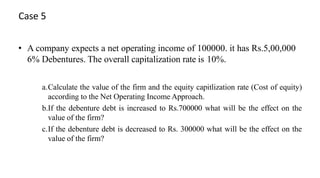
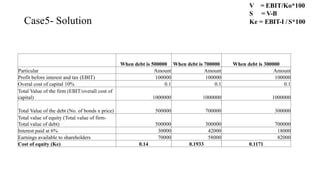
Case 5
• A company expects a net operating income of 100000. it has Rs.5,00,000
6% Debentures. The overall capitalization rate is 10%.
a.Calculate the value of the firm and the equity capitlization rate (Cost of equity)
according to the Net Operating Income Approach.
b.If the debenture debt is increased to Rs.700000 what will be the effect on the
value of the firm?
c.If the debenture debt is decreased to Rs. 300000 what will be the effect on the
value of the firm?
Case5- Solution
V = EBIT/Ko*100
S = V-B
Ke = EBIT-I /S*100
When debt is 500000 When debt is 700000 When debt is 300000
Particular Amount Amount Amount
Profit before interest and tax (EBIT) 100000 100000 100000
Overal cost of capital 10% 0.1 0.1 0.1
Total Value of the firm (EBIT/overall cost of
capital) 1000000 1000000 1000000
Total Value of the debt (No. of bonds x price) 500000 700000 300000
Total value of equity (Total value of firm-
Total value of debt) 500000 300000 700000
Interest paid at 6% 30000 42000 18000
Earnings available to shareholders 70000 58000 82000
Cost of equity (Ke) 0.14 0.1933 0.1171
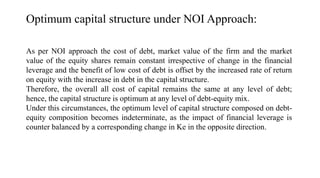
As per NOI approach the cost of debt, market value of the firm and the market
value of the equity shares remain constant irrespective of change in the financial
leverage and the benefit of low cost of debt is offset by the increased rate of return
on equity with the increase in debt in the capital structure.
Therefore, the overall all cost of capital remains the same at any level of debt;
hence, the capital structure is optimum at any level of debt-equity mix.
Under this circumstances, the optimum level of capital structure composed on debt-
equity composition becomes indeterminate, as the impact of financial leverage is
counter balanced by a corresponding change in Ke in the opposite direction.
Optimum capital structure under NOI Approach:
Traditional Approach
The traditional approach was propounded by Ezra Soloman in 1963 . This
approach is the compromise between NI approach and NOI approach. The
traditional approach rejects both extreme prepositions of relevance approach of NI
theory and irrelevance approach of NOI theory. This approach neither assumes
constant cost of equity (ke) and declining Weighted Average Cost of Capital
(WACC) like NI approach nor increasing cost of equity and constant cost of debt
(kd) and over all cost of capital (ko) like NOI approach.
TraditionalApproach
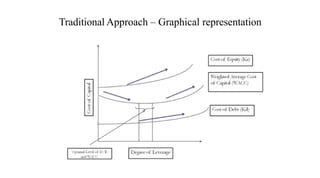
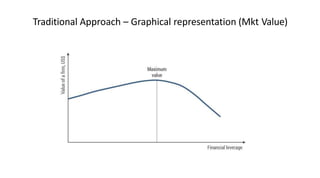
Under traditional approach wacc decreases only up to a certain level of financial leverage
and starts increasing beyond this level. At the judicious mix of debt and equity as of
optimum capital structure weighted average cost of capital is minimum and the market
value of the firm is maximum.
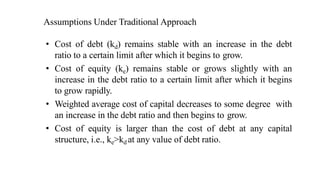
Stage 1:
The value of the firm may first increase with moderate leverage when WACC is
decreasing.
Stage 2:
Reach the maximum value when WACC is minimum.
Stage 3:
Then starts declining with higher financial leverage when WACC start increasing.
Three stage of capital structure under traditional approach
Assumptions Under Traditional Approach
• Cost of debt (kd) remains stable with an increase in the debt
ratio to a certain limit after which it begins to grow.
• Cost of equity (ke) remains stable or grows slightly with an
increase in the debt ratio to a certain limit after which it begins
to grow rapidly.
• Weighted average cost of capital decreases to some degree with
an increase in the debt ratio and then begins to grow.
• Cost of equity is larger than the cost of debt at any capital
structure, i.e., ke>kd at any value of debt ratio.
Traditional Approach – Graphical representation
Traditional Approach – Graphical representation (Mkt Value)
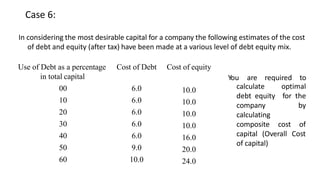
Case 6:
Use of Debt as a percentage
in total capital
Cost of Debt Cost of equity
00 6.0 10.0
10 6.0 10.0
20 6.0 10.0
30 6.0 10.0
40 6.0 16.0
50 9.0 20.0
60 10.0 24.0
In considering the most desirable capital for a company the following estimates of the cost
of debt and equity (after tax) have been made at a various level of debt equity mix.
You are required to
optimal
for the
by
calculate
debt equity
company
calculating
composite cost of
capital (Overall Cost
of capital)
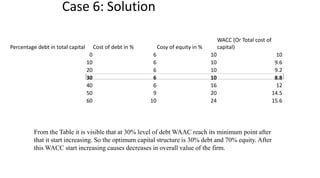
Case 6: Solution
Percentage debt in total capital Cost of debt in % Cosy of equity in %
WACC (Or Total cost of
capital)
0 6 10 10
10 6 10 9.6
20 6 10 9.2
30 6 10 8.8
40 6 16 12
50 9 20 14.5
60 10 24 15.6
From the Table it is visible that at 30% level of debt WAAC reach its minimum point after
that it start increasing. So the optimum capital structure is 30% debt and 70% equity. After
this WACC start increasing causes decreases in overall value of the firm.
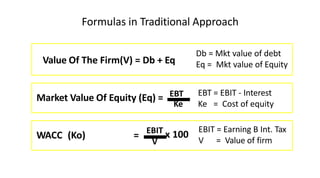
Formulas in Traditional Approach
Value Of The Firm(V) = Db + Eq
Market Value Of Equity (Eq) = EBT
Db = Mkt value of debt
Eq = Mkt value of Equity
V
WACC (Ko) = EBIT x 100
EBT = EBIT - Interest
Ke Ke = Cost of equity
EBIT = Earning B Int. Tax
V = Value of firm
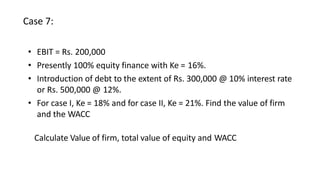
• EBIT = Rs. 200,000
• Presently 100% equity finance with Ke = 16%.
• Introduction of debt to the extent of Rs. 300,000 @ 10% interest rate
or Rs. 500,000 @ 12%.
• For case I, Ke = 18% and for case II, Ke = 21%. Find the value of firm
and the WACC
Calculate Value of firm, total value of equity and WACC
Case 7:
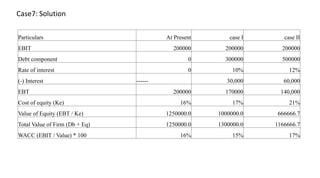
Case7: Solution
Particulars At Present case I case II
EBIT 200000 200000 200000
Debt component 0 300000 500000
Rate of interest 0 10% 12%
(-) Interest ------ 30,000 60,000
EBT 200000 170000 140,000
Cost of equity (Ke) 16% 17% 21%
Value of Equity (EBT / Ke) 1250000.0 1000000.0 666666.7
Total Value of Firm (Db + Eq) 1250000.0 1300000.0 1166666.7
WACC (EBIT / Value) * 100 16% 15% 17%
Modigliani – Miller Model (MM)
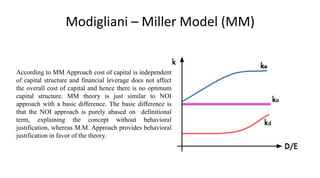
According to MM Approach cost of capital is independent
of capital structure and financial leverage does not affect
the overall cost of capital and hence there is no optimum
capital structure. MM theory is just similar to NOI
approach with a basic difference. The basic difference is
that the NOI approach is purely abased on definitional
term, explaining the concept without behavioral
justification, whereas M.M. Approach provides behavioral
justification in favor of the theory.
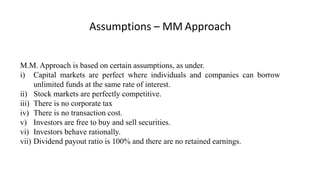
Assumptions – MM Approach
M.M. Approach is based on certain assumptions, as under.
i) Capital markets are perfect where individuals and companies can borrow
unlimited funds at the same rate of interest.
ii) Stock markets are perfectly competitive.
iii) There is no corporate tax
iv) There is no transaction cost.
v) Investors are free to buy and sell securities.
vi) Investors behave rationally.
vii) Dividend payout ratio is 100% and there are no retained earnings.
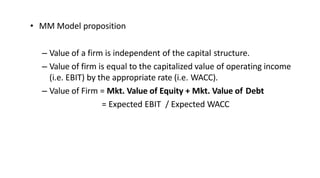
• MM Model proposition
– Value of a firm is independent of the capital structure.
– Value of firm is equal to the capitalized value of operating income
(i.e. EBIT) by the appropriate rate (i.e. WACC).
– Value of Firm = Mkt. Value of Equity + Mkt. Value of Debt
= Expected EBIT / Expected WACC
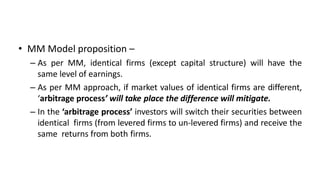
• MM Model proposition –
– As per MM, identical firms (except capital structure) will have the
same level of earnings.
– As per MM approach, if market values of identical firms are different,
‘arbitrage process’ will take place the difference will mitigate.
– In the ‘arbitrage process’ investors will switch their securities between
identical firms (from levered firms to un-levered firms) and receive the
same returns from both firms.
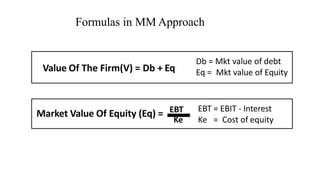
Formulas in MM Approach
Value Of The Firm(V) = Db + Eq
EBT = EBIT - Interest
Ke Ke = Cost of equity
Market Value Of Equity (Eq) = EBT
Db = Mkt value of debt
Eq = Mkt value of Equity
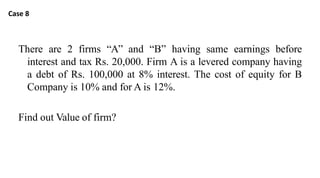
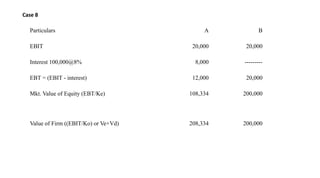
There are 2 firms “A” and “B” having same earnings before
interest and tax Rs. 20,000. Firm A is a levered company having
a debt of Rs. 100,000 at 8% interest. The cost of equity for B
Company is 10% and for A is 12%.
Find out Value of firm?
Case 8
Particulars A B
EBIT 20,000 20,000
Interest 100,000@8% 8,000 ---------
EBT = (EBIT - interest) 12,000 20,000
Mkt. Value of Equity (EBT/Ke) 108,334 200,000
Value of Firm ((EBIT/Ko) or Ve+Vd) 208,334 200,000
Case 8
Contd
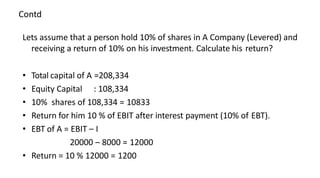
Lets assume that a person hold 10% of shares in A Company (Levered) and
receiving a return of 10% on his investment. Calculate his return?
• Total capital of A =208,334
• Equity Capital : 108,334
• 10% shares of 108,334 = 10833
• Return for him 10 % of EBIT after interest payment (10% of EBT).
• EBT of A = EBIT – I
20000 – 8000 = 12000
• Return = 10 % 12000 = 1200
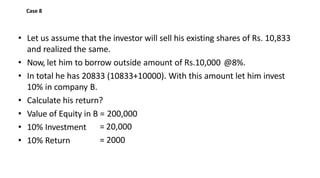
• Let us assume that the investor will sell his existing shares of Rs. 10,833
and realized the same.
• Now, let him to borrow outside amount of Rs.10,000 @8%.
• In total he has 20833 (10833+10000). With this amount let him invest
10% in company B.
• Calculate his return?
• Value of Equity in B = 200,000
• 10% Investment
• 10% Return
= 20,000
= 2000
Case 8
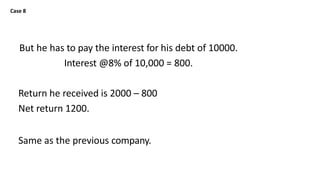
But he has to pay the interest for his debt of 10000.
Interest @8% of 10,000 = 800.
Return he received is 2000 – 800
Net return 1200.
Same as the previous company.
Case 8
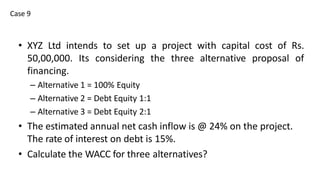
Case 9
• XYZ Ltd intends to set up a project with capital cost of Rs.
50,00,000. Its considering the three alternative proposal of
financing.
– Alternative 1 = 100% Equity
– Alternative 2 = Debt Equity 1:1
– Alternative 3 = Debt Equity 2:1
• The estimated annual net cash inflow is @ 24% on the project.
The rate of interest on debt is 15%.
• Calculate the WACC for three alternatives?
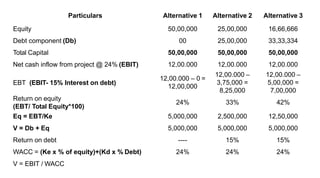
Particulars Alternative 1 Alternative 2 Alternative 3
Equity 50,00,000 25,00,000 16,66,666
Debt component (Db) 00 25,00,000 33,33,334
Total Capital 50,00,000 50,00,000 50,00,000
Net cash inflow from project @ 24% (EBIT) 12,00.000 12,00.000 12,00.000
EBT (EBIT- 15% Interest on debt)
12,00.000 – 0 =
12,00,000
12,00.000 –
3,75,000 =
8,25,000
12,00.000 –
5,00,000 =
7,00,000
Return on equity
(EBT/ Total Equity*100)
24% 33% 42%
Eq = EBT/Ke 5,000,000 2,500,000 12,50,000
V = Db + Eq 5,000,000 5,000,000 5,000,000
Return on debt ---- 15% 15%
WACC = (Ke x % of equity)+(Kd x % Debt) 24% 24% 24%
V = EBIT / WACC
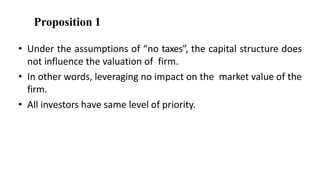
Proposition 1
• Under the assumptions of “no taxes”, the capital structure does
not influence the valuation of firm.
• In other words, leveraging no impact on the market value of the
firm.
• All investors have same level of priority.
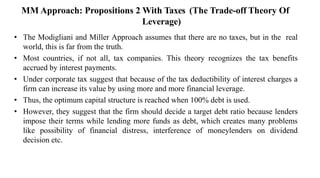
MM Approach: Propositions 2 With Taxes (The Trade-off Theory Of
Leverage)
• The Modigliani and Miller Approach assumes that there are no taxes, but in the real
world, this is far from the truth.
• Most countries, if not all, tax companies. This theory recognizes the tax benefits
accrued by interest payments.
• Under corporate tax suggest that because of the tax deductibility of interest charges a
firm can increase its value by using more and more financial leverage.
• Thus, the optimum capital structure is reached when 100% debt is used.
• However, they suggest that the firm should decide a target debt ratio because lenders
impose their terms while lending more funds as debt, which creates many problems
like possibility of financial distress, interference of moneylenders on dividend
decision etc.
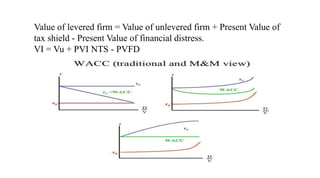
Value of levered firm = Value of unlevered firm + Present Value of
tax shield - Present Value of financial distress.
VI = Vu + PVI NTS - PVFD
References:
 Financial Management: Principles and Applications, by Keown, J. and Martin, John D.,
Published by Pearson, 13th edition, Copyright © 2018.
 Financial management, by I.M. Pandey, Vikas Publication..
 Financial management, by M.Y. Khan and P.K. Jain, TMH.
 Financial management, theory and practice, by Prasanna Chandra, TMH.
 Financial management and policy, by J.C. Vanhorne, PTH

Capital structure theroy(Financial Management).pdf

  • 1.
    By Dr. Vijay ShankarPandey Asst. Professor IMS- New Campus University of Lucknow, Lucknow Capital Structure Decision and Value of the Firm
  • 2.
    Theories of capitalstructure • NI approach • NOI approach • Traditional Approach • Modigliani and Miller Approach
  • 4.
    Capital structure decision Whatis capital structure? Combination of various component of capital is called capital structure. The over all cost of capital may reduce as the proportion of debt increases in the capital structure because cost of debt is less than cost of equity, while on the other hand risk of the firm increases with the increase in the fixed contractual obligation, which again increases the weighted average cost of capital. The firm may use only equity, or only debt, or a combination of equity +debt, or a combination of equity + debt + preference shares or may use other similar combinations to form capital structure.
  • 5.
    Ideal capital structure •It minimize cost of capital. • It reduce risks. • It give required flexibility. • It provide required control to the owners. • It enable the company to have adequate finance. • It maximize the value of the firm ultimately the wealth of the shareholders.
  • 6.
    Cost of cpital Returnon investment Total Return and Cost of Capital Which company has more value? A B
  • 7.
    Example Total capital neededfor a company is Rs. 2000. Company has 2 options 1) Issue 20 Equity shares of Rs. 100 2) Issue 10 Equity shares of Rs. 100 and 10% Debt for Rs. 1000. Assume that total return earned in both is Rs.1000. Calculate the return for shareholders (EPS)
  • 8.
    Earning per sharefor same profile with different capital structure 50.00 90.00 - 100.00 90.00 80.00 70.00 60.00 50.00 40.00 30.00 20.00 10.00 Pure Equity firm Mix of Debt and Equity EPS It means when capital structure is changing the cost of capital will change and also it will effect the value of the firm
  • 9.
    Capital Structure Theories I.Net Income Approach (NI) II. Net Operating IncomeApproach (NOI) III. TraditionalApproach IV. Modigiliani – Miller Approach (MM Approach)
  • 10.
    Net Income Approach(NI Approach) • Suggested By David Durand in 1959. • The earning of the firm after the payment of all other expenses except interest on debt is called Net Operating Income (NOI) and the earning available for equity shareholders after the payment of interest is called as “Net Income (NI). • Therefore, Net Income = Net Operating Income (NOI) - Interest on debt (I). • According to NI approach capital structure decision is relevant for the value of the firm. • Change in the capital structure will corresponding bring change in the overall cost of capital
  • 11.
    Contd … • According tothis approach, “a high debt equity ratio in the capital structure (called financial leverage) will result in decline in the overall cost of capital (WACC) of the firm and increase value of firm.” • According to NI Approach, change in the financial leverage (debt/equity ratio) of a firm will lead to a corresponding change in the WACC and also the value of the firm. • The NI Approach suggests that with the increase in leverage (proportion of debt), the WACC decreases and the value of firm increases and vice versa.
  • 12.
    • Under NIapproach, higher use of debt in capital structure will result in reduction of WACC. As a consequence, value of firm will be increased • Value of firm = Earnings WACC • Earnings (EBIT) being constant and WACC is reduced, the value of a firm will always increase. • The capital structure is said to be optimum at that stage of debt-equity mix where the overall cost of capital is minimum. As per this approach the cost of capital is minimum at 100% level of debt, therefore the capital structure is optimized at the 100% debt level. WACC= Weighted Average Cost of Capital Contd.
  • 13.
    Assumptions (i) There areno corporate taxes. (ii) The cost of debt is less than the cost of equity (Kd < Ke ) i.e. the capitalization rate of debt is less than the capitalization rate of equity. This prompts the firm to borrow. (iii)The debt capitalization rate and the equity capitalization rate remain constant over the time. (iv)The proportion of the debt does not affect the risk perception of the investors. Investors are only concerned with their desired return. (v) The cost of debt remains constant at any level of debt. (vi) Dividend pay out ratio is 100%.
  • 14.
    10% 15% Ke = Costof equity Kd = Cost of debt Ko = Overall Cost Financial Leverage or Use Of Debt In Capital Cost of Capital Graphical representation of NI Approach
  • 15.
    Formulas in NIApproach S = Market Value Of Equity NI = Net Income for E-Share holders Ke = Cost of Equity Ke Value Of The Firm(V) = S+B S= Value of share B = Value Of Debt Market Value Of Equity = NI x100
  • 16.
    Case 1. XYZ LtdEarned a profit of Rs. 25 Lakhs before providing interest and tax. The company’s capital structure is as follows You are required to calculate Value of firm by using NI Approach and Overall cost of capital of the firm. 4,50,000 E/S of Rs. 10 each and its market capitalization rate is 16% 26,000 14% secured redeemable debentures of Rs. 150 each
  • 17.
    Solution NI = EBIT– Interest S = NI/Ke * 100 B = No of Debt * Price Value of firm = S+B Overall Cost = EBIT / V Profit Before Interest And Tax 2500000 Less Debt Interest (14%* 26000*150) 546000 Net Income available to E/S H 1954000 Value of Share at 16% capitalisation rate 12212500 Value of Debt at 14% capialisation rate 3900000 Total Value of the firm (S+B) 16112500 Overall cost of capital (WACC) 0.1552
  • 18.
    Case 2. • Acompany expects its annual EBITto be Rs. 80,000. The company has 2,00,000 in 10% Debt and the Ke = 12.5%. – Calculate Value of firm and Overall cost of capital –If the company Increase the debt content to Rs. 3,00,000 (Assume that there is no change in Profit)
  • 19.
    Case 2 -SolutionNI = EBIT – Interest S = NI/Ke * 100 B = No of Debt * Price Value of firm = S+B Overall Cost = EBIT / V Profit Before Interest And Tax 80000 Less Debt Interest (10%* 200,000) 20000 Net Income available to E/S H 60000 Value of Share at 12.5% capitalisation rate 480000 Value of Debt at 10% capialisation rate 200000 Total Value of the firm (S+B) 680000 Overall cost of capital (WACC) 0.1176
  • 20.
    Case 2 -Solution Cotd.. NI = EBIT – Interest S = NI/Ke * 100 B = No of Debt * Price Value of firm = S+B Overall Cost = EBIT / V Value of Share at 12.5% capitalisation rate 480000 Value of Debt at 10% capialisation rate 200000 Total Value of the firm (S+B) 680000 Overall cost of capital (WACC) 0.1176 Profit Before Interest And Tax 80000 Less Debt Interest (10%* 300,000) 30000 Net Income available to E/S H 50000 Value of Share at 12.5% capitalisation rate 400000 Value of Debt at 10% capialisation rate 300000 Total Value of the firm (S+B) 700000 Overall cost of capital (WACC) 0.1143
  • 21.
    Calculate the valueof Firm and WACC for the following capital structures EBIT of a firm Rs. 3,00,000 Ke = 10% Kd = 6% Case 1 Debt capital Rs. 500,000 Case 2 Debt = Rs. 800,000 Case 3 Debt = Rs. 200,000 Case 3.
  • 22.
    Particulars Case 3.1Case3.2 Case 3.3 Total Debt used by Firm 500000 800000 200000 Profit Before Interest And Tax 200000 200000 200000 Less Debt Interest at 6% 30000 48000 12000 Net Income available to E/S H 170000 152000 188000 Value of Share at 10% capitalisation rate 1700000 1520000 1880000 Value of Debt at 6% capialisation rate 500000 800000 200000 Total Value of the firm (S+B) 2200000 2320000 2080000 Overall cost of capital (WACC) 0.0909 0.0862 0.0962 Under NI approach when firm is using maximum debt its WACC is minimum and total value of the firm is maximum. Case 3 - Solution NI = EBIT – Interest S = NI/Ke * 100 B = No of Debt * Price Value of firm = S+B Overall Cost = EBIT / V
  • 23.
    2. Net OperatingIncomeApproach (NOI Approach) This theory is just opposite to NI approach. NI approach is relevant to capital structure decision. It means decision of debt equity mix does affect the WACC and value of the firm. As per NOI approach the capital structure decision is irrelevant and the degree of financial leverage does not affect the WACC and market value of the firm. NOI approach evaluates the cost of capital and therefore the optimal Capital Structure on the basis of operating leverage by means of NOI approach.
  • 24.
    The NOI approachis based on following assumptions: (i) There are no corporate taxes. (ii) Cost of debt remains constant at all level of debt. (iii)Overall cost of capital remains constant. (iv) Value of the firm depends on expected net operating income and overall capitalization rate or the opportunity cost of capital. (v) Net operating income of the firm is not affected by the degree of financial leverage. (vi) The operating risk or business risk does not change with the change in debt equity mix. (vii)WACC does not change with the change in financial leverage
  • 25.
    Formulas in NOIApproach Ko V = Value of Firm B = Value of Debt Market Value Of Equity (S) = V - B EBIT = Earnings Before Int. & Tax Ko = Overall Cost of Capital Value Of The Firm(V) = EBIT x100
  • 26.
    10% 15% Kd = Costof debt Cost of Capital Graphical representation of NOI Approach Increasing Debt in Capital Ko = Overall Cost Financial Leverage or Use Of Debt In Capital Ke = Cost of equity capital
  • 27.
    Case 4 The XYZLtd. has earned a profit before interest and tax Rs. 7 lakhs. The company’s capital structure includes 30,000 14% Debenture of Rs. 100 each. The overall capitalization rate of the firm is 16%. – Calculate the Total value of firm and the equity capitalization rate?
  • 28.
    Case 4 -Solution V = EBIT/Ko*100 S = V-B Ke = EBIT-I /S*100 = Particular Amount Profit before interest and tax (EBIT) 700000 Overal cost of capital 16% 0.16 Total Value of the firm (EBIT/overall cost of capital) 4375000 Total Value of the debt (No. of bonds x price) 3000000 Total value of equity (Total value of firm-Total value of debt) 1375000 Interest paid 420000 Earnings available to shareholders 280000 Cost of equity Ke 0.2036
  • 29.
    Case 5 • Acompany expects a net operating income of 100000. it has Rs.5,00,000 6% Debentures. The overall capitalization rate is 10%. a.Calculate the value of the firm and the equity capitlization rate (Cost of equity) according to the Net Operating Income Approach. b.If the debenture debt is increased to Rs.700000 what will be the effect on the value of the firm? c.If the debenture debt is decreased to Rs. 300000 what will be the effect on the value of the firm?
  • 30.
    Case5- Solution V =EBIT/Ko*100 S = V-B Ke = EBIT-I /S*100 When debt is 500000 When debt is 700000 When debt is 300000 Particular Amount Amount Amount Profit before interest and tax (EBIT) 100000 100000 100000 Overal cost of capital 10% 0.1 0.1 0.1 Total Value of the firm (EBIT/overall cost of capital) 1000000 1000000 1000000 Total Value of the debt (No. of bonds x price) 500000 700000 300000 Total value of equity (Total value of firm- Total value of debt) 500000 300000 700000 Interest paid at 6% 30000 42000 18000 Earnings available to shareholders 70000 58000 82000 Cost of equity (Ke) 0.14 0.1933 0.1171
  • 31.
    As per NOIapproach the cost of debt, market value of the firm and the market value of the equity shares remain constant irrespective of change in the financial leverage and the benefit of low cost of debt is offset by the increased rate of return on equity with the increase in debt in the capital structure. Therefore, the overall all cost of capital remains the same at any level of debt; hence, the capital structure is optimum at any level of debt-equity mix. Under this circumstances, the optimum level of capital structure composed on debt- equity composition becomes indeterminate, as the impact of financial leverage is counter balanced by a corresponding change in Ke in the opposite direction. Optimum capital structure under NOI Approach:
  • 32.
  • 33.
    The traditional approachwas propounded by Ezra Soloman in 1963 . This approach is the compromise between NI approach and NOI approach. The traditional approach rejects both extreme prepositions of relevance approach of NI theory and irrelevance approach of NOI theory. This approach neither assumes constant cost of equity (ke) and declining Weighted Average Cost of Capital (WACC) like NI approach nor increasing cost of equity and constant cost of debt (kd) and over all cost of capital (ko) like NOI approach. TraditionalApproach Under traditional approach wacc decreases only up to a certain level of financial leverage and starts increasing beyond this level. At the judicious mix of debt and equity as of optimum capital structure weighted average cost of capital is minimum and the market value of the firm is maximum.
  • 34.
    Stage 1: The valueof the firm may first increase with moderate leverage when WACC is decreasing. Stage 2: Reach the maximum value when WACC is minimum. Stage 3: Then starts declining with higher financial leverage when WACC start increasing. Three stage of capital structure under traditional approach
  • 35.
    Assumptions Under TraditionalApproach • Cost of debt (kd) remains stable with an increase in the debt ratio to a certain limit after which it begins to grow. • Cost of equity (ke) remains stable or grows slightly with an increase in the debt ratio to a certain limit after which it begins to grow rapidly. • Weighted average cost of capital decreases to some degree with an increase in the debt ratio and then begins to grow. • Cost of equity is larger than the cost of debt at any capital structure, i.e., ke>kd at any value of debt ratio.
  • 36.
    Traditional Approach –Graphical representation
  • 37.
    Traditional Approach –Graphical representation (Mkt Value)
  • 38.
    Case 6: Use ofDebt as a percentage in total capital Cost of Debt Cost of equity 00 6.0 10.0 10 6.0 10.0 20 6.0 10.0 30 6.0 10.0 40 6.0 16.0 50 9.0 20.0 60 10.0 24.0 In considering the most desirable capital for a company the following estimates of the cost of debt and equity (after tax) have been made at a various level of debt equity mix. You are required to optimal for the by calculate debt equity company calculating composite cost of capital (Overall Cost of capital)
  • 39.
    Case 6: Solution Percentagedebt in total capital Cost of debt in % Cosy of equity in % WACC (Or Total cost of capital) 0 6 10 10 10 6 10 9.6 20 6 10 9.2 30 6 10 8.8 40 6 16 12 50 9 20 14.5 60 10 24 15.6 From the Table it is visible that at 30% level of debt WAAC reach its minimum point after that it start increasing. So the optimum capital structure is 30% debt and 70% equity. After this WACC start increasing causes decreases in overall value of the firm.
  • 40.
    Formulas in TraditionalApproach Value Of The Firm(V) = Db + Eq Market Value Of Equity (Eq) = EBT Db = Mkt value of debt Eq = Mkt value of Equity V WACC (Ko) = EBIT x 100 EBT = EBIT - Interest Ke Ke = Cost of equity EBIT = Earning B Int. Tax V = Value of firm
  • 41.
    • EBIT =Rs. 200,000 • Presently 100% equity finance with Ke = 16%. • Introduction of debt to the extent of Rs. 300,000 @ 10% interest rate or Rs. 500,000 @ 12%. • For case I, Ke = 18% and for case II, Ke = 21%. Find the value of firm and the WACC Calculate Value of firm, total value of equity and WACC Case 7:
  • 42.
    Case7: Solution Particulars AtPresent case I case II EBIT 200000 200000 200000 Debt component 0 300000 500000 Rate of interest 0 10% 12% (-) Interest ------ 30,000 60,000 EBT 200000 170000 140,000 Cost of equity (Ke) 16% 17% 21% Value of Equity (EBT / Ke) 1250000.0 1000000.0 666666.7 Total Value of Firm (Db + Eq) 1250000.0 1300000.0 1166666.7 WACC (EBIT / Value) * 100 16% 15% 17%
  • 43.
  • 44.
    Modigliani – MillerModel (MM) According to MM Approach cost of capital is independent of capital structure and financial leverage does not affect the overall cost of capital and hence there is no optimum capital structure. MM theory is just similar to NOI approach with a basic difference. The basic difference is that the NOI approach is purely abased on definitional term, explaining the concept without behavioral justification, whereas M.M. Approach provides behavioral justification in favor of the theory.
  • 45.
    Assumptions – MMApproach M.M. Approach is based on certain assumptions, as under. i) Capital markets are perfect where individuals and companies can borrow unlimited funds at the same rate of interest. ii) Stock markets are perfectly competitive. iii) There is no corporate tax iv) There is no transaction cost. v) Investors are free to buy and sell securities. vi) Investors behave rationally. vii) Dividend payout ratio is 100% and there are no retained earnings.
  • 46.
    • MM Modelproposition – Value of a firm is independent of the capital structure. – Value of firm is equal to the capitalized value of operating income (i.e. EBIT) by the appropriate rate (i.e. WACC). – Value of Firm = Mkt. Value of Equity + Mkt. Value of Debt = Expected EBIT / Expected WACC
  • 47.
    • MM Modelproposition – – As per MM, identical firms (except capital structure) will have the same level of earnings. – As per MM approach, if market values of identical firms are different, ‘arbitrage process’ will take place the difference will mitigate. – In the ‘arbitrage process’ investors will switch their securities between identical firms (from levered firms to un-levered firms) and receive the same returns from both firms.
  • 48.
    Formulas in MMApproach Value Of The Firm(V) = Db + Eq EBT = EBIT - Interest Ke Ke = Cost of equity Market Value Of Equity (Eq) = EBT Db = Mkt value of debt Eq = Mkt value of Equity
  • 49.
    There are 2firms “A” and “B” having same earnings before interest and tax Rs. 20,000. Firm A is a levered company having a debt of Rs. 100,000 at 8% interest. The cost of equity for B Company is 10% and for A is 12%. Find out Value of firm? Case 8
  • 50.
    Particulars A B EBIT20,000 20,000 Interest 100,000@8% 8,000 --------- EBT = (EBIT - interest) 12,000 20,000 Mkt. Value of Equity (EBT/Ke) 108,334 200,000 Value of Firm ((EBIT/Ko) or Ve+Vd) 208,334 200,000 Case 8
  • 51.
    Contd Lets assume thata person hold 10% of shares in A Company (Levered) and receiving a return of 10% on his investment. Calculate his return? • Total capital of A =208,334 • Equity Capital : 108,334 • 10% shares of 108,334 = 10833 • Return for him 10 % of EBIT after interest payment (10% of EBT). • EBT of A = EBIT – I 20000 – 8000 = 12000 • Return = 10 % 12000 = 1200
  • 52.
    • Let usassume that the investor will sell his existing shares of Rs. 10,833 and realized the same. • Now, let him to borrow outside amount of Rs.10,000 @8%. • In total he has 20833 (10833+10000). With this amount let him invest 10% in company B. • Calculate his return? • Value of Equity in B = 200,000 • 10% Investment • 10% Return = 20,000 = 2000 Case 8
  • 53.
    But he hasto pay the interest for his debt of 10000. Interest @8% of 10,000 = 800. Return he received is 2000 – 800 Net return 1200. Same as the previous company. Case 8
  • 54.
    Case 9 • XYZLtd intends to set up a project with capital cost of Rs. 50,00,000. Its considering the three alternative proposal of financing. – Alternative 1 = 100% Equity – Alternative 2 = Debt Equity 1:1 – Alternative 3 = Debt Equity 2:1 • The estimated annual net cash inflow is @ 24% on the project. The rate of interest on debt is 15%. • Calculate the WACC for three alternatives?
  • 55.
    Particulars Alternative 1Alternative 2 Alternative 3 Equity 50,00,000 25,00,000 16,66,666 Debt component (Db) 00 25,00,000 33,33,334 Total Capital 50,00,000 50,00,000 50,00,000 Net cash inflow from project @ 24% (EBIT) 12,00.000 12,00.000 12,00.000 EBT (EBIT- 15% Interest on debt) 12,00.000 – 0 = 12,00,000 12,00.000 – 3,75,000 = 8,25,000 12,00.000 – 5,00,000 = 7,00,000 Return on equity (EBT/ Total Equity*100) 24% 33% 42% Eq = EBT/Ke 5,000,000 2,500,000 12,50,000 V = Db + Eq 5,000,000 5,000,000 5,000,000 Return on debt ---- 15% 15% WACC = (Ke x % of equity)+(Kd x % Debt) 24% 24% 24% V = EBIT / WACC
  • 56.
    Proposition 1 • Underthe assumptions of “no taxes”, the capital structure does not influence the valuation of firm. • In other words, leveraging no impact on the market value of the firm. • All investors have same level of priority.
  • 57.
    MM Approach: Propositions2 With Taxes (The Trade-off Theory Of Leverage) • The Modigliani and Miller Approach assumes that there are no taxes, but in the real world, this is far from the truth. • Most countries, if not all, tax companies. This theory recognizes the tax benefits accrued by interest payments. • Under corporate tax suggest that because of the tax deductibility of interest charges a firm can increase its value by using more and more financial leverage. • Thus, the optimum capital structure is reached when 100% debt is used. • However, they suggest that the firm should decide a target debt ratio because lenders impose their terms while lending more funds as debt, which creates many problems like possibility of financial distress, interference of moneylenders on dividend decision etc.
  • 58.
    Value of leveredfirm = Value of unlevered firm + Present Value of tax shield - Present Value of financial distress. VI = Vu + PVI NTS - PVFD
  • 59.
    References:  Financial Management:Principles and Applications, by Keown, J. and Martin, John D., Published by Pearson, 13th edition, Copyright © 2018.  Financial management, by I.M. Pandey, Vikas Publication..  Financial management, by M.Y. Khan and P.K. Jain, TMH.  Financial management, theory and practice, by Prasanna Chandra, TMH.  Financial management and policy, by J.C. Vanhorne, PTH