Spinal Cord and
Brain
Introduction
■ The nervous system divide into two parts:
1. Central nervous system
2. Peripheral nervous system
■ Central nervous system consists of brain and spinal cord.
■ This complex system is part of everything we do. It controls
the things like walk and talk and the things our body does
automatically.
■ The central nervous system is also involved with our
senses as well as our emotions, thoughts, and memory.
Brain
■ The brain is a soft, spongy mass of nerve cells and
supportive tissue.
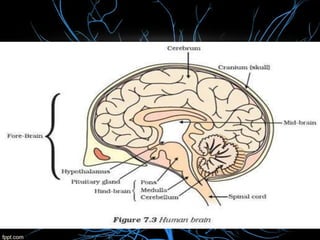
■ It has three major parts: Forebrain, Mid-brain , and Hind-
brain.
■ Fore-Brain: It is the largest area of brain. Following
are the important parts of this region:
1. Thalamus
2. Hypothalamus
3. Cerebrum
Brain
 Mid-Brain: It lies between hind-brain and fore-
brain and connect the two. It receive the information
and send it to appropriate part of fore-brain.
 Hind-brain: It is the lower part of brainstem. It
consists of three major parts.
1. Medulla oblongata
2. Cerebellum
3. Pons
Spinal cord
 The spinal cord is tubular bundle of nerves. It start
from brain stem and extends to lower back.
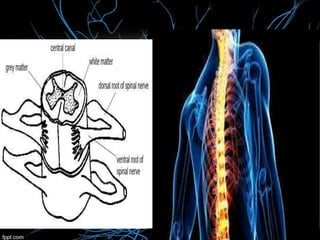
 The outer region of spinal cord is made of white
matter.
 The central region is butterfly shaped that surrounds
the central canal. It is made of grey matter.
 Spinal nerve has two roots:
 The dorsal root contains sensory axons and a
ganglion.
Spinal cord
 The ventral root contains axons of motor neurons.
 Spinal perform two main functions:
1. It serve as a link between body parts and brain.
2. Spinal cord also acts as a coordinator, responsible for
some simple reflexives.
 Spinal cord is 40cm long and as wide as your thumb
for most of length.
Spinal Cord and brain

Spinal Cord and brain

  • 1.
  • 2.
    Introduction ■ The nervoussystem divide into two parts: 1. Central nervous system 2. Peripheral nervous system ■ Central nervous system consists of brain and spinal cord. ■ This complex system is part of everything we do. It controls the things like walk and talk and the things our body does automatically. ■ The central nervous system is also involved with our senses as well as our emotions, thoughts, and memory.
  • 3.
    Brain ■ The brainis a soft, spongy mass of nerve cells and supportive tissue. ■ It has three major parts: Forebrain, Mid-brain , and Hind- brain. ■ Fore-Brain: It is the largest area of brain. Following are the important parts of this region: 1. Thalamus 2. Hypothalamus 3. Cerebrum
  • 4.
    Brain  Mid-Brain: Itlies between hind-brain and fore- brain and connect the two. It receive the information and send it to appropriate part of fore-brain.  Hind-brain: It is the lower part of brainstem. It consists of three major parts. 1. Medulla oblongata 2. Cerebellum 3. Pons
  • 6.
    Spinal cord  Thespinal cord is tubular bundle of nerves. It start from brain stem and extends to lower back.  The outer region of spinal cord is made of white matter.  The central region is butterfly shaped that surrounds the central canal. It is made of grey matter.  Spinal nerve has two roots:  The dorsal root contains sensory axons and a ganglion.
  • 7.
    Spinal cord  Theventral root contains axons of motor neurons.  Spinal perform two main functions: 1. It serve as a link between body parts and brain. 2. Spinal cord also acts as a coordinator, responsible for some simple reflexives.  Spinal cord is 40cm long and as wide as your thumb for most of length.