 The  nervous system is the part of
  an animal’s body that coordinates the actions
  of the animal and transmits signals between
  different parts of its body.
 It controls and regulates all activities of the
  body, whether voluntary or involuntary, and
  adjusts the individual (organism) to the given
  surroundings. This is based on the special
  properties of sensitivity, conductivity and
  responsiveness of the nervous system.
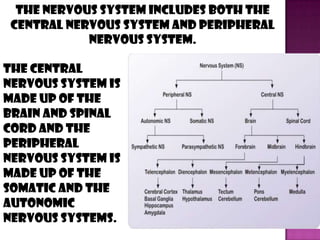
The nervous system includes both the
 Central nervous system and Peripheral
            nervous system.

The Central
nervous system is
made up of the
brain and spinal
cord and The
Peripheral
nervous system is
made up of the
Somatic and the
Autonomic
nervous systems.
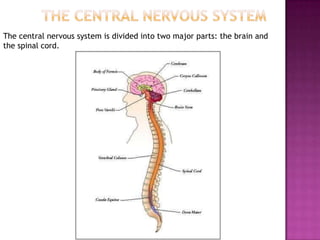
The central nervous system is divided into two major parts: the brain and
the spinal cord.
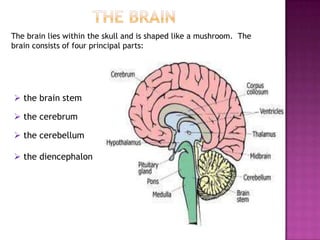
The brain lies within the skull and is shaped like a mushroom. The
brain consists of four principal parts:


 the brain stem

 the cerebrum

 the cerebellum

 the diencephalon
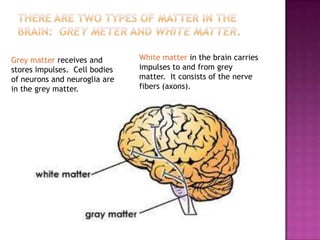
Grey matter receives and       White matter in the brain carries
stores impulses. Cell bodies   impulses to and from grey
of neurons and neuroglia are   matter. It consists of the nerve
in the grey matter.            fibers (axons).
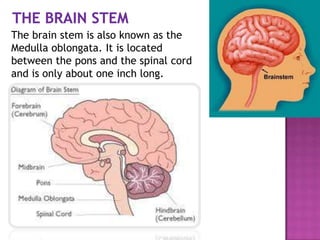
The brain stem is also known as the
Medulla oblongata. It is located
between the pons and the spinal cord
and is only about one inch long.
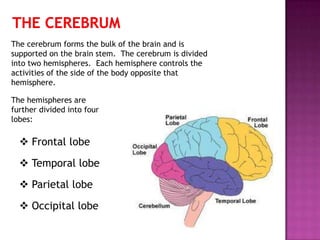
The cerebrum forms the bulk of the brain and is
supported on the brain stem. The cerebrum is divided
into two hemispheres. Each hemisphere controls the
activities of the side of the body opposite that
hemisphere.

The hemispheres are
further divided into four
lobes:

   Frontal lobe

   Temporal lobe

   Parietal lobe

   Occipital lobe
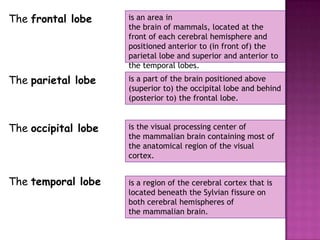
The frontal lobe     is an area in
                     the brain of mammals, located at the
                     front of each cerebral hemisphere and
                     positioned anterior to (in front of) the
                     parietal lobe and superior and anterior to
                     the temporal lobes.
The parietal lobe    is a part of the brain positioned above
                     (superior to) the occipital lobe and behind
                     (posterior to) the frontal lobe.


The occipital lobe   is the visual processing center of
                     the mammalian brain containing most of
                     the anatomical region of the visual
                     cortex.


The temporal lobe    is a region of the cerebral cortex that is
                     located beneath the Sylvian fissure on
                     both cerebral hemispheres of
                     the mammalian brain.
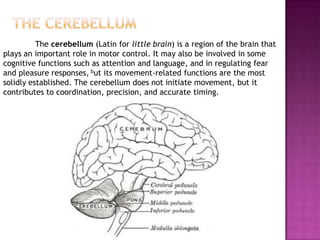
The cerebellum (Latin for little brain) is a region of the brain that
plays an important role in motor control. It may also be involved in some
cognitive functions such as attention and language, and in regulating fear
and pleasure responses, but its movement-related functions are the most
solidly established. The cerebellum does not initiate movement, but it
contributes to coordination, precision, and accurate timing.
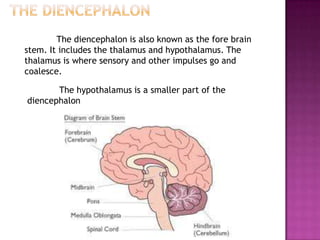
The diencephalon is also known as the fore brain
stem. It includes the thalamus and hypothalamus. The
thalamus is where sensory and other impulses go and
coalesce.

       The hypothalamus is a smaller part of the
diencephalon
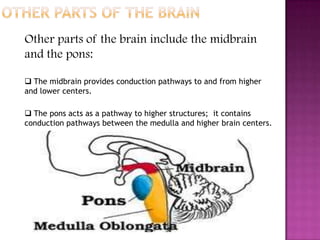
Other parts of the brain include the midbrain
and the pons:

 The midbrain provides conduction pathways to and from higher
and lower centers.

 The pons acts as a pathway to higher structures; it contains
conduction pathways between the medulla and higher brain centers.
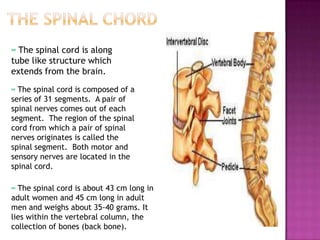
∞ The spinal cord is along
tube like structure which
extends from the brain.

∞ The spinal cord is composed of a
series of 31 segments. A pair of
spinal nerves comes out of each
segment. The region of the spinal
cord from which a pair of spinal
nerves originates is called the
spinal segment. Both motor and
sensory nerves are located in the
spinal cord.

∞ The spinal cord is about 43 cm long in
adult women and 45 cm long in adult
men and weighs about 35-40 grams. It
lies within the vertebral column, the
collection of bones (back bone).
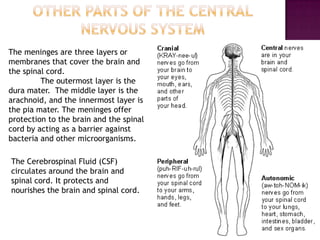
The meninges are three layers or
membranes that cover the brain and
the spinal cord.
         The outermost layer is the
dura mater. The middle layer is the
arachnoid, and the innermost layer is
the pia mater. The meninges offer
protection to the brain and the spinal
cord by acting as a barrier against
bacteria and other microorganisms.

The Cerebrospinal Fluid (CSF)
circulates around the brain and
spinal cord. It protects and
nourishes the brain and spinal cord.
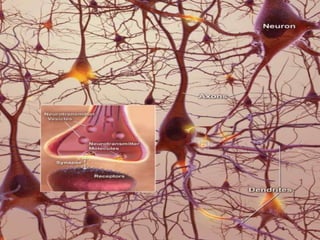
The neuron is the basic unit in the nervous system. It is
   a specialized conductor cell that receives and transmits
   electrochemical nerve impulses. A typical neuron has a
   cell body and long arms that conduct impulses from one
   body part to another body part.
There are three different parts of the
neuron:
  the cell body - The cell body is like any other cell with a nucleus or
 control center.
  dendrites - The cell body has several highly branched, thick
 extensions that appear like cables and are called dendrites. The
 exception is a sensory neuron that has a single, long dendrite instead of
 many dendrites. Motor neurons have multiple thick dendrites. The
 dendrite's function is to carry a nerve impulse into the cell body.
  axon - An axon is a long, thin process that carries impulses away from
 the cell body to another neuron or tissue. There is usually only one axon
 per neuron.
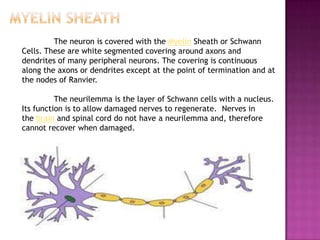
The neuron is covered with the Myelin Sheath or Schwann
Cells. These are white segmented covering around axons and
dendrites of many peripheral neurons. The covering is continuous
along the axons or dendrites except at the point of termination and at
the nodes of Ranvier.

          The neurilemma is the layer of Schwann cells with a nucleus.
Its function is to allow damaged nerves to regenerate. Nerves in
the brain and spinal cord do not have a neurilemma and, therefore
cannot recover when damaged.
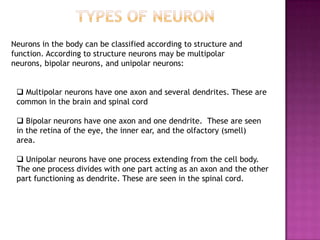
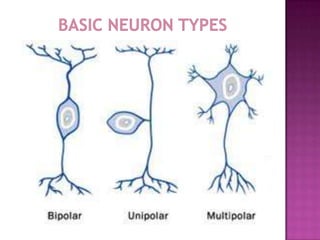
Neurons in the body can be classified according to structure and
function. According to structure neurons may be multipolar
neurons, bipolar neurons, and unipolar neurons:


  Multipolar neurons have one axon and several dendrites. These are
 common in the brain and spinal cord

  Bipolar neurons have one axon and one dendrite. These are seen
 in the retina of the eye, the inner ear, and the olfactory (smell)
 area.

  Unipolar neurons have one process extending from the cell body.
 The one process divides with one part acting as an axon and the other
 part functioning as dendrite. These are seen in the spinal cord.
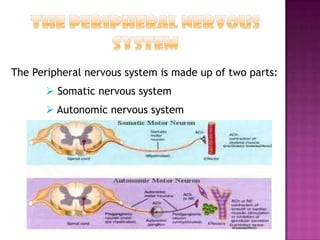
The Peripheral nervous system is made up of two parts:
        Somatic nervous system
        Autonomic nervous system
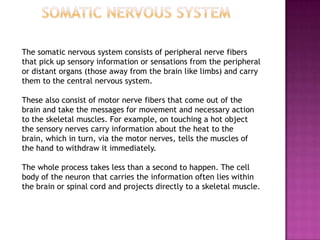
The somatic nervous system consists of peripheral nerve fibers
that pick up sensory information or sensations from the peripheral
or distant organs (those away from the brain like limbs) and carry
them to the central nervous system.

These also consist of motor nerve fibers that come out of the
brain and take the messages for movement and necessary action
to the skeletal muscles. For example, on touching a hot object
the sensory nerves carry information about the heat to the
brain, which in turn, via the motor nerves, tells the muscles of
the hand to withdraw it immediately.

The whole process takes less than a second to happen. The cell
body of the neuron that carries the information often lies within
the brain or spinal cord and projects directly to a skeletal muscle.
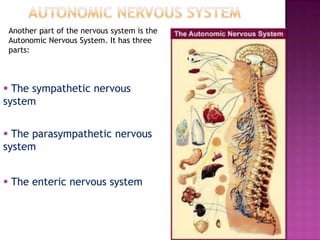
Another part of the nervous system is the
 Autonomic Nervous System. It has three
 parts:


 The sympathetic nervous
system


 The parasympathetic nervous
system


 The enteric nervous system
 The (ortho-) sympathetic nervous system (SNS) is one of the three
parts of the autonomic nervous system, along with the enteric and
parasympathetic systems. Its general action is to mobilize the body's
nervous system fight-or-flight response. It is, however, constantly active
at a basic level to maintain homeostasis.

 The parasympathetic nervous system (PSNS, or occasionally PNS) is
one of the three main divisions of the autonomic nervous
system (ANS). The ANS is responsible for regulation of internal organs
and glands, which occurs unconsciously. To be specific, the
parasympathetic system is responsible for stimulation of "rest-and-
digest" or "feed and breed" activities that occur when the body is at
rest, including sexual arousal, salivation, lacrimation
(tears), urination, digestion and defication. Its action is described as
being complementary to that of one of the other main branches of the
ANS, the sympathetic nervous system, which is responsible for
stimulating activities associated with the fight-or-flight response.

 The enteric nervous system (ENS) or Intrinsic nervous system is a
subdivision of the autonomic nervous system (ANS) that directly controls
the gastrointestinal system in vertebrates.

It is derived from neural crest.
This nervous system controls the nerves of the inner
organs of the body on which humans have no conscious
control. This includes the
heartbeat, digestion, breathing (except conscious
breathing) etc.

The nerves of the autonomic nervous system enervate
the smooth involuntary muscles of the (internal organs)
and glands and cause them to function and secrete
their enzymes etc.

The Enteric nervous system is the third part of the
autonomic nervous system. The enteric nervous system
is a complex network of nerve fibers that innervate the
organs within the abdomen like the gastrointestinal
tract, pancreas, gall bladder etc. It contains nearly 100
million nerves.
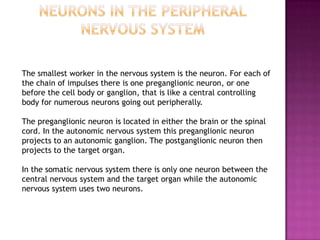
The smallest worker in the nervous system is the neuron. For each of
the chain of impulses there is one preganglionic neuron, or one
before the cell body or ganglion, that is like a central controlling
body for numerous neurons going out peripherally.

The preganglionic neuron is located in either the brain or the spinal
cord. In the autonomic nervous system this preganglionic neuron
projects to an autonomic ganglion. The postganglionic neuron then
projects to the target organ.

In the somatic nervous system there is only one neuron between the
central nervous system and the target organ while the autonomic
nervous system uses two neurons.
Nervous system

Nervous system

  • 2.
     The nervous system is the part of an animal’s body that coordinates the actions of the animal and transmits signals between different parts of its body.  It controls and regulates all activities of the body, whether voluntary or involuntary, and adjusts the individual (organism) to the given surroundings. This is based on the special properties of sensitivity, conductivity and responsiveness of the nervous system.
  • 5.
    The nervous systemincludes both the Central nervous system and Peripheral nervous system. The Central nervous system is made up of the brain and spinal cord and The Peripheral nervous system is made up of the Somatic and the Autonomic nervous systems.
  • 6.
    The central nervoussystem is divided into two major parts: the brain and the spinal cord.
  • 7.
    The brain lieswithin the skull and is shaped like a mushroom. The brain consists of four principal parts:  the brain stem  the cerebrum  the cerebellum  the diencephalon
  • 8.
    Grey matter receivesand White matter in the brain carries stores impulses. Cell bodies impulses to and from grey of neurons and neuroglia are matter. It consists of the nerve in the grey matter. fibers (axons).
  • 9.
    The brain stemis also known as the Medulla oblongata. It is located between the pons and the spinal cord and is only about one inch long.
  • 10.
    The cerebrum formsthe bulk of the brain and is supported on the brain stem. The cerebrum is divided into two hemispheres. Each hemisphere controls the activities of the side of the body opposite that hemisphere. The hemispheres are further divided into four lobes:  Frontal lobe  Temporal lobe  Parietal lobe  Occipital lobe
  • 11.
    The frontal lobe is an area in the brain of mammals, located at the front of each cerebral hemisphere and positioned anterior to (in front of) the parietal lobe and superior and anterior to the temporal lobes. The parietal lobe is a part of the brain positioned above (superior to) the occipital lobe and behind (posterior to) the frontal lobe. The occipital lobe is the visual processing center of the mammalian brain containing most of the anatomical region of the visual cortex. The temporal lobe is a region of the cerebral cortex that is located beneath the Sylvian fissure on both cerebral hemispheres of the mammalian brain.
  • 12.
    The cerebellum (Latinfor little brain) is a region of the brain that plays an important role in motor control. It may also be involved in some cognitive functions such as attention and language, and in regulating fear and pleasure responses, but its movement-related functions are the most solidly established. The cerebellum does not initiate movement, but it contributes to coordination, precision, and accurate timing.
  • 13.
    The diencephalon isalso known as the fore brain stem. It includes the thalamus and hypothalamus. The thalamus is where sensory and other impulses go and coalesce. The hypothalamus is a smaller part of the diencephalon
  • 14.
    Other parts ofthe brain include the midbrain and the pons:  The midbrain provides conduction pathways to and from higher and lower centers.  The pons acts as a pathway to higher structures; it contains conduction pathways between the medulla and higher brain centers.
  • 15.
    ∞ The spinalcord is along tube like structure which extends from the brain. ∞ The spinal cord is composed of a series of 31 segments. A pair of spinal nerves comes out of each segment. The region of the spinal cord from which a pair of spinal nerves originates is called the spinal segment. Both motor and sensory nerves are located in the spinal cord. ∞ The spinal cord is about 43 cm long in adult women and 45 cm long in adult men and weighs about 35-40 grams. It lies within the vertebral column, the collection of bones (back bone).
  • 16.
    The meninges arethree layers or membranes that cover the brain and the spinal cord. The outermost layer is the dura mater. The middle layer is the arachnoid, and the innermost layer is the pia mater. The meninges offer protection to the brain and the spinal cord by acting as a barrier against bacteria and other microorganisms. The Cerebrospinal Fluid (CSF) circulates around the brain and spinal cord. It protects and nourishes the brain and spinal cord.
  • 17.
    The neuron isthe basic unit in the nervous system. It is a specialized conductor cell that receives and transmits electrochemical nerve impulses. A typical neuron has a cell body and long arms that conduct impulses from one body part to another body part. There are three different parts of the neuron:  the cell body - The cell body is like any other cell with a nucleus or control center.  dendrites - The cell body has several highly branched, thick extensions that appear like cables and are called dendrites. The exception is a sensory neuron that has a single, long dendrite instead of many dendrites. Motor neurons have multiple thick dendrites. The dendrite's function is to carry a nerve impulse into the cell body.  axon - An axon is a long, thin process that carries impulses away from the cell body to another neuron or tissue. There is usually only one axon per neuron.
  • 19.
    The neuron iscovered with the Myelin Sheath or Schwann Cells. These are white segmented covering around axons and dendrites of many peripheral neurons. The covering is continuous along the axons or dendrites except at the point of termination and at the nodes of Ranvier. The neurilemma is the layer of Schwann cells with a nucleus. Its function is to allow damaged nerves to regenerate. Nerves in the brain and spinal cord do not have a neurilemma and, therefore cannot recover when damaged.
  • 20.
    Neurons in thebody can be classified according to structure and function. According to structure neurons may be multipolar neurons, bipolar neurons, and unipolar neurons:  Multipolar neurons have one axon and several dendrites. These are common in the brain and spinal cord  Bipolar neurons have one axon and one dendrite. These are seen in the retina of the eye, the inner ear, and the olfactory (smell) area.  Unipolar neurons have one process extending from the cell body. The one process divides with one part acting as an axon and the other part functioning as dendrite. These are seen in the spinal cord.
  • 22.
    The Peripheral nervoussystem is made up of two parts:  Somatic nervous system  Autonomic nervous system
  • 23.
    The somatic nervoussystem consists of peripheral nerve fibers that pick up sensory information or sensations from the peripheral or distant organs (those away from the brain like limbs) and carry them to the central nervous system. These also consist of motor nerve fibers that come out of the brain and take the messages for movement and necessary action to the skeletal muscles. For example, on touching a hot object the sensory nerves carry information about the heat to the brain, which in turn, via the motor nerves, tells the muscles of the hand to withdraw it immediately. The whole process takes less than a second to happen. The cell body of the neuron that carries the information often lies within the brain or spinal cord and projects directly to a skeletal muscle.
  • 24.
    Another part ofthe nervous system is the Autonomic Nervous System. It has three parts:  The sympathetic nervous system  The parasympathetic nervous system  The enteric nervous system
  • 25.
     The (ortho-)sympathetic nervous system (SNS) is one of the three parts of the autonomic nervous system, along with the enteric and parasympathetic systems. Its general action is to mobilize the body's nervous system fight-or-flight response. It is, however, constantly active at a basic level to maintain homeostasis.  The parasympathetic nervous system (PSNS, or occasionally PNS) is one of the three main divisions of the autonomic nervous system (ANS). The ANS is responsible for regulation of internal organs and glands, which occurs unconsciously. To be specific, the parasympathetic system is responsible for stimulation of "rest-and- digest" or "feed and breed" activities that occur when the body is at rest, including sexual arousal, salivation, lacrimation (tears), urination, digestion and defication. Its action is described as being complementary to that of one of the other main branches of the ANS, the sympathetic nervous system, which is responsible for stimulating activities associated with the fight-or-flight response.  The enteric nervous system (ENS) or Intrinsic nervous system is a subdivision of the autonomic nervous system (ANS) that directly controls the gastrointestinal system in vertebrates. It is derived from neural crest.
  • 26.
    This nervous systemcontrols the nerves of the inner organs of the body on which humans have no conscious control. This includes the heartbeat, digestion, breathing (except conscious breathing) etc. The nerves of the autonomic nervous system enervate the smooth involuntary muscles of the (internal organs) and glands and cause them to function and secrete their enzymes etc. The Enteric nervous system is the third part of the autonomic nervous system. The enteric nervous system is a complex network of nerve fibers that innervate the organs within the abdomen like the gastrointestinal tract, pancreas, gall bladder etc. It contains nearly 100 million nerves.
  • 27.
    The smallest workerin the nervous system is the neuron. For each of the chain of impulses there is one preganglionic neuron, or one before the cell body or ganglion, that is like a central controlling body for numerous neurons going out peripherally. The preganglionic neuron is located in either the brain or the spinal cord. In the autonomic nervous system this preganglionic neuron projects to an autonomic ganglion. The postganglionic neuron then projects to the target organ. In the somatic nervous system there is only one neuron between the central nervous system and the target organ while the autonomic nervous system uses two neurons.