NERRS Jan 2014
Pediatric Radiology
Unknown Cases
Kirsten Ecklund, M.D.
Clinical Vice Chair of Radiology
Division Chief Musculoskeletal Imaging
Boston Children’s Hospital
Assistant Professor of Radiology
Harvard Medical School, Boston, MA
Case 1: Diego Jaramillo
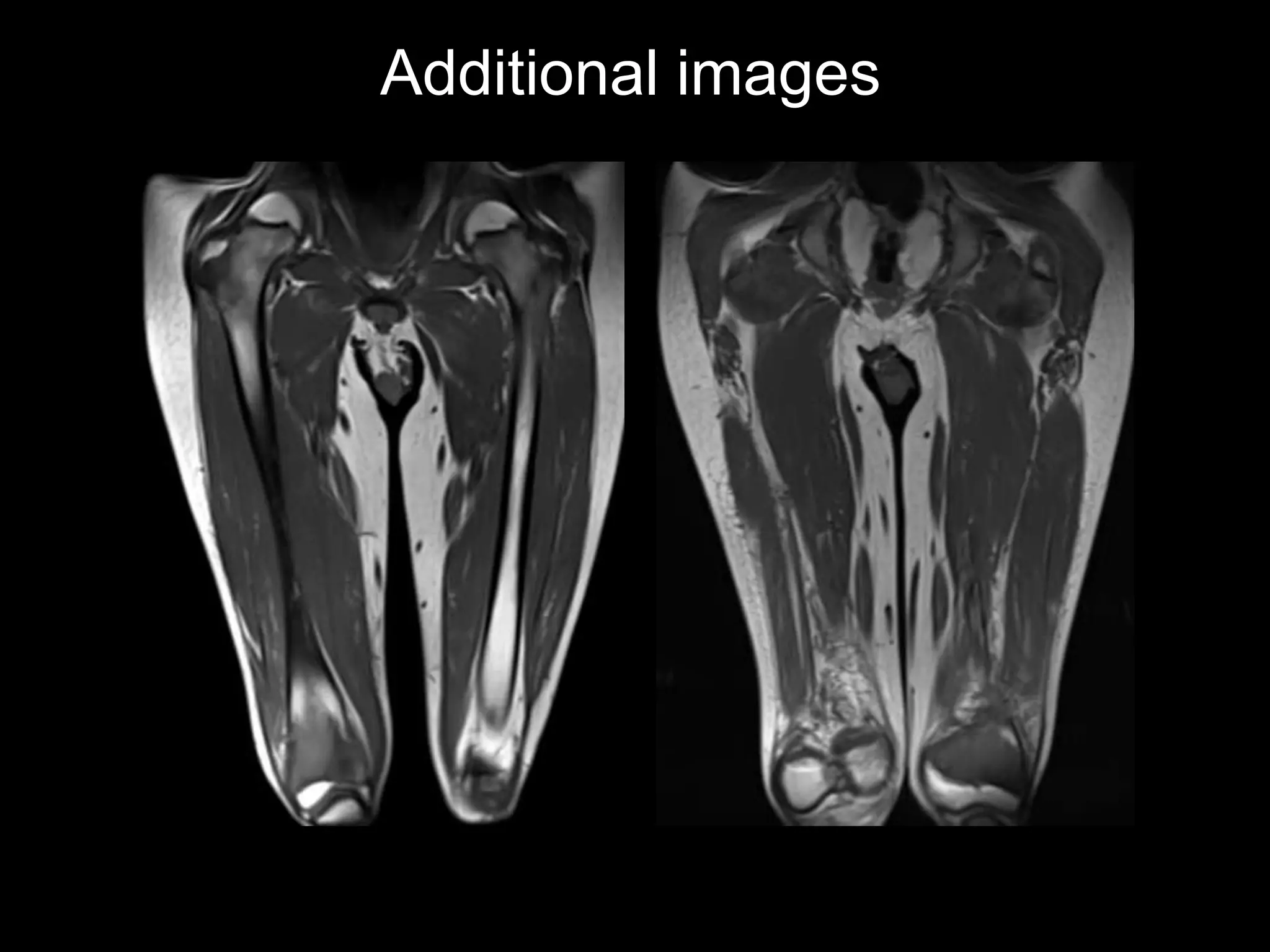
7 y.o. boy with fatigue, knee pain and swelling
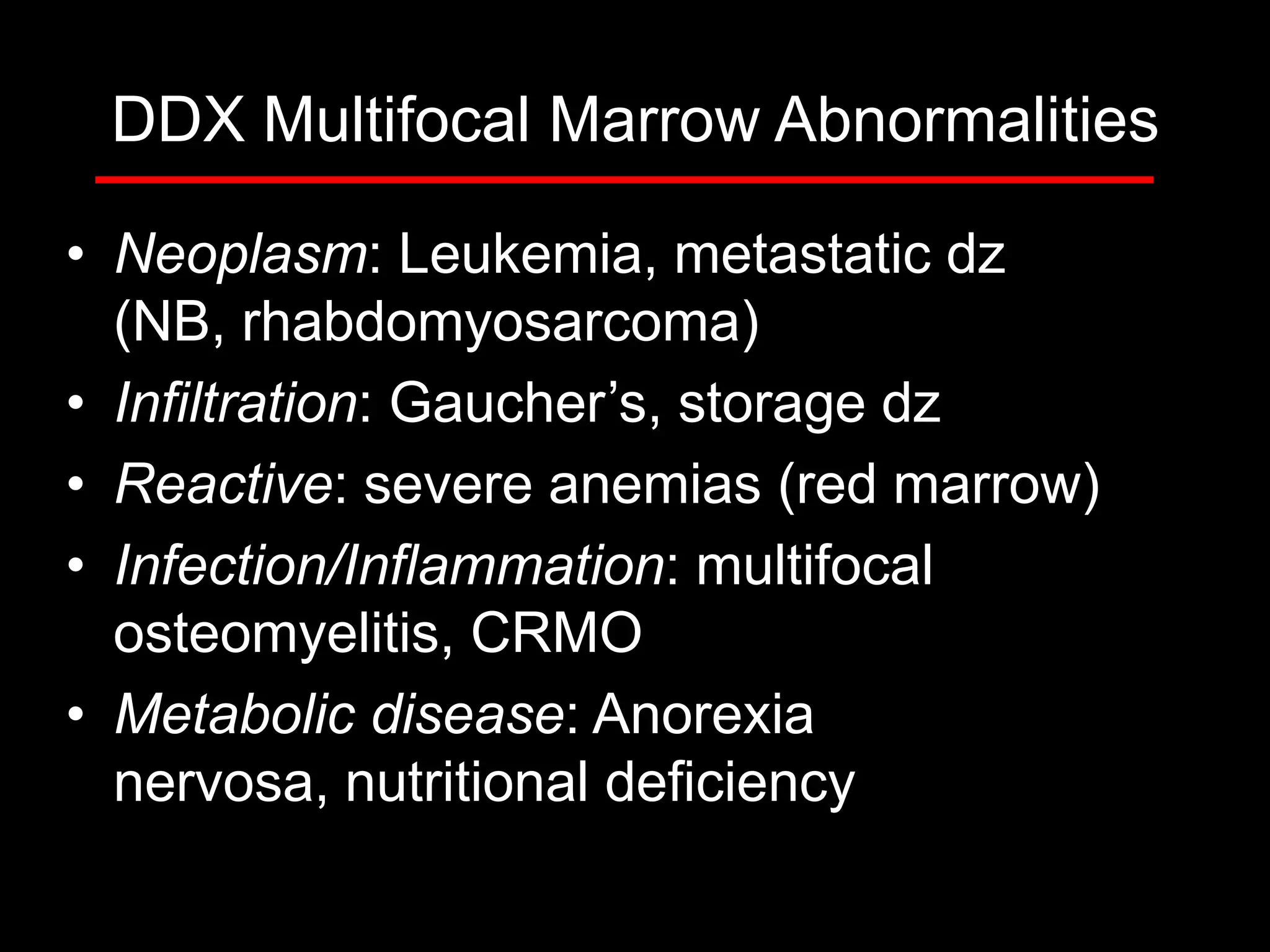
Additional images
DDX Multifocal Marrow Abnormalities
• Neoplasm: Leukemia, metastatic dz
(NB, rhabdomyosarcoma)
• Infiltration: Gaucher’s, storage dz
• Reactive: severe anemias (red marrow)
• Infection/Inflammation: multifocal
osteomyelitis, CRMO
• Metabolic disease: Anorexia
nervosa, nutritional deficiency
Scurvy
• Vitamin C deficiency
– Vit C facilitates hydroxylation of lysine, proline
required for crosslinking collagen
– Deficiency impairs enchondral ossification

• Etiologies
– Nutritional deficiency
– Intestinal malabsorption
– Over utilization (thyrotoxicosis)

• Symptoms
– Lethargy, fever, malaise
– MSK sxs (80%) include bruising, joint pain
Scurvy
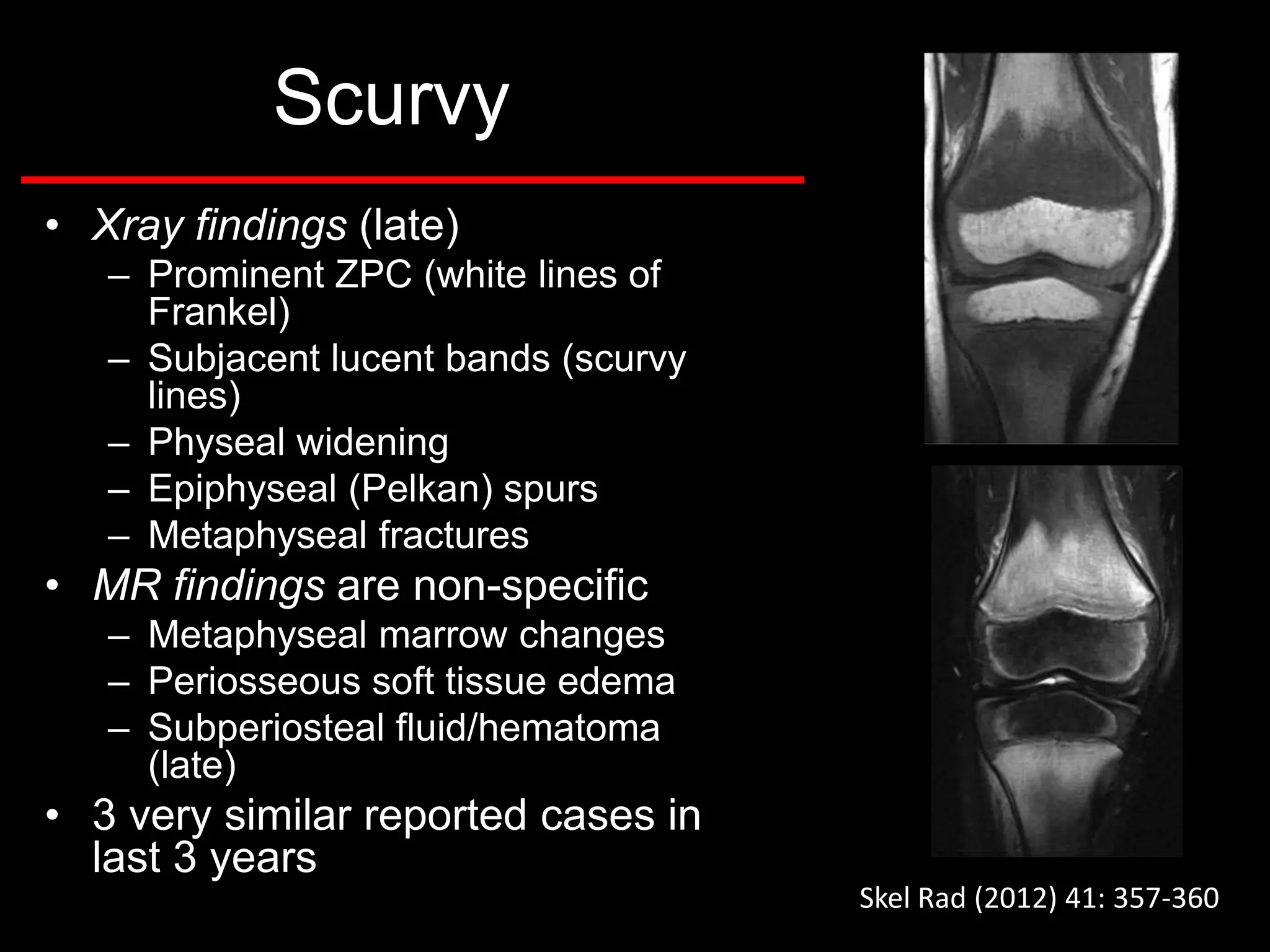
• Xray findings (late)
– Prominent ZPC (white lines of
Frankel)
– Subjacent lucent bands (scurvy
lines)
– Physeal widening
– Epiphyseal (Pelkan) spurs
– Metaphyseal fractures

• MR findings are non-specific
– Metaphyseal marrow changes
– Periosseous soft tissue edema
– Subperiosteal fluid/hematoma
(late)

• 3 very similar reported cases in
last 3 years
Skel Rad (2012) 41: 357-360
Scurvy
• Intramedullary and subperiosteal
hemorrhage
• Gelatinous transformation of marrow
• Our patient
– Marrow bx – fibrosis, hemorrhage
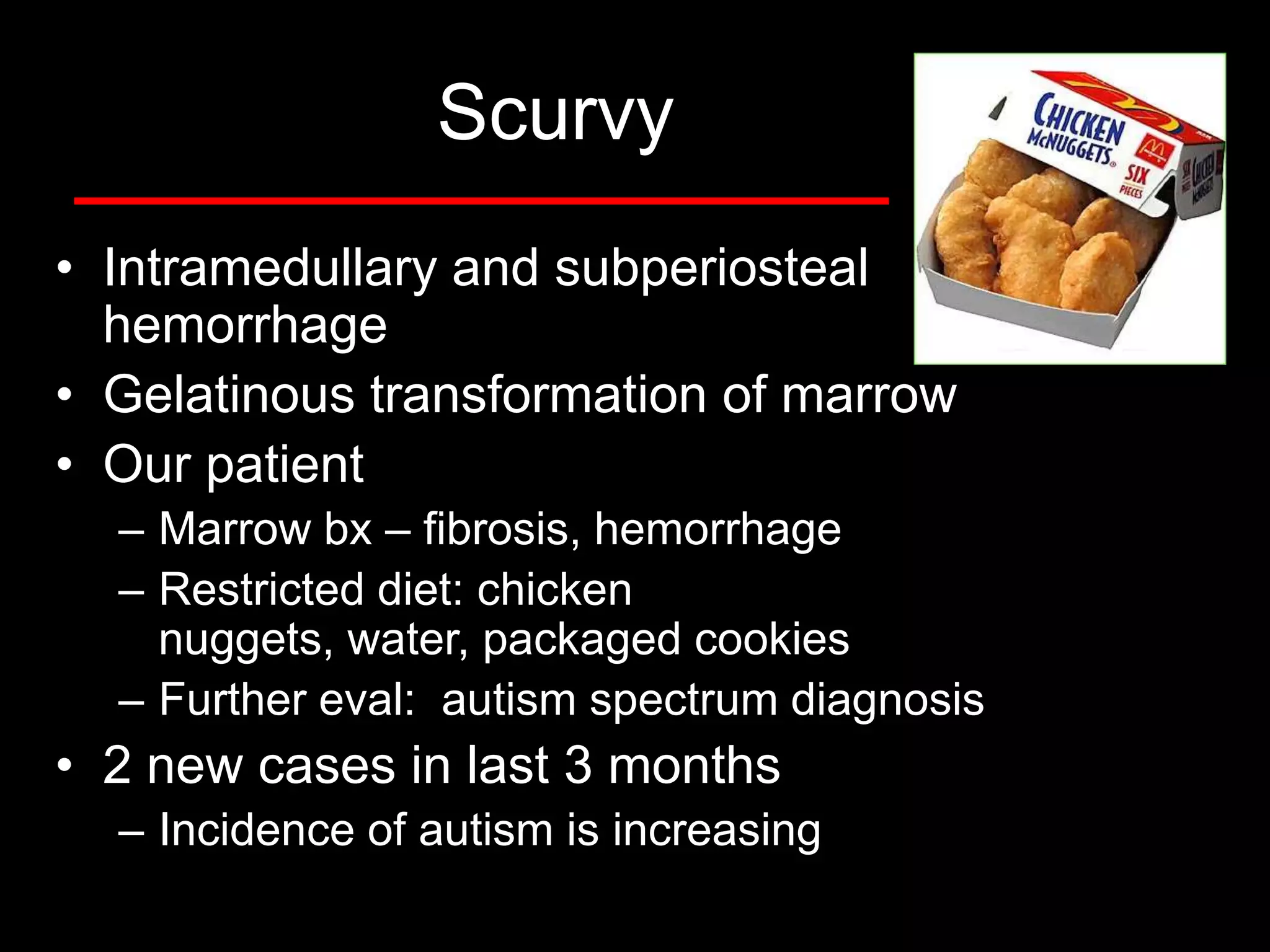
– Restricted diet: chicken
nuggets, water, packaged cookies
– Further eval: autism spectrum diagnosis

• 2 new cases in last 3 months
– Incidence of autism is increasing
Case 2 : Cicero Silva
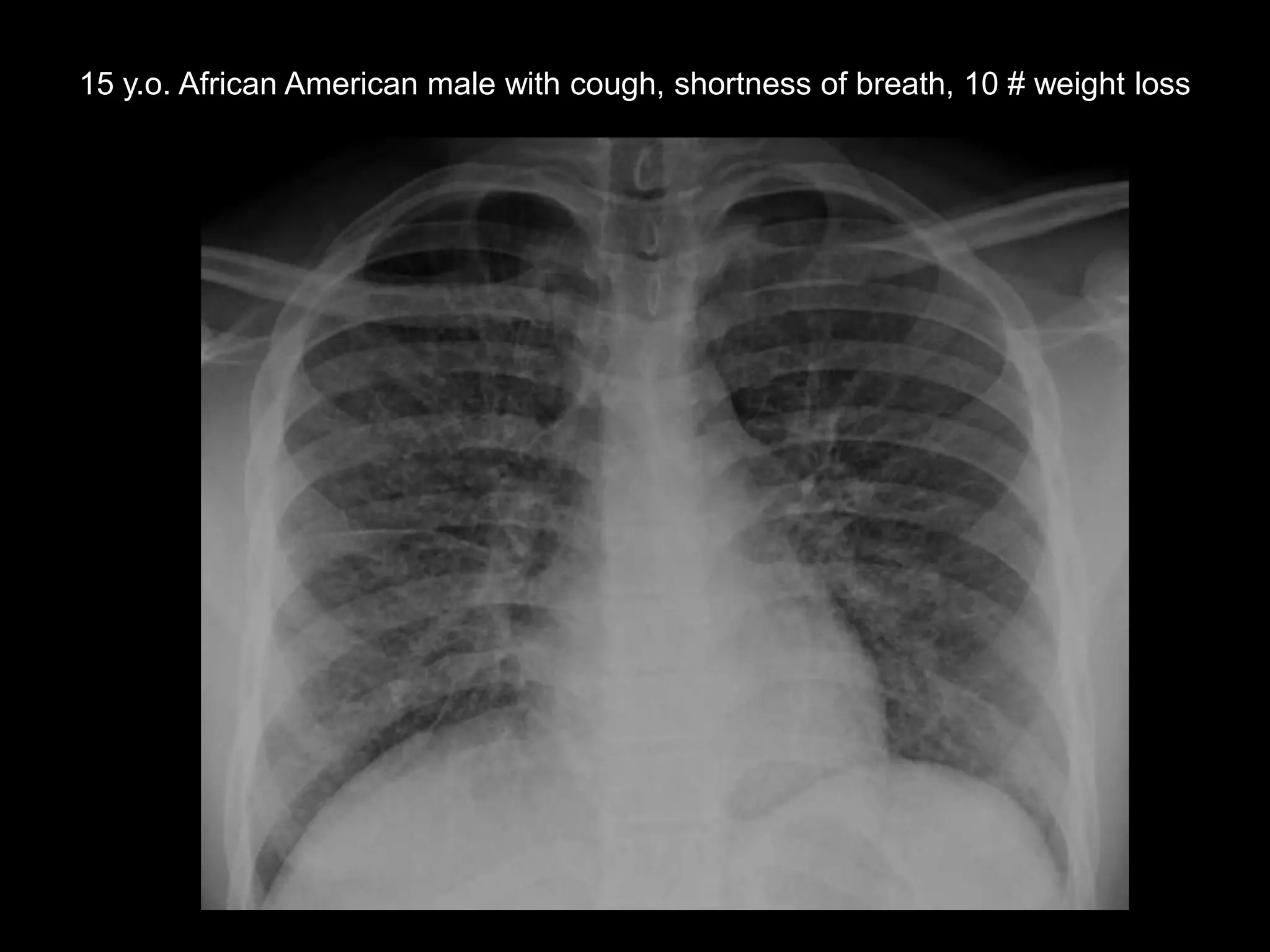
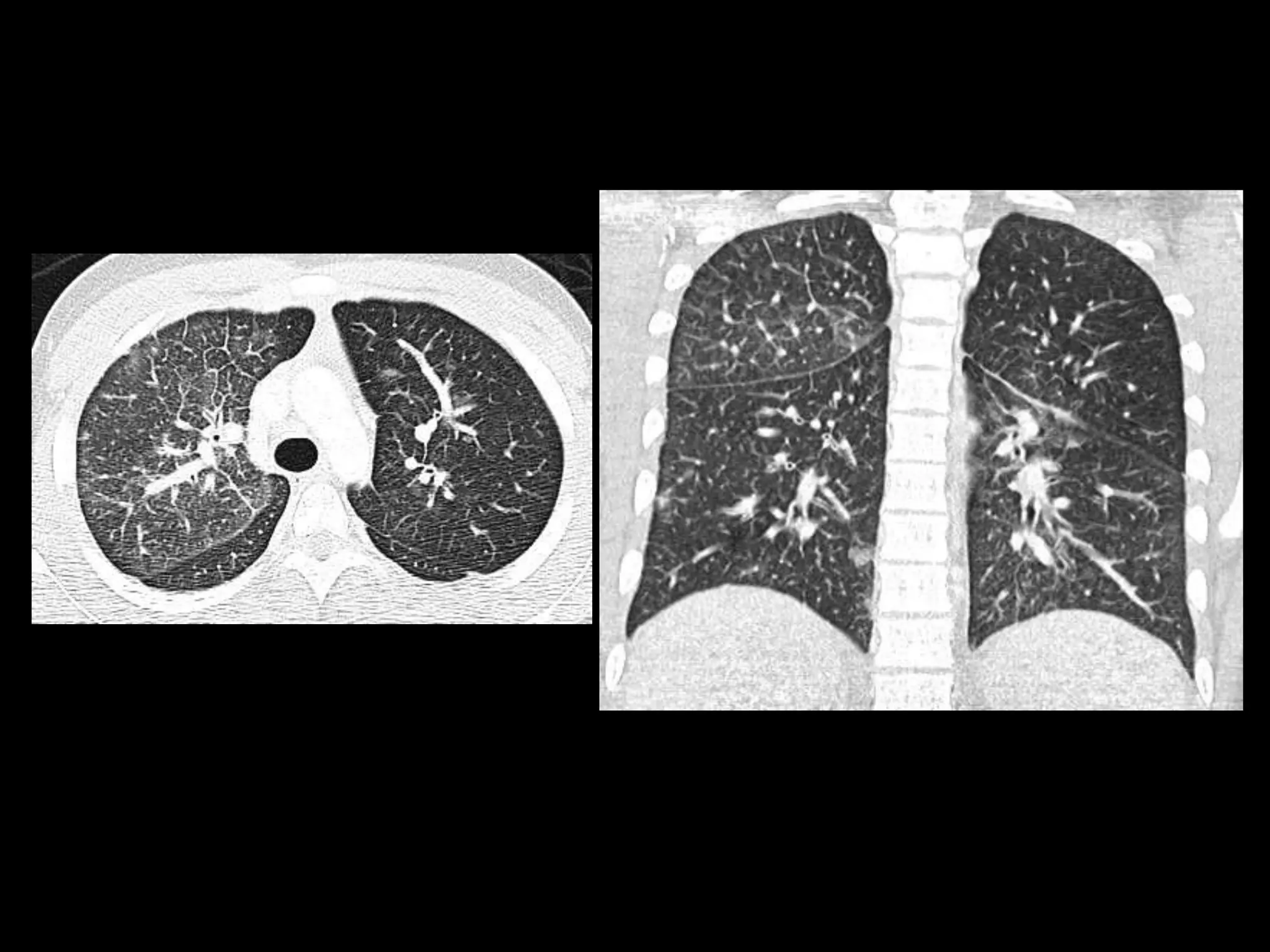
15 y.o. African American male with cough, shortness of breath, 10 # weight loss
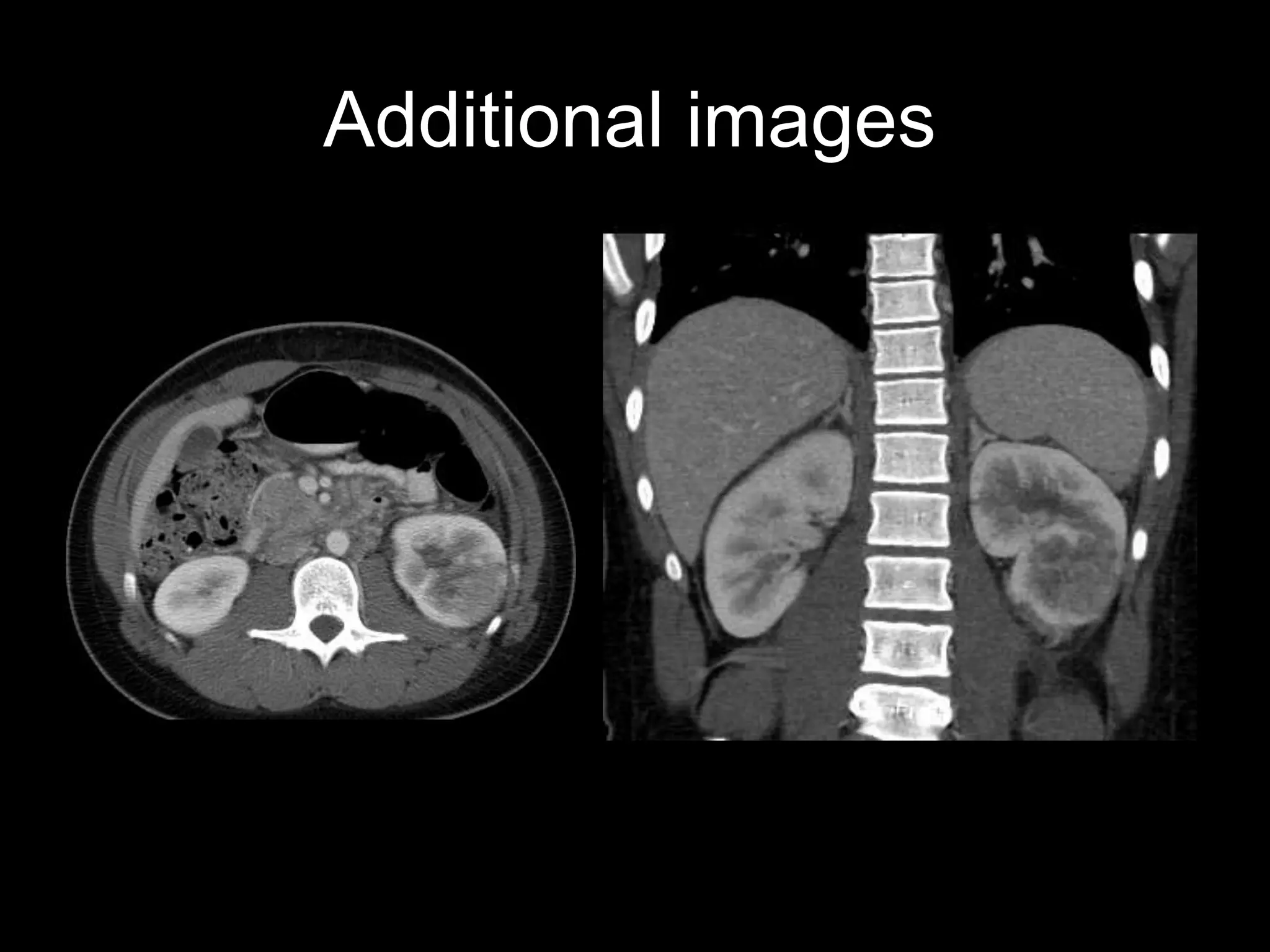
Additional images
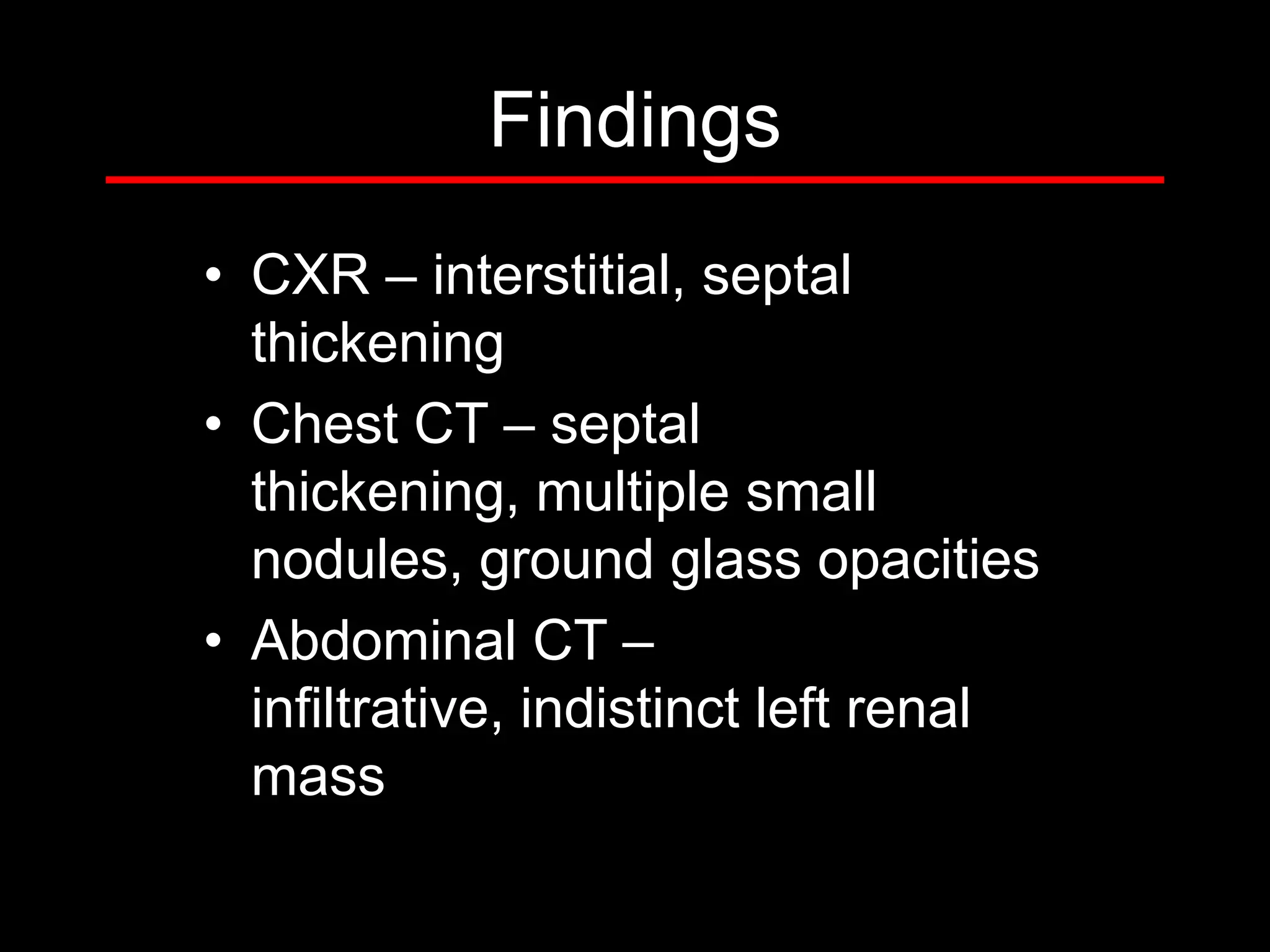
Findings
• CXR – interstitial, septal
thickening
• Chest CT – septal
thickening, multiple small
nodules, ground glass opacities
• Abdominal CT –
infiltrative, indistinct left renal
mass
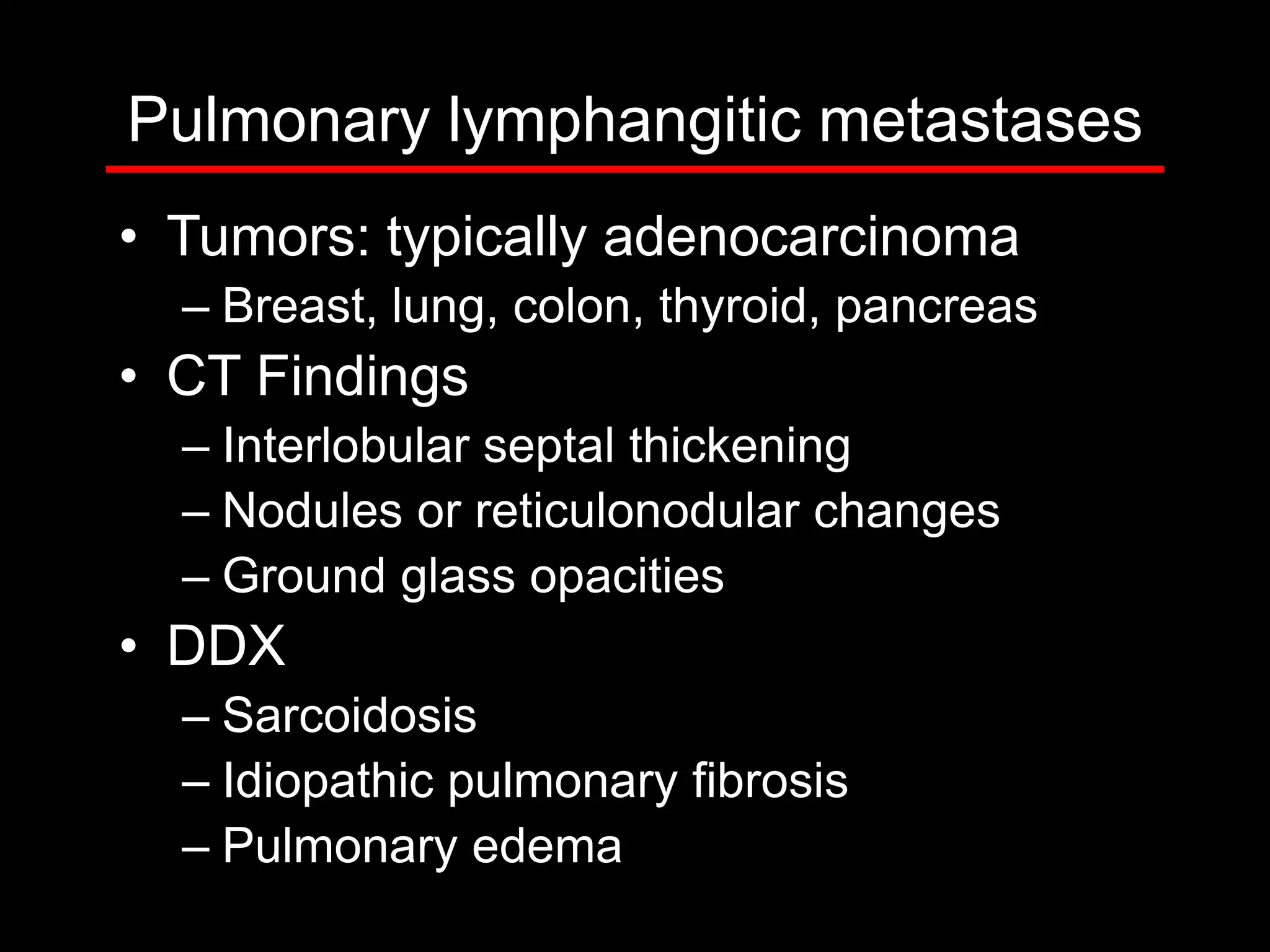
Pulmonary lymphangitic metastases
• Tumors: typically adenocarcinoma
– Breast, lung, colon, thyroid, pancreas

• CT Findings
– Interlobular septal thickening
– Nodules or reticulonodular changes
– Ground glass opacities

• DDX
– Sarcoidosis
– Idiopathic pulmonary fibrosis
– Pulmonary edema
Metastatic renal medullary carcinoma
• Demographics:
– Seen almost exclusively in pts with sickle trait
– Age range = 11 – 39, Male: female=3:1

• Symptoms: pain, hematuria, wt loss
• Renal mass imaging features
– Infiltrative, associated necrosis, caliectasis
– More commonly right-sided

• Often widely metastatic at dx
– Pulm lymph spread is common
Case 3: Ilse Castro-Aragon
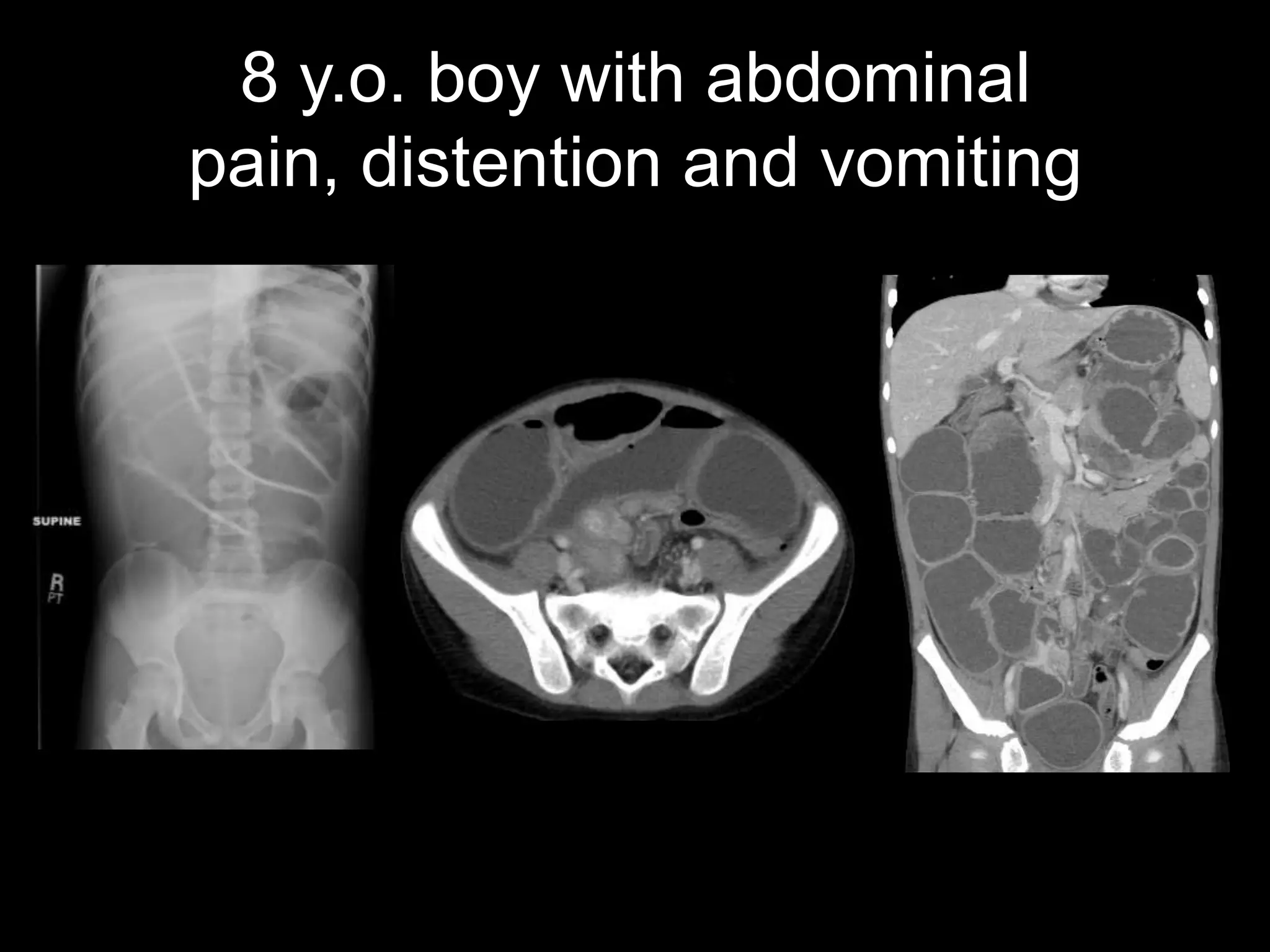
8 y.o. boy with abdominal
pain, distention and vomiting
Findings/ DDX
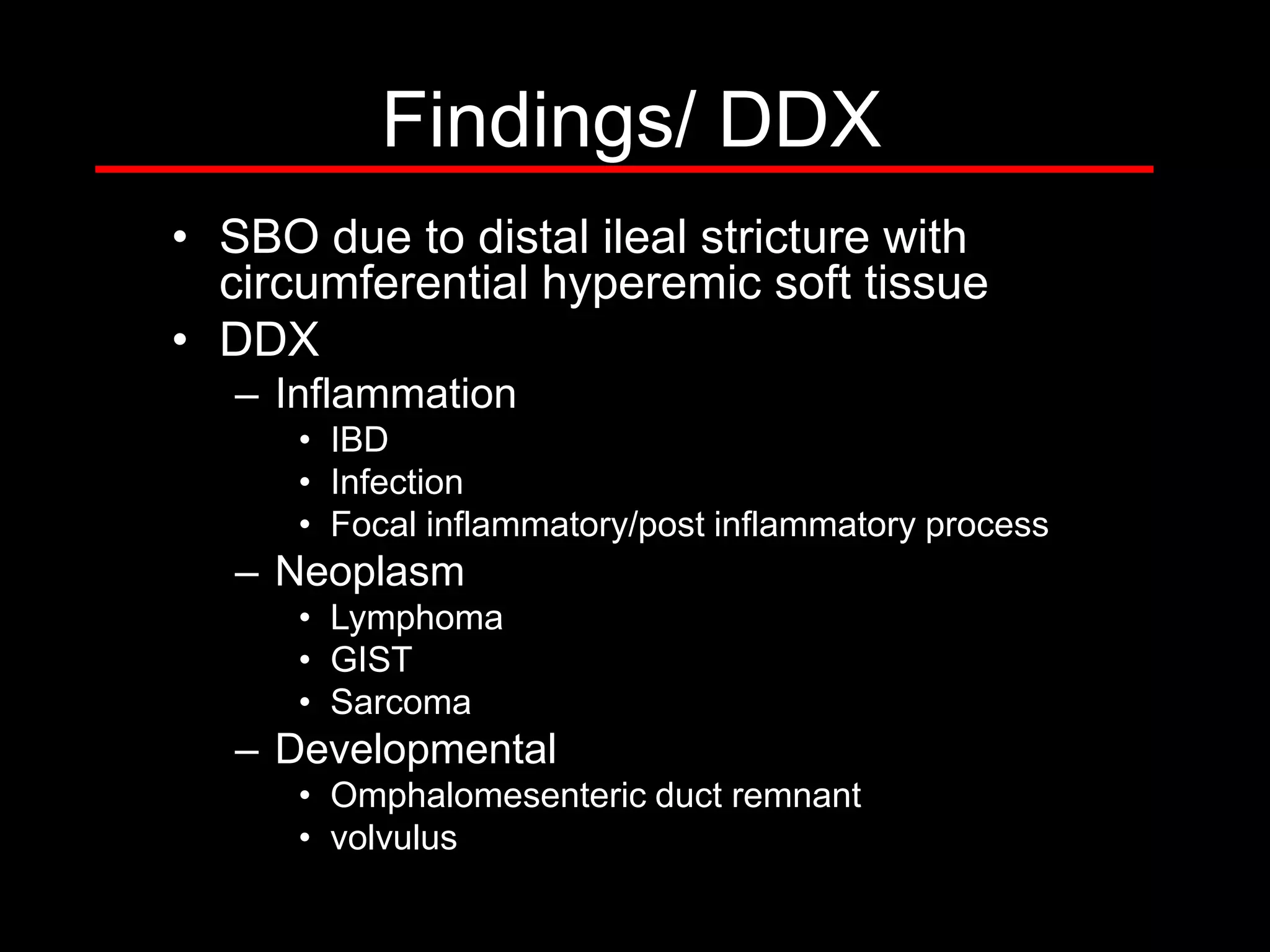
• SBO due to distal ileal stricture with
circumferential hyperemic soft tissue
• DDX
– Inflammation
• IBD
• Infection
• Focal inflammatory/post inflammatory process

– Neoplasm
• Lymphoma
• GIST
• Sarcoma

– Developmental
• Omphalomesenteric duct remnant
• volvulus
Inflammatory Myofibroblastic Tumor
• Synonyms: inflammatory pseudotumor, plasma cell
granuloma, pseudosarcoma
• Sites: Lung, orbit most common, but anywhere
• Etiology: ?, likely reactive
• Path: No malignant features, spindle
cells, mononuclear inflammatory cells
• Symptoms: depend upon site
– Abdomen: pain, fever most common

• RX: surgical resection, chemo?
• Prognosis
– Good for local, resectable dz
– Poor for infiltrative dz, esp abdominal, locally recurrent
IMT: imaging features
• Dependent upon anatomic site
• Typical: low density, +/- calc, focal mass
vs infiltrative soft tissue
• Bowel lesions: diffuse, infiltrative wall
thickening
• Overall, somewhat nonspecific
Case 3: Michele Walters
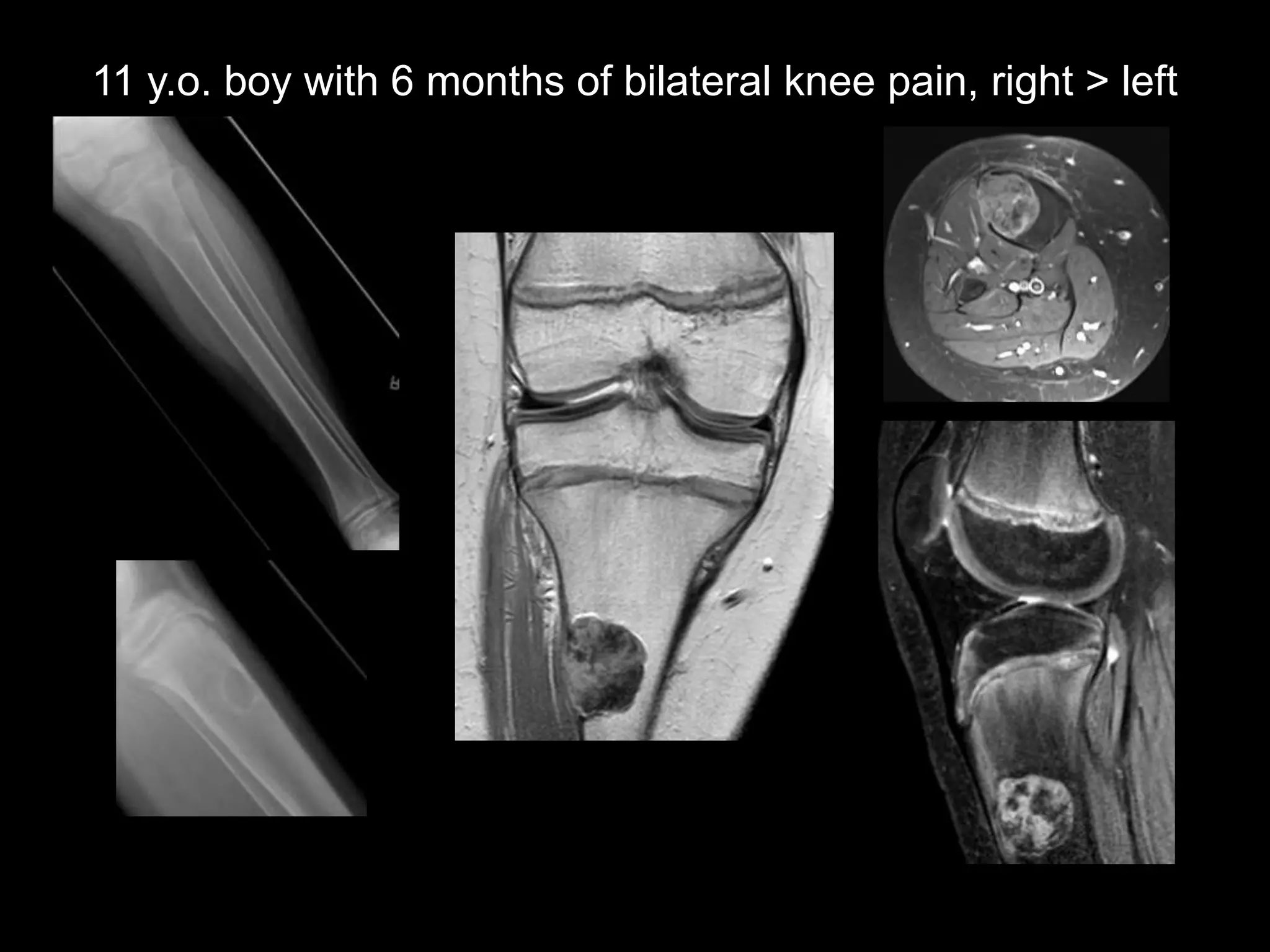
11 y.o. boy with 6 months of bilateral knee pain, right > left
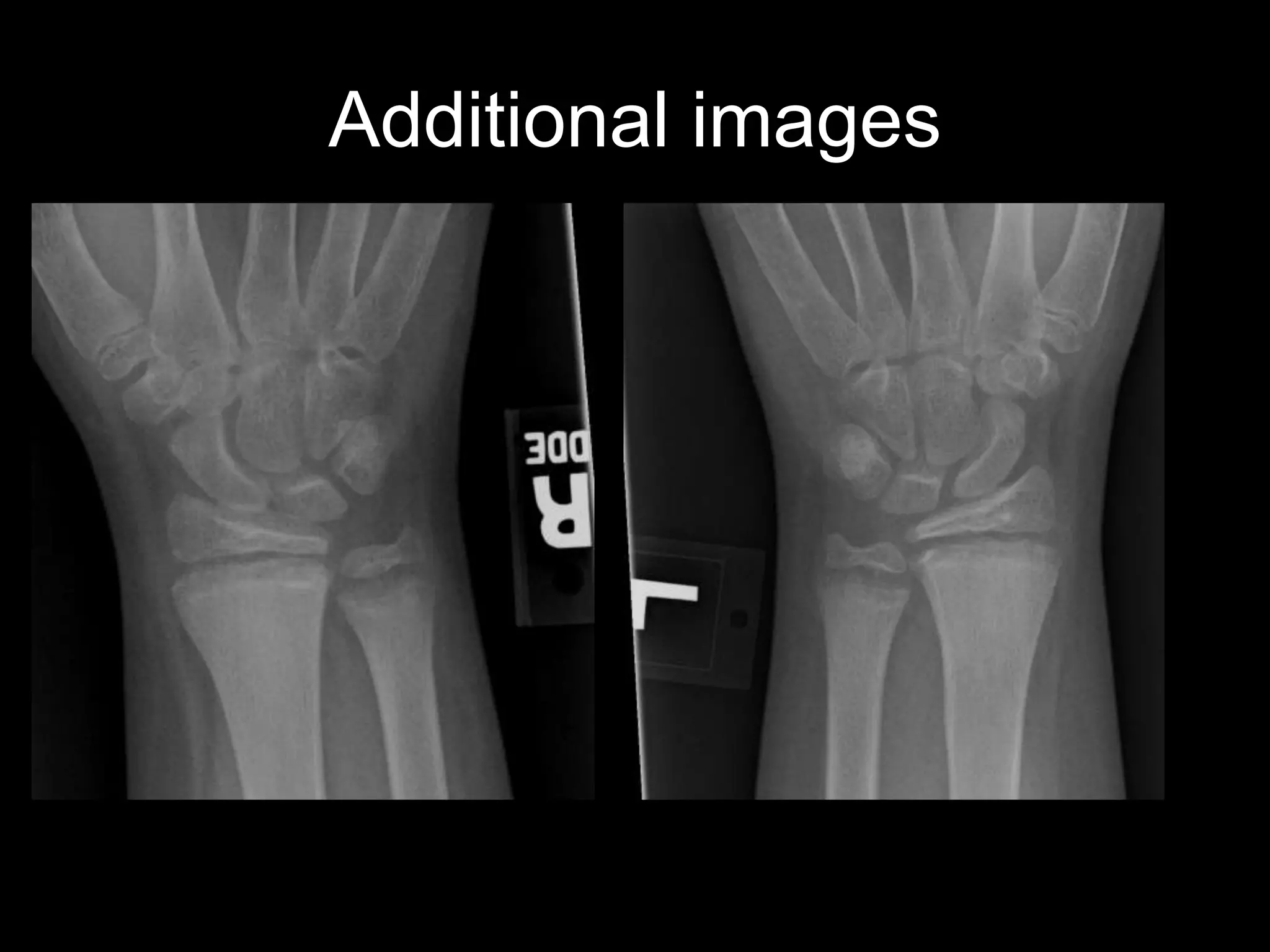
Additional images
Findings
• Benign appearing tibial metaphyseal lesion
– Vascular (enhancement)
– No marrow edema or soft tissue mass
– Cortically based, sclerotic margins

• Systemic physeal widening
– Faint ZPC
– Metaphyseal fraying, osteopenia
Phosphaturic mesenchymal tumor
(PMT) with oncogenic osteomalacia
• Benign mesenchymal neoplasm
• Secretes phosphatonin (FGF 23)
– Inhibits renal phosphate reabsorption and conversion of
25-hydroxyvitamin D > 1,25 dihydroxyvitamin D
– Result is osteomalacia (rickets)- paraneoplastic
syndrome

• Tumor locations: extremities, facial bones
• Mesenchymal tumor types associated with OO:
– PMT, mixed connective tissue type
• Hemangiopericytoma

– Osteoblastoma-like tumors
– Ossifying fibroma-like tumors
– Non-ossifying fibroma-like tumors
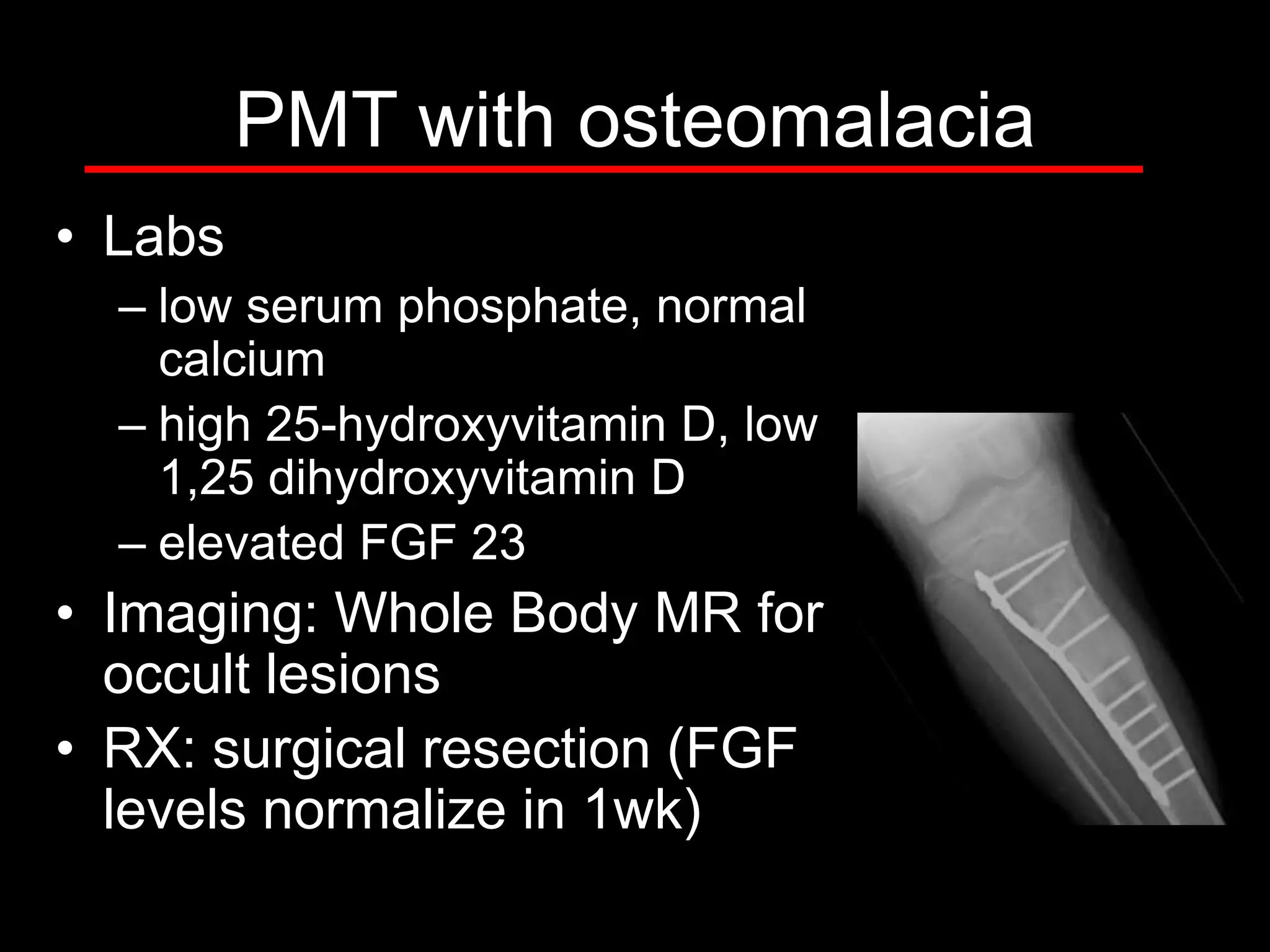
PMT with osteomalacia
• Labs
– low serum phosphate, normal
calcium
– high 25-hydroxyvitamin D, low
1,25 dihydroxyvitamin D
– elevated FGF 23

• Imaging: Whole Body MR for
occult lesions
• RX: surgical resection (FGF
levels normalize in 1wk)

NERRS Jan 2014 Pediatric Radiology Case Answers

  • 1.
    NERRS Jan 2014 PediatricRadiology Unknown Cases Kirsten Ecklund, M.D. Clinical Vice Chair of Radiology Division Chief Musculoskeletal Imaging Boston Children’s Hospital Assistant Professor of Radiology Harvard Medical School, Boston, MA
  • 2.
    Case 1: DiegoJaramillo
  • 3.
    7 y.o. boywith fatigue, knee pain and swelling
  • 4.
  • 5.
    DDX Multifocal MarrowAbnormalities • Neoplasm: Leukemia, metastatic dz (NB, rhabdomyosarcoma) • Infiltration: Gaucher’s, storage dz • Reactive: severe anemias (red marrow) • Infection/Inflammation: multifocal osteomyelitis, CRMO • Metabolic disease: Anorexia nervosa, nutritional deficiency
  • 6.
    Scurvy • Vitamin Cdeficiency – Vit C facilitates hydroxylation of lysine, proline required for crosslinking collagen – Deficiency impairs enchondral ossification • Etiologies – Nutritional deficiency – Intestinal malabsorption – Over utilization (thyrotoxicosis) • Symptoms – Lethargy, fever, malaise – MSK sxs (80%) include bruising, joint pain
  • 7.
    Scurvy • Xray findings(late) – Prominent ZPC (white lines of Frankel) – Subjacent lucent bands (scurvy lines) – Physeal widening – Epiphyseal (Pelkan) spurs – Metaphyseal fractures • MR findings are non-specific – Metaphyseal marrow changes – Periosseous soft tissue edema – Subperiosteal fluid/hematoma (late) • 3 very similar reported cases in last 3 years Skel Rad (2012) 41: 357-360
  • 8.
    Scurvy • Intramedullary andsubperiosteal hemorrhage • Gelatinous transformation of marrow • Our patient – Marrow bx – fibrosis, hemorrhage – Restricted diet: chicken nuggets, water, packaged cookies – Further eval: autism spectrum diagnosis • 2 new cases in last 3 months – Incidence of autism is increasing
  • 9.
    Case 2 :Cicero Silva
  • 10.
    15 y.o. AfricanAmerican male with cough, shortness of breath, 10 # weight loss
  • 12.
  • 13.
    Findings • CXR –interstitial, septal thickening • Chest CT – septal thickening, multiple small nodules, ground glass opacities • Abdominal CT – infiltrative, indistinct left renal mass
  • 14.
    Pulmonary lymphangitic metastases •Tumors: typically adenocarcinoma – Breast, lung, colon, thyroid, pancreas • CT Findings – Interlobular septal thickening – Nodules or reticulonodular changes – Ground glass opacities • DDX – Sarcoidosis – Idiopathic pulmonary fibrosis – Pulmonary edema
  • 15.
    Metastatic renal medullarycarcinoma • Demographics: – Seen almost exclusively in pts with sickle trait – Age range = 11 – 39, Male: female=3:1 • Symptoms: pain, hematuria, wt loss • Renal mass imaging features – Infiltrative, associated necrosis, caliectasis – More commonly right-sided • Often widely metastatic at dx – Pulm lymph spread is common
  • 16.
    Case 3: IlseCastro-Aragon
  • 17.
    8 y.o. boywith abdominal pain, distention and vomiting
  • 18.
    Findings/ DDX • SBOdue to distal ileal stricture with circumferential hyperemic soft tissue • DDX – Inflammation • IBD • Infection • Focal inflammatory/post inflammatory process – Neoplasm • Lymphoma • GIST • Sarcoma – Developmental • Omphalomesenteric duct remnant • volvulus
  • 19.
    Inflammatory Myofibroblastic Tumor •Synonyms: inflammatory pseudotumor, plasma cell granuloma, pseudosarcoma • Sites: Lung, orbit most common, but anywhere • Etiology: ?, likely reactive • Path: No malignant features, spindle cells, mononuclear inflammatory cells • Symptoms: depend upon site – Abdomen: pain, fever most common • RX: surgical resection, chemo? • Prognosis – Good for local, resectable dz – Poor for infiltrative dz, esp abdominal, locally recurrent
  • 20.
    IMT: imaging features •Dependent upon anatomic site • Typical: low density, +/- calc, focal mass vs infiltrative soft tissue • Bowel lesions: diffuse, infiltrative wall thickening • Overall, somewhat nonspecific
  • 21.
  • 22.
    11 y.o. boywith 6 months of bilateral knee pain, right > left
  • 23.
  • 24.
    Findings • Benign appearingtibial metaphyseal lesion – Vascular (enhancement) – No marrow edema or soft tissue mass – Cortically based, sclerotic margins • Systemic physeal widening – Faint ZPC – Metaphyseal fraying, osteopenia
  • 25.
    Phosphaturic mesenchymal tumor (PMT)with oncogenic osteomalacia • Benign mesenchymal neoplasm • Secretes phosphatonin (FGF 23) – Inhibits renal phosphate reabsorption and conversion of 25-hydroxyvitamin D > 1,25 dihydroxyvitamin D – Result is osteomalacia (rickets)- paraneoplastic syndrome • Tumor locations: extremities, facial bones • Mesenchymal tumor types associated with OO: – PMT, mixed connective tissue type • Hemangiopericytoma – Osteoblastoma-like tumors – Ossifying fibroma-like tumors – Non-ossifying fibroma-like tumors
  • 26.
    PMT with osteomalacia •Labs – low serum phosphate, normal calcium – high 25-hydroxyvitamin D, low 1,25 dihydroxyvitamin D – elevated FGF 23 • Imaging: Whole Body MR for occult lesions • RX: surgical resection (FGF levels normalize in 1wk)

Editor's Notes

  • #4 Aiden Moore 4091639
  • #7 Xray findings reflect this impaired enchondral ossification in the setting of persistent resorption
  • #11 Davonte Neal 1274980
  • #12 Davonte Neal 1274980
  • #13 Davonte Neal 1274980 Abd CT done for pain, wt loss, transaminitis
  • #18 Atkinson 4600003
  • #20 Berry 4590649Shevenell 4237902 (recurrent, required chemotherapy, multivisceraltxSpringer 4640349
  • #23 Kidder 4509262MR: sag PD fs, cor PD, ax T1 fs post contrast
  • #26 FGF = fibroblast growth factor