Introduction to
Musculoskeletal
Tumors
Dr. Ahmed Youssef
MD Orthopedics
Mubarak Alkabeer Hospital
Kuwait
EPIDEMIOLOGY
The vast majority of primary bone tumors are
benign and many are detected incidentally at
radiographic examinations for other reasons.
Primary malignant bone tumors are very rare. The
most common genuine primary bone malignancies
account for only 0.2% of all malignancies in the UK
and USA.
However, in children (< 15 years) malignant bone
tumors account for approximately 5% of all
malignancies.
EPIDEMIOLOGY
The most common Benign bone Tumor is
osteochondrma.
The most common Primary Malignant Bone
tumor is Multiple Myeloma.
The most common Malignant bone tumor is
Metastatic Bone Carcinoma.
PRESENTATION
Pain: Most common, Not constant ,Worse at night,
Activity Related, Later— constant at rest.
Swelling
Pathological Fractures: Bone cancer can weaken
the bone it develops in.
Constitutional Symptoms: Weight loss, fatigue, etc.
Others: Pressure on nerves, leading to numbness
and tingling or even weakness.
EXAMINATION
Look For
Swelling: Site, size, …etc.
Adenopathy
General Musculoskeletal Exam
Metastasis: Examine thyroid, abdomen,
prostate, breasts
PLAIN X-RAYS
PLAIN X-Rays is the GOLD standard
diagnostic tool
X-rays (two views) of the whole bone including
joint above and below it
Don’t accept bad quality X-rays
PLAIN X-RAYS
Comment on:
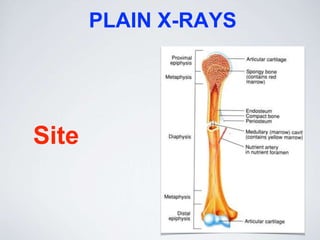
1. Site
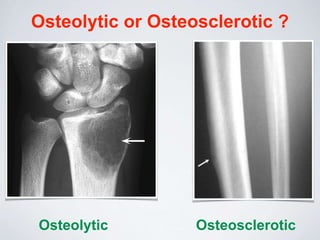
2. Osteolytic or Osteosclerotic margin
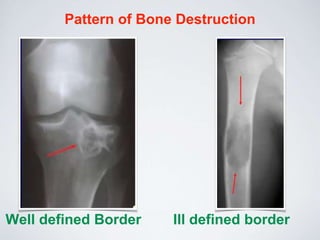
3. Pattern of bone destruction
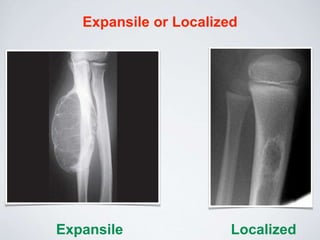
4. Expansion
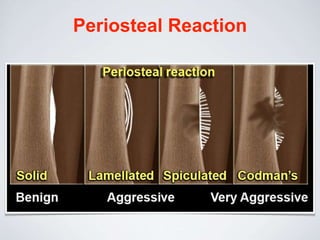
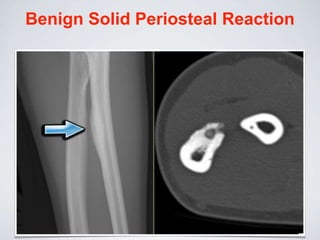
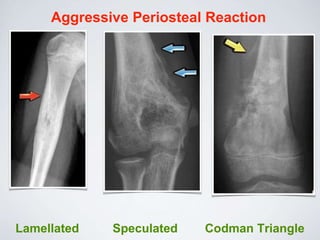
5. Periosteal Reaction
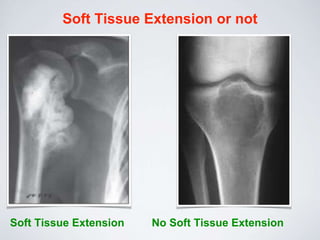
6. Soft tissue extension
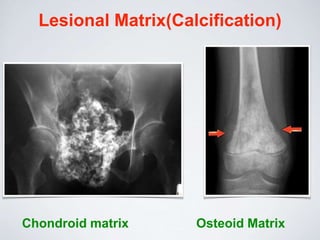
7. Lesional Matrix
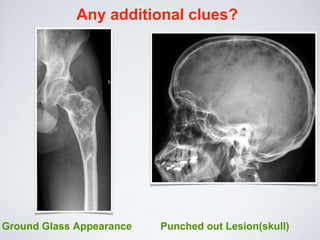
8. Additional clues
PLAIN X-RAYS
Site
Areas of Greatest Bone Growth:
1. PROXIMAL FEMUR
2.DISTAL FEMUR
3.PROXIMAL TIBIA
4.PROXIMAL HUMERUS
5.DISTAL RADIUS
PLAIN X-RAYS
Site
PLAIN X-RAYS
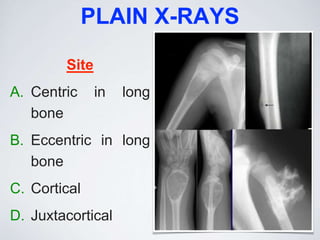
Site
A. Centric in long
bone
B. Eccentric in long
bone
C. Cortical
D. Juxtacortical
Osteolytic or Osteosclerotic ?
Osteolytic Osteosclerotic
Pattern of Bone Destruction
Well defined Border Ill defined border
Expansile or Localized
Expansile Localized
Periosteal Reaction
Benign Solid Periosteal Reaction
Aggressive Periosteal Reaction
Lamellated Speculated Codman Triangle
Soft Tissue Extension or not
Soft Tissue Extension No Soft Tissue Extension
Lesional Matrix(Calcification)
Chondroid matrix Osteoid Matrix
Any additional clues?
Ground Glass Appearance Punched out Lesion(skull)
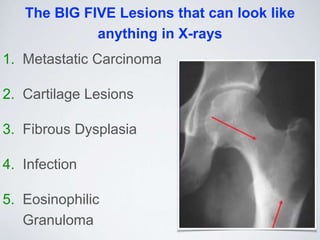
The BIG FIVE Lesions that can look like
anything in X-rays
1. Metastatic Carcinoma
2. Cartilage Lesions
3. Fibrous Dysplasia
4. Infection
5. Eosinophilic
Granuloma
OTHER IMAGING STUDIES
When Suspicion of Malignant Lesion
Skeletal survey: In Multiple Myeloma
Chest XR/ Chest Abdomen & Pelvis CT Scan:
Suspected malignant lesions
Whole Body Bone Scan: To search for occult or
multiple lesions
MRI Scan: Extent of lesion, soft tissue mass, screen
for spine mets, skip lesions.
LABORATORY STUDIES
Usually non-specific, but may help in the
diagnosis of the unknown lesions.
CBC, ESR, CRP, to exclude infection
Urine Protein Electrophoresis for Multiple
Myeloma
Tumor Markers: PSA, Alphafetoproien etc.
CURRENT TRENDS IN DIAGNOSIS
Molecular Biology of Sarcomas is a big area
of research and interest.
Tumor Suppressor Genes
Oncogenes
Chromosomal Translocations
HISTOLOGY OF BONE LESIONS
Overall Cellularity of the lesion
Nuclear to Cytoplasmic Ratio
Cellular Atypia
Pleomorphism
Presence or absence of Necrosis
HISTOPATHOLOGICAL EXAMINATION OF THE BIOPSYHistopathology of
Low Grade
Malignancy
Well differentiated
Few mitotic figures
Moderate cellular
atypia
Moderate nuclear
atypia
Histopathology of
High Grade
Malignancy
Dedifferentiated
Abundant mitotic
figures
Abundant cellular
atypia
Abundant nuclear
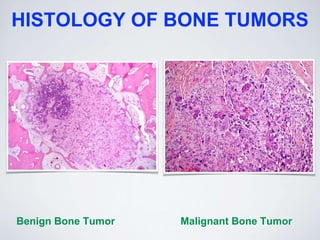
HISTOLOGY OF BONE TUMORS
Benign Bone Tumor Malignant Bone Tumor
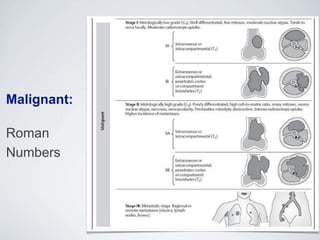
IS IT BENIGN OR MALIGNANT?
(Enneking) Staging System
Benign: Arabic Numbers
Malignant:
Roman
Numbers
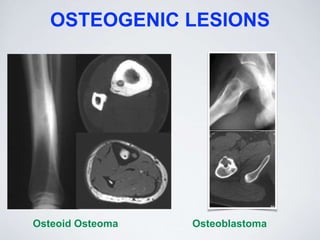
OSTEOGENIC LESIONS
Osteoid Osteoma Osteoblastoma
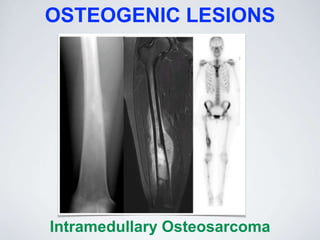
OSTEOGENIC LESIONS
Intramedullary Osteosarcoma
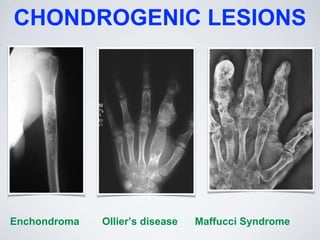
CHONDROGENIC LESIONS
Enchondroma Ollier’s disease Maffucci Syndrome
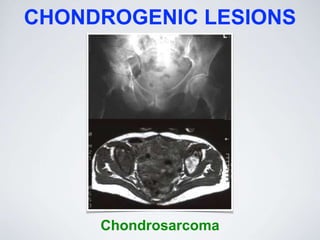
CHONDROGENIC LESIONS
Chondrosarcoma
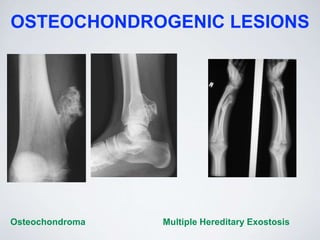
OSTEOCHONDROGENIC LESIONS
Osteochondroma Multiple Hereditary Exostosis
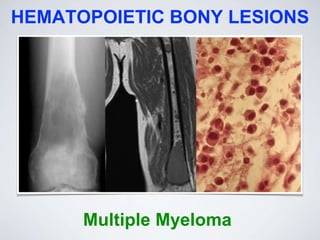
HEMATOPOIETIC BONY LESIONS
Multiple Myeloma
HEMATOPOIETIC BONY LESIONS
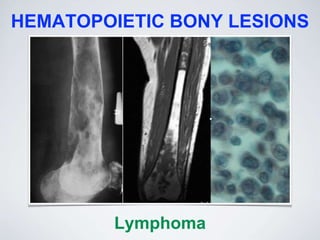
Lymphoma
CYSTIC BONY LESIONS
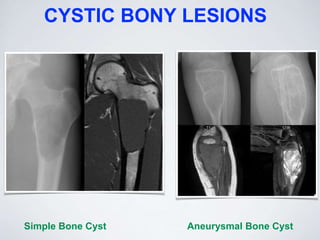
Simple Bone Cyst Aneurysmal Bone Cyst
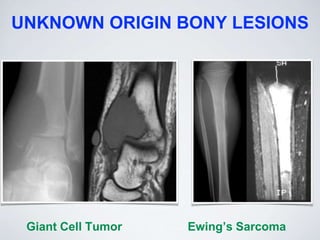
UNKNOWN ORIGIN BONY LESIONS
Giant Cell Tumor Ewing’s Sarcoma
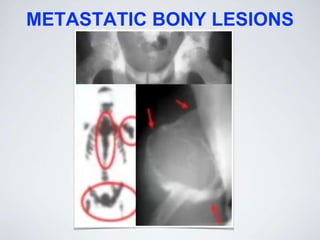
METASTATIC BONY LESIONS
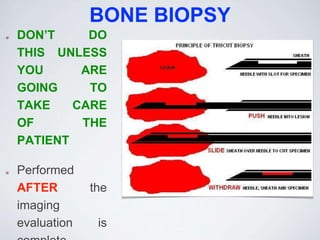
BONE BIOPSY
DON’T DO
THIS UNLESS
YOU ARE
GOING TO
TAKE CARE
OF THE
PATIENT
Performed
AFTER the
imaging
evaluation is
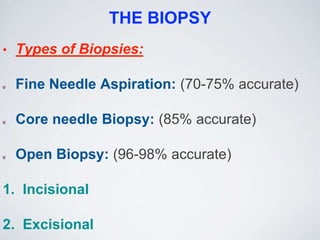
THE BIOPSY
• Types of Biopsies:
Fine Needle Aspiration: (70-75% accurate)
Core needle Biopsy: (85% accurate)
Open Biopsy: (96-98% accurate)
1. Incisional
2. Excisional
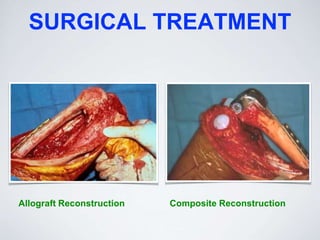
SURGICAL TREATMENT
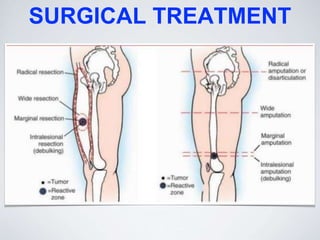
REMOVE THE LESION WITH MINIMAL RISK
OF LOCAL RECURRENCE
Limb Salvage is today’s standard.
Salvaged limb must be functional (compare
to amputation).
Local recurrence may be associated with
presence of Metastasis but generally worse
prognosis.
SURGICAL TREATMENT
SURGICAL TREATMENT
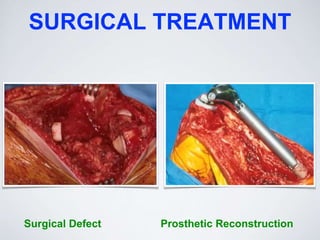
Surgical Defect Prosthetic Reconstruction
SURGICAL TREATMENT
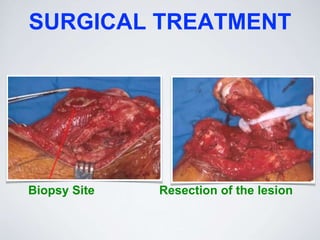
Biopsy Site Resection of the lesion
SURGICAL TREATMENT
Allograft Reconstruction Composite Reconstruction
ADJUVANT CHEMOTHERAPY
Multiagent chemotherapy is a reason that
patients survive malignant bone lesions.
Usually given pre-op. (neo-adjuvant) and
post-op (adjuvant) for several months.
Has led to 5 yr survival rates of 60% - 70% in
osteosarcoma versus 11% in non-chemo
patients.
ADJUVANT CHEMOTHERAPY
Common Agents for Osteosarcoma
1. High-dose Methotrexate
2. Doxorubicin
3. Vincristine
4. Cyclophosphamide
COMPLICATIONS OF CHEMOTHERAPY
Nausea & Vomiting
Allergic reaction (including anaphylaxis)
Bone Marrow Depression
Extravasation
Nephrotoxicity
ADJUVANT RADIOTHERAPY
Dose measured in grays (Gy)
l rad = l centigray (cGy)
1,000 rads = l0Gy
Mechanism: Oxygenation of H2O, free
radical release -DNA injury
Dose: 180-200 cGy/day, 5 days a week
COMPLICATIONS OF RADIOTHERAPY
Nausea & Vomiting
Skin Ulceration& Alopecia
Lung Fibrosis
Cardiomyopathy
Infertility
Post irradiation Sarcoma
TAKE HOME MESSAGES
The most common Benign bone Tumor is
osteochondrma.
The most common Malignant bone tumor is
Metastatic Bone Carcinoma.
Pain and Swelling are the most common
presentation of bone tumors.
Plain X-ray is the Gold standard diagnostic tool for
benign bone tumors.
TAKE HOME MESSAGES
When you suspect Malignant bone tumor, CT
chest abdomen and pelvis, Bone Scan and
MRI should be done searching for primary
lesion.
Don’t Do Biopsy UNLESS You are going to
treat the patient.
Limb Salvage is today’s standard surgical
treatment for bone tumors
Musculoskeletal tumors

Musculoskeletal tumors