Pediatric & Neonatal Resuscitation Dr.  Mohammad Mireskandari Assistant professor Bahrami Children’s Hospital
Pediatric Chain of Survival   For best survival and quality of life, pediatric basic life support (BLS) should be part of a community effort that includes prevention, basic CPR, prompt access to the emergency medical services (EMS) system, and prompt pediatric advanced life support (PALS). These 4 links form the American Heart Association (AHA) pediatric Chain of Survival
Rapid and effective bystander CPR is associated with successful return of spontaneous circulation and neurologically intact survival in children. The greatest impact occurs in respiratory arrest, in which neurologically intact survival rates of 70% are possible, and in ventricular fibrillation (VF), in which survival rates of 30% have been documented. Only 2% to 10% of all children who develop out-of hospital cardiac arrest survive, and most are neurologically devastated.
The major causes of death in infants and children are respiratory failure, sudden infant death syndrome (SIDS), sepsis, neurologic diseases, and injuries.
Sudden Infant Death Syndrome SIDS is “the sudden death of an infant under 1 year of age, which remains unexplained after a thorough case investigation, including performance of a complete autopsy, examination  of the death scene, and review of the clinical history. The peak incidence of SIDs occurs in infants 2 to 4 months age.  The etiology of SIDS remains unknown. Risk factors include prone sleeping position, sleeping on a soft surface, and second-hand smoke.
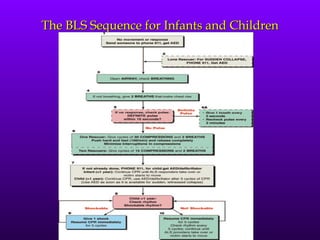
The BLS Sequence for Infants and Children


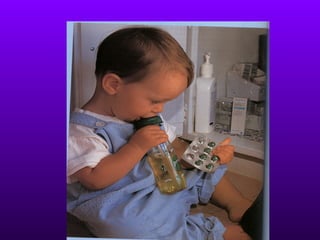
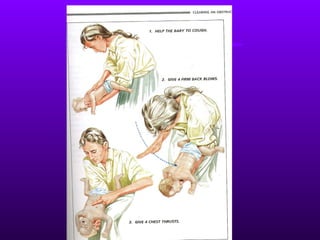
Foreign-Body Airway Obstruction (Choking) More than 90% of deaths from foreign-body aspiration occur in children < 5 years of age; 65% of the victims are infants. Liquids are the most common cause of choking in infants, whereas balloons, small objects, and foods ( eg, hot dogs, round candies, nuts, and grapes) are the most common causes of foreign-body airway obstruction (FBAO) in children
 
 
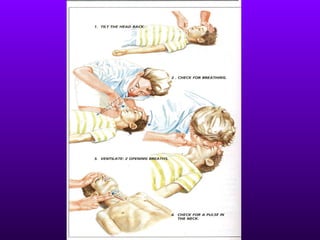
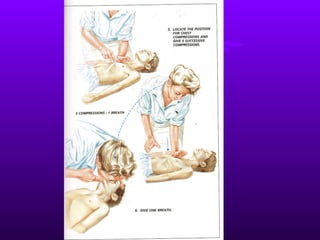
Safety of Rescuer and Victim Check for Response Activate the EMS System and Get the AED Position the Victim Open the Airway and Check Breathing Give Rescue Breaths Pulse Check (for Healthcare Providers) Rescue Breathing Without Chest Compressions (for Healthcare Providers Only) Chest Compressions
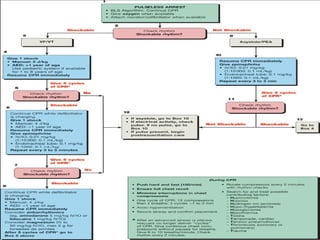
Pediatric Advanced Life Support In contrast to adults, sudden cardiac arrest in children is uncommon, and cardiac arrest does not usually result from a primary cardiac cause. More often it is the terminal event of progressive respiratory failure or shock, also called an asphyxial arrest.
VF occurs in 5% to 15% of all pediatric victims of out-of hospital cardiac arrest and is reported in up to 20% of pediatric in-hospital arrests at some point during the resuscitation. The incidence increases with age. Defibrillation is the definitive treatment for VF with an overall survival rate of 17% to 20%


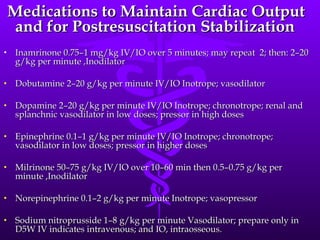
Medications to Maintain Cardiac Output and for Postresuscitation Stabilization Inamrinone 0.75–1 mg/kg IV/IO over 5 minutes; may repeat  2; then: 2–20 g/kg per minute ,Inodilator Dobutamine 2–20 g/kg per minute IV/IO Inotrope; vasodilator Dopamine 2–20 g/kg per minute IV/IO Inotrope; chronotrope; renal and splanchnic vasodilator in low doses; pressor in high doses Epinephrine 0.1–1 g/kg per minute IV/IO Inotrope; chronotrope; vasodilator in low doses; pressor in higher doses Milrinone 50–75 g/kg IV/IO over 10–60 min then 0.5–0.75 g/kg per minute ,Inodilator Norepinephrine 0.1–2 g/kg per minute Inotrope; vasopressor Sodium nitroprusside 1–8 g/kg per minute Vasodilator; prepare only in D5W IV indicates intravenous; and IO, intraosseous.
Neonatal Resuscitation Guidelines Approximately 10% of newborns require some assistance to begin breathing at birth.  About 1% require extensive resuscitative measures
Those newly born infants who do not require resuscitation can generally be identified by a rapid assessment of the following 4 characteristics: ●  Was the baby born after a full-term gestation? ●  Is the amniotic fluid clear of meconium and evidence of infection? ●  Is the baby breathing or crying? ●  Does the baby have good muscle tone? If the answer to all 4 of these questions is “yes,” the baby does not need resuscitation and should not be separated from the mother.
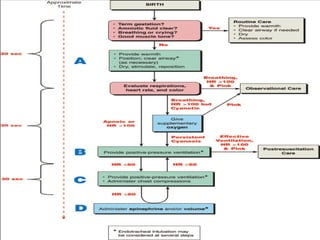
If the answer to any of these assessment questions is “no,” there is general agreement that the infant should receive one or more of the following 4 categories of action in sequence: A. Initial steps in stabilization (provide warmth, position, clear airway, dry, stimulate, reposition) B. Ventilation C. Chest compressions D. Administration of epinephrine and/or volume expansion The decision to progress from one category to the next is determined by the simultaneous assessment of 3 vital signs: respirations, heart rate, and color. Approximately 30 seconds is allotted to complete each step, reevaluate, and decide whether to progress to the next step.
 
Endotracheal Tube Placement Endotracheal intubation may be indicated at several points during neonatal resuscitation: ●  When tracheal suctioning for meconium is required ●  If bag-mask ventilation is ineffective or prolonged ●  When chest compressions are performed ●  When endotracheal administration of medications is desired ●  For special resuscitation circumstances, such as congenital diaphragmatic hernia or extremely low birth weight (1000 g)
Discontinuing Resuscitative Efforts Infants without signs of life (no heart beat and no respiratory effort) after 10 minutes of resuscitation show either a high mortality or severe neurodevelopmental disability . After 10 minutes of continuous and adequate resuscitative efforts, discontinuation of resuscitation may be justified if there are no signs of life.

Pediatric And Neonatal Resuscitation

  • 1.
    Pediatric & NeonatalResuscitation Dr. Mohammad Mireskandari Assistant professor Bahrami Children’s Hospital
  • 2.
    Pediatric Chain ofSurvival For best survival and quality of life, pediatric basic life support (BLS) should be part of a community effort that includes prevention, basic CPR, prompt access to the emergency medical services (EMS) system, and prompt pediatric advanced life support (PALS). These 4 links form the American Heart Association (AHA) pediatric Chain of Survival
  • 3.
    Rapid and effectivebystander CPR is associated with successful return of spontaneous circulation and neurologically intact survival in children. The greatest impact occurs in respiratory arrest, in which neurologically intact survival rates of 70% are possible, and in ventricular fibrillation (VF), in which survival rates of 30% have been documented. Only 2% to 10% of all children who develop out-of hospital cardiac arrest survive, and most are neurologically devastated.
  • 4.
    The major causesof death in infants and children are respiratory failure, sudden infant death syndrome (SIDS), sepsis, neurologic diseases, and injuries.
  • 5.
    Sudden Infant DeathSyndrome SIDS is “the sudden death of an infant under 1 year of age, which remains unexplained after a thorough case investigation, including performance of a complete autopsy, examination of the death scene, and review of the clinical history. The peak incidence of SIDs occurs in infants 2 to 4 months age. The etiology of SIDS remains unknown. Risk factors include prone sleeping position, sleeping on a soft surface, and second-hand smoke.
  • 6.
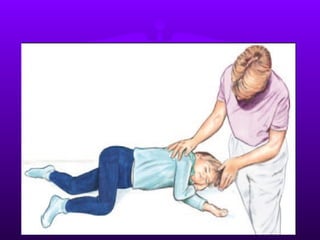
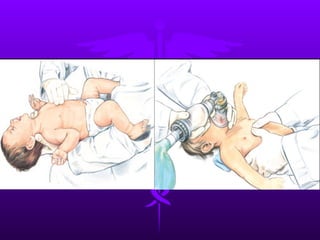
    The BLS Sequencefor Infants and Children
  • 7.
  • 8.
  • 9.
  • 10.
  • 11.
    Foreign-Body Airway Obstruction(Choking) More than 90% of deaths from foreign-body aspiration occur in children < 5 years of age; 65% of the victims are infants. Liquids are the most common cause of choking in infants, whereas balloons, small objects, and foods ( eg, hot dogs, round candies, nuts, and grapes) are the most common causes of foreign-body airway obstruction (FBAO) in children
  • 12.
  • 13.
  • 14.
    Safety of Rescuerand Victim Check for Response Activate the EMS System and Get the AED Position the Victim Open the Airway and Check Breathing Give Rescue Breaths Pulse Check (for Healthcare Providers) Rescue Breathing Without Chest Compressions (for Healthcare Providers Only) Chest Compressions
  • 15.
    Pediatric Advanced LifeSupport In contrast to adults, sudden cardiac arrest in children is uncommon, and cardiac arrest does not usually result from a primary cardiac cause. More often it is the terminal event of progressive respiratory failure or shock, also called an asphyxial arrest.
  • 16.
    VF occurs in5% to 15% of all pediatric victims of out-of hospital cardiac arrest and is reported in up to 20% of pediatric in-hospital arrests at some point during the resuscitation. The incidence increases with age. Defibrillation is the definitive treatment for VF with an overall survival rate of 17% to 20%
  • 17.
  • 18.
  • 19.
  • 20.
    Medications to MaintainCardiac Output and for Postresuscitation Stabilization Inamrinone 0.75–1 mg/kg IV/IO over 5 minutes; may repeat 2; then: 2–20 g/kg per minute ,Inodilator Dobutamine 2–20 g/kg per minute IV/IO Inotrope; vasodilator Dopamine 2–20 g/kg per minute IV/IO Inotrope; chronotrope; renal and splanchnic vasodilator in low doses; pressor in high doses Epinephrine 0.1–1 g/kg per minute IV/IO Inotrope; chronotrope; vasodilator in low doses; pressor in higher doses Milrinone 50–75 g/kg IV/IO over 10–60 min then 0.5–0.75 g/kg per minute ,Inodilator Norepinephrine 0.1–2 g/kg per minute Inotrope; vasopressor Sodium nitroprusside 1–8 g/kg per minute Vasodilator; prepare only in D5W IV indicates intravenous; and IO, intraosseous.
  • 21.
    Neonatal Resuscitation GuidelinesApproximately 10% of newborns require some assistance to begin breathing at birth. About 1% require extensive resuscitative measures
  • 22.
    Those newly borninfants who do not require resuscitation can generally be identified by a rapid assessment of the following 4 characteristics: ● Was the baby born after a full-term gestation? ● Is the amniotic fluid clear of meconium and evidence of infection? ● Is the baby breathing or crying? ● Does the baby have good muscle tone? If the answer to all 4 of these questions is “yes,” the baby does not need resuscitation and should not be separated from the mother.
  • 23.
    If the answerto any of these assessment questions is “no,” there is general agreement that the infant should receive one or more of the following 4 categories of action in sequence: A. Initial steps in stabilization (provide warmth, position, clear airway, dry, stimulate, reposition) B. Ventilation C. Chest compressions D. Administration of epinephrine and/or volume expansion The decision to progress from one category to the next is determined by the simultaneous assessment of 3 vital signs: respirations, heart rate, and color. Approximately 30 seconds is allotted to complete each step, reevaluate, and decide whether to progress to the next step.
  • 24.
  • 25.
    Endotracheal Tube PlacementEndotracheal intubation may be indicated at several points during neonatal resuscitation: ● When tracheal suctioning for meconium is required ● If bag-mask ventilation is ineffective or prolonged ● When chest compressions are performed ● When endotracheal administration of medications is desired ● For special resuscitation circumstances, such as congenital diaphragmatic hernia or extremely low birth weight (1000 g)
  • 26.
    Discontinuing Resuscitative EffortsInfants without signs of life (no heart beat and no respiratory effort) after 10 minutes of resuscitation show either a high mortality or severe neurodevelopmental disability . After 10 minutes of continuous and adequate resuscitative efforts, discontinuation of resuscitation may be justified if there are no signs of life.