NEONATAL ASSESSMENT
BY
DR. AYODELE, NOSRULLAH S.
FMC, BIRNIN KEBBI
1
OUTLINE
 INTRODUCTION
 AIMS OF ASSESSMENT
 COMPONENTS OF ASSESSMENT
 HISTORY
 PHYSICAL EXAMINATIONS
 INVESTIGATIONS
 CONCLUSION
 REFERENCES
2
INTRODUCTION
 Pregnancy, labour and delivery can greatly
affect the health of a neonate.
 Therefore, effective care of a baby should
start right from the antenatal period to
the point of delivery
 The period of transition puts a great risk
on the neonate as it needs various
adaptations to cope with the extrauterine
life
 Every year nearly 41% of all under 5
deaths occur in the neonatal period 3
INTRODUCTION
 Three quarters of these deaths occur in
the first week of life
 Up to two third of newborn death can be
prevented if known, effective health
measures are provided at birth and during
the first week of life
 Careful resuscitation, examination and
assessment of the new born help to detect
health challenges which when addressed
may avert many of these undue deaths
4
AIMS OF NEONATAL
ASSESSMENT
1. Identify prenatal influences on health status of
the baby
2. Identifying potential problems with the newborn
3. detecting adaptation failure and need for
immediate intervention e.g. prematurity,
asphyxia
4. detecting anomalies and establish baseline for
subsequent examination
5. Plan appropriate nursing care for infant and
identify teaching needs of parents
5
COMPONENTS OF ASSESSMENT
 Assessment involves:
 History
 Physical examination
6
HISTORY
 Maternal History
Parity
Obstetric history
Details of antenatal care
Other problems of the current pregnancy
Maternal illnesses
Details of labour and delivery
Use of sedation or anaesthesia
Significant family history
7
HISTORY
 Perinatal History
 Events in the delivery room
 Apgar scores and resuscitation,
 Feeding and behaviour since birth
8
PHYSICAL EXAMINATION
 It should be carried out immediately after
delivery
 Must be carried out in a regular sequence so
that items are not forgotten
 A useful approach is the head to toe
technique
 Should not take more than 5-10 minutes and
should be done in a quiet warm environment
 Whenever possible the infant should be
examined in the presence of at least one
parent 9
PHASES OF EXAMINATION
 Initial assessment (Apgar score)
 General examination
 Systemic examination
10
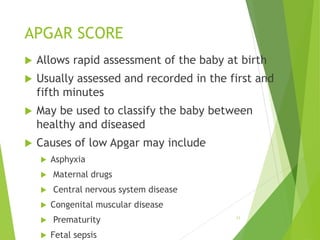
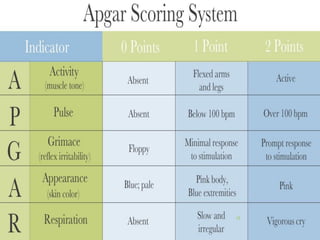
APGAR SCORE
 Allows rapid assessment of the baby at birth
 Usually assessed and recorded in the first and
fifth minutes
 May be used to classify the baby between
healthy and diseased
 Causes of low Apgar may include
 Asphyxia
 Maternal drugs
 Central nervous system disease
 Congenital muscular disease
 Prematurity
 Fetal sepsis
11
12
INSPECTION
 Should follow inspection, palpation,
percussion and auscultation
(inspection>>>percussion)
 Facies
 Posture: well flexed, partially flexed or limp
 Behavioral state/spontaneous activity:
sleeping, crying, alert
 Skin:
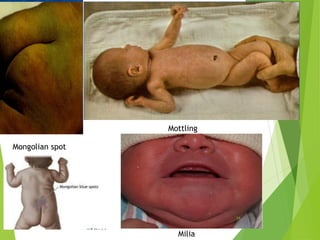
 Colour: pallor, plethora, jaundice, cyanosis,
other pigmentation
 Texture: sticky, smooth, peeling, lanugo
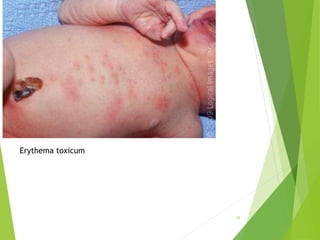
 Rashes
13
Mongolian spot
Mottling
Milia
14
Erythema toxicum
15
INSPECTION
 Respiratory effort
 Observe pattern – rhythm, grunt, accessory
muscle use
 Count rate (for 1 minute)
16
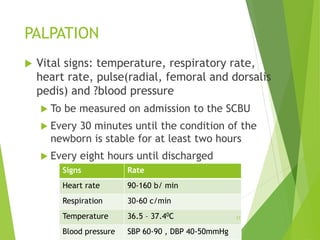
PALPATION
 Vital signs: temperature, respiratory rate,
heart rate, pulse(radial, femoral and dorsalis
pedis) and ?blood pressure
 To be measured on admission to the SCBU
 Every 30 minutes until the condition of the
newborn is stable for at least two hours
 Every eight hours until discharged
Signs Rate
Heart rate 90-160 b/ min
Respiration 30-60 c/min
Temperature 36.5 – 37.40C
Blood pressure SBP 60-90 , DBP 40-50mmHg
17
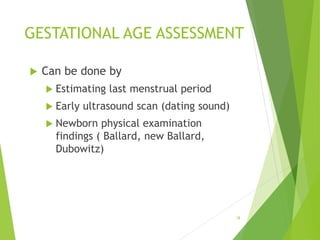
GESTATIONAL AGE ASSESSMENT
 Can be done by
 Estimating last menstrual period
 Early ultrasound scan (dating sound)
 Newborn physical examination
findings ( Ballard, new Ballard,
Dubowitz)
18
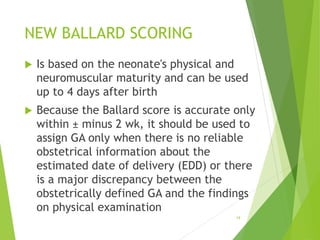
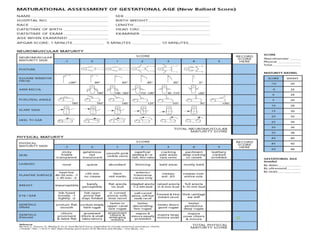
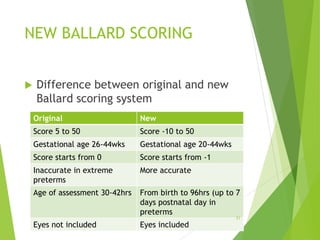
NEW BALLARD SCORING
 Is based on the neonate's physical and
neuromuscular maturity and can be used
up to 4 days after birth
 Because the Ballard score is accurate only
within ± minus 2 wk, it should be used to
assign GA only when there is no reliable
obstetrical information about the
estimated date of delivery (EDD) or there
is a major discrepancy between the
obstetrically defined GA and the findings
on physical examination
19
20
NEW BALLARD SCORING
 Difference between original and new
Ballard scoring system
Original New
Score 5 to 50 Score -10 to 50
Gestational age 26-44wks Gestational age 20-44wks
Score starts from 0 Score starts from -1
Inaccurate in extreme
preterms
More accurate
Age of assessment 30-42hrs From birth to 96hrs (up to 7
days postnatal day in
preterms
Eyes not included Eyes included
21
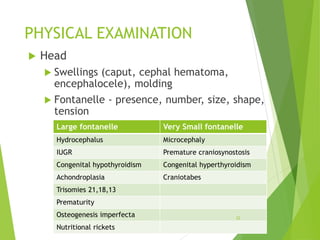
PHYSICAL EXAMINATION
 Head
 Swellings (caput, cephal hematoma,
encephalocele), molding
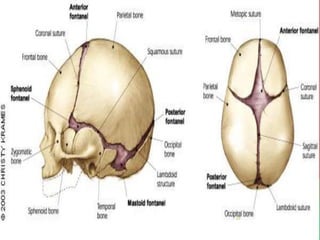
 Fontanelle - presence, number, size, shape,
tension
Large fontanelle Very Small fontanelle
Hydrocephalus Microcephaly
IUGR Premature craniosynostosis
Congenital hypothyroidism Congenital hyperthyroidism
Achondroplasia Craniotabes
Trisomies 21,18,13
Prematurity
Osteogenesis imperfecta
Nutritional rickets
22
23
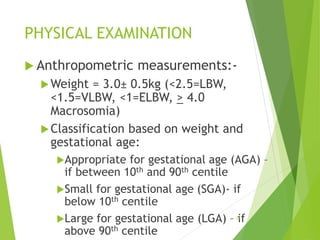
PHYSICAL EXAMINATION
 Anthropometric measurements:-
Weight = 3.0± 0.5kg (<2.5=LBW,
<1.5=VLBW, <1=ELBW, > 4.0
Macrosomia)
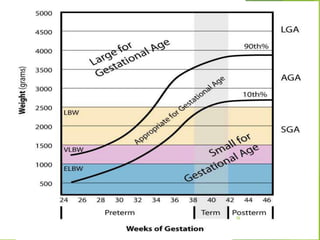
Classification based on weight and
gestational age:
Appropriate for gestational age (AGA) –
if between 10th and 90th centile
Small for gestational age (SGA)- if
below 10th centile
Large for gestational age (LGA) – if
above 90th centile
24
PHYSICAL EXAMINATION
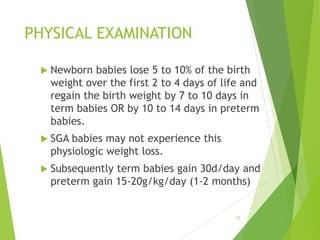
 Newborn babies lose 5 to 10% of the birth
weight over the first 2 to 4 days of life and
regain the birth weight by 7 to 10 days in
term babies OR by 10 to 14 days in preterm
babies.
 SGA babies may not experience this
physiologic weight loss.
 Subsequently term babies gain 30d/day and
preterm gain 15-20g/kg/day (1-2 months)
25
26
PHYSICAL EXAMINATION
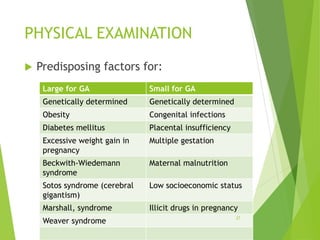
 Predisposing factors for:
Large for GA Small for GA
Genetically determined Genetically determined
Obesity Congenital infections
Diabetes mellitus Placental insufficiency
Excessive weight gain in
pregnancy
Multiple gestation
Beckwith-Wiedemann
syndrome
Maternal malnutrition
Sotos syndrome (cerebral
gigantism)
Low socioeconomic status
Marshall, syndrome Illicit drugs in pregnancy
Weaver syndrome
27
PHYSICAL EXAMINATION
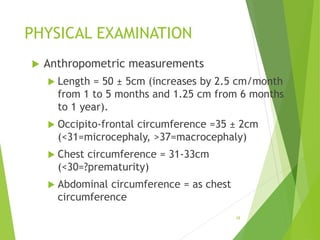
 Anthropometric measurements
 Length = 50 ± 5cm (increases by 2.5 cm/month
from 1 to 5 months and 1.25 cm from 6 months
to 1 year).
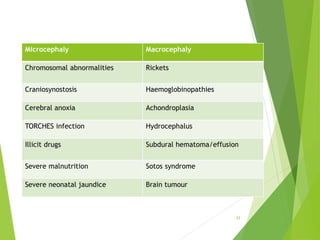
 Occipito-frontal circumference =35 ± 2cm
(<31=microcephaly, >37=macrocephaly)
 Chest circumference = 31-33cm
(<30=?prematurity)
 Abdominal circumference = as chest
circumference
28
Microcephaly Macrocephaly
Chromosomal abnormalities Rickets
Craniosynostosis Haemoglobinopathies
Cerebral anoxia Achondroplasia
TORCHES infection Hydrocephalus
Illicit drugs Subdural hematoma/effusion
Severe malnutrition Sotos syndrome
Severe neonatal jaundice Brain tumour
29
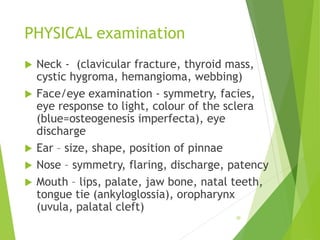
PHYSICAL examination
 Neck - (clavicular fracture, thyroid mass,
cystic hygroma, hemangioma, webbing)
 Face/eye examination - symmetry, facies,
eye response to light, colour of the sclera
(blue=osteogenesis imperfecta), eye
discharge
 Ear – size, shape, position of pinnae
 Nose – symmetry, flaring, discharge, patency
 Mouth – lips, palate, jaw bone, natal teeth,
tongue tie (ankyloglossia), oropharynx
(uvula, palatal cleft)
30
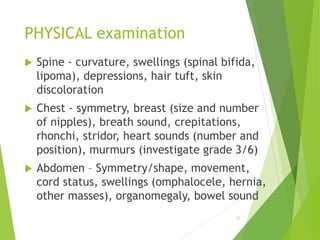
PHYSICAL examination
 Spine - curvature, swellings (spinal bifida,
lipoma), depressions, hair tuft, skin
discoloration
 Chest - symmetry, breast (size and number
of nipples), breath sound, crepitations,
rhonchi, stridor, heart sounds (number and
position), murmurs (investigate grade 3/6)
 Abdomen – Symmetry/shape, movement,
cord status, swellings (omphalocele, hernia,
other masses), organomegaly, bowel sound
31
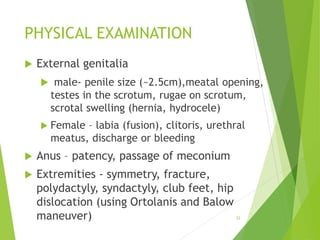
PHYSICAL EXAMINATION
 External genitalia
 male- penile size (~2.5cm),meatal opening,
testes in the scrotum, rugae on scrotum,
scrotal swelling (hernia, hydrocele)
 Female – labia (fusion), clitoris, urethral
meatus, discharge or bleeding
 Anus – patency, passage of meconium
 Extremities - symmetry, fracture,
polydactyly, syndactyly, club feet, hip
dislocation (using Ortolanis and Balow
maneuver) 32
PHYSICAL EXAMINATION
 Nervous system- palsies, fasciculations/
tremors, seizures,
 Tone
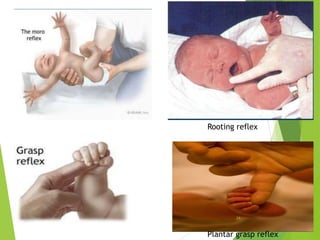
 Primitive reflexes – grasp (palmar, plantar),
rooting, sucking, moro, startle
33
Rooting reflex
Plantar grasp reflex
34
INVESTIGATIONS
 These will be directed to the abnormlities
noted in the assessment of the baby
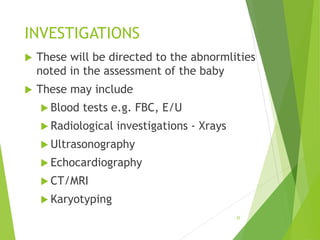
 These may include
 Blood tests e.g. FBC, E/U
 Radiological investigations - Xrays
 Ultrasonography
 Echocardiography
 CT/MRI
 Karyotyping
35
CONCLUSION
 The health of a neonate is very important
following delivery and in the rest of the
neonatal period as it may determine the
subsequent health status of the baby throughout
life.
 Therefore after delivery, a careful examination
and assessment of the baby should be carried
out to determine signs or complications which
need further assessment or management either
primarily from the pediatrician or from other
specialties in order to ensure proper growth and
development of the baby. 36
REFERENCES
 Azubuike JC, Nkanginieme KE. Paediatrics and
child health in a tropical region. 2nd edition.
African Educational Services;. Pp 163-170
 WHO. Partnership for maternal, newborn and
child health. Online. Available at
www.who.int/pmnch/media/press_materials/f
s/fs_newborndeath_illness/en
 Essential Newborn Nursing for Small Hospitals
Learner’s Guide, WHO Collaborating Centre for
Training and Research in Newborn Care, All
India Institute of Medical Sciences, New Delhi,
2004
 Maria Loreto, Evangelista-Sia . Infant Care and
Feeding 2nd edition. RMSIA Publishing. pp. 38-
57
37
THANK YOU
38

Neonatal assessment

  • 1.
    NEONATAL ASSESSMENT BY DR. AYODELE,NOSRULLAH S. FMC, BIRNIN KEBBI 1
  • 2.
    OUTLINE  INTRODUCTION  AIMSOF ASSESSMENT  COMPONENTS OF ASSESSMENT  HISTORY  PHYSICAL EXAMINATIONS  INVESTIGATIONS  CONCLUSION  REFERENCES 2
  • 3.
    INTRODUCTION  Pregnancy, labourand delivery can greatly affect the health of a neonate.  Therefore, effective care of a baby should start right from the antenatal period to the point of delivery  The period of transition puts a great risk on the neonate as it needs various adaptations to cope with the extrauterine life  Every year nearly 41% of all under 5 deaths occur in the neonatal period 3
  • 4.
    INTRODUCTION  Three quartersof these deaths occur in the first week of life  Up to two third of newborn death can be prevented if known, effective health measures are provided at birth and during the first week of life  Careful resuscitation, examination and assessment of the new born help to detect health challenges which when addressed may avert many of these undue deaths 4
  • 5.
    AIMS OF NEONATAL ASSESSMENT 1.Identify prenatal influences on health status of the baby 2. Identifying potential problems with the newborn 3. detecting adaptation failure and need for immediate intervention e.g. prematurity, asphyxia 4. detecting anomalies and establish baseline for subsequent examination 5. Plan appropriate nursing care for infant and identify teaching needs of parents 5
  • 6.
    COMPONENTS OF ASSESSMENT Assessment involves:  History  Physical examination 6
  • 7.
    HISTORY  Maternal History Parity Obstetrichistory Details of antenatal care Other problems of the current pregnancy Maternal illnesses Details of labour and delivery Use of sedation or anaesthesia Significant family history 7
  • 8.
    HISTORY  Perinatal History Events in the delivery room  Apgar scores and resuscitation,  Feeding and behaviour since birth 8
  • 9.
    PHYSICAL EXAMINATION  Itshould be carried out immediately after delivery  Must be carried out in a regular sequence so that items are not forgotten  A useful approach is the head to toe technique  Should not take more than 5-10 minutes and should be done in a quiet warm environment  Whenever possible the infant should be examined in the presence of at least one parent 9
  • 10.
    PHASES OF EXAMINATION Initial assessment (Apgar score)  General examination  Systemic examination 10
  • 11.
    APGAR SCORE  Allowsrapid assessment of the baby at birth  Usually assessed and recorded in the first and fifth minutes  May be used to classify the baby between healthy and diseased  Causes of low Apgar may include  Asphyxia  Maternal drugs  Central nervous system disease  Congenital muscular disease  Prematurity  Fetal sepsis 11
  • 12.
  • 13.
    INSPECTION  Should followinspection, palpation, percussion and auscultation (inspection>>>percussion)  Facies  Posture: well flexed, partially flexed or limp  Behavioral state/spontaneous activity: sleeping, crying, alert  Skin:  Colour: pallor, plethora, jaundice, cyanosis, other pigmentation  Texture: sticky, smooth, peeling, lanugo  Rashes 13
  • 14.
  • 15.
  • 16.
    INSPECTION  Respiratory effort Observe pattern – rhythm, grunt, accessory muscle use  Count rate (for 1 minute) 16
  • 17.
    PALPATION  Vital signs:temperature, respiratory rate, heart rate, pulse(radial, femoral and dorsalis pedis) and ?blood pressure  To be measured on admission to the SCBU  Every 30 minutes until the condition of the newborn is stable for at least two hours  Every eight hours until discharged Signs Rate Heart rate 90-160 b/ min Respiration 30-60 c/min Temperature 36.5 – 37.40C Blood pressure SBP 60-90 , DBP 40-50mmHg 17
  • 18.
    GESTATIONAL AGE ASSESSMENT Can be done by  Estimating last menstrual period  Early ultrasound scan (dating sound)  Newborn physical examination findings ( Ballard, new Ballard, Dubowitz) 18
  • 19.
    NEW BALLARD SCORING Is based on the neonate's physical and neuromuscular maturity and can be used up to 4 days after birth  Because the Ballard score is accurate only within ± minus 2 wk, it should be used to assign GA only when there is no reliable obstetrical information about the estimated date of delivery (EDD) or there is a major discrepancy between the obstetrically defined GA and the findings on physical examination 19
  • 20.
  • 21.
    NEW BALLARD SCORING Difference between original and new Ballard scoring system Original New Score 5 to 50 Score -10 to 50 Gestational age 26-44wks Gestational age 20-44wks Score starts from 0 Score starts from -1 Inaccurate in extreme preterms More accurate Age of assessment 30-42hrs From birth to 96hrs (up to 7 days postnatal day in preterms Eyes not included Eyes included 21
  • 22.
    PHYSICAL EXAMINATION  Head Swellings (caput, cephal hematoma, encephalocele), molding  Fontanelle - presence, number, size, shape, tension Large fontanelle Very Small fontanelle Hydrocephalus Microcephaly IUGR Premature craniosynostosis Congenital hypothyroidism Congenital hyperthyroidism Achondroplasia Craniotabes Trisomies 21,18,13 Prematurity Osteogenesis imperfecta Nutritional rickets 22
  • 23.
  • 24.
    PHYSICAL EXAMINATION  Anthropometricmeasurements:- Weight = 3.0± 0.5kg (<2.5=LBW, <1.5=VLBW, <1=ELBW, > 4.0 Macrosomia) Classification based on weight and gestational age: Appropriate for gestational age (AGA) – if between 10th and 90th centile Small for gestational age (SGA)- if below 10th centile Large for gestational age (LGA) – if above 90th centile 24
  • 25.
    PHYSICAL EXAMINATION  Newbornbabies lose 5 to 10% of the birth weight over the first 2 to 4 days of life and regain the birth weight by 7 to 10 days in term babies OR by 10 to 14 days in preterm babies.  SGA babies may not experience this physiologic weight loss.  Subsequently term babies gain 30d/day and preterm gain 15-20g/kg/day (1-2 months) 25
  • 26.
  • 27.
    PHYSICAL EXAMINATION  Predisposingfactors for: Large for GA Small for GA Genetically determined Genetically determined Obesity Congenital infections Diabetes mellitus Placental insufficiency Excessive weight gain in pregnancy Multiple gestation Beckwith-Wiedemann syndrome Maternal malnutrition Sotos syndrome (cerebral gigantism) Low socioeconomic status Marshall, syndrome Illicit drugs in pregnancy Weaver syndrome 27
  • 28.
    PHYSICAL EXAMINATION  Anthropometricmeasurements  Length = 50 ± 5cm (increases by 2.5 cm/month from 1 to 5 months and 1.25 cm from 6 months to 1 year).  Occipito-frontal circumference =35 ± 2cm (<31=microcephaly, >37=macrocephaly)  Chest circumference = 31-33cm (<30=?prematurity)  Abdominal circumference = as chest circumference 28
  • 29.
    Microcephaly Macrocephaly Chromosomal abnormalitiesRickets Craniosynostosis Haemoglobinopathies Cerebral anoxia Achondroplasia TORCHES infection Hydrocephalus Illicit drugs Subdural hematoma/effusion Severe malnutrition Sotos syndrome Severe neonatal jaundice Brain tumour 29
  • 30.
    PHYSICAL examination  Neck- (clavicular fracture, thyroid mass, cystic hygroma, hemangioma, webbing)  Face/eye examination - symmetry, facies, eye response to light, colour of the sclera (blue=osteogenesis imperfecta), eye discharge  Ear – size, shape, position of pinnae  Nose – symmetry, flaring, discharge, patency  Mouth – lips, palate, jaw bone, natal teeth, tongue tie (ankyloglossia), oropharynx (uvula, palatal cleft) 30
  • 31.
    PHYSICAL examination  Spine- curvature, swellings (spinal bifida, lipoma), depressions, hair tuft, skin discoloration  Chest - symmetry, breast (size and number of nipples), breath sound, crepitations, rhonchi, stridor, heart sounds (number and position), murmurs (investigate grade 3/6)  Abdomen – Symmetry/shape, movement, cord status, swellings (omphalocele, hernia, other masses), organomegaly, bowel sound 31
  • 32.
    PHYSICAL EXAMINATION  Externalgenitalia  male- penile size (~2.5cm),meatal opening, testes in the scrotum, rugae on scrotum, scrotal swelling (hernia, hydrocele)  Female – labia (fusion), clitoris, urethral meatus, discharge or bleeding  Anus – patency, passage of meconium  Extremities - symmetry, fracture, polydactyly, syndactyly, club feet, hip dislocation (using Ortolanis and Balow maneuver) 32
  • 33.
    PHYSICAL EXAMINATION  Nervoussystem- palsies, fasciculations/ tremors, seizures,  Tone  Primitive reflexes – grasp (palmar, plantar), rooting, sucking, moro, startle 33
  • 34.
  • 35.
    INVESTIGATIONS  These willbe directed to the abnormlities noted in the assessment of the baby  These may include  Blood tests e.g. FBC, E/U  Radiological investigations - Xrays  Ultrasonography  Echocardiography  CT/MRI  Karyotyping 35
  • 36.
    CONCLUSION  The healthof a neonate is very important following delivery and in the rest of the neonatal period as it may determine the subsequent health status of the baby throughout life.  Therefore after delivery, a careful examination and assessment of the baby should be carried out to determine signs or complications which need further assessment or management either primarily from the pediatrician or from other specialties in order to ensure proper growth and development of the baby. 36
  • 37.
    REFERENCES  Azubuike JC,Nkanginieme KE. Paediatrics and child health in a tropical region. 2nd edition. African Educational Services;. Pp 163-170  WHO. Partnership for maternal, newborn and child health. Online. Available at www.who.int/pmnch/media/press_materials/f s/fs_newborndeath_illness/en  Essential Newborn Nursing for Small Hospitals Learner’s Guide, WHO Collaborating Centre for Training and Research in Newborn Care, All India Institute of Medical Sciences, New Delhi, 2004  Maria Loreto, Evangelista-Sia . Infant Care and Feeding 2nd edition. RMSIA Publishing. pp. 38- 57 37
  • 38.