Neonatal Resuscitation Program
8th edition
Dr. Renold S. Xavier
Why?
• Most newborns make the transition to extrauterine
life without intervention
• 5% of term NB- PPV
• 2% of term NB- intubated
• 1 to 3 per 1000 births- CC or emergency medications
Preparing for resuscitation
Team and equipment preparation: the “brief”
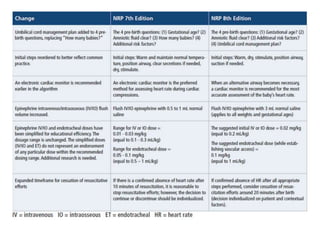
4 pre-birth questions
Expected gestational age
Is the AF clear ?
Any additional risk factors?
Umbilical cord management plan
Timing of umbilical cord clamping
• DCC for 30-60 s is reasonable for both term and
preterm infants who do not require resuscitation at
birth.
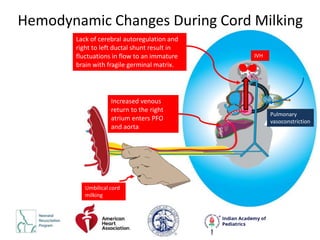
Increased venous
return to the right
atrium enters PFO
and aorta
Umbilical cord
milking
Pulmonary
vasoconstriction
Lack of cerebral autoregulation and
right to left ductal shunt result in
fluctuations in flow to an immature
brain with fragile germinal matrix.
IVH
Hemodynamic Changes During Cord Milking
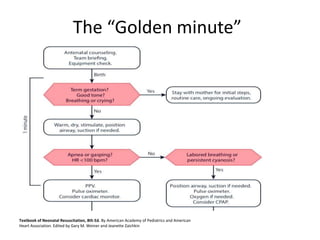
The “Golden minute”
Textbook of Neonatal Resuscitation, 8th Ed. By American Academy of Pediatrics and American
Heart Association. Edited by Gary M. Weiner and Jeanette Zaichkin
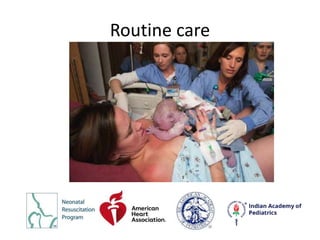
Routine care
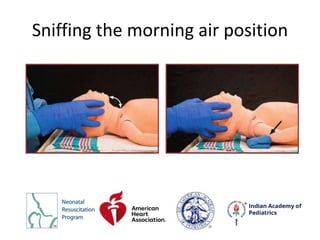
Sniffing the morning air position
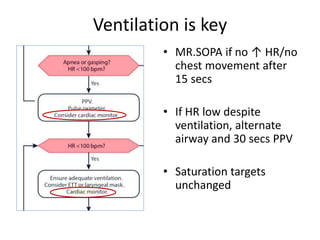
Ventilation is key
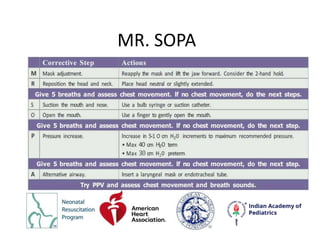
• MR.SOPA if no ↑ HR/no
chest movement after
15 secs
• If HR low despite
ventilation, alternate
airway and 30 secs PPV
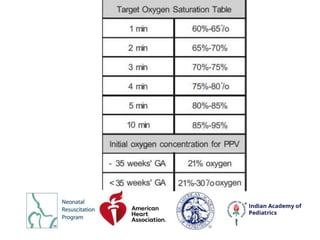
• Saturation targets
unchanged
Ventilation of the newborn's lungs is
the single most important and
effective step in neonatal resuscitation
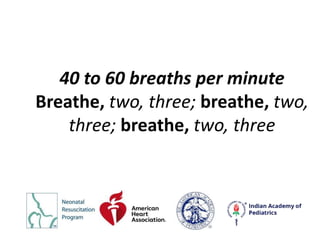
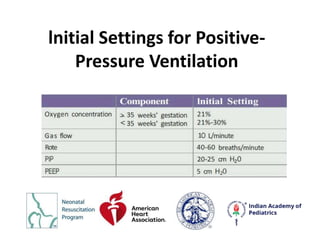
40 to 60 breaths per minute
Breathe, two, three; breathe, two,
three; breathe, two, three
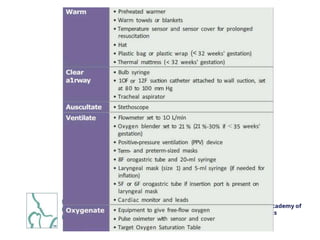
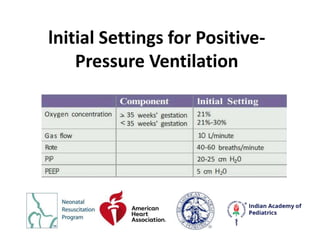
lnitial Settings for Positive-
Pressure Ventilation
MR. SOPA
lnitial Settings for Positive-
Pressure Ventilation
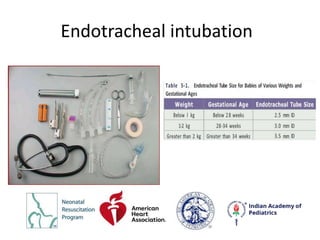
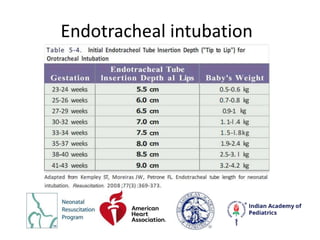
Endotracheal intubation
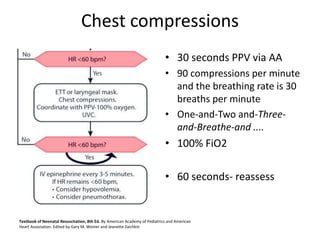
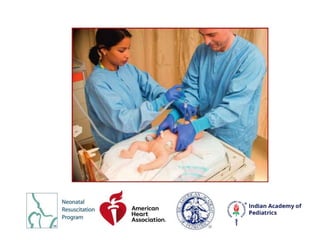
Chest compressions
• 30 seconds PPV via AA
• 90 compressions per minute
and the breathing rate is 30
breaths per minute
• One-and-Two and-Three-
and-Breathe-and ....
• 100% FiO2
• 60 seconds- reassess
Textbook of Neonatal Resuscitation, 8th Ed. By American Academy of Pediatrics and American
Heart Association. Edited by Gary M. Weiner and Jeanette Zaichkin
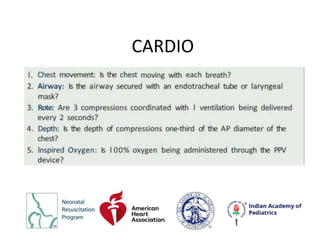
CARDIO
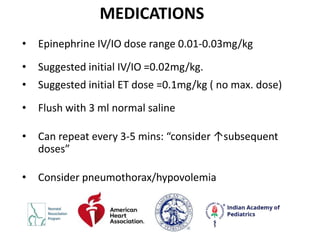
MEDICATIONS
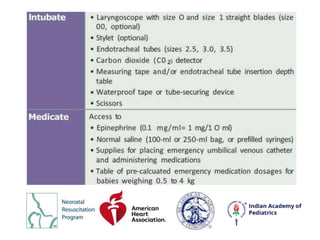
• Epinephrine IV/IO dose range 0.01-0.03mg/kg
• Suggested initial IV/IO =0.02mg/kg.
• Suggested initial ET dose =0.1mg/kg ( no max. dose)
• Flush with 3 ml normal saline
• Can repeat every 3-5 mins: “consider ↑subsequent
doses”
• Consider pneumothorax/hypovolemia
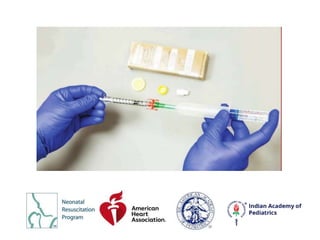
Volume expansion recommendations
a. Solution: Normal saline (NS) or type O Rh-negative
blood
b. Route: Intravenous or intraosseous
c. Preparation: 30- to 60-mL syringe (labeled NS or O-
blood)
d. Dose: 1O mL/kg
e. Rate: Over 5 to 1O minutes
Normal saline remains crystalloid expander of choice
Packed cells in cases of suspected fetal anemia
“Reasonable time frame for considering cessation of
resuscitation efforts is around 20 minutes after birth”….
“individualized based on patient and contextual
factors”
A baby who required resuscitation must have close monitoring and
frequent assessment of respiratory effort, oxygenation, blood
pressure, blood glucose, electrolytes, urine output, neurologic status,
and temperature during the immediate neonatal period.
Be careful to avoid overheating the baby during or after
resuscitation.
If indicated, therapeutic hypothermia must be initiated promptly;
therefore, every birth unit should have a system for identifying
potential candidates and contacting appropriate resources.
POST RESUSCITATION CARE
Thank you

Neonatal Resuscitation Program eighth edition.pptx

  • 1.
    Neonatal Resuscitation Program 8thedition Dr. Renold S. Xavier
  • 2.
    Why? • Most newbornsmake the transition to extrauterine life without intervention • 5% of term NB- PPV • 2% of term NB- intubated • 1 to 3 per 1000 births- CC or emergency medications
  • 4.
    Preparing for resuscitation Teamand equipment preparation: the “brief” 4 pre-birth questions Expected gestational age Is the AF clear ? Any additional risk factors? Umbilical cord management plan
  • 7.
    Timing of umbilicalcord clamping • DCC for 30-60 s is reasonable for both term and preterm infants who do not require resuscitation at birth.
  • 8.
    Increased venous return tothe right atrium enters PFO and aorta Umbilical cord milking Pulmonary vasoconstriction Lack of cerebral autoregulation and right to left ductal shunt result in fluctuations in flow to an immature brain with fragile germinal matrix. IVH Hemodynamic Changes During Cord Milking
  • 9.
    The “Golden minute” Textbookof Neonatal Resuscitation, 8th Ed. By American Academy of Pediatrics and American Heart Association. Edited by Gary M. Weiner and Jeanette Zaichkin
  • 10.
  • 11.
  • 13.
    Ventilation is key •MR.SOPA if no ↑ HR/no chest movement after 15 secs • If HR low despite ventilation, alternate airway and 30 secs PPV • Saturation targets unchanged
  • 14.
    Ventilation of thenewborn's lungs is the single most important and effective step in neonatal resuscitation
  • 16.
    40 to 60breaths per minute Breathe, two, three; breathe, two, three; breathe, two, three
  • 17.
    lnitial Settings forPositive- Pressure Ventilation
  • 18.
  • 19.
    lnitial Settings forPositive- Pressure Ventilation
  • 20.
  • 21.
  • 22.
    Chest compressions • 30seconds PPV via AA • 90 compressions per minute and the breathing rate is 30 breaths per minute • One-and-Two and-Three- and-Breathe-and .... • 100% FiO2 • 60 seconds- reassess Textbook of Neonatal Resuscitation, 8th Ed. By American Academy of Pediatrics and American Heart Association. Edited by Gary M. Weiner and Jeanette Zaichkin
  • 24.
  • 25.
    MEDICATIONS • Epinephrine IV/IOdose range 0.01-0.03mg/kg • Suggested initial IV/IO =0.02mg/kg. • Suggested initial ET dose =0.1mg/kg ( no max. dose) • Flush with 3 ml normal saline • Can repeat every 3-5 mins: “consider ↑subsequent doses” • Consider pneumothorax/hypovolemia
  • 27.
    Volume expansion recommendations a.Solution: Normal saline (NS) or type O Rh-negative blood b. Route: Intravenous or intraosseous c. Preparation: 30- to 60-mL syringe (labeled NS or O- blood) d. Dose: 1O mL/kg e. Rate: Over 5 to 1O minutes
  • 28.
    Normal saline remainscrystalloid expander of choice Packed cells in cases of suspected fetal anemia “Reasonable time frame for considering cessation of resuscitation efforts is around 20 minutes after birth”…. “individualized based on patient and contextual factors”
  • 29.
    A baby whorequired resuscitation must have close monitoring and frequent assessment of respiratory effort, oxygenation, blood pressure, blood glucose, electrolytes, urine output, neurologic status, and temperature during the immediate neonatal period. Be careful to avoid overheating the baby during or after resuscitation. If indicated, therapeutic hypothermia must be initiated promptly; therefore, every birth unit should have a system for identifying potential candidates and contacting appropriate resources. POST RESUSCITATION CARE
  • 31.