COMA STIMULATION
WHAT IS COMA
• Patient’s eyes do not open either spontaneously or to external stimuli
• Does not follow command
• Does not mouth or speak recognizable words
• Does not demonstrate intentional movement ( may show reflexive
movement such as posturing, withdrawal from pain or involuntary
smiling)
• Patient cannot sustain visual pursuits through a 45° arc in any
direction when the eyes are held open manually.
(American Congress of Rehabilitation Medicine, 1995)
Coma is a profound state of unconsciousness.
COMA STIMULATION
• Coma stimulation programme is an approach based on stimulating the
unconscious person’s senses of hearing, touch, smell, taste and vision
individually in order to help their recovery.
• Types: Unimodal/Multimodal
• Techniques:
Visual/Auditory/Olfactory/Gustatory/Cutaneous/Kinesthetic.
THEORIES OF COMA STIMULATION
• Spare capacity and reorganization: Activation of Non-
Active/Spare/Dormant areas
• The redundancy theory: Ability to duplicate neuronal pathways
• The response at a cellular level theory: Collateral sprouting to attempt
rewiring the system.
• The environmental effects theory
PRINCIPLES
• Cardinal Rule - Do not harm the
patient
• Check the resting vitals
• Stop immediately in case of
ICP/CPP raise
• Control environmental
distractions
• Organise the stimuli
• Provide distinct and well
differentiated stimuli
• Allow extra time for the patient
to respond
• Meaningful stimuli
• Verbally reinforce responses
• Try stimulating all the senses
• Identify stimuli which the patient
responds to
• Include family participation
Garret, Muehhng, Morrow and Riggs (1990)
CRITERIA FOR ELIGIBLE PATIENTS
• Patients with acute hemorrhage, diffuse axonal injury, hypoxia or
stroke
• GCS score less than 10
• RLA score of I, II, III
• Stable vitals
• ICP of less than 15 mm hg for atleast a 24 hour period
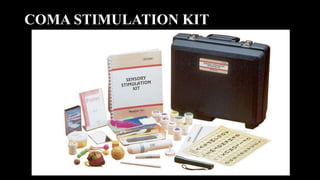
COMA STIMULATION KIT
AUDITORY STIMULATION
• Loud noises e.g., banging two saucepans, ringing bell or rattle,
blowing whistle, clapping hands, reading books, playing tape, TV,
Radio
• Should to irregular to prevent habituation
• Talk to patient, call by patient’s name
• Speak slowly, no complex commands
• Regular stimulation
VISUAL STIMULATION
• Flashing Lights, Strobes, Flash cards (Words or pictures printed on
contrast background), photographs, TV
• Reinforce with verbal instruction
OLFACTORY STIMULATION
• Use after shave, cologne, perfume, shampoo, eucalyptus oil, patient
favorite coffee or tea
• Avoid vinegar and ammonia
• Provide the stimuli for no more than 10 seconds
• Use garlic and mustard as noxious stimuli
ORAL STIMULATION
• Use a sponge tipped or glycerin swab or a soft tooth brush to reduce
hypersensitivity and abnormal oral/facial reflexes.
• Provide stimulation to the lips and area around the mouth.
• Pursing lips, closing mouth or pulling away from the stimulus are the
indicators of right stimulation.
TACTILE STIMULATION
• May be facilitatory or inhibitory. E.g., Pain and light touch to skin
produces inhibitory response/ Touch, pressure, slow stroking of the
spine produces facilitatory response
• Avoid unpleasant stimuli like pin prick, Avoid ice to face or body as it
may trigger sympathetic nervous system
• Use variety of textures/ variet of temperatures (warm or cold clothes/
metal spoons dipped for 30 secs in hot or cold water)
• Varying pressure on muscle belly and tendon, rubbing sternum,
pressing nail bed etc.,
GUSTATORY STIMULATION
• Provide taste stimulation, unless patient is prone to aspiration.
• Cotton swab dipped in sweet, salty or sour solution
• Avoid excess sweet as it induces more salivation.
• Facial grimacing is an indicator that the taste sensation is working
KINESTHETIC/PROPICEPTIVE/
VESTIBULAR STIMULATION
• Slow change in position tend to inhibit/ Faster movements facilitate
arousal
• Mobility activities promote body and positional awareness
• Using Tilt table, Rocking chairs, frequent position changes in bed
• Avoid spinning movements may trigger seizures
• Avoid mechanical inputs like sudden raising and lowering of bed
SESSIONS
• Frequency: Start at an hour per day to increase gradually to an intense
6 – 8 hours per day.
• 10 to 15 minute sessions to 45 to 90 minutes sessions as patient
improves.
• Wait for 1 to 2 minutes for response to occur
• Adequate rest in between sessions is recommended
RIGHT MEDIAN NERVE STIMULATION
[RMNS]
• Large cortical representation
• Peripheral port
• Spinoreticular component of median nerve
pathway
• RAS & Limbic system
• Activates projections between thalamus
and cortex
• Possibly silent or injured synapses are
transformed into functional ones by
neurotrophic factors
• Increased cerebral blood flow and
enhancement of neurotransmitter
metabolism
Lei J, et al. J Neurotrauma 2015;32:1584–89
RMNS - PARAMETERS
• High Frequency biphasic Electrical Stimulation
• Asymmetric biphasic pluses at an amplitude of 15–20 mA (as
tolerated)
• Pulse width of 300 μs at 40 Hz ON for 20 s and OFF for 40 s
• 8 hours per day
Wu X, Zhang C et al., Right median nerve electrical stimulation for acute traumatic coma (the Asia
Coma Electrical Stimulation trial): study protocol for a randomised controlled trial. Trials.
2017;18(1):311.
THANK YOU

Coma Stimulation Techniques

  • 1.
  • 2.
    WHAT IS COMA •Patient’s eyes do not open either spontaneously or to external stimuli • Does not follow command • Does not mouth or speak recognizable words • Does not demonstrate intentional movement ( may show reflexive movement such as posturing, withdrawal from pain or involuntary smiling) • Patient cannot sustain visual pursuits through a 45° arc in any direction when the eyes are held open manually. (American Congress of Rehabilitation Medicine, 1995) Coma is a profound state of unconsciousness.
  • 3.
    COMA STIMULATION • Comastimulation programme is an approach based on stimulating the unconscious person’s senses of hearing, touch, smell, taste and vision individually in order to help their recovery. • Types: Unimodal/Multimodal • Techniques: Visual/Auditory/Olfactory/Gustatory/Cutaneous/Kinesthetic.
  • 4.
    THEORIES OF COMASTIMULATION • Spare capacity and reorganization: Activation of Non- Active/Spare/Dormant areas • The redundancy theory: Ability to duplicate neuronal pathways • The response at a cellular level theory: Collateral sprouting to attempt rewiring the system. • The environmental effects theory
  • 5.
    PRINCIPLES • Cardinal Rule- Do not harm the patient • Check the resting vitals • Stop immediately in case of ICP/CPP raise • Control environmental distractions • Organise the stimuli • Provide distinct and well differentiated stimuli • Allow extra time for the patient to respond • Meaningful stimuli • Verbally reinforce responses • Try stimulating all the senses • Identify stimuli which the patient responds to • Include family participation Garret, Muehhng, Morrow and Riggs (1990)
  • 6.
    CRITERIA FOR ELIGIBLEPATIENTS • Patients with acute hemorrhage, diffuse axonal injury, hypoxia or stroke • GCS score less than 10 • RLA score of I, II, III • Stable vitals • ICP of less than 15 mm hg for atleast a 24 hour period
  • 7.
  • 8.
    AUDITORY STIMULATION • Loudnoises e.g., banging two saucepans, ringing bell or rattle, blowing whistle, clapping hands, reading books, playing tape, TV, Radio • Should to irregular to prevent habituation • Talk to patient, call by patient’s name • Speak slowly, no complex commands • Regular stimulation
  • 9.
    VISUAL STIMULATION • FlashingLights, Strobes, Flash cards (Words or pictures printed on contrast background), photographs, TV • Reinforce with verbal instruction
  • 10.
    OLFACTORY STIMULATION • Useafter shave, cologne, perfume, shampoo, eucalyptus oil, patient favorite coffee or tea • Avoid vinegar and ammonia • Provide the stimuli for no more than 10 seconds • Use garlic and mustard as noxious stimuli
  • 11.
    ORAL STIMULATION • Usea sponge tipped or glycerin swab or a soft tooth brush to reduce hypersensitivity and abnormal oral/facial reflexes. • Provide stimulation to the lips and area around the mouth. • Pursing lips, closing mouth or pulling away from the stimulus are the indicators of right stimulation.
  • 12.
    TACTILE STIMULATION • Maybe facilitatory or inhibitory. E.g., Pain and light touch to skin produces inhibitory response/ Touch, pressure, slow stroking of the spine produces facilitatory response • Avoid unpleasant stimuli like pin prick, Avoid ice to face or body as it may trigger sympathetic nervous system • Use variety of textures/ variet of temperatures (warm or cold clothes/ metal spoons dipped for 30 secs in hot or cold water) • Varying pressure on muscle belly and tendon, rubbing sternum, pressing nail bed etc.,
  • 13.
    GUSTATORY STIMULATION • Providetaste stimulation, unless patient is prone to aspiration. • Cotton swab dipped in sweet, salty or sour solution • Avoid excess sweet as it induces more salivation. • Facial grimacing is an indicator that the taste sensation is working
  • 14.
    KINESTHETIC/PROPICEPTIVE/ VESTIBULAR STIMULATION • Slowchange in position tend to inhibit/ Faster movements facilitate arousal • Mobility activities promote body and positional awareness • Using Tilt table, Rocking chairs, frequent position changes in bed • Avoid spinning movements may trigger seizures • Avoid mechanical inputs like sudden raising and lowering of bed
  • 15.
    SESSIONS • Frequency: Startat an hour per day to increase gradually to an intense 6 – 8 hours per day. • 10 to 15 minute sessions to 45 to 90 minutes sessions as patient improves. • Wait for 1 to 2 minutes for response to occur • Adequate rest in between sessions is recommended
  • 16.
    RIGHT MEDIAN NERVESTIMULATION [RMNS] • Large cortical representation • Peripheral port • Spinoreticular component of median nerve pathway • RAS & Limbic system • Activates projections between thalamus and cortex • Possibly silent or injured synapses are transformed into functional ones by neurotrophic factors • Increased cerebral blood flow and enhancement of neurotransmitter metabolism Lei J, et al. J Neurotrauma 2015;32:1584–89
  • 17.
    RMNS - PARAMETERS •High Frequency biphasic Electrical Stimulation • Asymmetric biphasic pluses at an amplitude of 15–20 mA (as tolerated) • Pulse width of 300 μs at 40 Hz ON for 20 s and OFF for 40 s • 8 hours per day Wu X, Zhang C et al., Right median nerve electrical stimulation for acute traumatic coma (the Asia Coma Electrical Stimulation trial): study protocol for a randomised controlled trial. Trials. 2017;18(1):311.
  • 18.