drifting into drug dependence
& beyond
Alferdose Hariri
Saudi psychiatric board R2
western region
alamal hospital
Revised by & Special thanks to
Dr. Samara Mansour
Objectives
1-What is the Neuroanatomy & neurophysiology of the
REWARD PATHWAY & why is it important to know?
2-what is the mechanisms of action of substances?
3-What make people vulnerable for drug dependence?
4-What is the Pathophysiology of relapse?
5-What are the Consequences of drug dependency ? Mcqs
Reward
1-natural rewards
feelings of wellbeing to prevent Aversive stimuli
   a-Hunger > food 
   b-Solitary & Lonely >Social interaction > Praise & touch 
   c-Extinction >reproduction
<<Hunger  & Extinction = death & the end of human being
Catatonia?? 
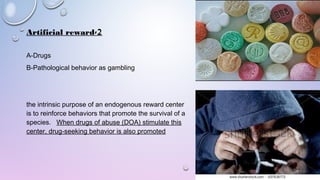
2-Artificial reward
A-Drugs
B-Pathological behavior as gambling
the intrinsic purpose of an endogenous reward center
is to reinforce behaviors that promote the survival of a
species.   When drugs of abuse (DOA) stimulate this
center, drug-seeking behavior is also promoted
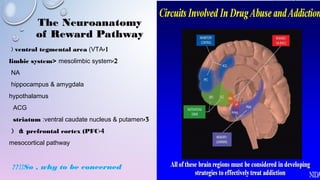
The Neuroanatomy
of Reward Pathway
1-ventral tegmental area (VTA( 
2-limbic system> mesolimbic system
NA
hippocampus & amygdala
hypothalamus
ACG
3-striatum :ventral caudate nucleus & putamen
4-prefrontal cortex (PFC(  <
mesocortical pathway
So , why to be concerned??!!
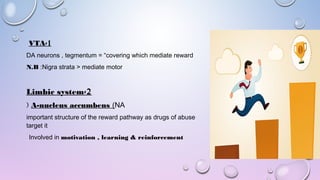
1-VTA
DA neurons , tegmentum = “covering which mediate reward
N.B :Nigra strata > mediate motor
2-Limbic system
A-nucleus accumbens (NA(
important structure of the reward pathway as drugs of abuse
target it
Involved in motivation , learning & reinforcement
B-Hippocampus:
acquisition of new factual information and the formation of new
memories about personally experienced events
Cannabis & amnesia??
C-Amygdala
implicated in the acquisition, storage, expression of emotional
memories
the amygdala is often activated outside of conscious
awareness. Upon stimulation of it , inducing a desire, or
wanting, for additional drug due to reward value to stimuli.
Flashback.?
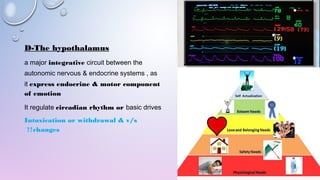
D-The hypothalamus
a major integrative circuit between the
autonomic nervous & endocrine systems , as
it express endocrine & motor component
of emotion
It regulate circadian rhythm or basic drives
Intoxication or withdrawal & v/s
changes??
 
E-Anterior cingulate gyrus
is involved in emotional self-control, cognitive function including
focused problem-solving
error detection
performance monitoring
detection of processing conflicts, but is influenced by both
motivation and affective state.
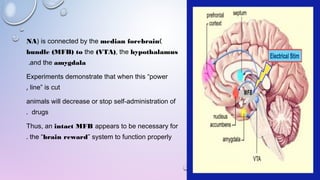
)NA) is connected by the median forebrain
bundle (MFB) to the (VTA), the hypothalamus
and the amygdala.
Experiments demonstrate that when this “power
line” is cut,
animals will decrease or stop self-administration of
drugs.  
Thus, an intact MFB appears to be necessary for
the “brain reward” system to function properly. 
MCQ
30-year-old man who has had many negative life experiences becomes upset
when he sees photographs of himself taken during these times. The brain area most
likely to be activated by these photographs is the
)A) dorsolateral pre frontal cortex
(B) hypothalamus
(C) orbitofrontal cortex
(D) reticular system
(E) amygdala
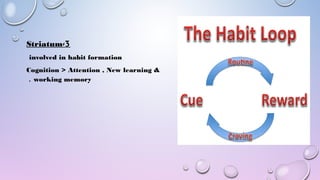
3-Striatum
involved in habit formation
Cognition > Attention , New learning &
working memory. 
4-prefrontal cortex
A-Dorsolateral prefrontal cortex
(DLPFC(:
Implicated in difficulties holding/maintaining several pieces of
information “on line” or in short-term storage (i.e., “working
memory”(
It is crucial for the control and regulation of cognitive
activities, including attention , sequencing events, planning
and the selection of goals
B-Orbitofrontal cortex (OFC(:
assessing the salience of potential rewards
and punishments (immediate vs. delayed gain(
It assesses and decodes the likely value or
behavioral relevance of available choices of
action and is therefore activated in decision
making & impulse control
N.b
This lobe is critical In OCD also
Emotion vs cognition
1ry emotion > high DA > over ride higher cortical
function as judgment & decision making  
N.b
1ry emotion is the basic drives 
2ry emotion as pride  
These neuroadaptive responses remain engaged
even in the absence of ongoing drug use and are
thought to be a primary factor in drug relapse
MCQ
What is the major mechanism of action of cocaine on neurotransmitter systems in the
brain?
)A) Blocks reuptake of dopamine
(B) Blocks release of dopamine
(C) Blocks reuptake of serotonin
(D) Blocks release of serotonin
Neurophysiology
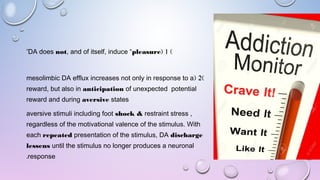
)1(DA does not, and of itself, induce “pleasure”
)2(mesolimbic DA efflux increases not only in response to a
reward, but also in anticipation of unexpected potential
reward and during aversive states
aversive stimuli including foot shock & restraint stress ,
regardless of the motivational valence of the stimulus. With
each repeated presentation of the stimulus, DA discharge
lessens until the stimulus no longer produces a neuronal
response.
GABA
  
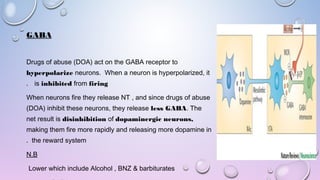
  Drugs of abuse (DOA) act on the GABA receptor to
hyperpolarize neurons.  When a neuron is hyperpolarized, it
is inhibited from firing.  
When neurons fire they release NT , and since drugs of abuse
(DOA) inhibit these neurons, they release less GABA. The
net result is disinhibition of dopaminergic neurons,
making them fire more rapidly and releasing more dopamine in
the reward system.  
N.B
Lower which include Alcohol , BNZ & barbiturates
 Serotonin
 
 is involved in the modulation of both drug self-administration
and dopamine levels.  
Serotonin may be important in modulating motivational factors, or
the amount of work an individual is willing to perform to obtain a
drug.
Also regulate mood, sleep , appetite , libido & impulse control
the relationship between serotonin and DA release is complex in
that, serotonin has numerous receptor types and its regulation of DA
release is at times inhibitory and at other times excitatory.
Drugs effect on serotonin?? 
Mechanisms of action
regarding NT
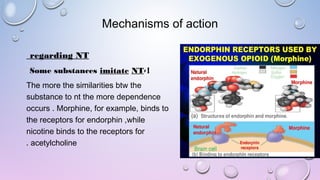
1-Some substances imitate NT
The more the similarities btw the
substance to nt the more dependence
occurs . Morphine, for example, binds to
the receptors for endorphin ,while
nicotine binds to the receptors for
acetylcholine.
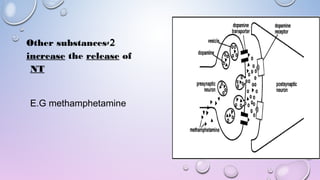
2-Other substances
increase the release of
NT
E.G methamphetamine
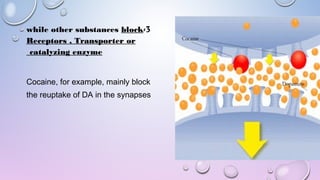
3-while other substances block
Receptors , Transporter or
catalyzing enzyme
Cocaine, for example, mainly block
the reuptake of DA in the synapses
Mechanisms of Action
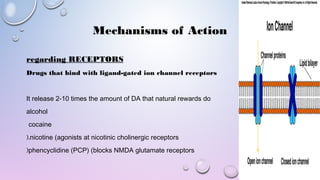
regarding RECEPTORS
Drugs that bind with ligand-gated ion channel receptors
It release 2-10 times the amount of DA that natural rewards do  
alcohol
cocaine
nicotine (agonists at nicotinic cholinergic receptors(.
phencyclidine (PCP) (blocks NMDA glutamate receptors(
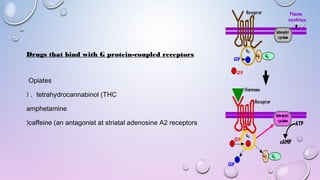
Drugs that bind with G protein-coupled receptors
Opiates
tetrahydrocannabinol (THC( .
amphetamine
caffeine (an antagonist at striatal adenosine A2 receptors(
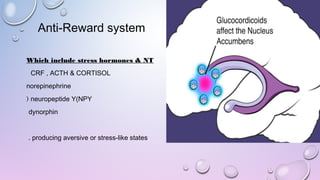
Anti-Reward system
Which include stress hormones & NT
CRF , ACTH & CORTISOL
norepinephrine
neuropeptide Y(NPY(
dynorphin
producing aversive or stress-like states.
MCQ
30-year-old woman who is withdrawing from heroin shows intense anxiety,
increased pulse, elevated bp and a hand tremor.
Her symptoms improve when she was given clonidine, an alpha-2-adrenergic receptor
agonist.
The area(s) of the brain most likely to be involved in the improvement in this patient’s
symptoms is
)A) right parietal lobe
(B) basal ganglia
(C) locus ceruleus
(D) raphe nuclei
Clinical correlations
Studies
either adoption or twin studies.
Adoption studies allow us to separate genetic and environmental factors.  
The individuals are then compared to their biological parents.  
In twin studies, identical and fraternal twins are compared. 
-vulnerability
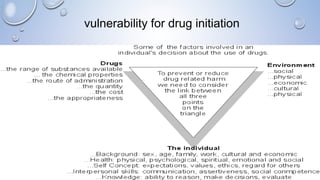
1-vulnerability for drug use initiation
2-vulnerability for drug dependence
vulnerability for drug initiation
the basis for drug self-medication
Is disordered of
1-emotions
2-self-esteem
3-relationships
vulnerability for drug
dependence
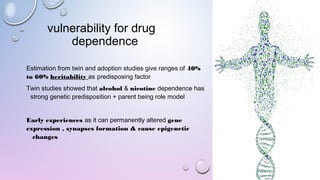
Estimation from twin and adoption studies give ranges of 40%
to 60% heritability as predisposing factor
Twin studies showed that alcohol & nicotine dependence has
strong genetic predisposition + parent being role model
Early experiences as it can permanently altered gene
expression , synapses formation & cause epigenetic
changes
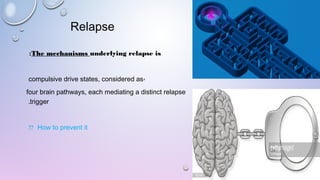
Relapse
The mechanisms underlying relapse is:
-compulsive drive states, considered as
four brain pathways, each mediating a distinct relapse
trigger.
How to prevent it??  
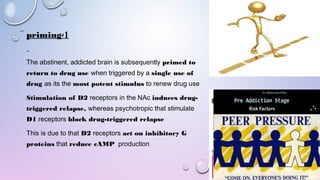
1-priming
The abstinent, addicted brain is subsequently primed to
return to drug use when triggered by a single use of
drug as its the most potent stimulus to renew drug use
Stimulation of D2 receptors in the NAc induces drug-
triggered relapse, whereas psychotropic that stimulate
D1 receptors block drug-triggered relapse
This is due to that D2 receptors act on inhibitory G
proteins that reduce cAMP production
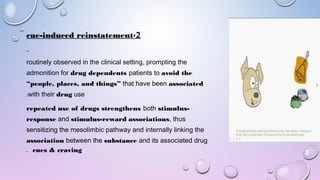
2-cue-induced reinstatement
routinely observed in the clinical setting, prompting the
admonition for drug dependents patients to avoid the
“people, places, and things” that have been associated
with their drug use.
repeated use of drugs strengthens both stimulus-
response and stimulus-reward associations, thus
sensitizing the mesolimbic pathway and internally linking the
association between the substance and its associated drug
cues & craving.
3-Craving
The compulsive drive toward drug use is
complemented by deficit in inhibitory restraint
as impulse control & decision making 2ry to
Lesions of the OFC synaptic plasticity &
stimulus-reward associations.
Person become concern about drugs more than
his essential needs as his reasoning & judgment got
impaired not due to underlying psychosis but his PFC
got affected
Drugs that act on craving??
4-stress-induced reinstatement
.
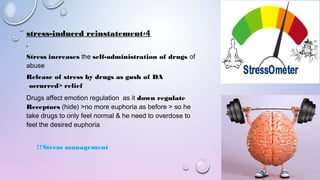
Stress increases the self-administration of drugs of
abuse
Release of stress by drugs as gush of DA
occurred> relief
Drugs affect emotion regulation as it down regulate
Receptors (hide) >no more euphoria as before > so he
take drugs to only feel normal & he need to overdose to
feel the desired euphoria
Stress management??   
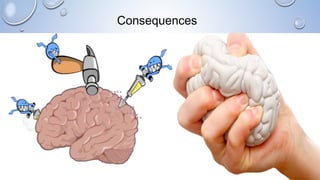
Consequences
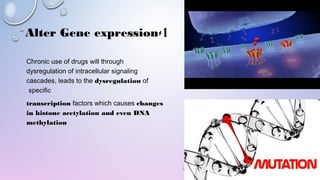
1-Alter Gene expression
Chronic use of drugs will through
dysregulation of intracellular signaling
cascades, leads to the dysregulation of
specific
transcription factors which causes changes
in histone acetylation and even DNA
methylation
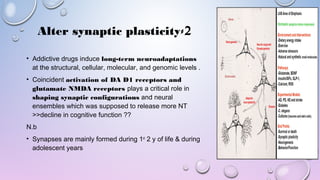
2-Alter synaptic plasticity
• Addictive drugs induce long-term neuroadaptations
at the structural, cellular, molecular, and genomic levels .
• Coincident activation of DA D1 receptors and
glutamate NMDA receptors plays a critical role in
shaping synaptic configurations and neural
ensembles which was supposed to release more NT
>>decline in cognitive function ??
N.b
• Synapses are mainly formed during 1st
2 y of life & during
adolescent years
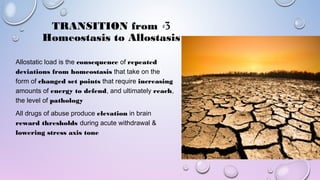
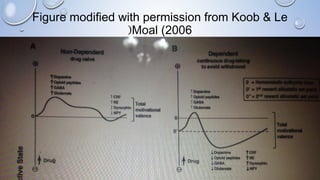
3-TRANSITION from
Homeostasis to Allostasis
Allostatic load is the consequence of repeated
deviations from homeostasis that take on the
form of changed set points that require increasing
amounts of energy to defend, and ultimately reach,
the level of pathology
All drugs of abuse produce elevation in brain
reward thresholds during acute withdrawal &
lowering stress axis tone
Figure modified with permission from Koob & Le
Moal (2006(
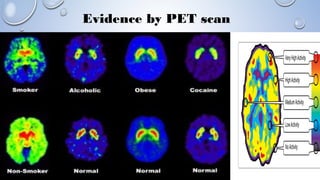
Evidence by PET scan
References
Synopsis Kaplan & sadock
http://ibgwww.colorado.edu/cadd/a_drug/essays/essay4.htm
https://www.drugabuse.gov/publications/drugs-brains-behavior-science-addiction/drugs-brain
www.annualreviews.org AddictionandtheBrainAntirewardSystem
Barbra behavioral science
Descriptive psychopathology
http://www.ncbi.nlm.nih.gov/pmc/articles/PMC1920543/pdf/nihms17876.pdf
Reward system (1) (1) (1)

Reward system (1) (1) (1)

  • 1.
    drifting into drugdependence & beyond Alferdose Hariri Saudi psychiatric board R2 western region alamal hospital
  • 2.
    Revised by &Special thanks to Dr. Samara Mansour
  • 3.
    Objectives 1-What is theNeuroanatomy & neurophysiology of the REWARD PATHWAY & why is it important to know? 2-what is the mechanisms of action of substances? 3-What make people vulnerable for drug dependence? 4-What is the Pathophysiology of relapse? 5-What are the Consequences of drug dependency ? Mcqs
  • 4.
    Reward 1-natural rewards feelings ofwellbeing to prevent Aversive stimuli    a-Hunger > food     b-Solitary & Lonely >Social interaction > Praise & touch     c-Extinction >reproduction <<Hunger  & Extinction = death & the end of human being Catatonia?? 
  • 5.
    2-Artificial reward A-Drugs B-Pathological behavioras gambling the intrinsic purpose of an endogenous reward center is to reinforce behaviors that promote the survival of a species.   When drugs of abuse (DOA) stimulate this center, drug-seeking behavior is also promoted
  • 6.
    The Neuroanatomy of RewardPathway 1-ventral tegmental area (VTA(  2-limbic system> mesolimbic system NA hippocampus & amygdala hypothalamus ACG 3-striatum :ventral caudate nucleus & putamen 4-prefrontal cortex (PFC(  < mesocortical pathway So , why to be concerned??!!
  • 7.
    1-VTA DA neurons ,tegmentum = “covering which mediate reward N.B :Nigra strata > mediate motor 2-Limbic system A-nucleus accumbens (NA( important structure of the reward pathway as drugs of abuse target it Involved in motivation , learning & reinforcement
  • 8.
    B-Hippocampus: acquisition of newfactual information and the formation of new memories about personally experienced events Cannabis & amnesia?? C-Amygdala implicated in the acquisition, storage, expression of emotional memories the amygdala is often activated outside of conscious awareness. Upon stimulation of it , inducing a desire, or wanting, for additional drug due to reward value to stimuli. Flashback.?
  • 9.
    D-The hypothalamus a majorintegrative circuit between the autonomic nervous & endocrine systems , as it express endocrine & motor component of emotion It regulate circadian rhythm or basic drives Intoxication or withdrawal & v/s changes??  
  • 10.
    E-Anterior cingulate gyrus isinvolved in emotional self-control, cognitive function including focused problem-solving error detection performance monitoring detection of processing conflicts, but is influenced by both motivation and affective state.
  • 11.
    )NA) is connectedby the median forebrain bundle (MFB) to the (VTA), the hypothalamus and the amygdala. Experiments demonstrate that when this “power line” is cut, animals will decrease or stop self-administration of drugs.   Thus, an intact MFB appears to be necessary for the “brain reward” system to function properly. 
  • 12.
    MCQ 30-year-old man whohas had many negative life experiences becomes upset when he sees photographs of himself taken during these times. The brain area most likely to be activated by these photographs is the )A) dorsolateral pre frontal cortex (B) hypothalamus (C) orbitofrontal cortex (D) reticular system (E) amygdala
  • 13.
    3-Striatum involved in habitformation Cognition > Attention , New learning & working memory. 
  • 14.
    4-prefrontal cortex A-Dorsolateral prefrontalcortex (DLPFC(: Implicated in difficulties holding/maintaining several pieces of information “on line” or in short-term storage (i.e., “working memory”( It is crucial for the control and regulation of cognitive activities, including attention , sequencing events, planning and the selection of goals
  • 15.
    B-Orbitofrontal cortex (OFC(: assessingthe salience of potential rewards and punishments (immediate vs. delayed gain( It assesses and decodes the likely value or behavioral relevance of available choices of action and is therefore activated in decision making & impulse control N.b This lobe is critical In OCD also
  • 16.
    Emotion vs cognition 1ryemotion > high DA > over ride higher cortical function as judgment & decision making   N.b 1ry emotion is the basic drives  2ry emotion as pride   These neuroadaptive responses remain engaged even in the absence of ongoing drug use and are thought to be a primary factor in drug relapse
  • 17.
    MCQ What is themajor mechanism of action of cocaine on neurotransmitter systems in the brain? )A) Blocks reuptake of dopamine (B) Blocks release of dopamine (C) Blocks reuptake of serotonin (D) Blocks release of serotonin
  • 18.
  • 20.
    )1(DA does not,and of itself, induce “pleasure” )2(mesolimbic DA efflux increases not only in response to a reward, but also in anticipation of unexpected potential reward and during aversive states aversive stimuli including foot shock & restraint stress , regardless of the motivational valence of the stimulus. With each repeated presentation of the stimulus, DA discharge lessens until the stimulus no longer produces a neuronal response.
  • 21.
    GABA      Drugs of abuse(DOA) act on the GABA receptor to hyperpolarize neurons.  When a neuron is hyperpolarized, it is inhibited from firing.   When neurons fire they release NT , and since drugs of abuse (DOA) inhibit these neurons, they release less GABA. The net result is disinhibition of dopaminergic neurons, making them fire more rapidly and releasing more dopamine in the reward system.   N.B Lower which include Alcohol , BNZ & barbiturates
  • 22.
     Serotonin    is involved inthe modulation of both drug self-administration and dopamine levels.   Serotonin may be important in modulating motivational factors, or the amount of work an individual is willing to perform to obtain a drug. Also regulate mood, sleep , appetite , libido & impulse control the relationship between serotonin and DA release is complex in that, serotonin has numerous receptor types and its regulation of DA release is at times inhibitory and at other times excitatory. Drugs effect on serotonin?? 
  • 23.
    Mechanisms of action regardingNT 1-Some substances imitate NT The more the similarities btw the substance to nt the more dependence occurs . Morphine, for example, binds to the receptors for endorphin ,while nicotine binds to the receptors for acetylcholine.
  • 24.
    2-Other substances increase therelease of NT E.G methamphetamine
  • 25.
    3-while other substancesblock Receptors , Transporter or catalyzing enzyme Cocaine, for example, mainly block the reuptake of DA in the synapses
  • 26.
    Mechanisms of Action regardingRECEPTORS Drugs that bind with ligand-gated ion channel receptors It release 2-10 times the amount of DA that natural rewards do   alcohol cocaine nicotine (agonists at nicotinic cholinergic receptors(. phencyclidine (PCP) (blocks NMDA glutamate receptors(
  • 27.
    Drugs that bindwith G protein-coupled receptors Opiates tetrahydrocannabinol (THC( . amphetamine caffeine (an antagonist at striatal adenosine A2 receptors(
  • 28.
    Anti-Reward system Which includestress hormones & NT CRF , ACTH & CORTISOL norepinephrine neuropeptide Y(NPY( dynorphin producing aversive or stress-like states.
  • 29.
    MCQ 30-year-old woman whois withdrawing from heroin shows intense anxiety, increased pulse, elevated bp and a hand tremor. Her symptoms improve when she was given clonidine, an alpha-2-adrenergic receptor agonist. The area(s) of the brain most likely to be involved in the improvement in this patient’s symptoms is )A) right parietal lobe (B) basal ganglia (C) locus ceruleus (D) raphe nuclei
  • 30.
  • 31.
    Studies either adoption ortwin studies. Adoption studies allow us to separate genetic and environmental factors.   The individuals are then compared to their biological parents.   In twin studies, identical and fraternal twins are compared.  -vulnerability 1-vulnerability for drug use initiation 2-vulnerability for drug dependence
  • 32.
  • 33.
    the basis fordrug self-medication Is disordered of 1-emotions 2-self-esteem 3-relationships
  • 34.
    vulnerability for drug dependence Estimationfrom twin and adoption studies give ranges of 40% to 60% heritability as predisposing factor Twin studies showed that alcohol & nicotine dependence has strong genetic predisposition + parent being role model Early experiences as it can permanently altered gene expression , synapses formation & cause epigenetic changes
  • 35.
    Relapse The mechanisms underlyingrelapse is: -compulsive drive states, considered as four brain pathways, each mediating a distinct relapse trigger. How to prevent it??  
  • 36.
    1-priming The abstinent, addictedbrain is subsequently primed to return to drug use when triggered by a single use of drug as its the most potent stimulus to renew drug use Stimulation of D2 receptors in the NAc induces drug- triggered relapse, whereas psychotropic that stimulate D1 receptors block drug-triggered relapse This is due to that D2 receptors act on inhibitory G proteins that reduce cAMP production
  • 37.
    2-cue-induced reinstatement routinely observedin the clinical setting, prompting the admonition for drug dependents patients to avoid the “people, places, and things” that have been associated with their drug use. repeated use of drugs strengthens both stimulus- response and stimulus-reward associations, thus sensitizing the mesolimbic pathway and internally linking the association between the substance and its associated drug cues & craving.
  • 38.
    3-Craving The compulsive drivetoward drug use is complemented by deficit in inhibitory restraint as impulse control & decision making 2ry to Lesions of the OFC synaptic plasticity & stimulus-reward associations. Person become concern about drugs more than his essential needs as his reasoning & judgment got impaired not due to underlying psychosis but his PFC got affected Drugs that act on craving??
  • 39.
    4-stress-induced reinstatement . Stress increasesthe self-administration of drugs of abuse Release of stress by drugs as gush of DA occurred> relief Drugs affect emotion regulation as it down regulate Receptors (hide) >no more euphoria as before > so he take drugs to only feel normal & he need to overdose to feel the desired euphoria Stress management??   
  • 40.
  • 41.
    1-Alter Gene expression Chronicuse of drugs will through dysregulation of intracellular signaling cascades, leads to the dysregulation of specific transcription factors which causes changes in histone acetylation and even DNA methylation
  • 42.
    2-Alter synaptic plasticity •Addictive drugs induce long-term neuroadaptations at the structural, cellular, molecular, and genomic levels . • Coincident activation of DA D1 receptors and glutamate NMDA receptors plays a critical role in shaping synaptic configurations and neural ensembles which was supposed to release more NT >>decline in cognitive function ?? N.b • Synapses are mainly formed during 1st 2 y of life & during adolescent years
  • 43.
    3-TRANSITION from Homeostasis toAllostasis Allostatic load is the consequence of repeated deviations from homeostasis that take on the form of changed set points that require increasing amounts of energy to defend, and ultimately reach, the level of pathology All drugs of abuse produce elevation in brain reward thresholds during acute withdrawal & lowering stress axis tone
  • 44.
    Figure modified withpermission from Koob & Le Moal (2006(
  • 45.
  • 47.
    References Synopsis Kaplan &sadock http://ibgwww.colorado.edu/cadd/a_drug/essays/essay4.htm https://www.drugabuse.gov/publications/drugs-brains-behavior-science-addiction/drugs-brain www.annualreviews.org AddictionandtheBrainAntirewardSystem Barbra behavioral science Descriptive psychopathology http://www.ncbi.nlm.nih.gov/pmc/articles/PMC1920543/pdf/nihms17876.pdf