NEONATAL JAUNDICE
YEE WEI HOONG
121303147
31B (L1)
1
DEFINITION
• Jaundice is a yellowish discolouration of
skin, sclerae, mucous membranes & nails
from accumulation of bilirubin.
• Hyperbilirubinemia refers to an excessive
level of bilirubin in blood.
2
Neonatal Jaundice
• One of the most common medical
conditions in newborn babies
• All babies have transient rise in
serum bilirubin, but only 75% are
visibly jaundiced.
• Jaundice is clinically detectable when
serum bilirubin levels are >5mg/dL
(85 umol/L)
• Jaundice is more common in Asian 3
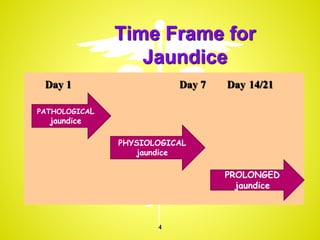
Day 1 Day 7 Day 14/21
PATHOLOGICAL
jaundice
PHYSIOLOGICAL
jaundice
PROLONGED
jaundice
Time Frame for
Jaundice
4
CLASSIFICATIONS
• Physiological
1. Appears after 24hrs
2. Maximum intensity by 3rd -5th day in term, 7th day in
preterm
3. TSB <15mg/dL (<255umol/L)
4. Not detectable clinically after 14days
5. No underlying cause
6. Disappears spontaneously
• Pathological
1. Appears within 24hrs of age
2. Serum bilirubin level increase >6mg/dl/day
3. TSB >20mg/dL(340umol/dL)
4. Conjugated/Direct bilirubin >2mg/dL(34umoLdL) 5
Pathophysiology of Physiological
Jaundice
1. Decreased erythrocyte life span (80 to 90 days) in a full
term infant
2. Increased erythrocyte volume
3. Increased bilirubin load on the hepatic cell
4. Defective uptake from plasma into liver cell – decreased
ligandin
5. Defective conjugation - relatively low activity of the
enzyme glucuronosyltransferase which normally converts
unconjugated bilirubin to conjugated bilirubin
6. Low conversion of bilirubin to urobilinogen by the
intestinal flora resulting in higher entero-hepatic
circulation
7. Decreased excretion 6
 RBC vol &  RBC survival
 Bil monoglucoronide
 Bil Diglucoronide
UCB
ProductionTransport
Uptake
Excretion
Conjugatio
n
 ineffective erythropoiesis &  haem
turnover
Non availability of
albumin binding sites
Defective conjugation
 Ligandin
Decreased
excretion
 gut motility
Poor
evacuation
 beta glucoronidase,  intestinal
bacteria
 BILIRUBIN load
Defective uptake from
plasma
 Entero-hepatic
circulation
Bilirubin Load Causing
Jaundice in Newborn
7
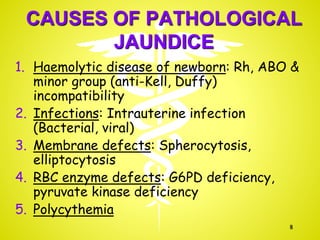
CAUSES OF PATHOLOGICAL
JAUNDICE
1. Haemolytic disease of newborn: Rh, ABO &
minor group (anti-Kell, Duffy)
incompatibility
2. Infections: Intrauterine infection
(Bacterial, viral)
3. Membrane defects: Spherocytosis,
elliptocytosis
4. RBC enzyme defects: G6PD deficiency,
pyruvate kinase deficiency
5. Polycythemia
8
NNJ & Mother’s Knowledge
• A Malaysian study found that less
than 50% of the mothers had good
knowledge & awareness about the
risks & complications of NNJ.1
9
1. Boo NY, et al. Med J Malaysia. 2011 Aug;66(3):239-243
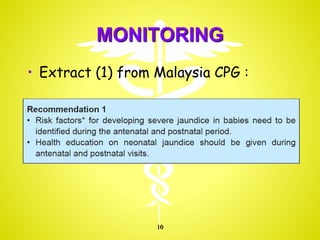
MONITORING
• Extract (1) from Malaysia CPG :
10
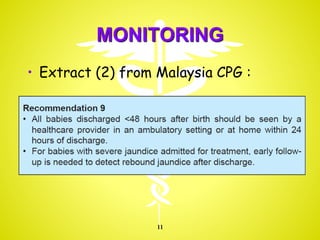
MONITORING
• Extract (2) from Malaysia CPG :
11
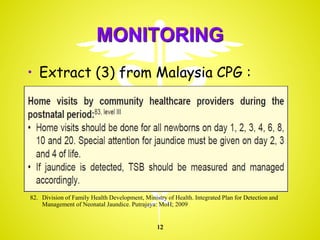
MONITORING
• Extract (3) from Malaysia CPG :
12
82. Division of Family Health Development, Ministry of Health. Integrated Plan for Detection and
Management of Neonatal Jaundice. Putrajaya: MoH; 2009
MONITORING
• Extract (4) from Malaysia CPG :
13
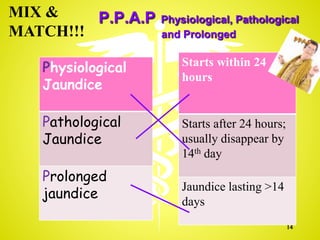
P.P.A.P Physiological, Pathological
and Prolonged
14
Physiological
Jaundice
Pathological
Jaundice
Prolonged
jaundice
Starts within 24
hours
Starts after 24 hours;
usually disappear by
14th day
Jaundice lasting >14
days
MIX &
MATCH!!!
Maybe Previous Q was too
easy…Try This Pulak.
In the development of physiological NNJ, there is:
a.decreased bilirubin load F
b.defective uptake of bilirubin from
plasma
T
c.defective conjugation T
d.increased excretion F
e.decreased entero-hepatic circulation F
15
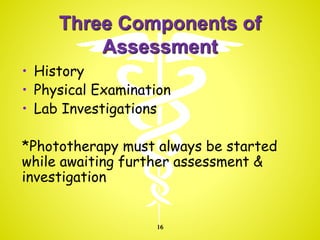
Three Components of
Assessment
• History
• Physical Examination
• Lab Investigations
*Phototherapy must always be started
while awaiting further assessment &
investigation
16
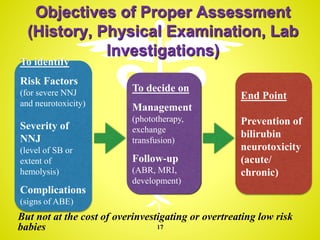
Objectives of Proper Assessment
(History, Physical Examination, Lab
Investigations)
17
End Point
Prevention of
bilirubin
neurotoxicity
(acute/
chronic)
To identify
Risk Factors
(for severe NNJ
and neurotoxicity)
Severity of
NNJ
(level of SB or
extent of
hemolysis)
Complications
(signs of ABE)
To decide on
Management
(phototherapy,
exchange
transfusion)
Follow-up
(ABR, MRI,
development)
But not at the cost of overinvestigating or overtreating low risk
babies
1. Risk Factor Identification
18
2. ASSESSMENT OF
SEVERITY
• Visual assessment
• Transcutaneous measurement
• Analysis of blood serum
19
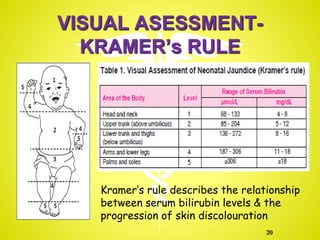
VISUAL ASESSMENT-
KRAMER’s RULE
Kramer’s rule describes the relationship
between serum bilirubin levels & the
progression of skin discolouration
20
Transcutaneous
bilirubinometer (TcB)
• The transcutaneous bilirubinometer is a hand-held
device that measures the amount of bilirubin in the
skin.
Bilicheck (Philips)
Does not require any disposable material & less time consuming
JM 103 (Draeger)
21
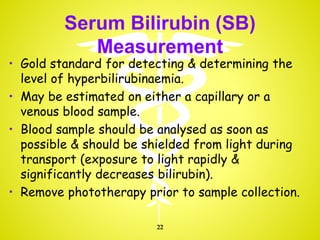
Serum Bilirubin (SB)
Measurement
• Gold standard for detecting & determining the
level of hyperbilirubinaemia.
• May be estimated on either a capillary or a
venous blood sample.
• Blood sample should be analysed as soon as
possible & should be shielded from light during
transport (exposure to light rapidly &
significantly decreases bilirubin).
• Remove phototherapy prior to sample collection.
22
CPG says…
23
3. Assessing
Complications
24
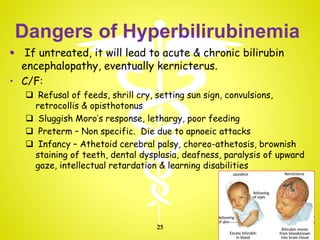
Dangers of Hyperbilirubinemia
• If untreated, it will lead to acute & chronic bilirubin
encephalopathy, eventually kernicterus.
• C/F:
 Refusal of feeds, shrill cry, setting sun sign, convulsions,
retrocollis & opisthotonus
 Sluggish Moro’s response, lethargy, poor feeding
 Preterm – Non specific. Die due to apnoeic attacks
 Infancy – Athetoid cerebral palsy, choreo-athetosis, brownish
staining of teeth, dental dysplasia, deafness, paralysis of upward
gaze, intellectual retardation & learning disabilities
25
26
Images taken from: Vinod K, et al. Bilirubin Neurotoxicity in Preterm Infants: Risk and Prevention. J
Clin Neonatol. 2013 Apr-Jun; 2(2): 61–69.
Acute Bilirubin
Encephalopathy (ABE)
• ABE: Changes of mental (behavioural)
status & muscle tone during the neonatal
period when the baby is having
hyperbilirubinaemia.
• Identifying & Monitoring of ABE:
• Term Babies: Use BIND Score
• Preterm Babies: Difficult, as signs are subtle.
Auditory Brainstem Response (ABR) could be
used.
27
BIND
Score
28
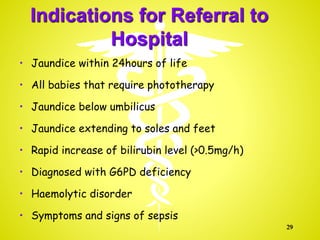
Indications for Referral to
Hospital
• Jaundice within 24hours of life
• All babies that require phototherapy
• Jaundice below umbilicus
• Jaundice extending to soles and feet
• Rapid increase of bilirubin level (>0.5mg/h)
• Diagnosed with G6PD deficiency
• Haemolytic disorder
• Symptoms and signs of sepsis
29
Investigations
• *Total serum bilirubin
• *G6PD status
• Others as indicated:
-infant’s blood group
-Maternal blood group
-Direct coombs’ test (indicated in day 1 jaundice and
severe jaundice)
-FBC, reticulocyte count, peripheral blood smear
-Blood culture, urine microscopy, and culture (infection
30
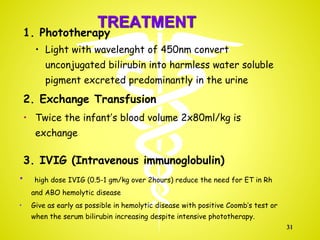
TREATMENT
1. Phototherapy
• Light with wavelenght of 450nm convert
unconjugated bilirubin into harmless water soluble
pigment excreted predominantly in the urine
2. Exchange Transfusion
• Twice the infant’s blood volume 2x80ml/kg is
exchange
3. IVIG (Intravenous immunoglobulin)
• high dose IVIG (0.5-1 gm/kg over 2hours) reduce the need for ET in Rh
and ABO hemolytic disease
• Give as early as possible in hemolytic disease with positive Coomb’s test or
when the serum bilirubin increasing despite intensive phototherapy.
31
Hmm…Final Q
• Following vessels can be utilised for
exchange transfusion, except:
A. Femoral Vein
B. Umbilical Artery
C. Umbilical Vein
D. Subclavian Vein
E. Peripheral Artery
32
Measures to Prevent Severe
Neonatal Jaundice
• Promote & support breastfeeding.
• Advise a frequency of 8 to 10 feedings per day
• Formula milk for term infants should be 1 to 2 ounce every 2 to
3 hrs in the 1st week.
• If phototherapy in infants with hemolytic jaundice is initiated
early and discontinue before infant 3-4 days old, must monitor
for rebound jaundice and adequacy of breast feeding within the
next 24-48 hours.
• Routine supplements with water or dextrose water will not help
prevent hyperbilirubinemia
33
Follow up
• All infant discharge < 48hrs after birth should be
monitor in ambulatory setting or at home
• Infants with risk factors for severe neonatal
jaundice, early follow up is a must to detect
rebound jaundice
• Infant with hemolytic diseases not requiring ET
should be closely followed up for anemia until risk
of ongoing hemolysis is minimal.
34
REFERENCES
1. Malaysia Clinical Practice Guidelines:
Management of Neonatal Jaundice, 2nd
edition, 2014.
2. Paediatric Protocol. 3rd ed: KKM,2015
3. Tom Lissauer, Illustrated TextBook of
Paediatrics, 4th ed.2012
4. Nelson essential of pediatrics.
5. http://emedicine.medscape.com/article/9
74786 35

Neonatal jaundice(reference msia cpg)

  • 1.
    NEONATAL JAUNDICE YEE WEIHOONG 121303147 31B (L1) 1
  • 2.
    DEFINITION • Jaundice isa yellowish discolouration of skin, sclerae, mucous membranes & nails from accumulation of bilirubin. • Hyperbilirubinemia refers to an excessive level of bilirubin in blood. 2
  • 3.
    Neonatal Jaundice • Oneof the most common medical conditions in newborn babies • All babies have transient rise in serum bilirubin, but only 75% are visibly jaundiced. • Jaundice is clinically detectable when serum bilirubin levels are >5mg/dL (85 umol/L) • Jaundice is more common in Asian 3
  • 4.
    Day 1 Day7 Day 14/21 PATHOLOGICAL jaundice PHYSIOLOGICAL jaundice PROLONGED jaundice Time Frame for Jaundice 4
  • 5.
    CLASSIFICATIONS • Physiological 1. Appearsafter 24hrs 2. Maximum intensity by 3rd -5th day in term, 7th day in preterm 3. TSB <15mg/dL (<255umol/L) 4. Not detectable clinically after 14days 5. No underlying cause 6. Disappears spontaneously • Pathological 1. Appears within 24hrs of age 2. Serum bilirubin level increase >6mg/dl/day 3. TSB >20mg/dL(340umol/dL) 4. Conjugated/Direct bilirubin >2mg/dL(34umoLdL) 5
  • 6.
    Pathophysiology of Physiological Jaundice 1.Decreased erythrocyte life span (80 to 90 days) in a full term infant 2. Increased erythrocyte volume 3. Increased bilirubin load on the hepatic cell 4. Defective uptake from plasma into liver cell – decreased ligandin 5. Defective conjugation - relatively low activity of the enzyme glucuronosyltransferase which normally converts unconjugated bilirubin to conjugated bilirubin 6. Low conversion of bilirubin to urobilinogen by the intestinal flora resulting in higher entero-hepatic circulation 7. Decreased excretion 6
  • 7.
     RBC vol&  RBC survival  Bil monoglucoronide  Bil Diglucoronide UCB ProductionTransport Uptake Excretion Conjugatio n  ineffective erythropoiesis &  haem turnover Non availability of albumin binding sites Defective conjugation  Ligandin Decreased excretion  gut motility Poor evacuation  beta glucoronidase,  intestinal bacteria  BILIRUBIN load Defective uptake from plasma  Entero-hepatic circulation Bilirubin Load Causing Jaundice in Newborn 7
  • 8.
    CAUSES OF PATHOLOGICAL JAUNDICE 1.Haemolytic disease of newborn: Rh, ABO & minor group (anti-Kell, Duffy) incompatibility 2. Infections: Intrauterine infection (Bacterial, viral) 3. Membrane defects: Spherocytosis, elliptocytosis 4. RBC enzyme defects: G6PD deficiency, pyruvate kinase deficiency 5. Polycythemia 8
  • 9.
    NNJ & Mother’sKnowledge • A Malaysian study found that less than 50% of the mothers had good knowledge & awareness about the risks & complications of NNJ.1 9 1. Boo NY, et al. Med J Malaysia. 2011 Aug;66(3):239-243
  • 10.
    MONITORING • Extract (1)from Malaysia CPG : 10
  • 11.
    MONITORING • Extract (2)from Malaysia CPG : 11
  • 12.
    MONITORING • Extract (3)from Malaysia CPG : 12 82. Division of Family Health Development, Ministry of Health. Integrated Plan for Detection and Management of Neonatal Jaundice. Putrajaya: MoH; 2009
  • 13.
    MONITORING • Extract (4)from Malaysia CPG : 13
  • 14.
    P.P.A.P Physiological, Pathological andProlonged 14 Physiological Jaundice Pathological Jaundice Prolonged jaundice Starts within 24 hours Starts after 24 hours; usually disappear by 14th day Jaundice lasting >14 days MIX & MATCH!!!
  • 15.
    Maybe Previous Qwas too easy…Try This Pulak. In the development of physiological NNJ, there is: a.decreased bilirubin load F b.defective uptake of bilirubin from plasma T c.defective conjugation T d.increased excretion F e.decreased entero-hepatic circulation F 15
  • 16.
    Three Components of Assessment •History • Physical Examination • Lab Investigations *Phototherapy must always be started while awaiting further assessment & investigation 16
  • 17.
    Objectives of ProperAssessment (History, Physical Examination, Lab Investigations) 17 End Point Prevention of bilirubin neurotoxicity (acute/ chronic) To identify Risk Factors (for severe NNJ and neurotoxicity) Severity of NNJ (level of SB or extent of hemolysis) Complications (signs of ABE) To decide on Management (phototherapy, exchange transfusion) Follow-up (ABR, MRI, development) But not at the cost of overinvestigating or overtreating low risk babies
  • 18.
    1. Risk FactorIdentification 18
  • 19.
    2. ASSESSMENT OF SEVERITY •Visual assessment • Transcutaneous measurement • Analysis of blood serum 19
  • 20.
    VISUAL ASESSMENT- KRAMER’s RULE Kramer’srule describes the relationship between serum bilirubin levels & the progression of skin discolouration 20
  • 21.
    Transcutaneous bilirubinometer (TcB) • Thetranscutaneous bilirubinometer is a hand-held device that measures the amount of bilirubin in the skin. Bilicheck (Philips) Does not require any disposable material & less time consuming JM 103 (Draeger) 21
  • 22.
    Serum Bilirubin (SB) Measurement •Gold standard for detecting & determining the level of hyperbilirubinaemia. • May be estimated on either a capillary or a venous blood sample. • Blood sample should be analysed as soon as possible & should be shielded from light during transport (exposure to light rapidly & significantly decreases bilirubin). • Remove phototherapy prior to sample collection. 22
  • 23.
  • 24.
  • 25.
    Dangers of Hyperbilirubinemia •If untreated, it will lead to acute & chronic bilirubin encephalopathy, eventually kernicterus. • C/F:  Refusal of feeds, shrill cry, setting sun sign, convulsions, retrocollis & opisthotonus  Sluggish Moro’s response, lethargy, poor feeding  Preterm – Non specific. Die due to apnoeic attacks  Infancy – Athetoid cerebral palsy, choreo-athetosis, brownish staining of teeth, dental dysplasia, deafness, paralysis of upward gaze, intellectual retardation & learning disabilities 25
  • 26.
    26 Images taken from:Vinod K, et al. Bilirubin Neurotoxicity in Preterm Infants: Risk and Prevention. J Clin Neonatol. 2013 Apr-Jun; 2(2): 61–69.
  • 27.
    Acute Bilirubin Encephalopathy (ABE) •ABE: Changes of mental (behavioural) status & muscle tone during the neonatal period when the baby is having hyperbilirubinaemia. • Identifying & Monitoring of ABE: • Term Babies: Use BIND Score • Preterm Babies: Difficult, as signs are subtle. Auditory Brainstem Response (ABR) could be used. 27
  • 28.
  • 29.
    Indications for Referralto Hospital • Jaundice within 24hours of life • All babies that require phototherapy • Jaundice below umbilicus • Jaundice extending to soles and feet • Rapid increase of bilirubin level (>0.5mg/h) • Diagnosed with G6PD deficiency • Haemolytic disorder • Symptoms and signs of sepsis 29
  • 30.
    Investigations • *Total serumbilirubin • *G6PD status • Others as indicated: -infant’s blood group -Maternal blood group -Direct coombs’ test (indicated in day 1 jaundice and severe jaundice) -FBC, reticulocyte count, peripheral blood smear -Blood culture, urine microscopy, and culture (infection 30
  • 31.
    TREATMENT 1. Phototherapy • Lightwith wavelenght of 450nm convert unconjugated bilirubin into harmless water soluble pigment excreted predominantly in the urine 2. Exchange Transfusion • Twice the infant’s blood volume 2x80ml/kg is exchange 3. IVIG (Intravenous immunoglobulin) • high dose IVIG (0.5-1 gm/kg over 2hours) reduce the need for ET in Rh and ABO hemolytic disease • Give as early as possible in hemolytic disease with positive Coomb’s test or when the serum bilirubin increasing despite intensive phototherapy. 31
  • 32.
    Hmm…Final Q • Followingvessels can be utilised for exchange transfusion, except: A. Femoral Vein B. Umbilical Artery C. Umbilical Vein D. Subclavian Vein E. Peripheral Artery 32
  • 33.
    Measures to PreventSevere Neonatal Jaundice • Promote & support breastfeeding. • Advise a frequency of 8 to 10 feedings per day • Formula milk for term infants should be 1 to 2 ounce every 2 to 3 hrs in the 1st week. • If phototherapy in infants with hemolytic jaundice is initiated early and discontinue before infant 3-4 days old, must monitor for rebound jaundice and adequacy of breast feeding within the next 24-48 hours. • Routine supplements with water or dextrose water will not help prevent hyperbilirubinemia 33
  • 34.
    Follow up • Allinfant discharge < 48hrs after birth should be monitor in ambulatory setting or at home • Infants with risk factors for severe neonatal jaundice, early follow up is a must to detect rebound jaundice • Infant with hemolytic diseases not requiring ET should be closely followed up for anemia until risk of ongoing hemolysis is minimal. 34
  • 35.
    REFERENCES 1. Malaysia ClinicalPractice Guidelines: Management of Neonatal Jaundice, 2nd edition, 2014. 2. Paediatric Protocol. 3rd ed: KKM,2015 3. Tom Lissauer, Illustrated TextBook of Paediatrics, 4th ed.2012 4. Nelson essential of pediatrics. 5. http://emedicine.medscape.com/article/9 74786 35