DR JALO I
NEONATAL JAUNDICE
DEFINITION
 Yellowish discoloration of the sclera of the eyes
and mucous membranes
 It is due to increased levels of serum bilirubin
 Bilirubin is derived mainly from breakdown of
haemoglobin
ETIOLOGY
 Increase load of bilirubin to be metabolized
 Damage or reduction in the activity of transferase
enzyme
 Competition for or blockage of the transferase
enzyme
 Reduction of bilirubin uptake by the liver
 Insufficient bilirubin excretion
 Increased enterohepatic circulation
BILIRUBIN PRODUCTION
 Bilirubin is the end product of catabolism of
heam, derived principally from circulating
haemoglobin
 1gm of haemoglobin gives 35g of bilirubin
 About 75% of bilirubin is derived from catabolism
of haemoglobin
 About 25% of bilirubin is derived from tissue
haemoproteins . (Cytochromes catalases)
CONVERSION OF HAEM TO
BILIRUBIN
BILIRUBIN METABOLISM
HEAM......haem oxygenase...........BILIVERDIN
BILIVERDIN....biliver reductase.......BILIRUBIN
BILIRUBIN......ligadin (Y)..........SERUM.......LIVER
UNCONJ.......glu transferase.....CONJ BILIRUBIN
UNCONJUGATED
HYPERBILIRUBINEMIA
(HEAMOLYSIS)
 Blood group incompatibilities( ABO, Rhesus)
 Deficiency of red cell enzymes (G6PD, Hexokinase,
pyruvate kinase)
 Congenital red cell membrane defects
(eliptocytosis,spherocytosis)
 Infections – Neonatal septicaemia
 Haemolytic agents (Naphthalene, Menepthone)
 Extravasated blood (cephalhaematoma , IVH)
UNCONJUGATED
HYPERBILIRUBINEMIA
(DEFECTIVE CONJUGATION)
 Crigler Najjar syndrome
 Breast milk jaundice
 Familial neonatal hyperbilirubinemia
 Hypothyroidism
UNCONJUGATED
HYPERBILIRUBINEMIA- OTHERS
 Down’s syndrome
 Infants of diabetic mothers
 prematurity
CAUSES OF CONJUGATED
HYPERBILIRUBINEMIA
 INFECTION
 Toxoplasmosis, CMV, Hepatitis B, Rubella
 Giant cell hepatitis
 BIOCHEMICAL/METABOLIC
 Galactosemia, alfa-1-antitripsin deficiency, Roto’s & Dubin
Johnson syndrome
 Hypothyroidism, tyrosinosis
 CONGENITAL OBLITERATION
 Congenital biliary atresia, Choledochal cyst, Bile duct stenosis
 Inspissated bile duct syndrome
 OTHERS
 Hypoxia, shock and TPN
PHYSIOLOGIC JAUNDICE
 This usually appears 2-3rd day of life
 Peaks to 5-6mg/dl on 4th day
 Bilirubin levels not more than 12mg/dl
 Returns to below 2mg/dl on the 7- 10th day
 It is a diagnosis of exclusion
BREAST FEEDING
JAUNDICE
Early unconjugated hyperbilirubinemia.
• Believed to be due to decreased PO
• Onset 2-4 days; peaks at 3-6 days (>12.0)
• Returns to < 3.0 at greater than 3 weeks
• Prevalence is ~ 12% in BF infants
BREAST FEEDING
JANDICE (CONT)
• Is it good for infants?? Bilirubin
is antioxidant.
• No evidence of increased BR
production in BF infants
• BF infants receive fewer
calories in first few days vs.
formula
BREAST MILK JAUNDICE
• Late unconjugated
hyperbilirubinemia
• Onset 4-7 days; peak 5-15 days (>
10.0)
• Returns to < 3.0 at greater than 9
weeks
• Prevalence is 2-4% of BF infants
Breast Milk Jaundice
Possible Etiologies:
–Inhibition of hepatic excretion
• factors in milk? Pregnanediol, FAs, lipase
–Intestinal Readsorption
• Delayed passage of meconium
• Sterile GI: no conversion to urobilinogen
• -glucuronidase: “unconjugates” BR
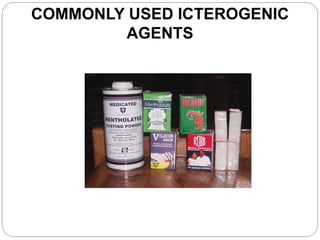
COMMONLY USED ICTEROGENIC
AGENTS
PATHOLOGICAL JAUNDICE
 Jaundice appearing in the first 24hrs of life
 Total serum bilirubin >12mg/dl
 Serum bilirubin increasing by >0.5mg/dl/hr
 Serum bilirubin increasing by >5mg/dl/day
 Conjugated bilirubin >2mg/dl
 Clinical jaundice persisting for more than 2 weeks
 Presence of evidence of haemolysis
CLINICAL FEATURES
 Jaundice may appear any time during neonatal period
 Jaundice begins on the face and as the level
increases, progress to the abdomen and feet
 Unconjugated bilirubin appears bright yellow or
orange
 Conjugated bilirubin appears greenish or muddy
yellow
 Infants usually lethargic and feed poorly
 Signs of primary disease.(sepsis, galactosemia etc)
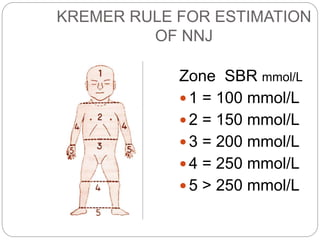
KREMER RULE FOR ESTIMATION
OF NNJ
Zone SBR mmol/L
 1 = 100 mmol/L
 2 = 150 mmol/L
 3 = 200 mmol/L
 4 = 250 mmol/L
 5 > 250 mmol/L
KERNICTERUS- BILIRUBIN
ENCEPALOPATHY
 Unbound bilirubin crosses the blood brain barrier and
causes toxic damage to brain cells of the basal
ganglia,hippocampus, substantia nigra, geniculate
body and cranial nerve nuclei.
 It is not known at what serum bilirubin concentration
or under what circumstance significant brain damage
occurs
 1/3 of infants with HD and bilirubin >25-30 will
develop acute bilirubin encephalopathy
 At autopsy 2 1% of hyperbirubinemic preterm babies
have bilirubin encephalopathy
STAGE I
• Lethargy
• Hypotonia
• Irritability
• Poor Moro reflex
• Poor oral intake
• High pitched cry
• Emesis
STAGE II
 Hypertonia arching
 Opisthotonic posturing
 High pitched cry
 Convulsions
STAGE III
 Evolves over several weeks or months
 Present with varying degrees of dystonia
 Choreoarthetoid cerebral palsy
 Mental retardation
 Auditory abnormalities, gauze palsies
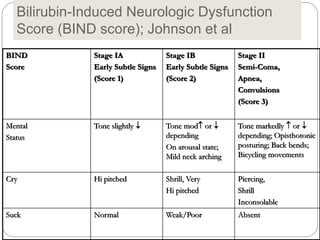
Bilirubin-Induced Neurologic Dysfunction
Score (BIND score); Johnson et al
BIND
Score
Stage IA
Early Subtle Signs
(Score 1)
Stage IB
Early Subtle Signs
(Score 2)
Stage II
Semi-Coma,
Apnea,
Convulsions
(Score 3)
Mental
Status
Tone slightly  Tone mod or 
depending
On arousal state;
Mild neck arching
Tone markedly  or 
depending; Opisthotonic
posturing; Back bends;
Bicycling movements
Cry Hi pitched Shrill, Very
Hi pitched
Piercing,
Shrill
Inconsolable
Suck Normal Weak/Poor Absent
Laboratory Evaluation of Neonatal
Hypybilirubinaemia
Urine Tests:
• Routine urinalysis, (including
protein and reducing substances)
• Urine culture
• Bilirubin and urobilinogen
• Amino acid screening
Laboratory Workup (contd.)
• Reticulocyte count
• RBC morphology
• Platelets count; clotting test
• White blood cell count
• Erythrocyte sedimentation rate
• Serology (specific IgM antibodies - TORCHES)
• Carboxyhaemoglobin level
• Hepatitis-associated antigens
• Alpha1-anti-trypsin concentration
Treatment of Unconjugated
Hyperbilirubinaemia
 Observation/monitoring
• Increase fluids/oral intake
• Phototherapy
• Exchange blood transfusion
• Phenobarbitone
• Antibiotics for suspected sepsis
• Supportive therapy
PHOTOTHERPY – INDICATION
 Prevention of hyperbilirubinaemia in preterm
babies (VLBW)
 Treatment of moderate hyperbilirubinemia
 Post EBT
Factors Affecting Efficacy of
phototherapy
 The spectrum of light delivered by the phototherapy
unit. Because of the optical properties of bilirubin
and skin, the most effective wavelengths are in the
blue-green spectrum
 The power output of the phototherapy light and flux
of light energy incident on the infant, expressed as
irradiance (watts per square meter). When measured
over a specific portion of the spectrum (e.g, the blue
spectrum, approximately 425 to 475 nm), it is called
the spectral irradiance and is measured in
µW/cm2/nm
 The surface area of the infant exposed to
phototherapy.
Standard/Intensive
Phototherapy
The overhead standard phototherapy unit,
delivered only 9 to 10 μW/cm2 per nanometer
- the bilirubin level decreased by only 6% (1
mg/dl)/24 hours
While intensive phototherapy produced an
irradiance of 35 μW/cm2 per nanometer -
produced an average decline of 43% (7.4
mg/dL) in 24 hours (from about 17 to 10
mg/dL)
Intensive/Therapeutic
Phototherapy
‘Intensive phototherapy’ is defined
as irradiance of 30 µW/cm2/nm or
higher in the 430- to 490-nm band
delivered to as much of the
infant’s surface area as possible.
PHOTOTHERAPY –
COMPLICATIONS
 Increased fluid lost with risk of dehydration
 Damage to the retina and gonads
 Skin damage – rashes, bronze baby syndrome
 Increase incidence of PDA
 Loose stools
PHARMACOTHERAPY
 Augments uptake of bilirubin by hepatic cells
 It increases the activity of UDPG-T enzyme
 Use of tin-mesoporphyrin to inhibit the production
of haeme oxygenase has shown some promise
but not yet in routine clinical use.
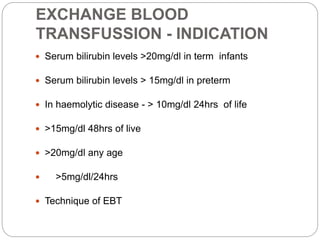
EXCHANGE BLOOD
TRANSFUSSION - INDICATION
 Serum bilirubin levels >20mg/dl in term infants
 Serum bilirubin levels > 15mg/dl in preterm
 In haemolytic disease - > 10mg/dl 24hrs of life
 >15mg/dl 48hrs of live
 >20mg/dl any age
 >5mg/dl/24hrs
 Technique of EBT
COMPLICATIONS OF EBT
 Catheter: gut perforation, cardiac arrythymias, NEC and liver cirrhosis
 Infection: HIV, Hepatitis, malaria
 Transfusion reactions
 Embolism
 Haemodynamic: hypo hyper vol
 Metabolic: Hypocalcaemia, hypoglycaemia, hypomagnesemia,
acid/base
imbalance
 hypothermia
THANK
YOU
FOR
LISTENING

1._NEONATAL_JAUNDICE.pptx

  • 1.
  • 2.
    DEFINITION  Yellowish discolorationof the sclera of the eyes and mucous membranes  It is due to increased levels of serum bilirubin  Bilirubin is derived mainly from breakdown of haemoglobin
  • 3.
    ETIOLOGY  Increase loadof bilirubin to be metabolized  Damage or reduction in the activity of transferase enzyme  Competition for or blockage of the transferase enzyme  Reduction of bilirubin uptake by the liver  Insufficient bilirubin excretion  Increased enterohepatic circulation
  • 4.
    BILIRUBIN PRODUCTION  Bilirubinis the end product of catabolism of heam, derived principally from circulating haemoglobin  1gm of haemoglobin gives 35g of bilirubin  About 75% of bilirubin is derived from catabolism of haemoglobin  About 25% of bilirubin is derived from tissue haemoproteins . (Cytochromes catalases)
  • 5.
    CONVERSION OF HAEMTO BILIRUBIN
  • 6.
    BILIRUBIN METABOLISM HEAM......haem oxygenase...........BILIVERDIN BILIVERDIN....biliverreductase.......BILIRUBIN BILIRUBIN......ligadin (Y)..........SERUM.......LIVER UNCONJ.......glu transferase.....CONJ BILIRUBIN
  • 7.
    UNCONJUGATED HYPERBILIRUBINEMIA (HEAMOLYSIS)  Blood groupincompatibilities( ABO, Rhesus)  Deficiency of red cell enzymes (G6PD, Hexokinase, pyruvate kinase)  Congenital red cell membrane defects (eliptocytosis,spherocytosis)  Infections – Neonatal septicaemia  Haemolytic agents (Naphthalene, Menepthone)  Extravasated blood (cephalhaematoma , IVH)
  • 8.
    UNCONJUGATED HYPERBILIRUBINEMIA (DEFECTIVE CONJUGATION)  CriglerNajjar syndrome  Breast milk jaundice  Familial neonatal hyperbilirubinemia  Hypothyroidism
  • 9.
    UNCONJUGATED HYPERBILIRUBINEMIA- OTHERS  Down’ssyndrome  Infants of diabetic mothers  prematurity
  • 10.
    CAUSES OF CONJUGATED HYPERBILIRUBINEMIA INFECTION  Toxoplasmosis, CMV, Hepatitis B, Rubella  Giant cell hepatitis  BIOCHEMICAL/METABOLIC  Galactosemia, alfa-1-antitripsin deficiency, Roto’s & Dubin Johnson syndrome  Hypothyroidism, tyrosinosis  CONGENITAL OBLITERATION  Congenital biliary atresia, Choledochal cyst, Bile duct stenosis  Inspissated bile duct syndrome  OTHERS  Hypoxia, shock and TPN
  • 11.
    PHYSIOLOGIC JAUNDICE  Thisusually appears 2-3rd day of life  Peaks to 5-6mg/dl on 4th day  Bilirubin levels not more than 12mg/dl  Returns to below 2mg/dl on the 7- 10th day  It is a diagnosis of exclusion
  • 12.
    BREAST FEEDING JAUNDICE Early unconjugatedhyperbilirubinemia. • Believed to be due to decreased PO • Onset 2-4 days; peaks at 3-6 days (>12.0) • Returns to < 3.0 at greater than 3 weeks • Prevalence is ~ 12% in BF infants
  • 13.
    BREAST FEEDING JANDICE (CONT) •Is it good for infants?? Bilirubin is antioxidant. • No evidence of increased BR production in BF infants • BF infants receive fewer calories in first few days vs. formula
  • 14.
    BREAST MILK JAUNDICE •Late unconjugated hyperbilirubinemia • Onset 4-7 days; peak 5-15 days (> 10.0) • Returns to < 3.0 at greater than 9 weeks • Prevalence is 2-4% of BF infants
  • 15.
    Breast Milk Jaundice PossibleEtiologies: –Inhibition of hepatic excretion • factors in milk? Pregnanediol, FAs, lipase –Intestinal Readsorption • Delayed passage of meconium • Sterile GI: no conversion to urobilinogen • -glucuronidase: “unconjugates” BR
  • 16.
  • 17.
    PATHOLOGICAL JAUNDICE  Jaundiceappearing in the first 24hrs of life  Total serum bilirubin >12mg/dl  Serum bilirubin increasing by >0.5mg/dl/hr  Serum bilirubin increasing by >5mg/dl/day  Conjugated bilirubin >2mg/dl  Clinical jaundice persisting for more than 2 weeks  Presence of evidence of haemolysis
  • 18.
    CLINICAL FEATURES  Jaundicemay appear any time during neonatal period  Jaundice begins on the face and as the level increases, progress to the abdomen and feet  Unconjugated bilirubin appears bright yellow or orange  Conjugated bilirubin appears greenish or muddy yellow  Infants usually lethargic and feed poorly  Signs of primary disease.(sepsis, galactosemia etc)
  • 19.
    KREMER RULE FORESTIMATION OF NNJ Zone SBR mmol/L  1 = 100 mmol/L  2 = 150 mmol/L  3 = 200 mmol/L  4 = 250 mmol/L  5 > 250 mmol/L
  • 20.
    KERNICTERUS- BILIRUBIN ENCEPALOPATHY  Unboundbilirubin crosses the blood brain barrier and causes toxic damage to brain cells of the basal ganglia,hippocampus, substantia nigra, geniculate body and cranial nerve nuclei.  It is not known at what serum bilirubin concentration or under what circumstance significant brain damage occurs  1/3 of infants with HD and bilirubin >25-30 will develop acute bilirubin encephalopathy  At autopsy 2 1% of hyperbirubinemic preterm babies have bilirubin encephalopathy
  • 21.
    STAGE I • Lethargy •Hypotonia • Irritability • Poor Moro reflex • Poor oral intake • High pitched cry • Emesis
  • 22.
    STAGE II  Hypertoniaarching  Opisthotonic posturing  High pitched cry  Convulsions
  • 23.
    STAGE III  Evolvesover several weeks or months  Present with varying degrees of dystonia  Choreoarthetoid cerebral palsy  Mental retardation  Auditory abnormalities, gauze palsies
  • 24.
    Bilirubin-Induced Neurologic Dysfunction Score(BIND score); Johnson et al BIND Score Stage IA Early Subtle Signs (Score 1) Stage IB Early Subtle Signs (Score 2) Stage II Semi-Coma, Apnea, Convulsions (Score 3) Mental Status Tone slightly  Tone mod or  depending On arousal state; Mild neck arching Tone markedly  or  depending; Opisthotonic posturing; Back bends; Bicycling movements Cry Hi pitched Shrill, Very Hi pitched Piercing, Shrill Inconsolable Suck Normal Weak/Poor Absent
  • 25.
    Laboratory Evaluation ofNeonatal Hypybilirubinaemia Urine Tests: • Routine urinalysis, (including protein and reducing substances) • Urine culture • Bilirubin and urobilinogen • Amino acid screening
  • 26.
    Laboratory Workup (contd.) •Reticulocyte count • RBC morphology • Platelets count; clotting test • White blood cell count • Erythrocyte sedimentation rate • Serology (specific IgM antibodies - TORCHES) • Carboxyhaemoglobin level • Hepatitis-associated antigens • Alpha1-anti-trypsin concentration
  • 27.
    Treatment of Unconjugated Hyperbilirubinaemia Observation/monitoring • Increase fluids/oral intake • Phototherapy • Exchange blood transfusion • Phenobarbitone • Antibiotics for suspected sepsis • Supportive therapy
  • 28.
    PHOTOTHERPY – INDICATION Prevention of hyperbilirubinaemia in preterm babies (VLBW)  Treatment of moderate hyperbilirubinemia  Post EBT
  • 29.
    Factors Affecting Efficacyof phototherapy  The spectrum of light delivered by the phototherapy unit. Because of the optical properties of bilirubin and skin, the most effective wavelengths are in the blue-green spectrum  The power output of the phototherapy light and flux of light energy incident on the infant, expressed as irradiance (watts per square meter). When measured over a specific portion of the spectrum (e.g, the blue spectrum, approximately 425 to 475 nm), it is called the spectral irradiance and is measured in µW/cm2/nm  The surface area of the infant exposed to phototherapy.
  • 30.
    Standard/Intensive Phototherapy The overhead standardphototherapy unit, delivered only 9 to 10 μW/cm2 per nanometer - the bilirubin level decreased by only 6% (1 mg/dl)/24 hours While intensive phototherapy produced an irradiance of 35 μW/cm2 per nanometer - produced an average decline of 43% (7.4 mg/dL) in 24 hours (from about 17 to 10 mg/dL)
  • 31.
    Intensive/Therapeutic Phototherapy ‘Intensive phototherapy’ isdefined as irradiance of 30 µW/cm2/nm or higher in the 430- to 490-nm band delivered to as much of the infant’s surface area as possible.
  • 32.
    PHOTOTHERAPY – COMPLICATIONS  Increasedfluid lost with risk of dehydration  Damage to the retina and gonads  Skin damage – rashes, bronze baby syndrome  Increase incidence of PDA  Loose stools
  • 33.
    PHARMACOTHERAPY  Augments uptakeof bilirubin by hepatic cells  It increases the activity of UDPG-T enzyme  Use of tin-mesoporphyrin to inhibit the production of haeme oxygenase has shown some promise but not yet in routine clinical use.
  • 34.
    EXCHANGE BLOOD TRANSFUSSION -INDICATION  Serum bilirubin levels >20mg/dl in term infants  Serum bilirubin levels > 15mg/dl in preterm  In haemolytic disease - > 10mg/dl 24hrs of life  >15mg/dl 48hrs of live  >20mg/dl any age  >5mg/dl/24hrs  Technique of EBT
  • 35.
    COMPLICATIONS OF EBT Catheter: gut perforation, cardiac arrythymias, NEC and liver cirrhosis  Infection: HIV, Hepatitis, malaria  Transfusion reactions  Embolism  Haemodynamic: hypo hyper vol  Metabolic: Hypocalcaemia, hypoglycaemia, hypomagnesemia, acid/base imbalance  hypothermia
  • 36.

Editor's Notes

  • #30 Irradiance depends not only on the power of the light, but also on the distance of the light from the infant.