Neonatal Jaundice
BY,
阿迪斯
2019-04
Definition
1
Etiology
2
Pathophysiology
3
Clinical features
4
2
Management
5
CONTENTS
Definition
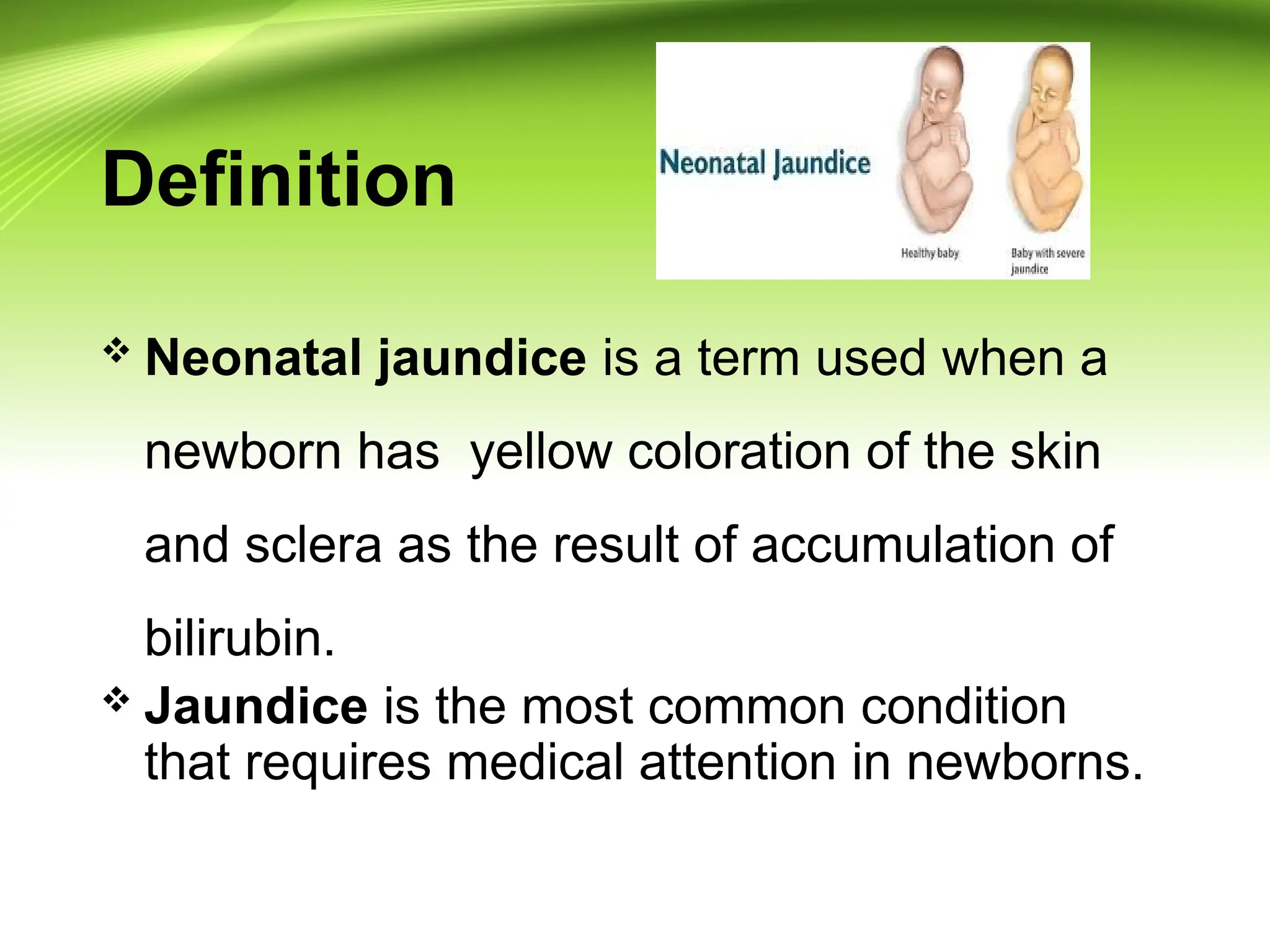
 Neonatal jaundice is a term used when a
newborn has yellow coloration of the skin
and sclera as the result of accumulation of
bilirubin.
 Jaundice is the most common condition
that requires medical attention in newborns.
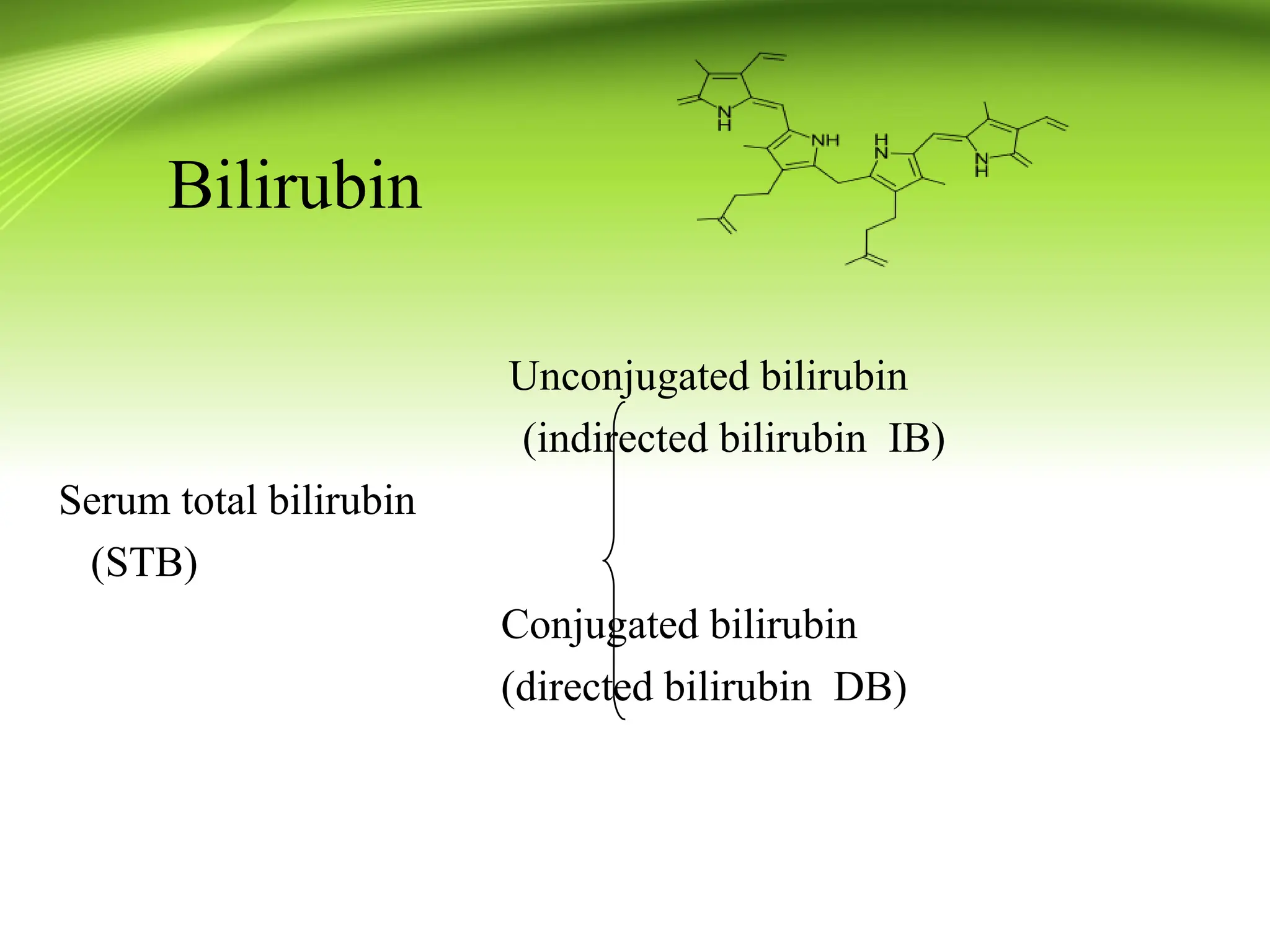
Bilirubin
Unconjugated bilirubin
(indirected bilirubin IB)
Serum total bilirubin
(STB)
Conjugated bilirubin
(directed bilirubin DB)
Bilirubin
● unconjugated bilirubin
lipid-soluble,
can cross the blood-brain barrier,
neurotoxic,
● conjugated bilirubin
water-soluble,
no directly toxic to brain in neonatal,
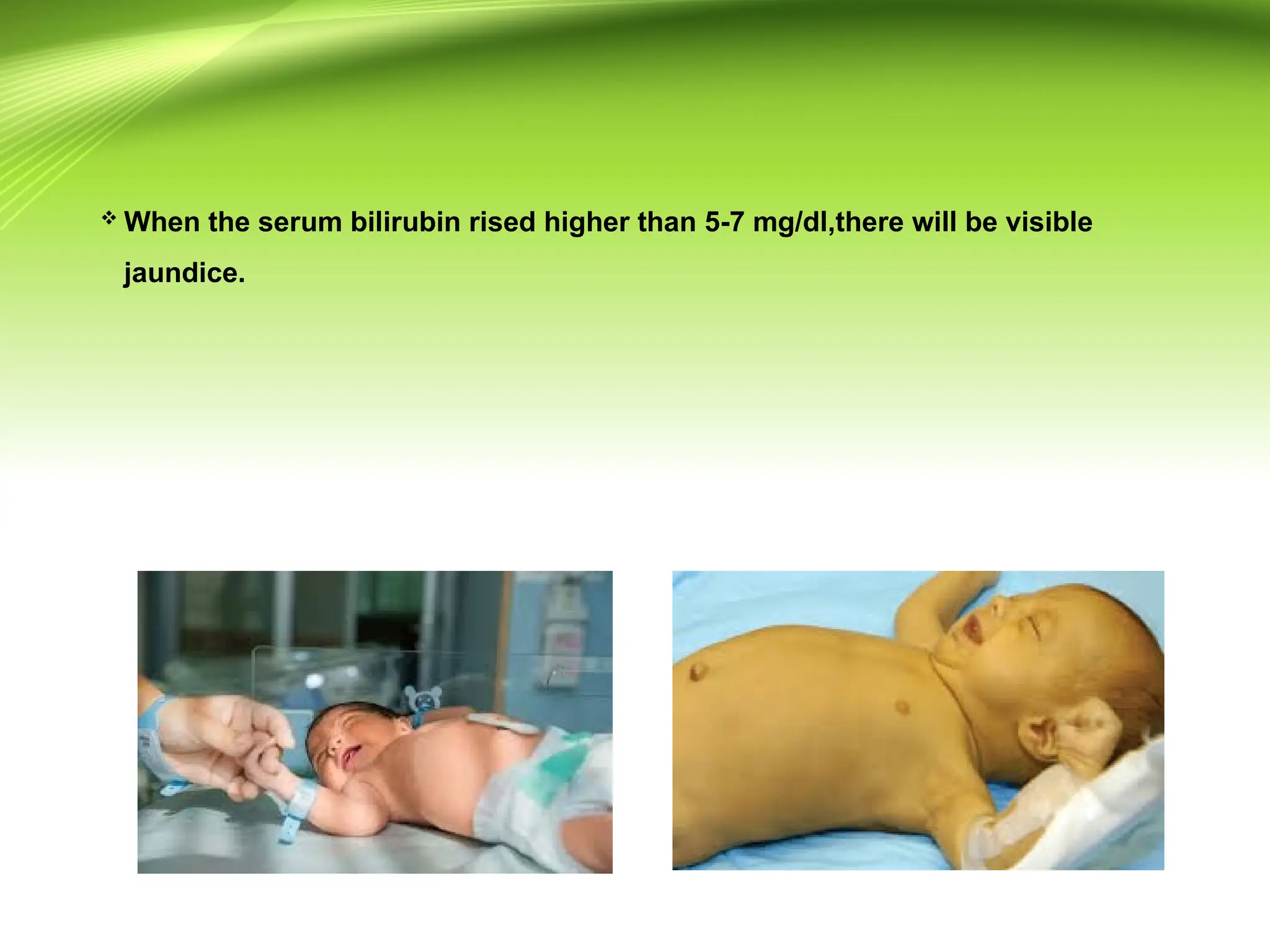
 When the serum bilirubin rised higher than 5-7 mg/dl,there will be visible
jaundice.
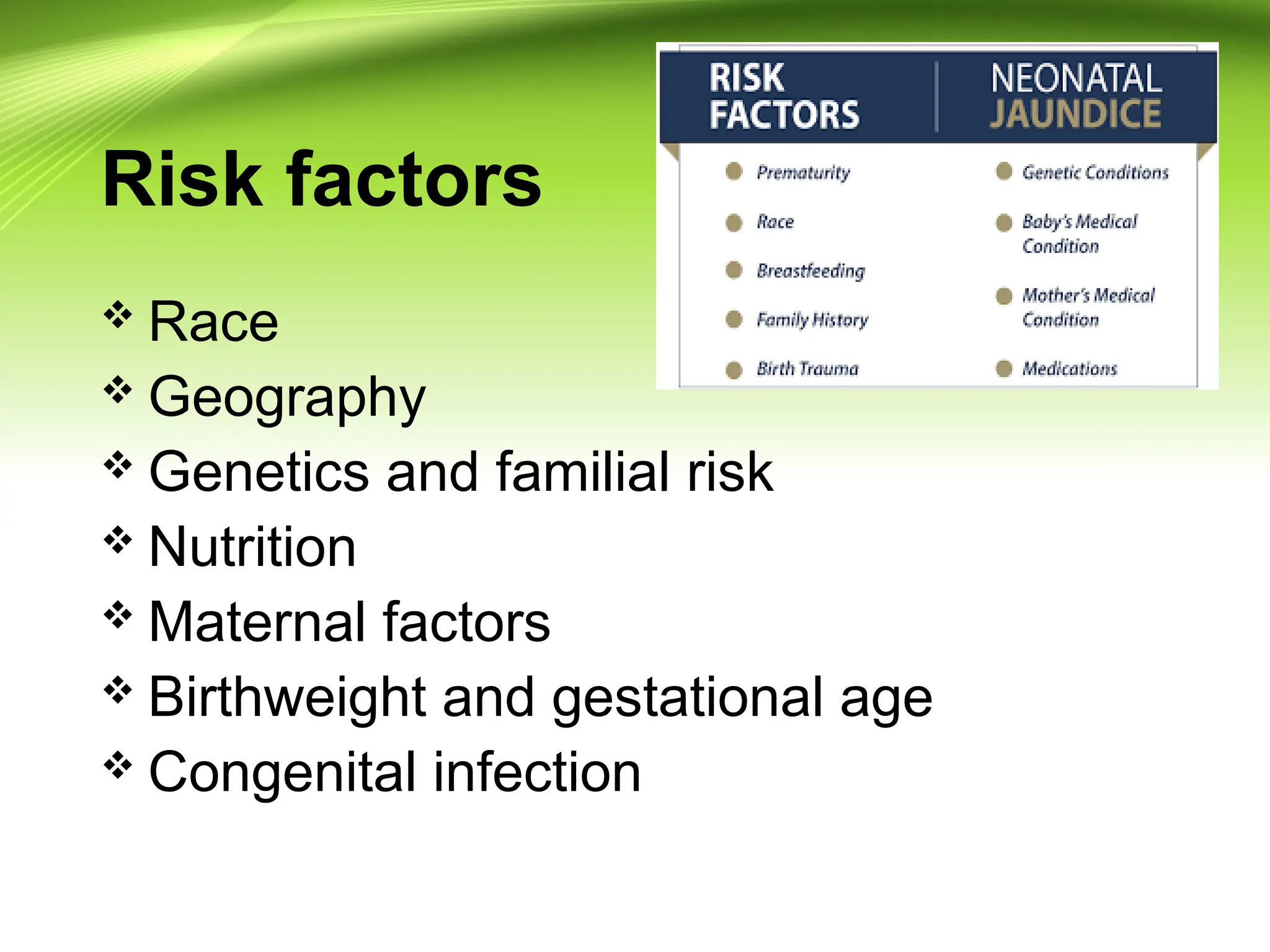
Risk factors
 Race
 Geography
 Genetics and familial risk
 Nutrition
 Maternal factors
 Birthweight and gestational age
 Congenital infection
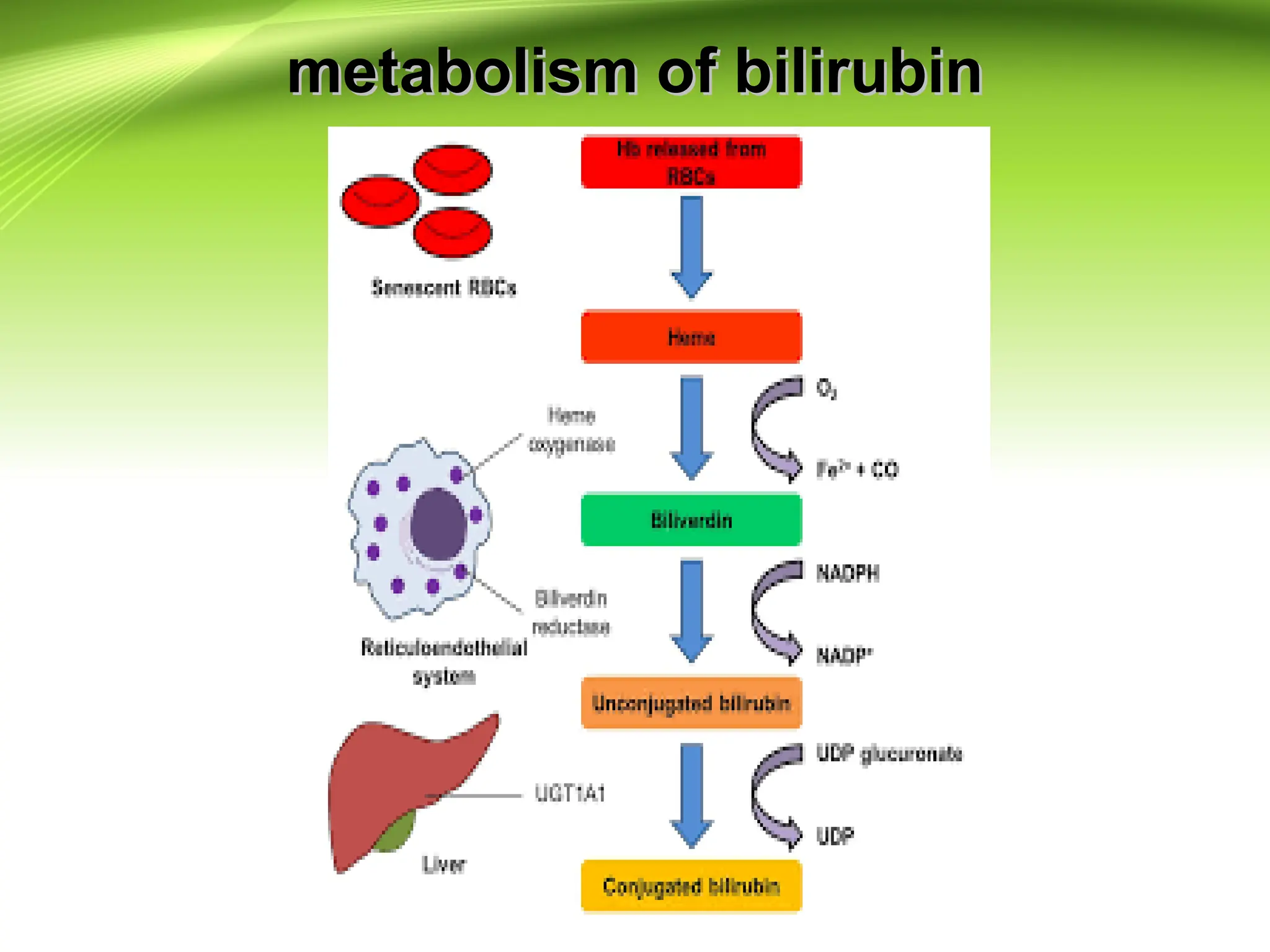
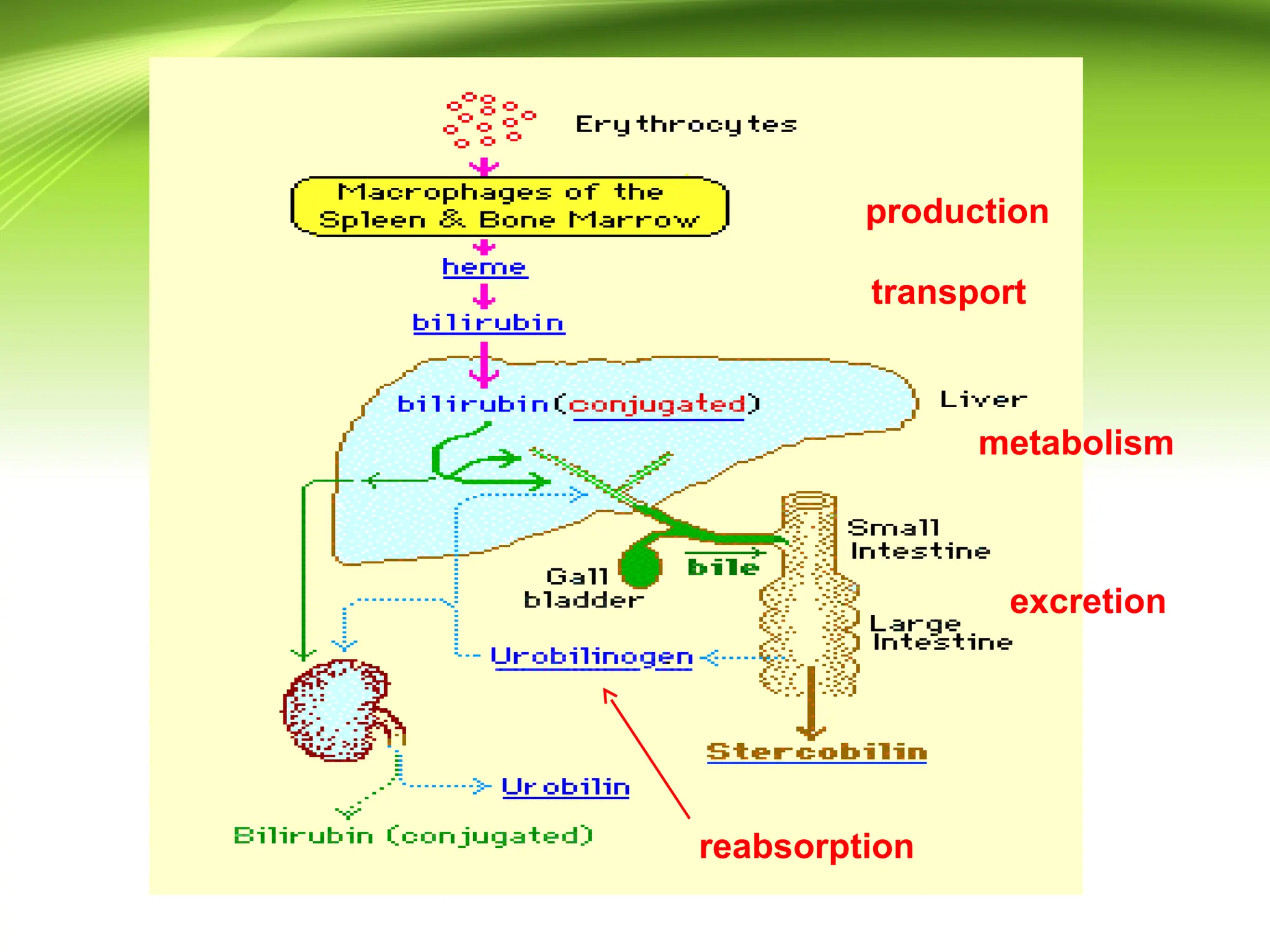
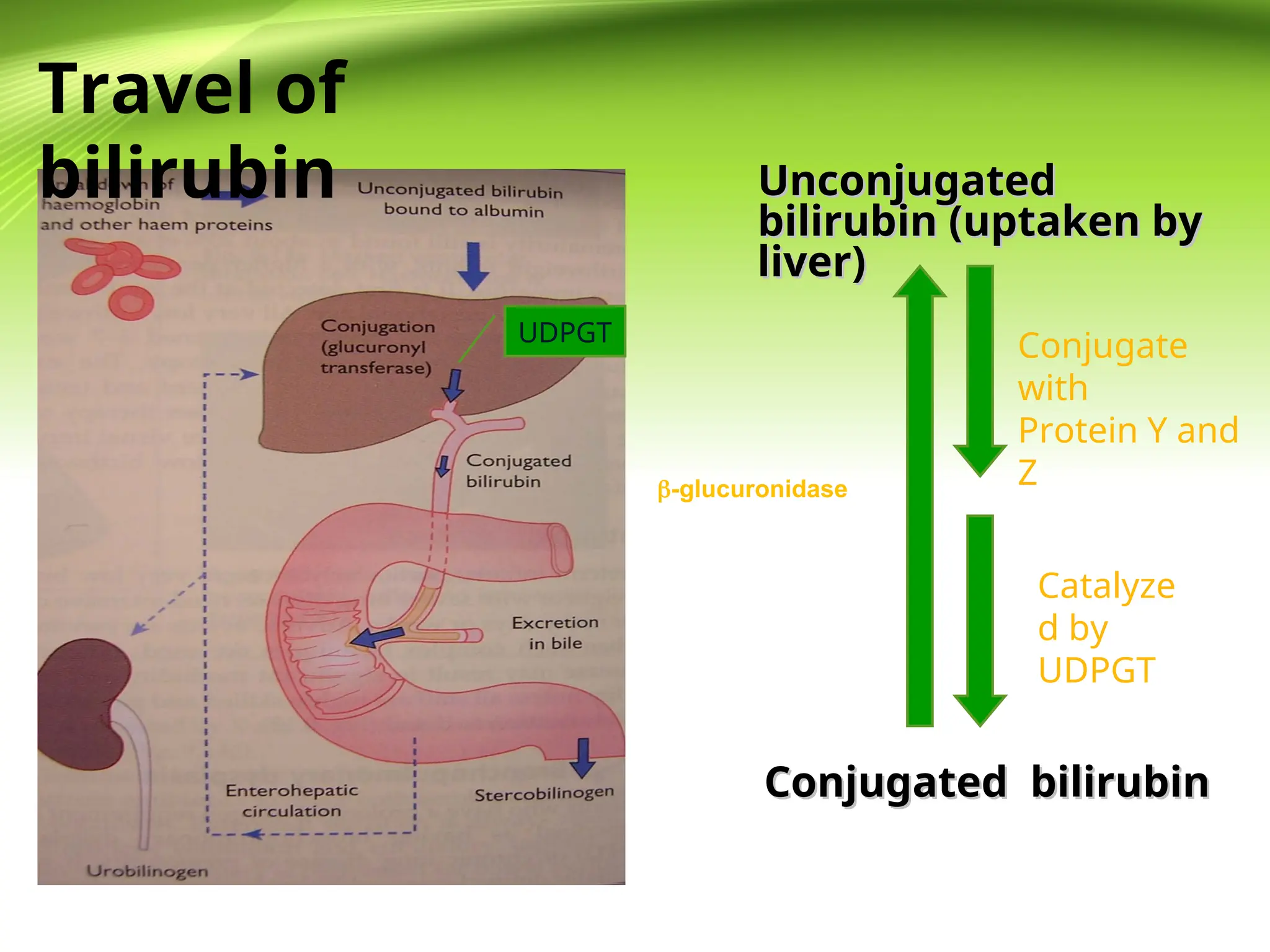
metabolism of bilirubin
Increased enterohepatic
Circulation
production
transport
metabolism
excretion
reabsorption
Unconjugated
Unconjugated
bilirubin (uptaken by
liver)
liver)
Conjugated bilirubin
Conjugate
with
Protein Y and
Z
Catalyze
d by
UDPGT
UDPGT
Travel of
bilirubin
-glucuronidase
Mechanism of Neonatal Jaundice
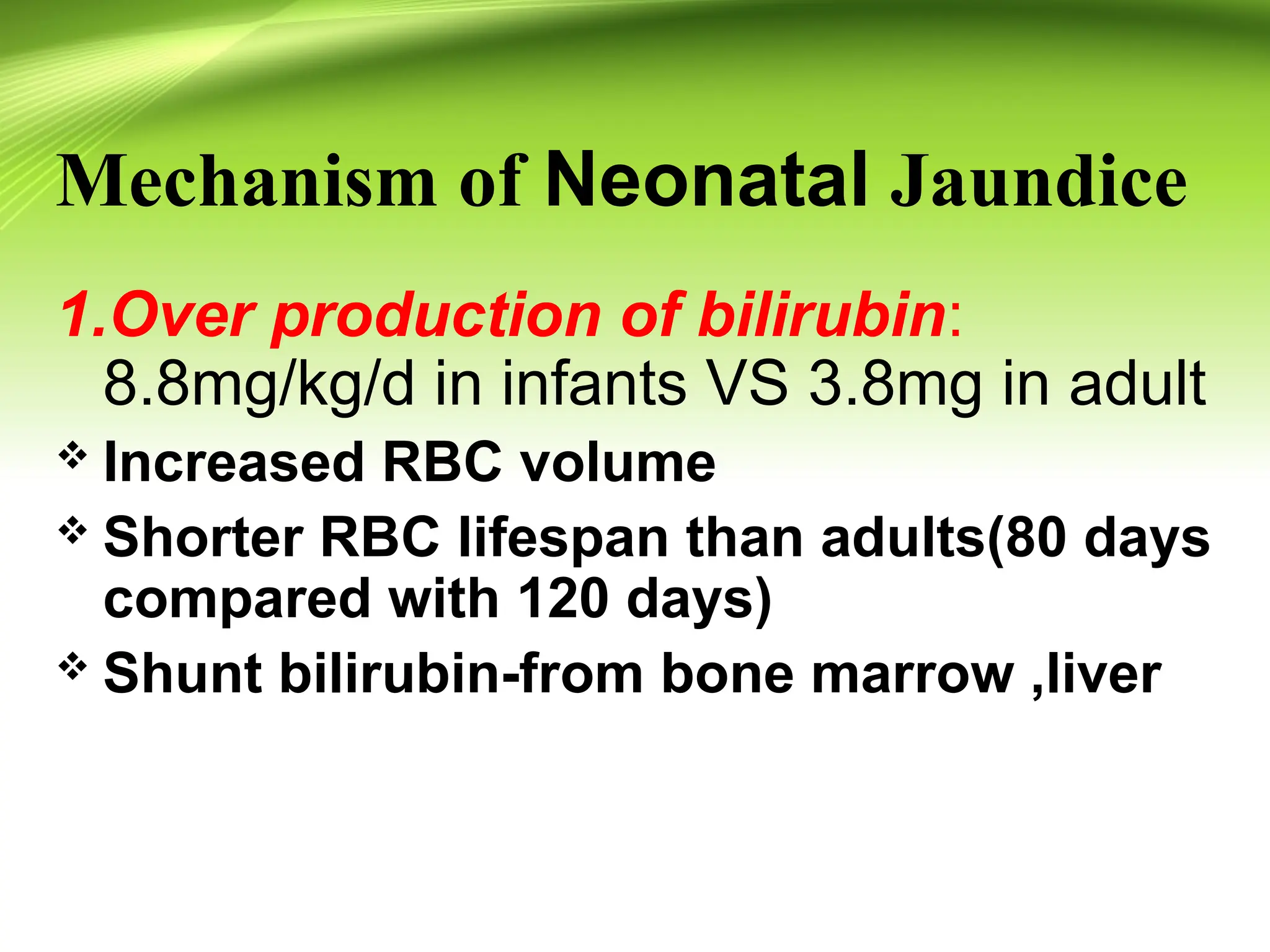
1.Over production of bilirubin:
8.8mg/kg/d in infants VS 3.8mg in adult
 Increased RBC volume
 Shorter RBC lifespan than adults(80 days
compared with 120 days)
 Shunt bilirubin-from bone marrow ,liver
Mechanism of Neonatal Jaundice
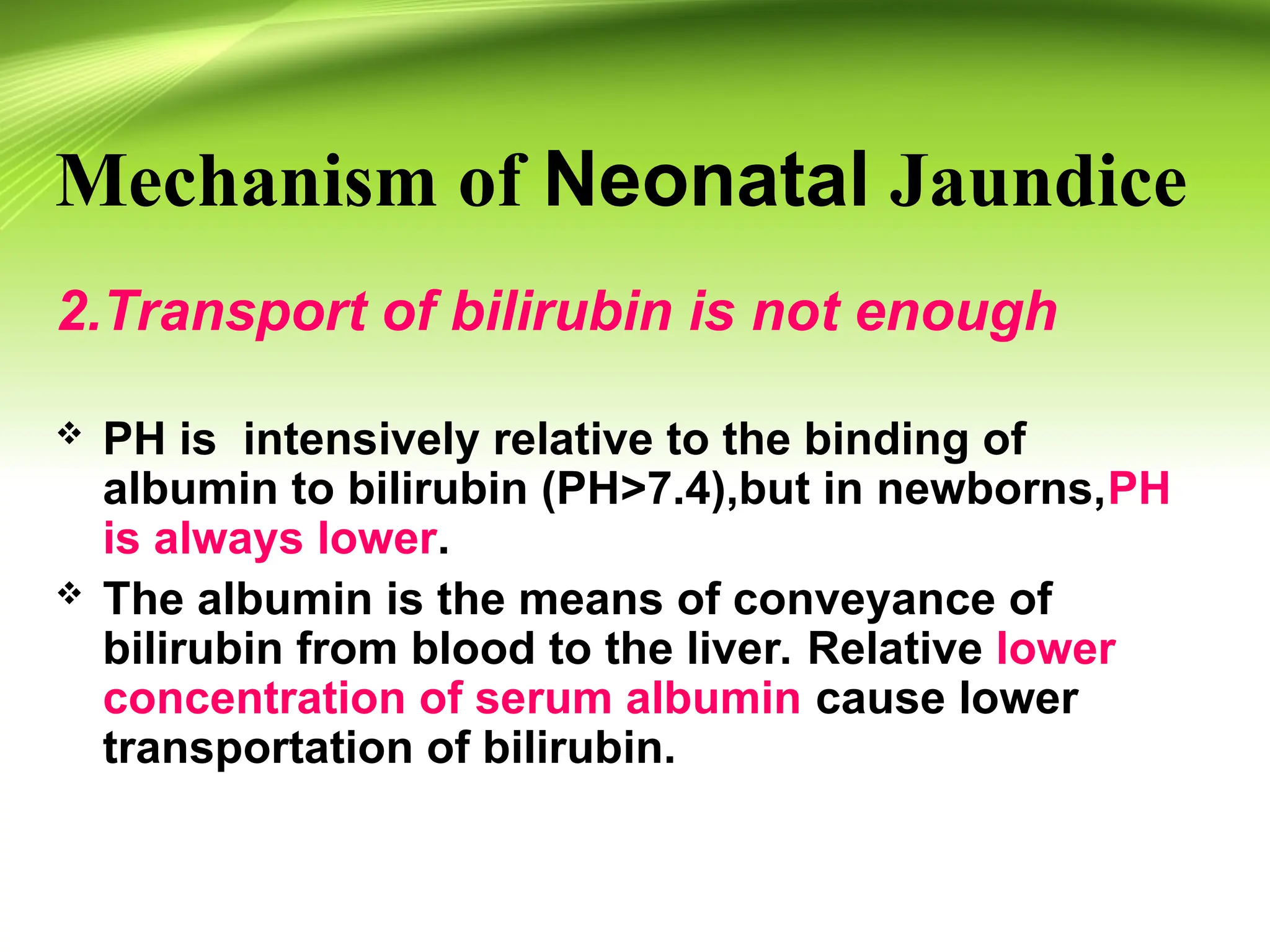
2.Transport of bilirubin is not enough
 PH is intensively relative to the binding of
albumin to bilirubin (PH>7.4),but in newborns,PH
is always lower.
 The albumin is the means of conveyance of
bilirubin from blood to the liver. Relative lower
concentration of serum albumin cause lower
transportation of bilirubin.
Mechanism of Neonatal Jaundice
3.Immaturity in metabolism in liver
 Acceptor proteins Y,Z in lower level
 Lower activity of uridine diphosphoglucurony1
transferase
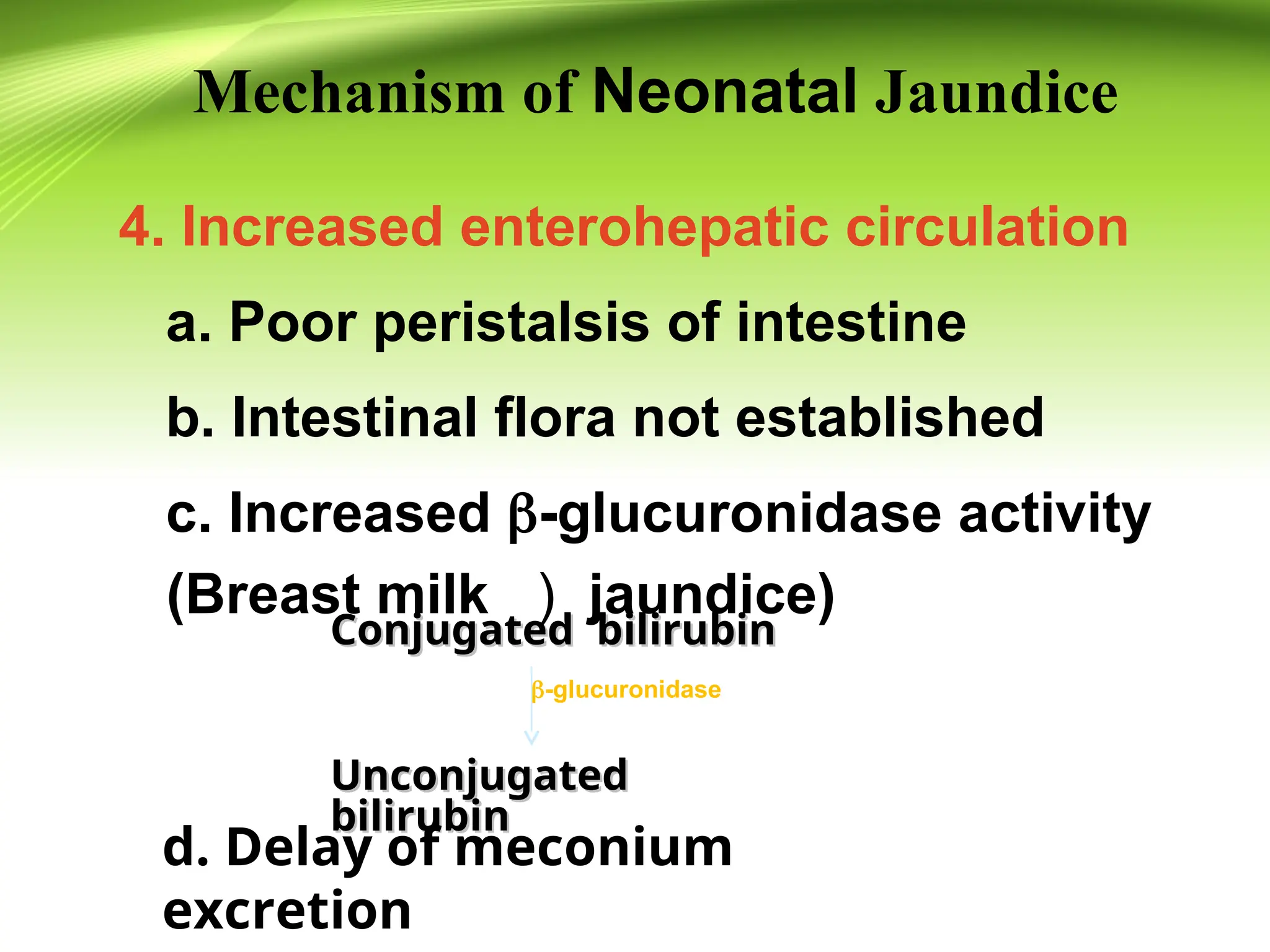
4. Increased enterohepatic circulation
a. Poor peristalsis of intestine
b. Intestinal flora not established
c. Increased -glucuronidase activity
(Breast milk ) jaundice)
Conjugated bilirubin
Unconjugated
Unconjugated
bilirubin
bilirubin
-glucuronidase
d. Delay of meconium
excretion
Mechanism of Neonatal Jaundice
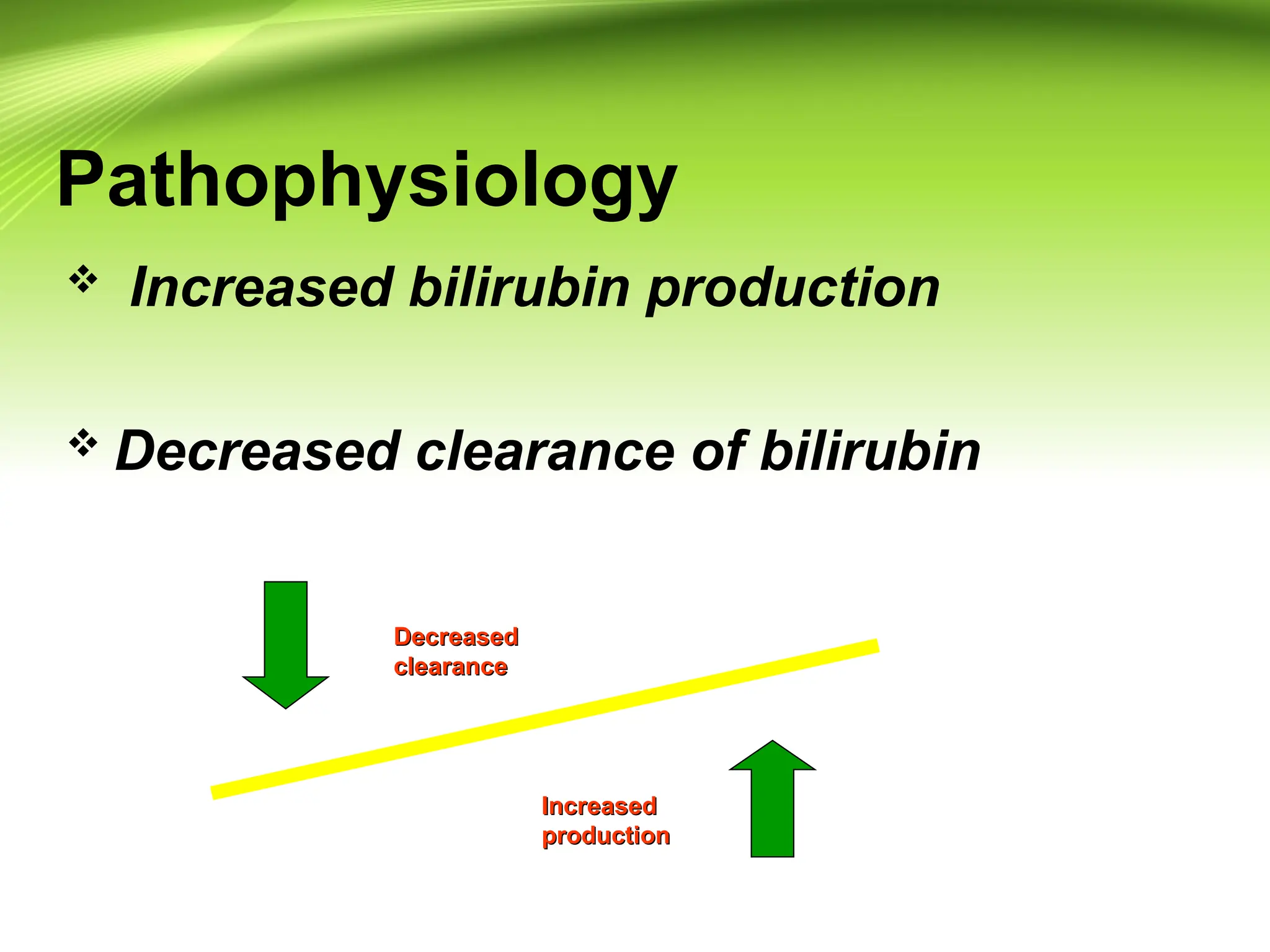
Pathophysiology
 Increased bilirubin production
 Decreased clearance of bilirubin
Decreased
Decreased
clearance
clearance
Increased
Increased
production
production
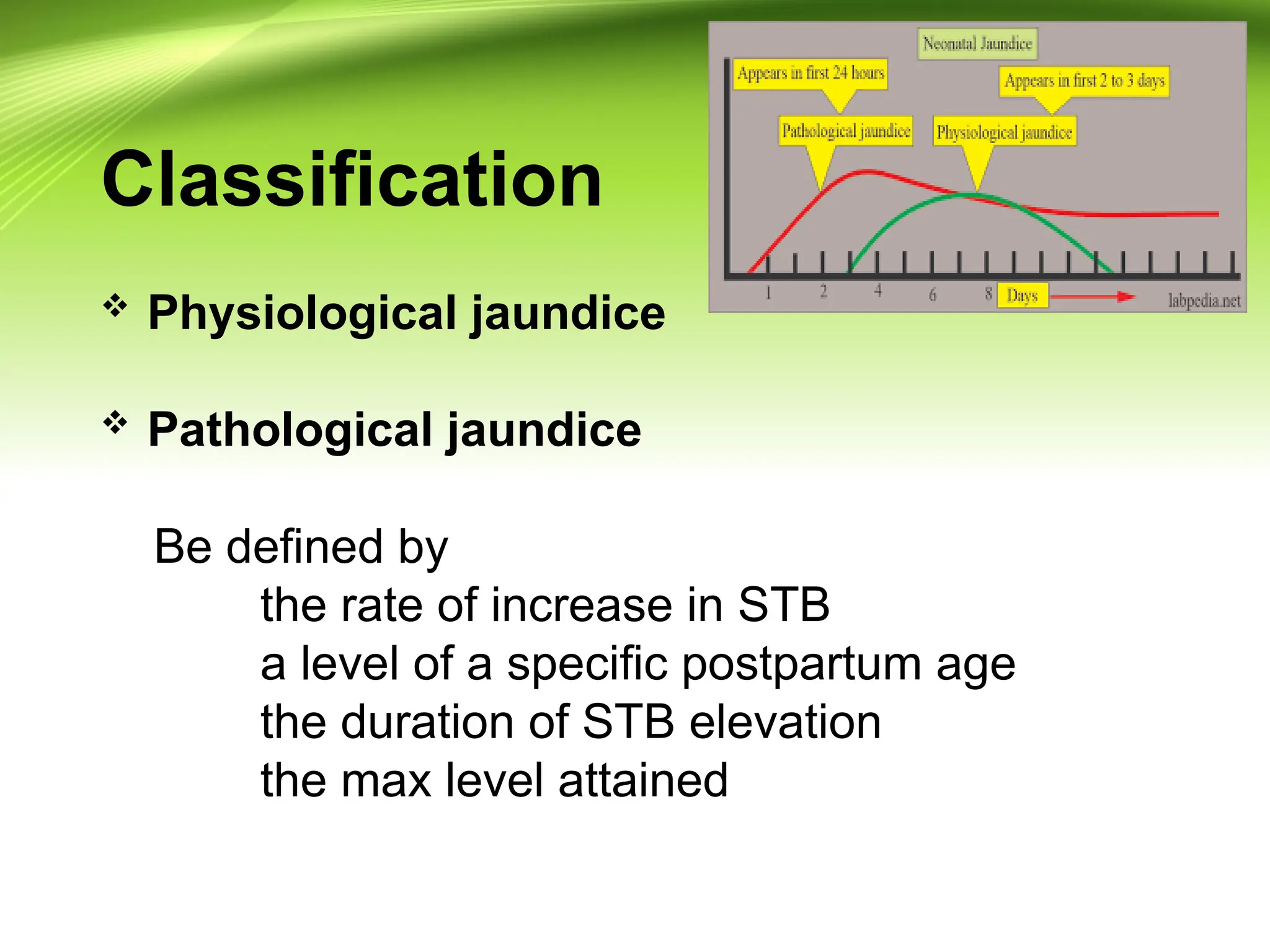
Classification
 Physiological jaundice
 Pathological jaundice
Be defined by
the rate of increase in STB
a level of a specific postpartum age
the duration of STB elevation
the max level attained
Physiological Jaundice
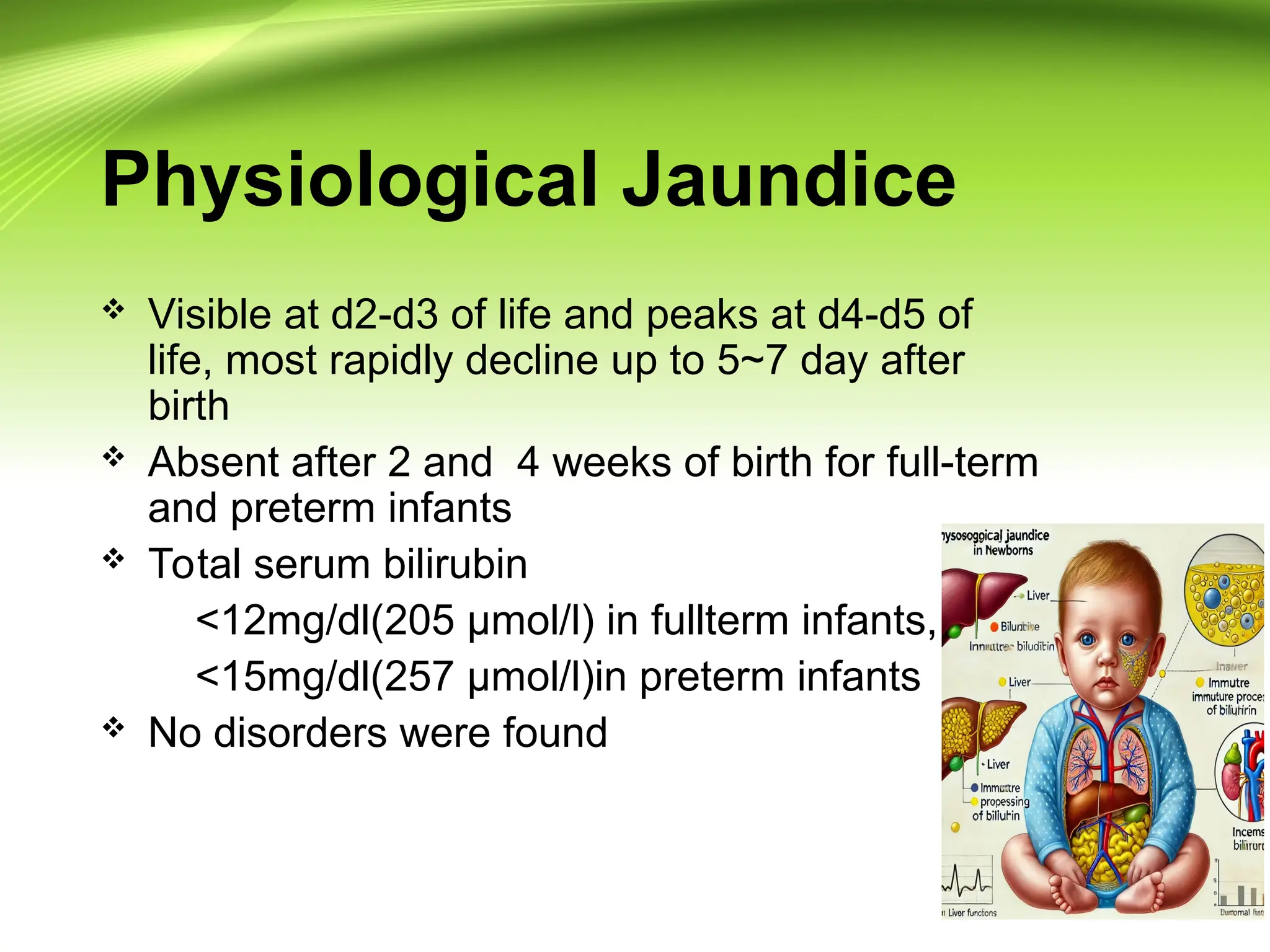
 Visible at d2-d3 of life and peaks at d4-d5 of
life, most rapidly decline up to 5~7 day after
birth
 Absent after 2 and 4 weeks of birth for full-term
and preterm infants
 Total serum bilirubin
<12mg/dl(205 µmol/l) in fullterm infants,
<15mg/dl(257 µmol/l)in preterm infants
 No disorders were found
Pathological
jaundice
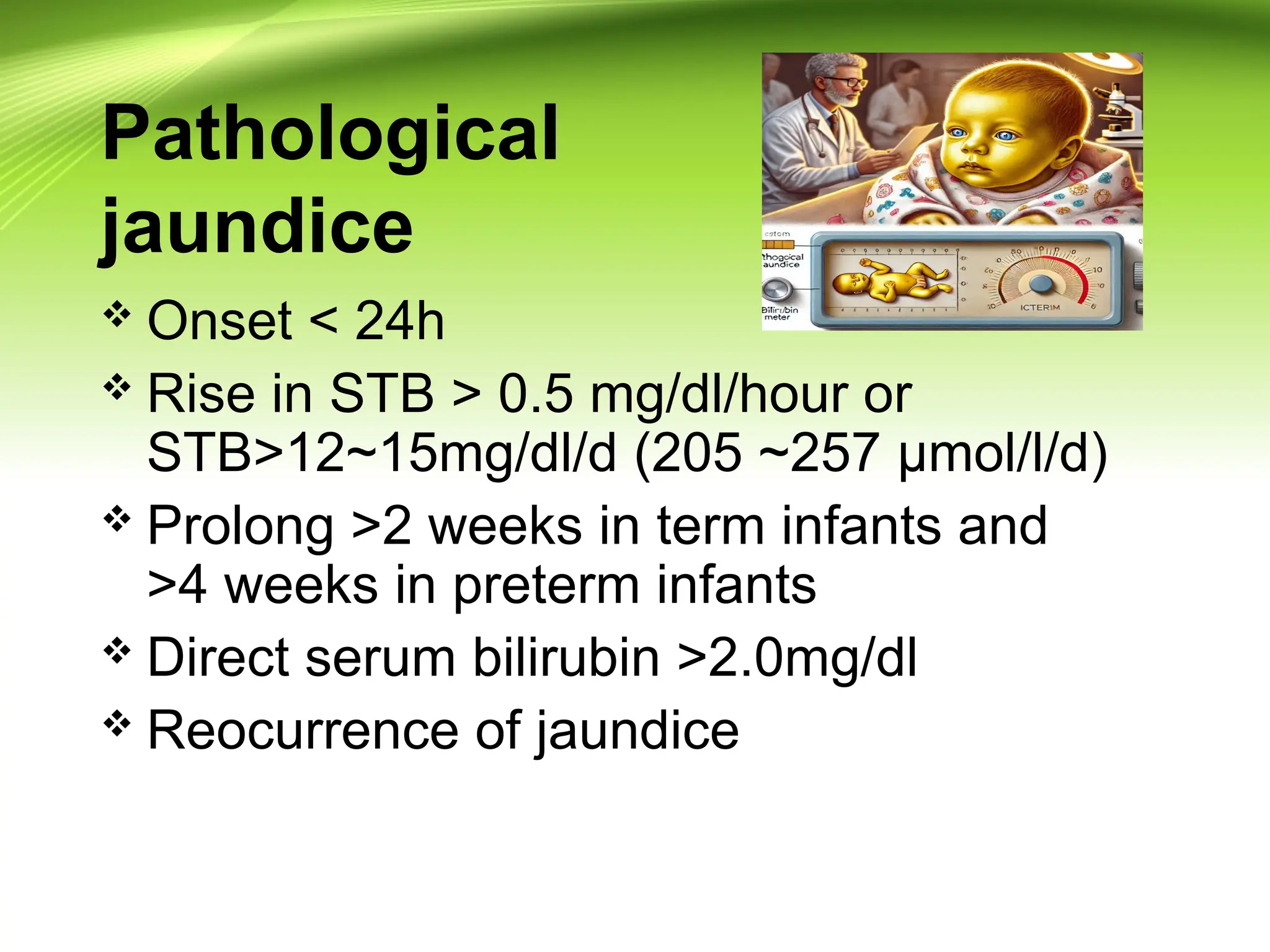
 Onset < 24h
 Rise in STB > 0.5 mg/dl/hour or
STB>12~15mg/dl/d (205 ~257 µmol/l/d)
 Prolong >2 weeks in term infants and
>4 weeks in preterm infants
 Direct serum bilirubin >2.0mg/dl
 Reocurrence of jaundice
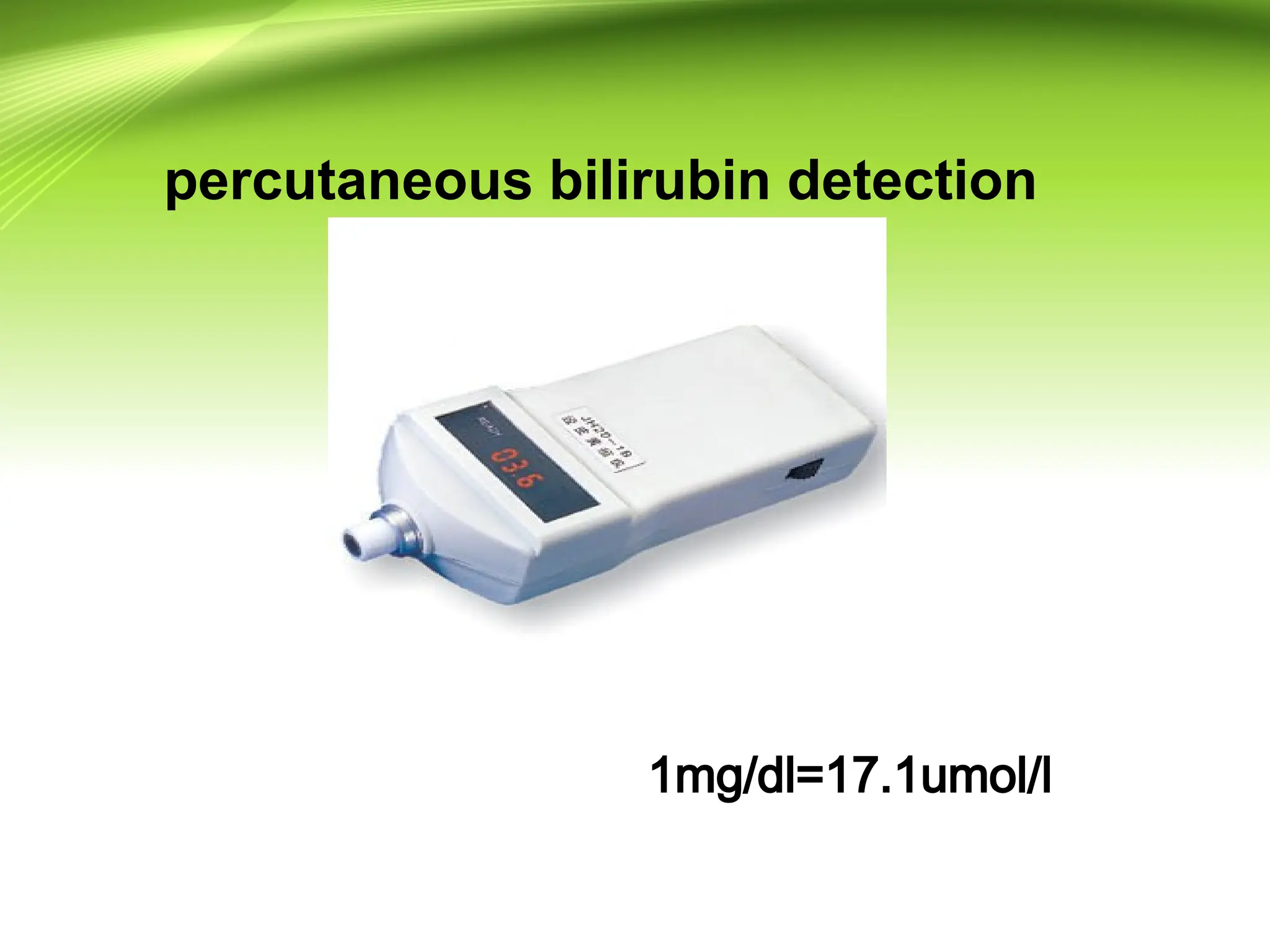
1mg/dl=17.1umol/l
percutaneous bilirubin detection
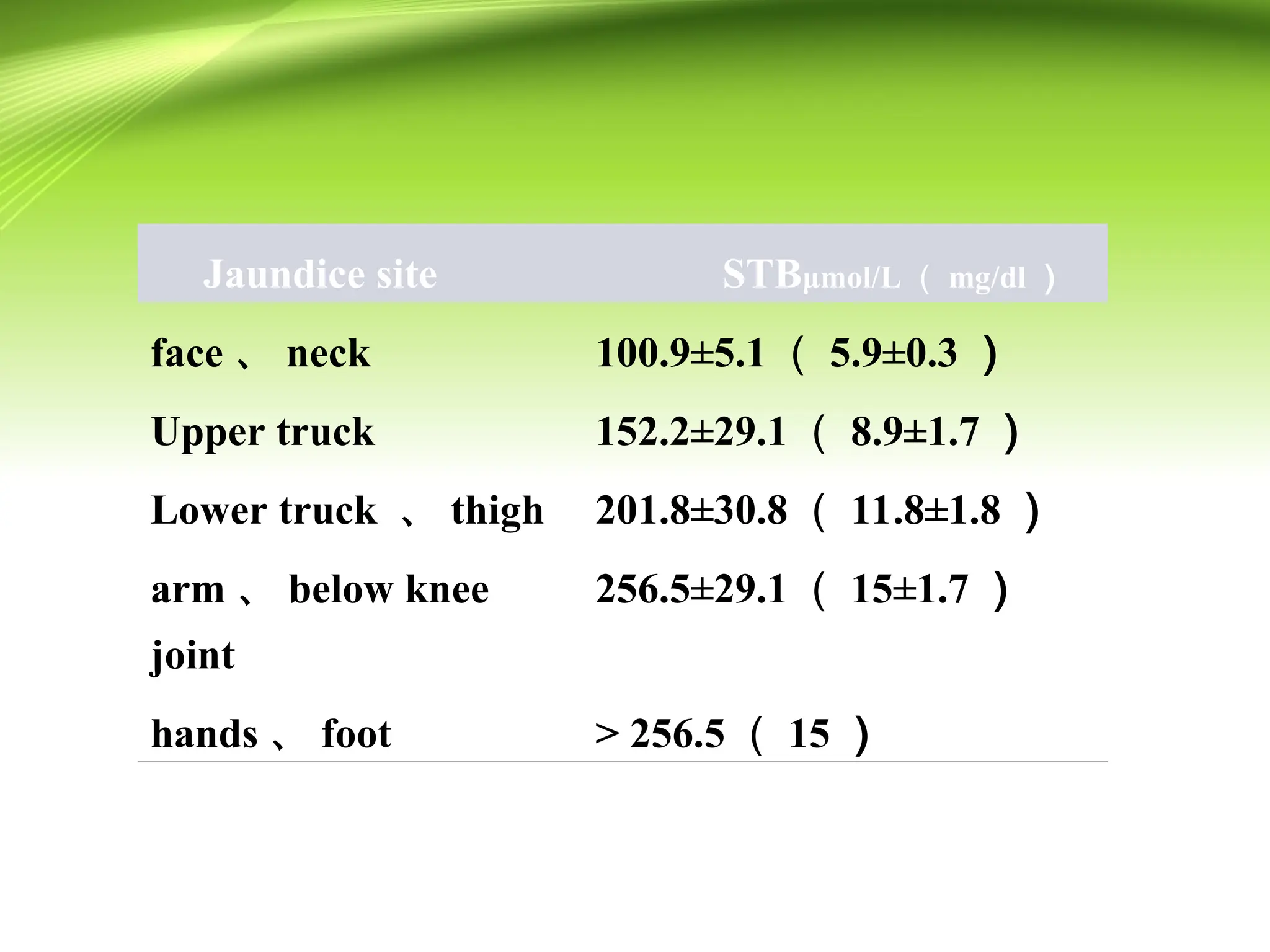
Jaundice site STBμmol/L ( mg/dl )
face 、 neck 100.9±5.1 ( 5.9±0.3 )
Upper truck 152.2±29.1 ( 8.9±1.7 )
Lower truck 、 thigh 201.8±30.8 ( 11.8±1.8 )
arm 、 below knee
joint
256.5±29.1 ( 15±1.7 )
hands 、 foot > 256.5 ( 15 )
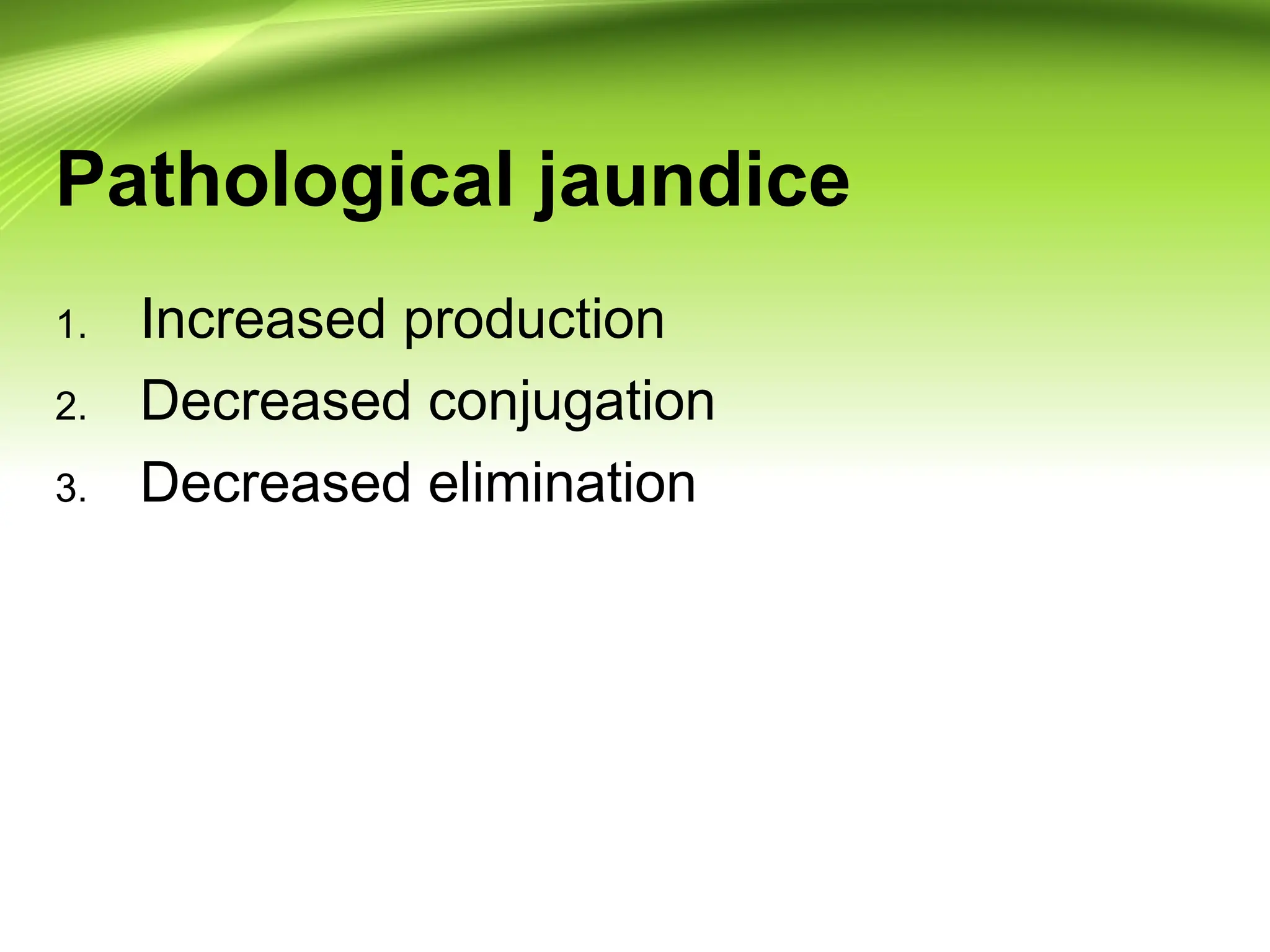
Pathological jaundice
1. Increased production
2. Decreased conjugation
3. Decreased elimination
Pathological
jaundice
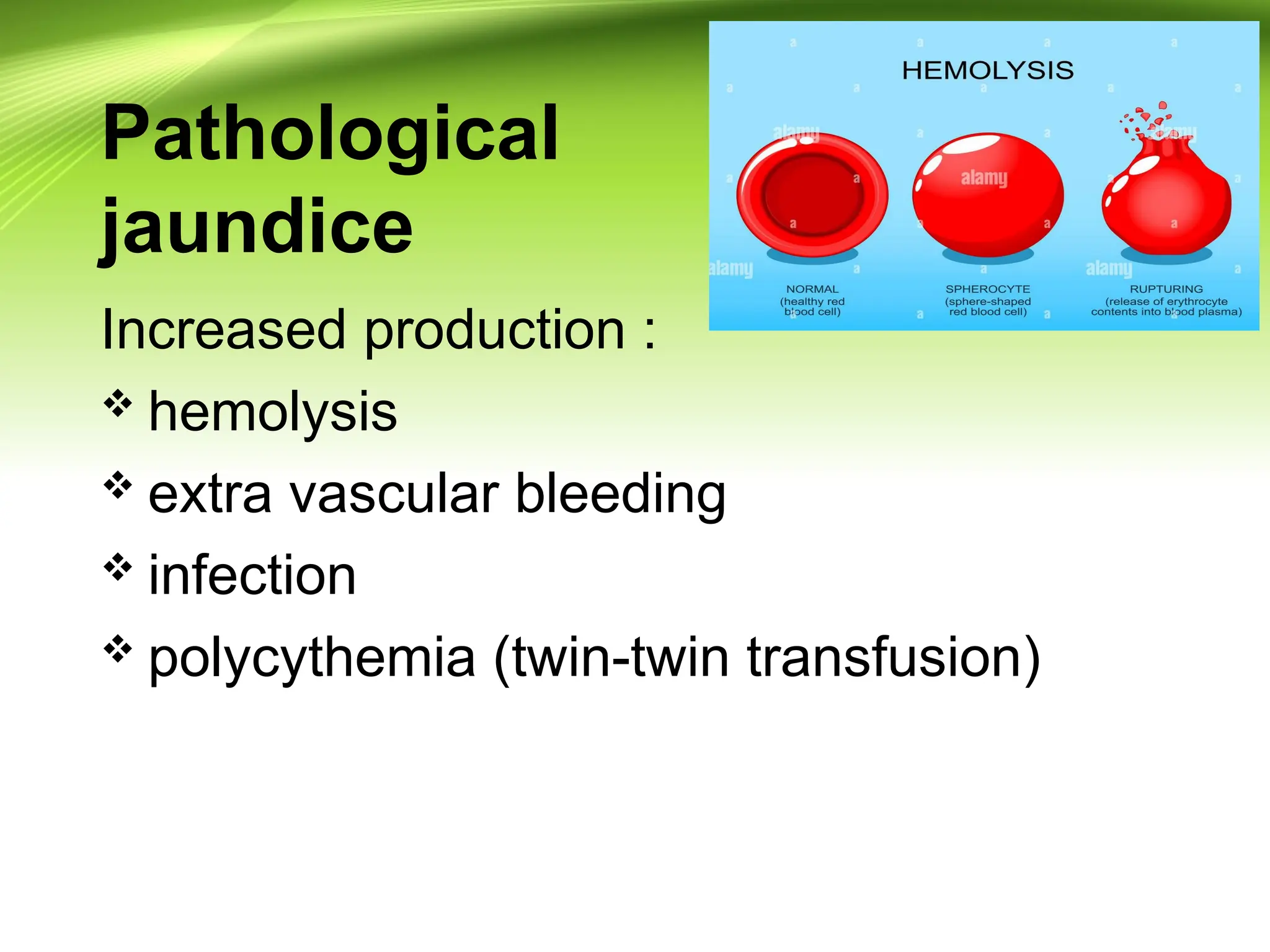
Increased production :
 hemolysis
 extra vascular bleeding
 infection
 polycythemia (twin-twin transfusion)
Pathological jaundice
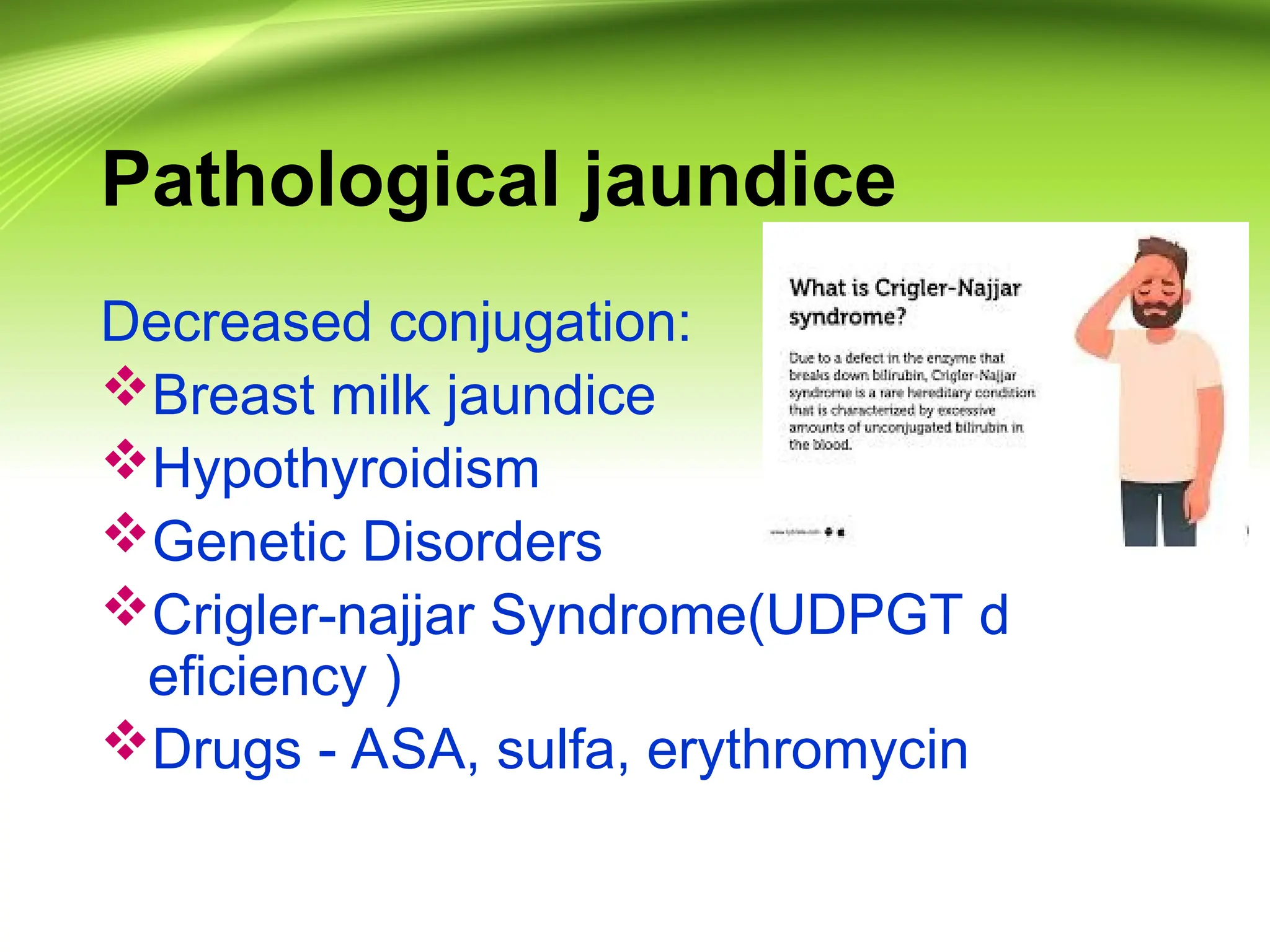
Decreased conjugation:
Breast milk jaundice
Hypothyroidism
Genetic Disorders
Crigler-najjar Syndrome(UDPGT d
eficiency )
Drugs - ASA, sulfa, erythromycin
Breastfeeding and Jaundice
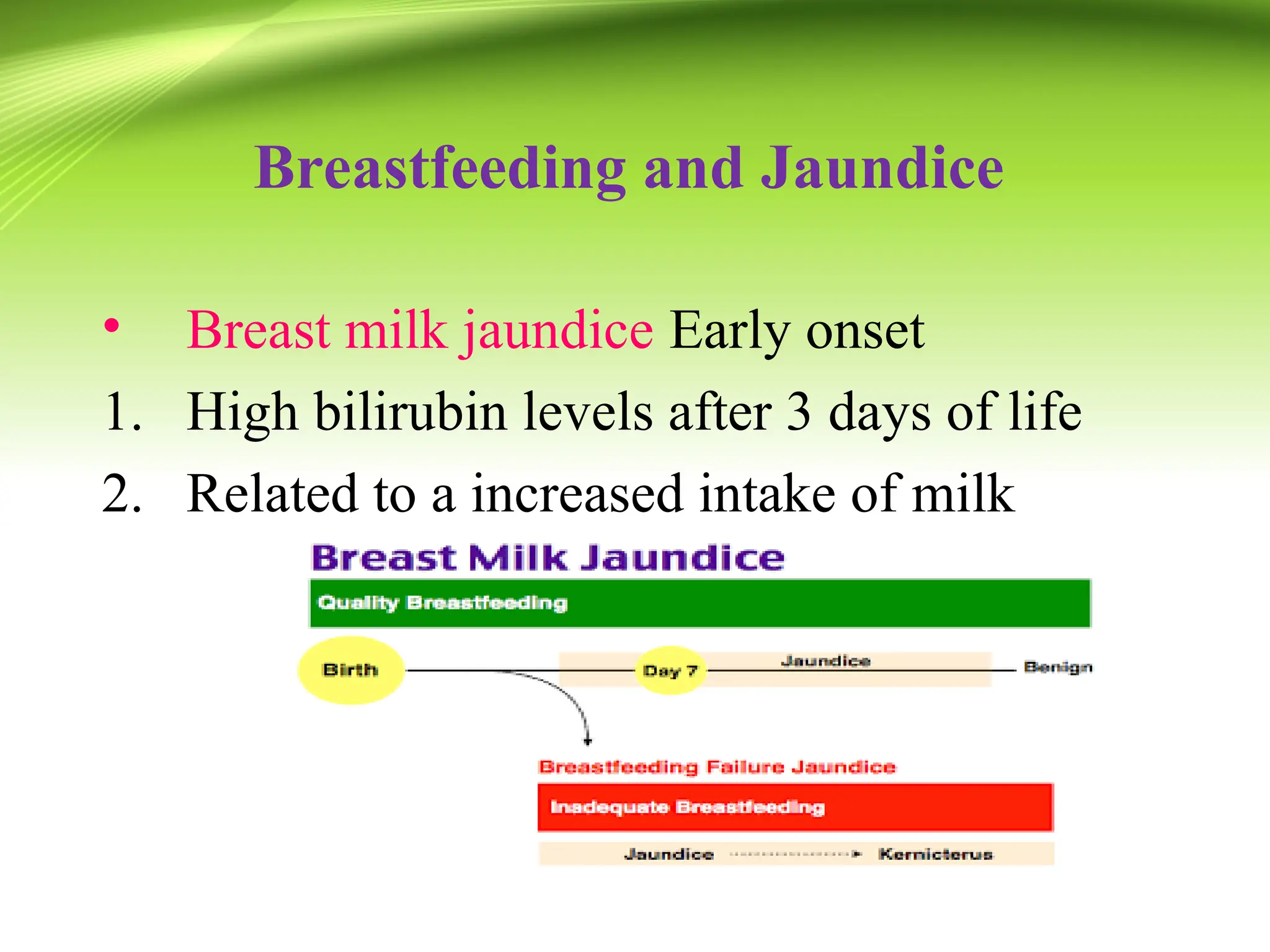
• Breast milk jaundice Early onset
1. High bilirubin levels after 3 days of life
2. Related to a increased intake of milk
Breastfeeding and Jaundice
• Breast-milk jaundice Late onset
1. High bilirubin levels by day 5-7 of life
2. Rise to peak level by 2 weeks of age
3. Bilirubin fall rapidly if stop breastfeeding
4. Rule out pathological condition
5. Mechanism is unknown(β-glucuronase)
Pathological jaundice
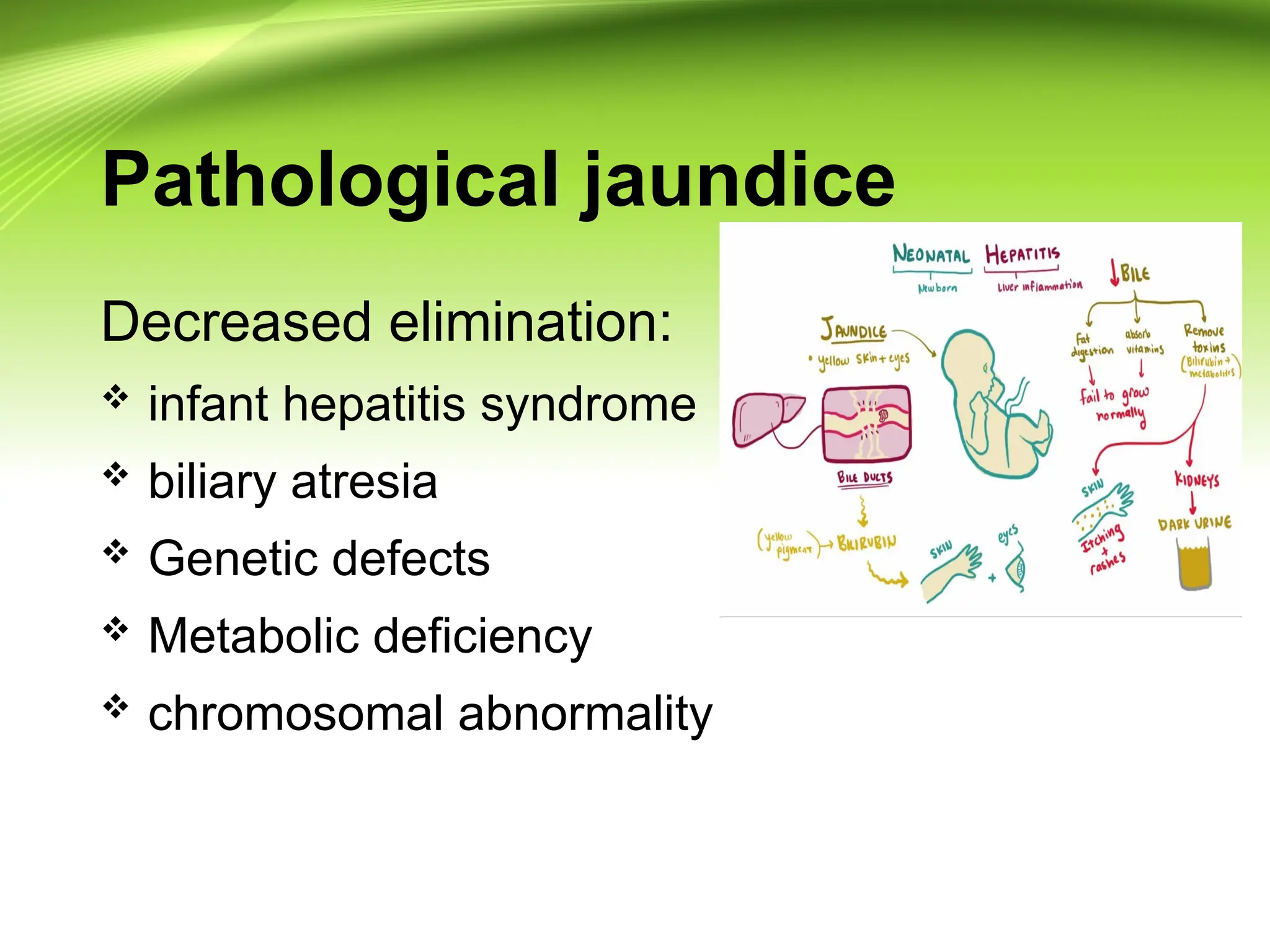
Decreased elimination:
 infant hepatitis syndrome
 biliary atresia
 Genetic defects
 Metabolic deficiency
 chromosomal abnormality
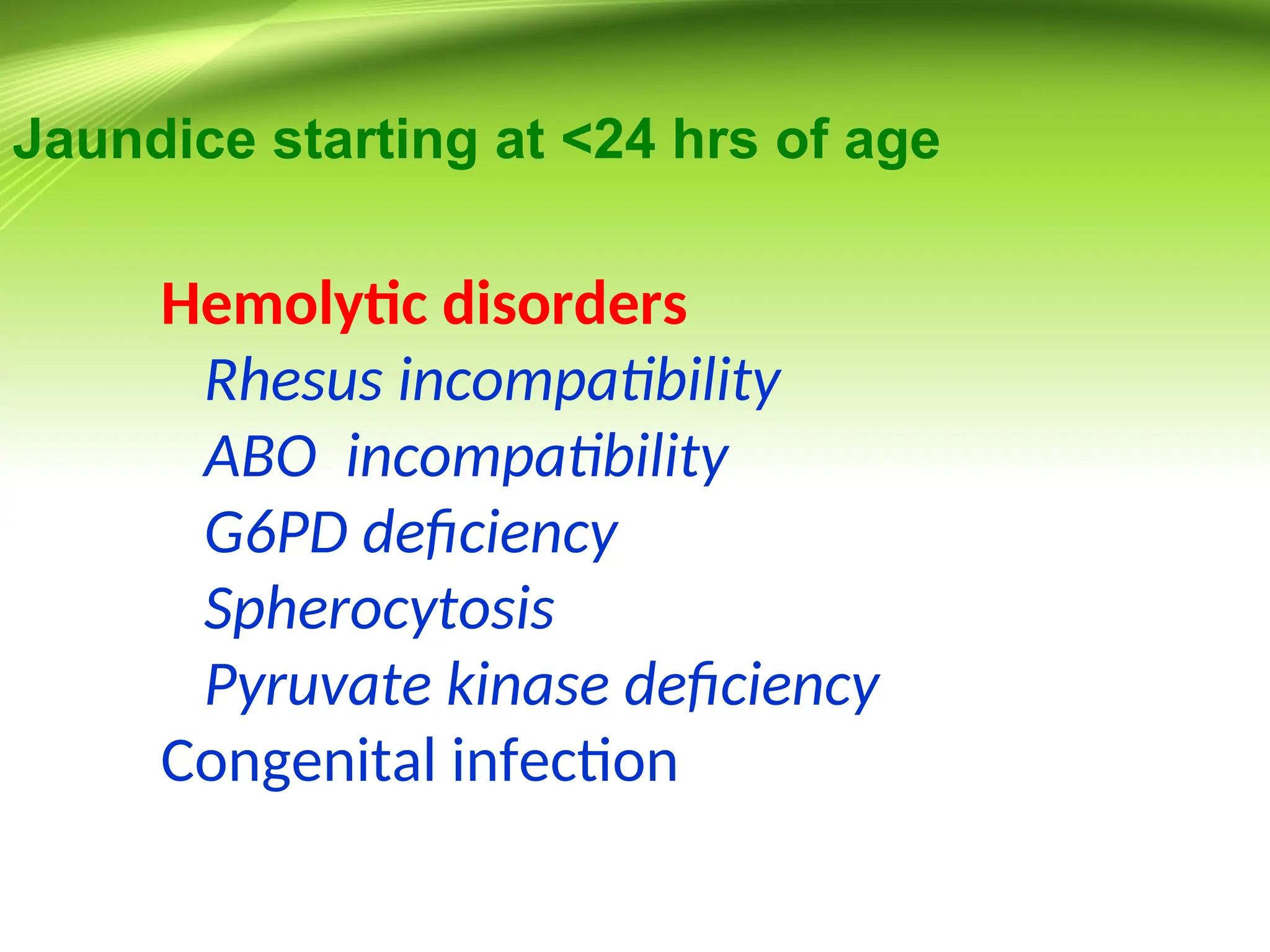
Jaundice starting at <24 hrs of age
Hemolytic disorders
Rhesus incompatibility
ABO incompatibility
G6PD deficiency
Spherocytosis
Pyruvate kinase deficiency
Congenital infection
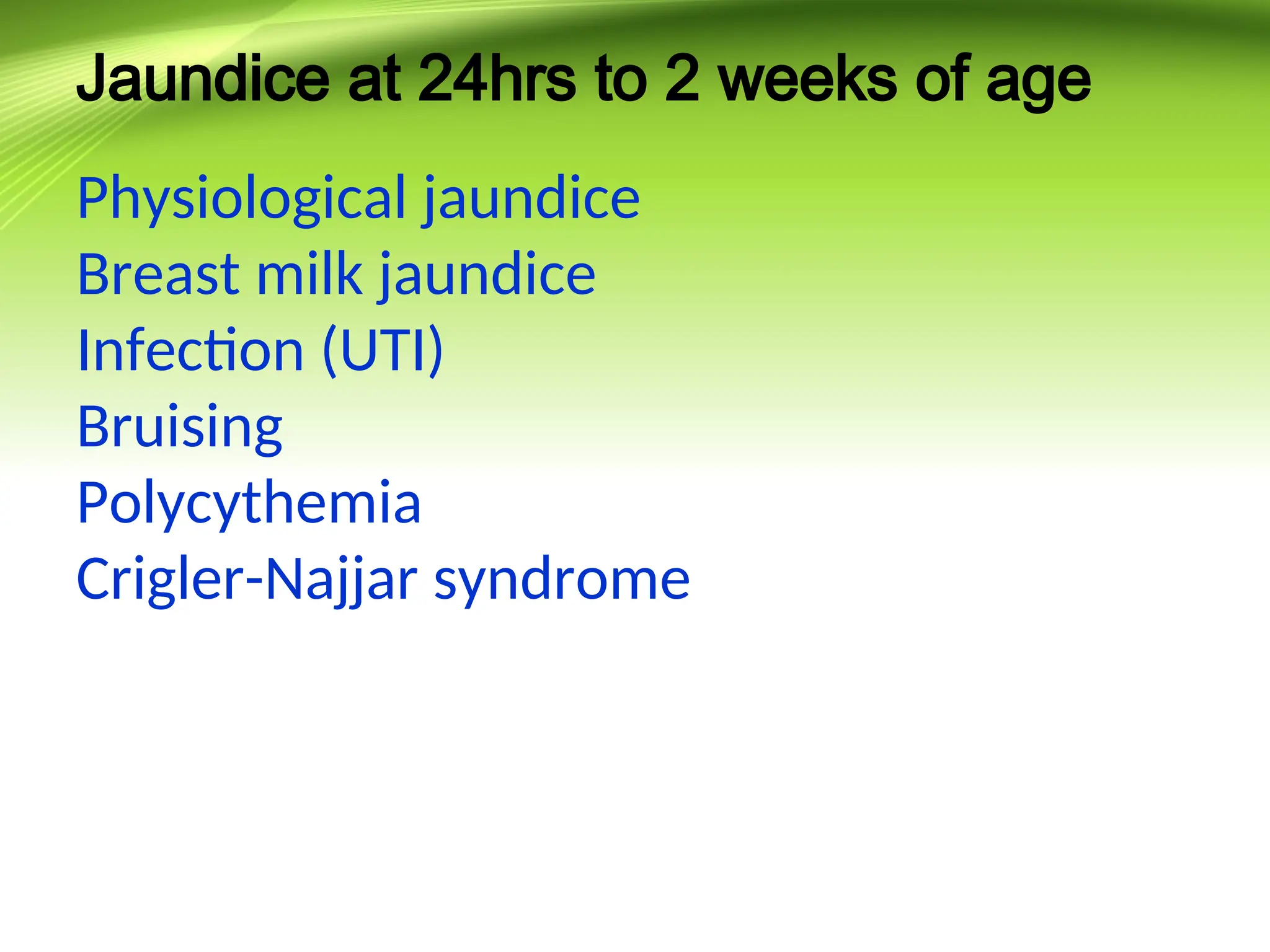
Jaundice at 24hrs to 2 weeks of age
Physiological jaundice
Breast milk jaundice
Infection (UTI)
Bruising
Polycythemia
Crigler-Najjar syndrome
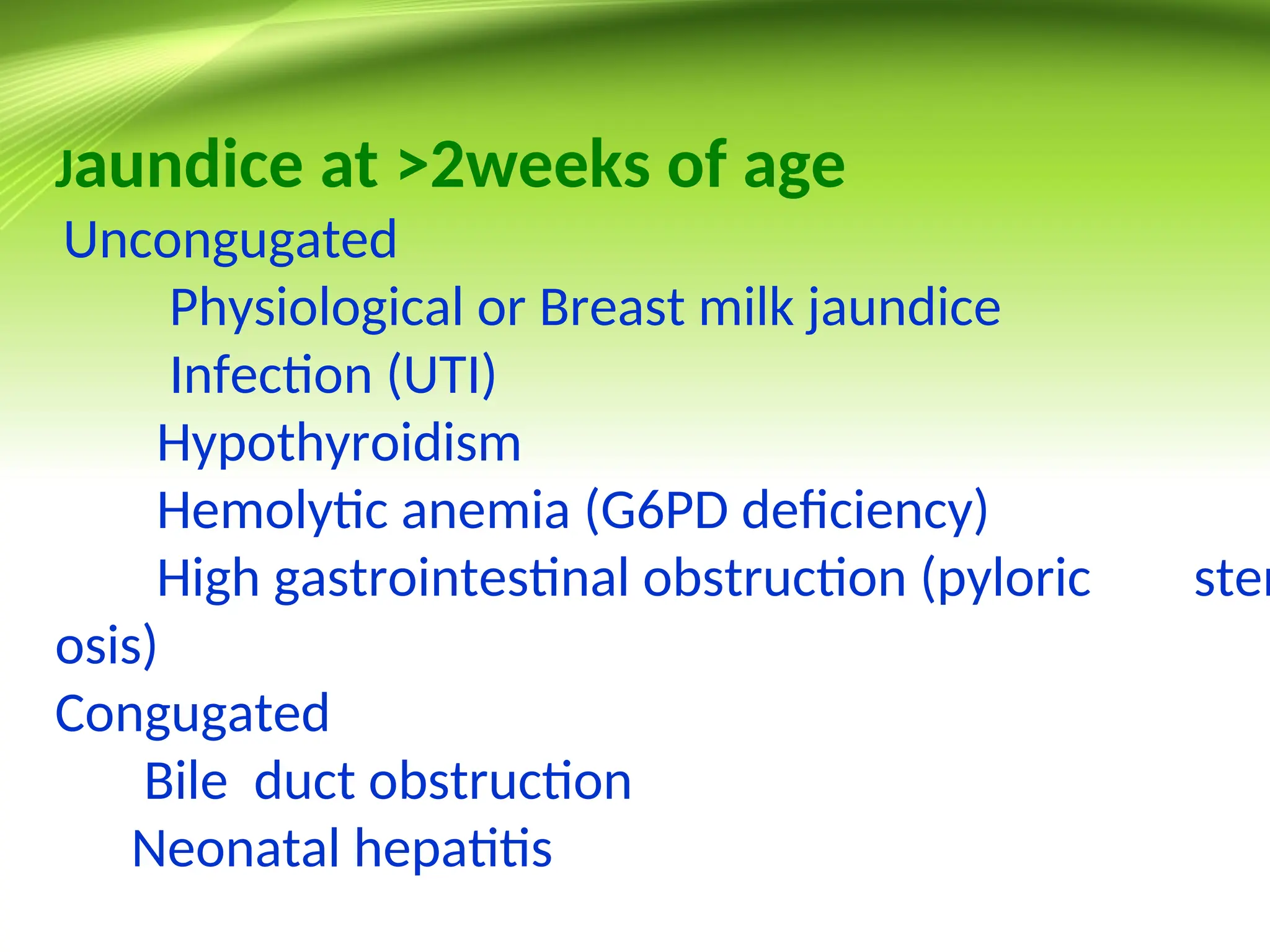
Jaundice at >2weeks of age
Uncongugated
Physiological or Breast milk jaundice
Infection (UTI)
Hypothyroidism
Hemolytic anemia (G6PD deficiency)
High gastrointestinal obstruction (pyloric sten
osis)
Congugated
Bile duct obstruction
Neonatal hepatitis
Diagnosis
 symptom
 Blood type
 Onset < 24h
 Blood test
Diagnosis
Blood test
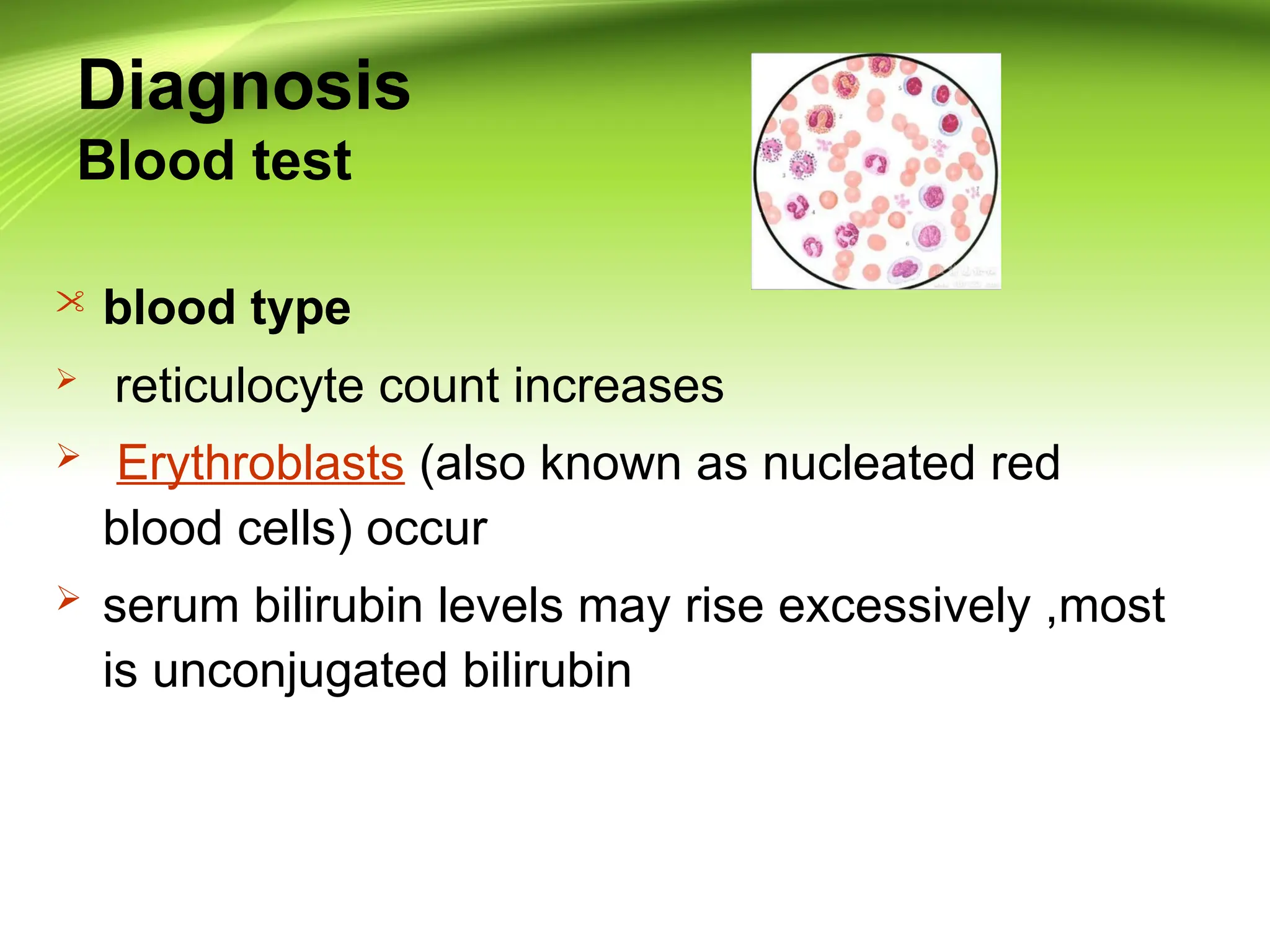
 blood type
 reticulocyte count increases
 Erythroblasts (also known as nucleated red
blood cells) occur
 serum bilirubin levels may rise excessively ,most
is unconjugated bilirubin
Diagnosis
Blood test
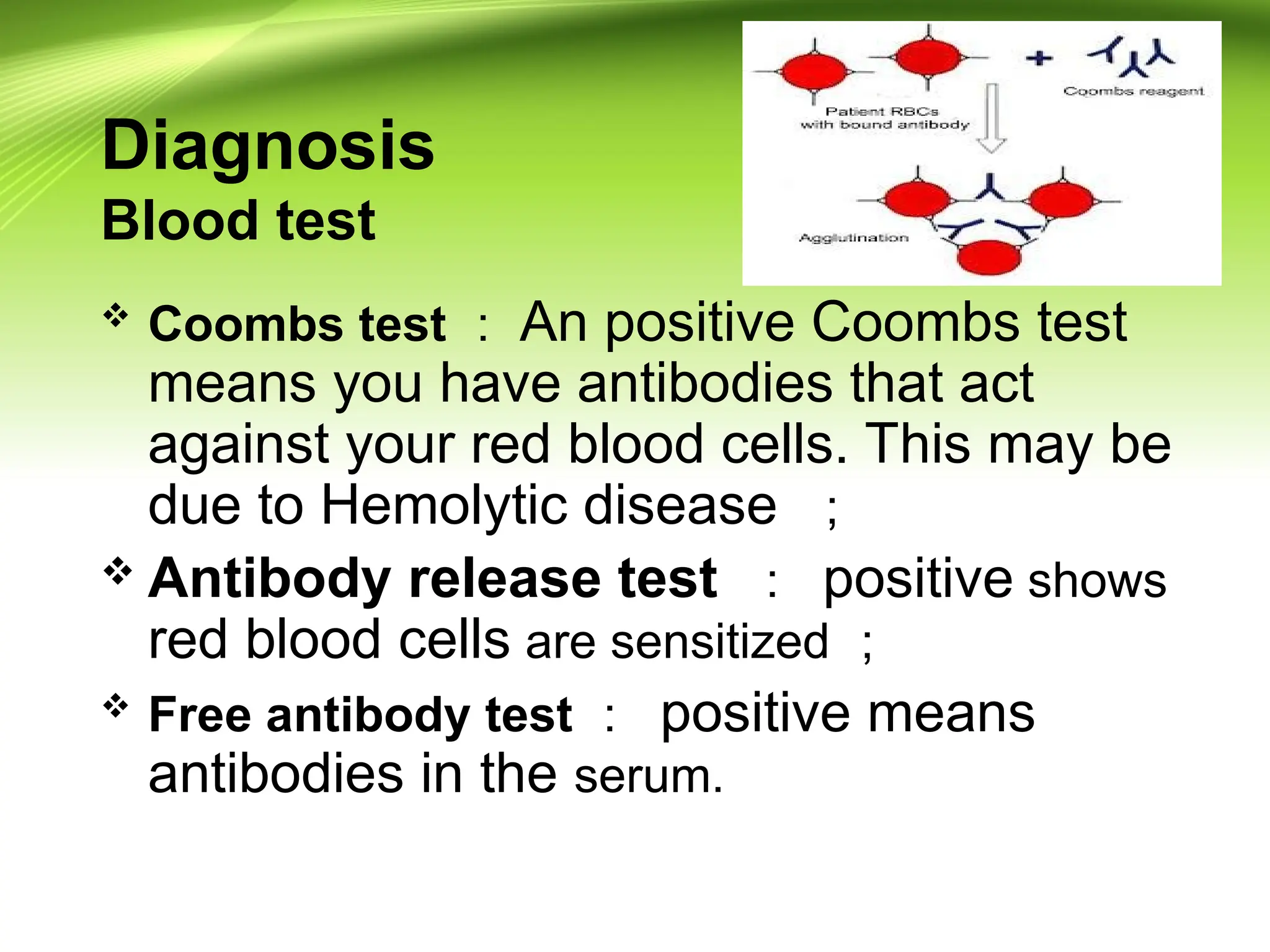
 Coombs test : An positive Coombs test
means you have antibodies that act
against your red blood cells. This may be
due to Hemolytic disease ;
 Antibody release test : positive shows
red blood cells are sensitized ;
 Free antibody test : positive means
antibodies in the serum.
Treatment
 Treatment depends on the severity of the
condition, but could include phototherapy,
exchange transfusion with a blood
type compatible with both the infant and the
mother, sodium bicarbonate for correction
of acidosis and so on.
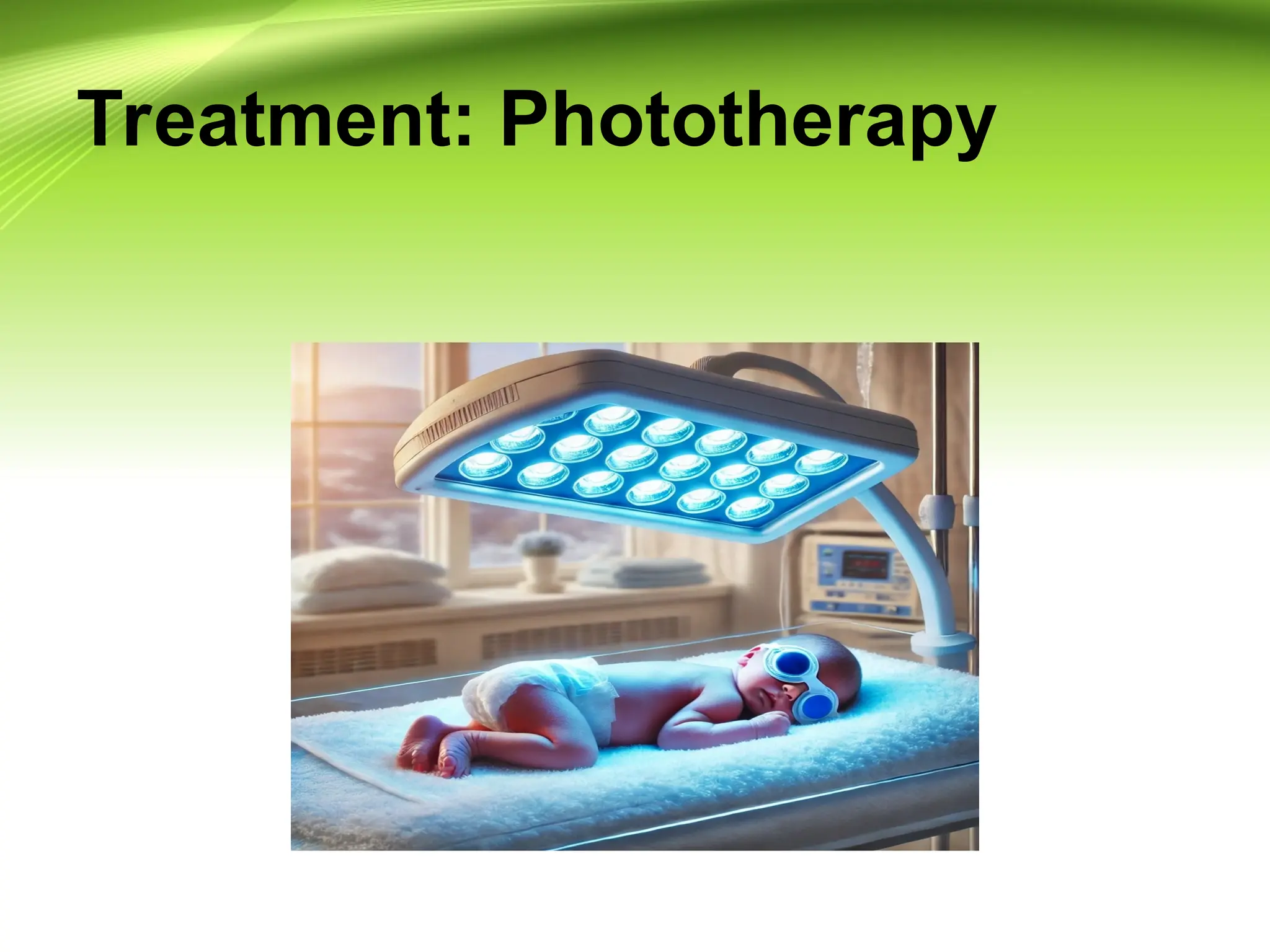
Treatment: Phototherapy
 Effective and safe method of reducing
unconjugated hyperbilirubinemia
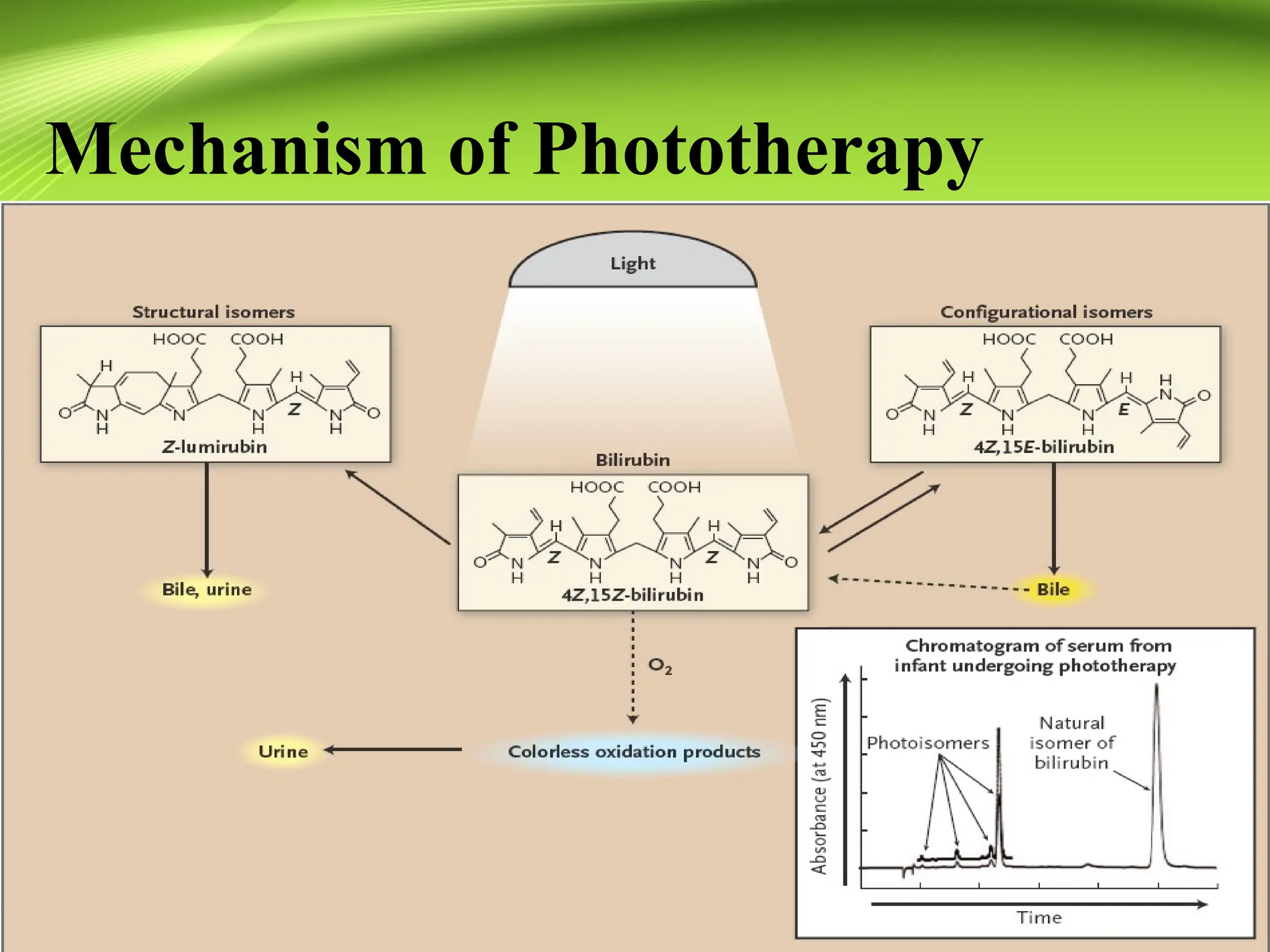
 Blue-green light transforms bilirubin to
lumirubin, it is water soluble and excreted
in the urine
Mechanism of Phototherapy
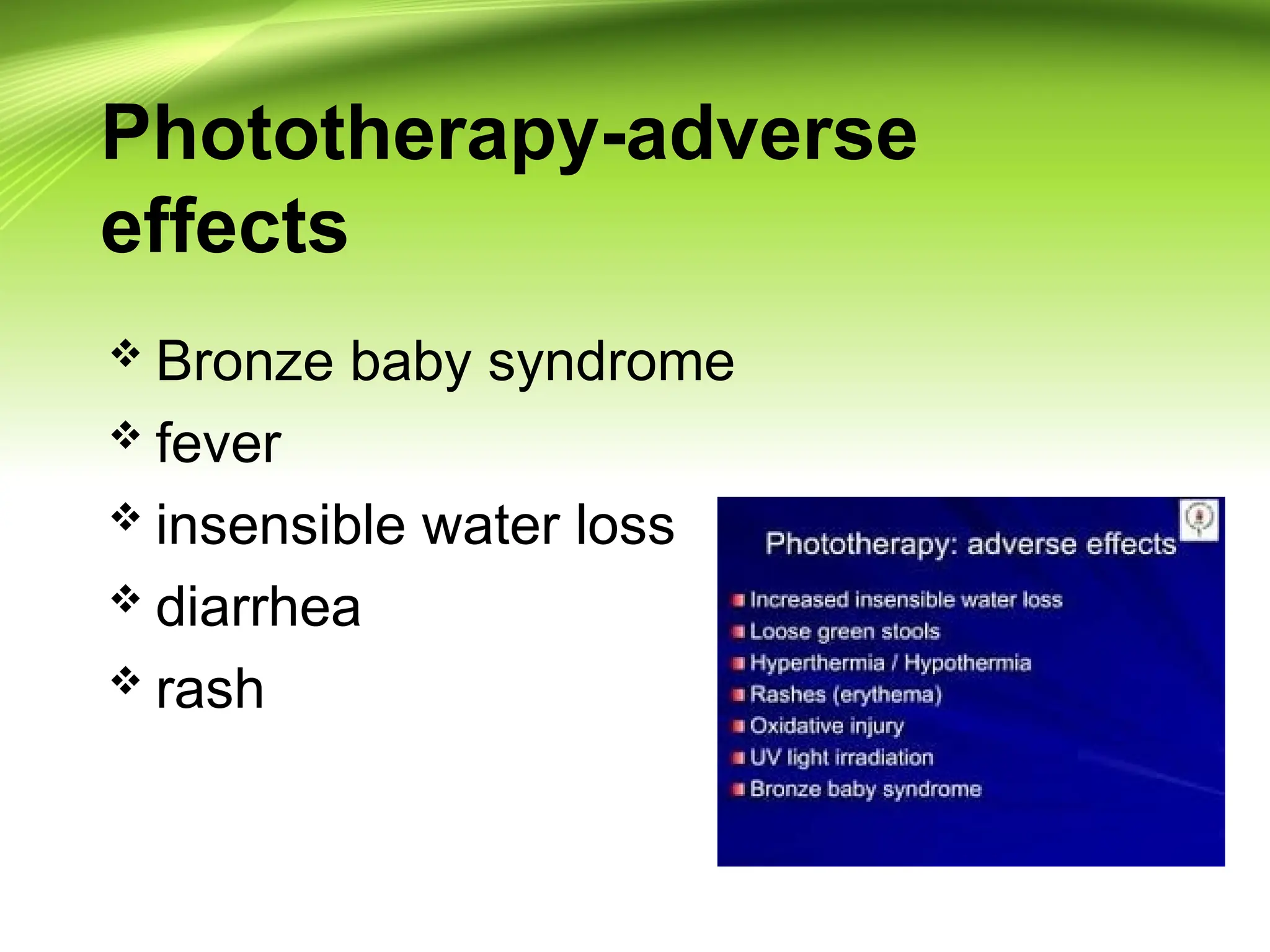
Phototherapy-adverse
effects
 Bronze baby syndrome
 fever
 insensible water loss
 diarrhea
 rash
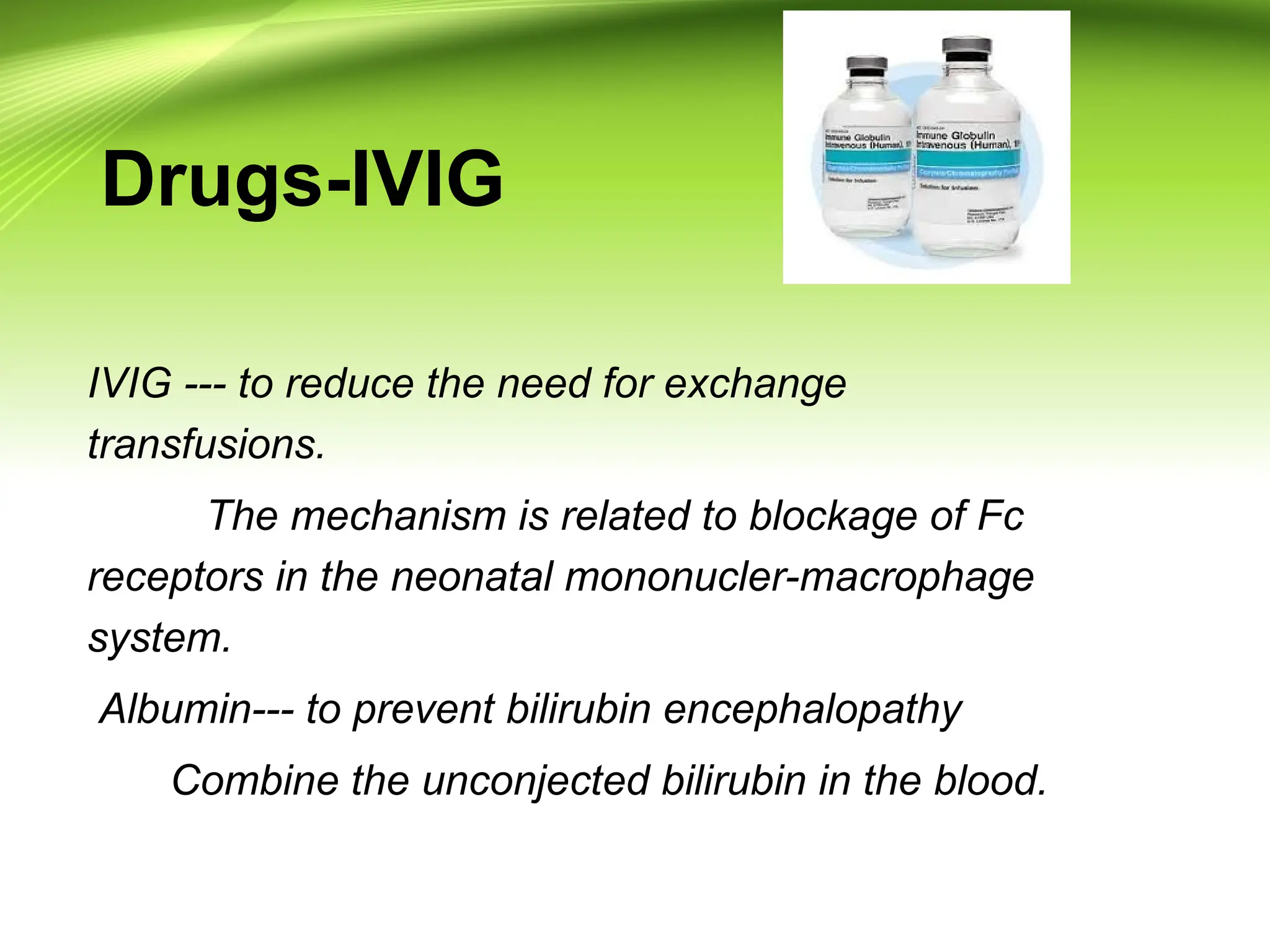
Drugs-IVIG
IVIG --- to reduce the need for exchange
transfusions.
The mechanism is related to blockage of Fc
receptors in the neonatal mononucler-macrophage
system.
Albumin--- to prevent bilirubin encephalopathy
Combine the unconjected bilirubin in the blood.
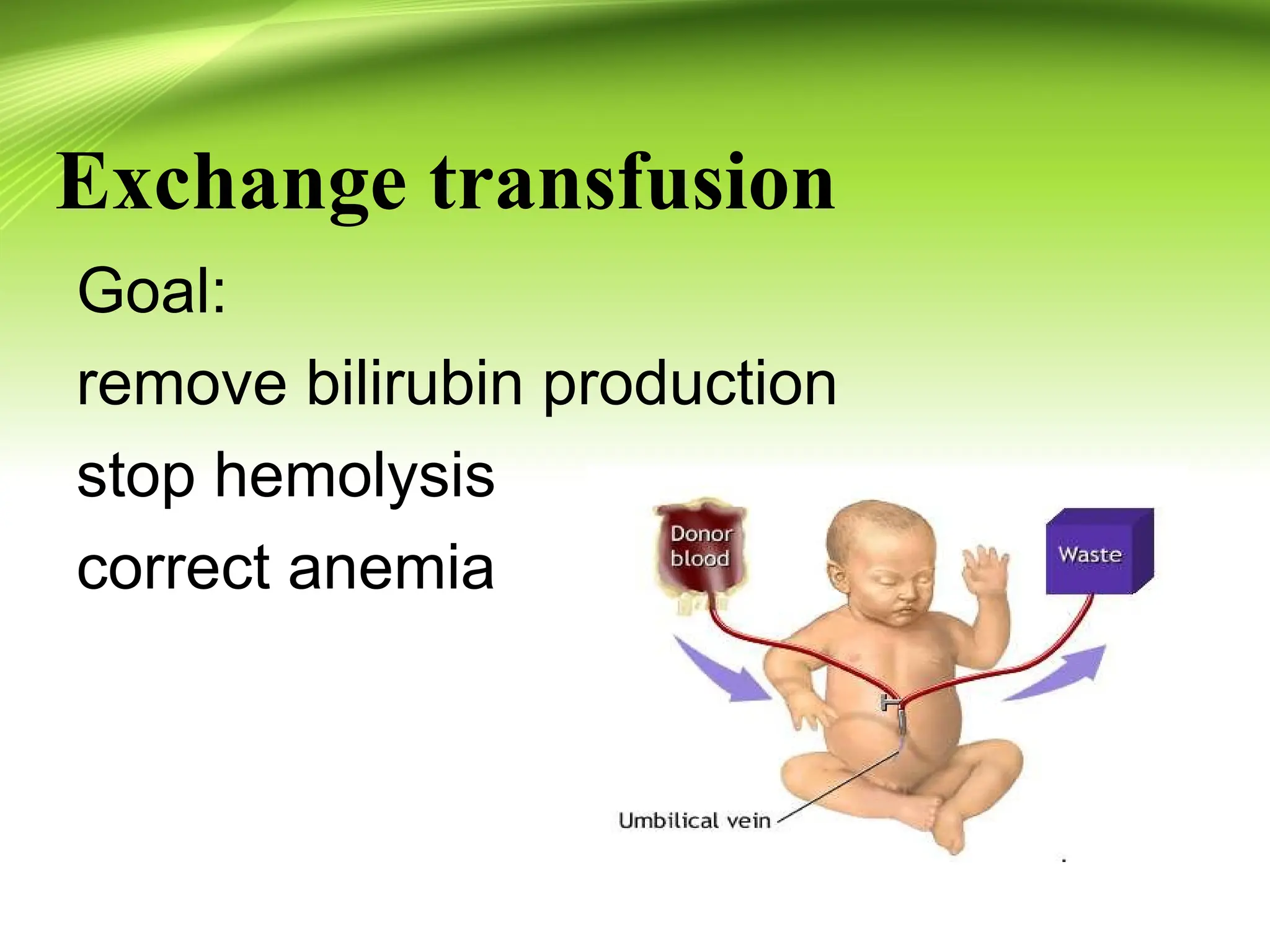
Exchange transfusion
Goal:
remove bilirubin production
stop hemolysis
correct anemia
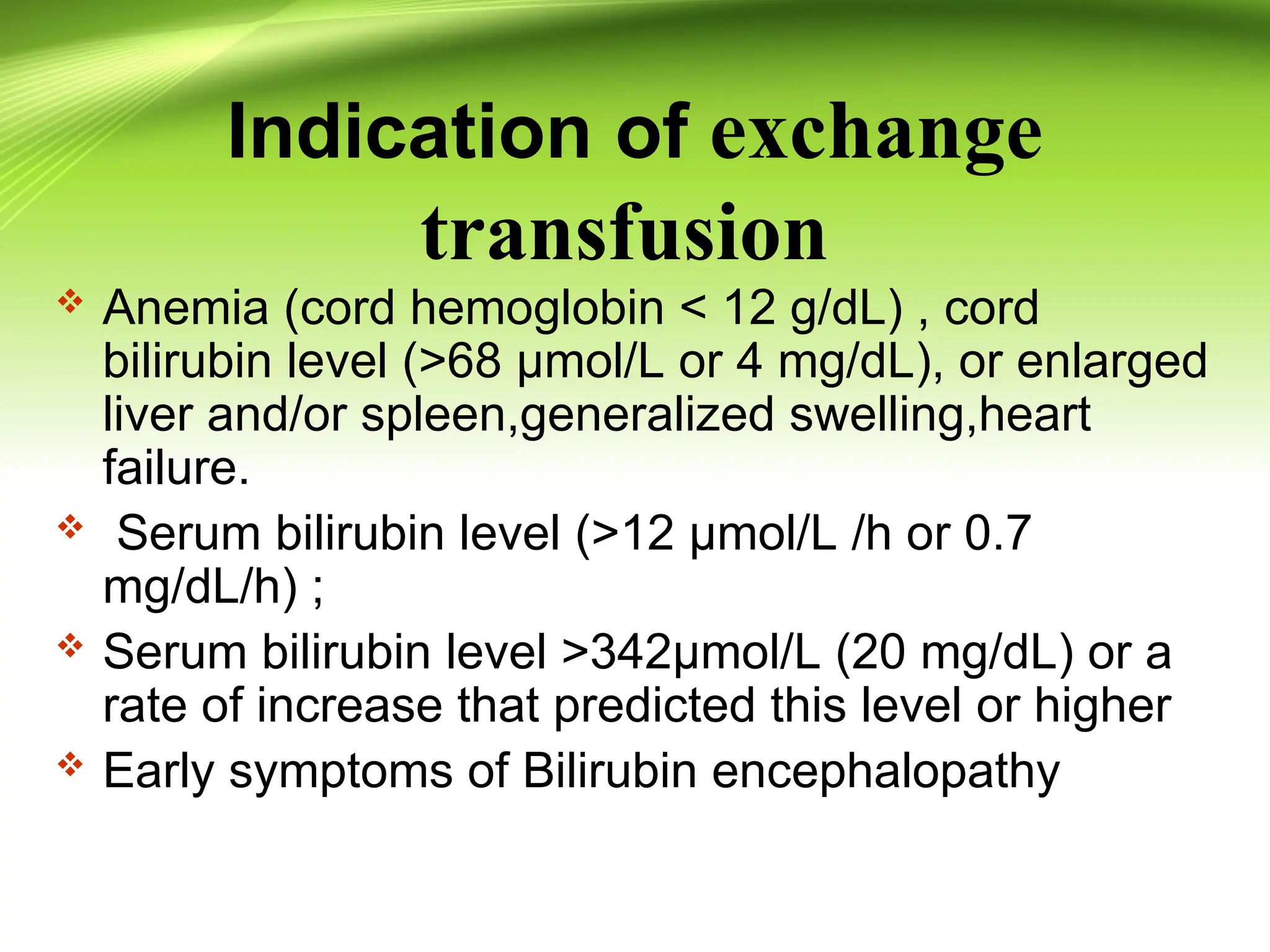
Indication of exchange
transfusion
 Anemia (cord hemoglobin < 12 g/dL) , cord
bilirubin level (>68 µmol/L or 4 mg/dL), or enlarged
liver and/or spleen,generalized swelling,heart
failure.
 Serum bilirubin level (>12 µmol/L /h or 0.7
mg/dL/h) ;
 Serum bilirubin level >342µmol/L (20 mg/dL) or a
rate of increase that predicted this level or higher
 Early symptoms of Bilirubin encephalopathy
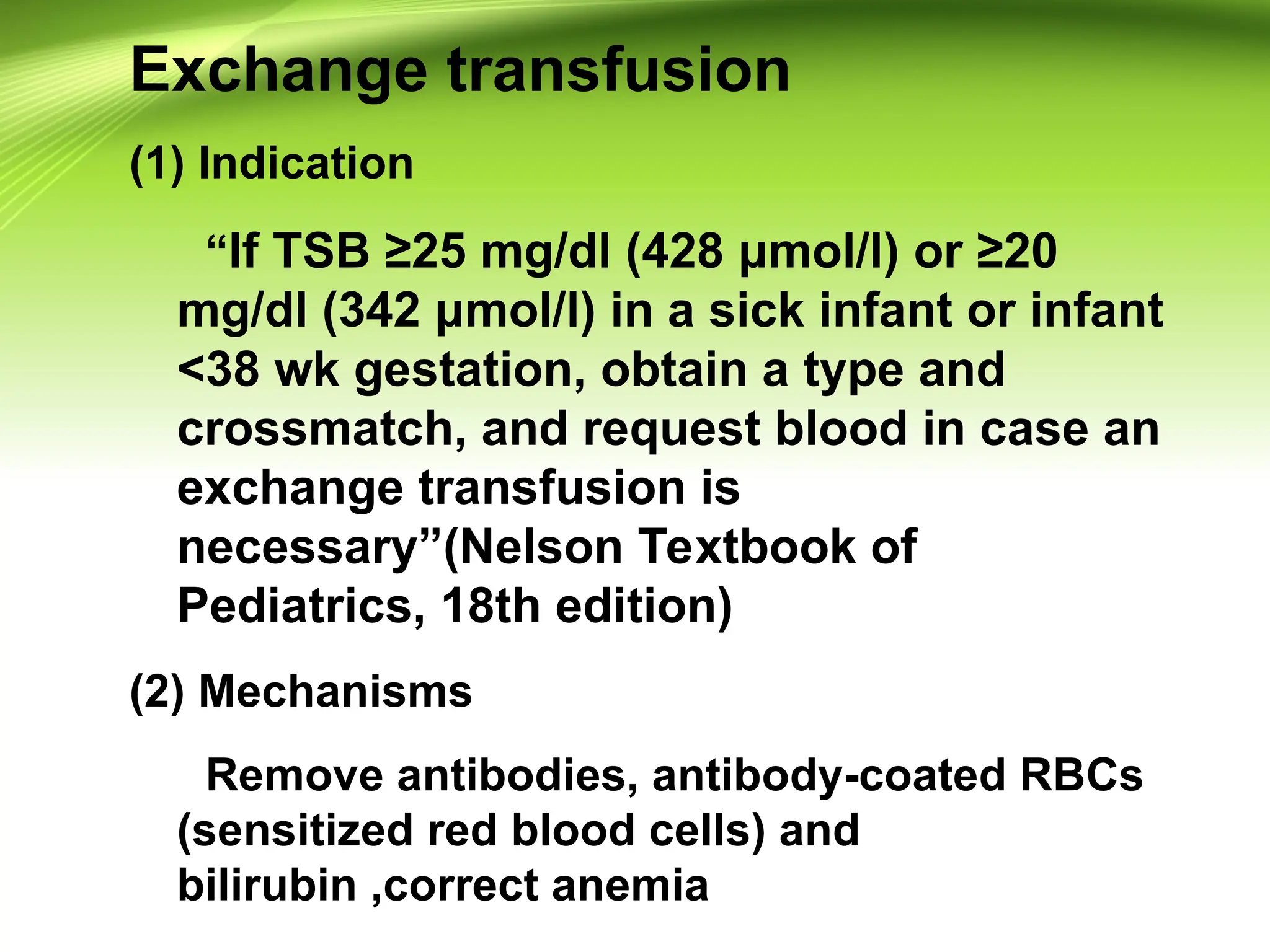
Exchange transfusion
(1) Indication
“If TSB ≥25 mg/dl (428 μmol/l) or ≥20
mg/dl (342 μmol/l) in a sick infant or infant
<38 wk gestation, obtain a type and
crossmatch, and request blood in case an
exchange transfusion is
necessary”(Nelson Textbook of
Pediatrics, 18th edition)
(2) Mechanisms
Remove antibodies, antibody-coated RBCs
(sensitized red blood cells) and
bilirubin ,correct anemia
Exchange transfusion
Blood
 Rh hemolytic disease:Rh cross-matched against
the mother, ABO cross-matched against the
infant
 ABO hemolytic disease: type O cells with AB
plasma
Volume
 Double the volume of the infant’s blood (two-
volume exchange), 150-180ml/kg
Complications
 Hypocalcemia, hypoglycemia, Acid-base
balance, hyperkalemia, embolization, bleeding,
infections
Neonatal Jaundice for the new borns .ppt

Neonatal Jaundice for the new borns .ppt

  • 1.
  • 2.
  • 3.
    Definition  Neonatal jaundiceis a term used when a newborn has yellow coloration of the skin and sclera as the result of accumulation of bilirubin.  Jaundice is the most common condition that requires medical attention in newborns.
  • 4.
    Bilirubin Unconjugated bilirubin (indirected bilirubinIB) Serum total bilirubin (STB) Conjugated bilirubin (directed bilirubin DB)
  • 5.
    Bilirubin ● unconjugated bilirubin lipid-soluble, cancross the blood-brain barrier, neurotoxic, ● conjugated bilirubin water-soluble, no directly toxic to brain in neonatal,
  • 6.
     When theserum bilirubin rised higher than 5-7 mg/dl,there will be visible jaundice.
  • 7.
    Risk factors  Race Geography  Genetics and familial risk  Nutrition  Maternal factors  Birthweight and gestational age  Congenital infection
  • 8.
  • 9.
  • 10.
    Unconjugated Unconjugated bilirubin (uptaken by bilirubin(uptaken by liver) liver) Conjugated bilirubin Conjugated bilirubin Conjugate with Protein Y and Z Catalyze d by UDPGT UDPGT Travel of bilirubin -glucuronidase
  • 11.
    Mechanism of NeonatalJaundice 1.Over production of bilirubin: 8.8mg/kg/d in infants VS 3.8mg in adult  Increased RBC volume  Shorter RBC lifespan than adults(80 days compared with 120 days)  Shunt bilirubin-from bone marrow ,liver
  • 12.
    Mechanism of NeonatalJaundice 2.Transport of bilirubin is not enough  PH is intensively relative to the binding of albumin to bilirubin (PH>7.4),but in newborns,PH is always lower.  The albumin is the means of conveyance of bilirubin from blood to the liver. Relative lower concentration of serum albumin cause lower transportation of bilirubin.
  • 13.
    Mechanism of NeonatalJaundice 3.Immaturity in metabolism in liver  Acceptor proteins Y,Z in lower level  Lower activity of uridine diphosphoglucurony1 transferase
  • 14.
    4. Increased enterohepaticcirculation a. Poor peristalsis of intestine b. Intestinal flora not established c. Increased -glucuronidase activity (Breast milk ) jaundice) Conjugated bilirubin Conjugated bilirubin Unconjugated Unconjugated bilirubin bilirubin -glucuronidase d. Delay of meconium excretion Mechanism of Neonatal Jaundice
  • 15.
    Pathophysiology  Increased bilirubinproduction  Decreased clearance of bilirubin Decreased Decreased clearance clearance Increased Increased production production
  • 16.
    Classification  Physiological jaundice Pathological jaundice Be defined by the rate of increase in STB a level of a specific postpartum age the duration of STB elevation the max level attained
  • 17.
    Physiological Jaundice  Visibleat d2-d3 of life and peaks at d4-d5 of life, most rapidly decline up to 5~7 day after birth  Absent after 2 and 4 weeks of birth for full-term and preterm infants  Total serum bilirubin <12mg/dl(205 µmol/l) in fullterm infants, <15mg/dl(257 µmol/l)in preterm infants  No disorders were found
  • 18.
    Pathological jaundice  Onset <24h  Rise in STB > 0.5 mg/dl/hour or STB>12~15mg/dl/d (205 ~257 µmol/l/d)  Prolong >2 weeks in term infants and >4 weeks in preterm infants  Direct serum bilirubin >2.0mg/dl  Reocurrence of jaundice
  • 19.
  • 20.
    Jaundice site STBμmol/L( mg/dl ) face 、 neck 100.9±5.1 ( 5.9±0.3 ) Upper truck 152.2±29.1 ( 8.9±1.7 ) Lower truck 、 thigh 201.8±30.8 ( 11.8±1.8 ) arm 、 below knee joint 256.5±29.1 ( 15±1.7 ) hands 、 foot > 256.5 ( 15 )
  • 21.
    Pathological jaundice 1. Increasedproduction 2. Decreased conjugation 3. Decreased elimination
  • 22.
    Pathological jaundice Increased production : hemolysis  extra vascular bleeding  infection  polycythemia (twin-twin transfusion)
  • 23.
    Pathological jaundice Decreased conjugation: Breastmilk jaundice Hypothyroidism Genetic Disorders Crigler-najjar Syndrome(UDPGT d eficiency ) Drugs - ASA, sulfa, erythromycin
  • 24.
    Breastfeeding and Jaundice •Breast milk jaundice Early onset 1. High bilirubin levels after 3 days of life 2. Related to a increased intake of milk
  • 25.
    Breastfeeding and Jaundice •Breast-milk jaundice Late onset 1. High bilirubin levels by day 5-7 of life 2. Rise to peak level by 2 weeks of age 3. Bilirubin fall rapidly if stop breastfeeding 4. Rule out pathological condition 5. Mechanism is unknown(β-glucuronase)
  • 26.
    Pathological jaundice Decreased elimination: infant hepatitis syndrome  biliary atresia  Genetic defects  Metabolic deficiency  chromosomal abnormality
  • 27.
    Jaundice starting at<24 hrs of age Hemolytic disorders Rhesus incompatibility ABO incompatibility G6PD deficiency Spherocytosis Pyruvate kinase deficiency Congenital infection
  • 28.
    Jaundice at 24hrsto 2 weeks of age Physiological jaundice Breast milk jaundice Infection (UTI) Bruising Polycythemia Crigler-Najjar syndrome
  • 29.
    Jaundice at >2weeksof age Uncongugated Physiological or Breast milk jaundice Infection (UTI) Hypothyroidism Hemolytic anemia (G6PD deficiency) High gastrointestinal obstruction (pyloric sten osis) Congugated Bile duct obstruction Neonatal hepatitis
  • 30.
    Diagnosis  symptom  Bloodtype  Onset < 24h  Blood test
  • 31.
    Diagnosis Blood test  bloodtype  reticulocyte count increases  Erythroblasts (also known as nucleated red blood cells) occur  serum bilirubin levels may rise excessively ,most is unconjugated bilirubin
  • 32.
    Diagnosis Blood test  Coombstest : An positive Coombs test means you have antibodies that act against your red blood cells. This may be due to Hemolytic disease ;  Antibody release test : positive shows red blood cells are sensitized ;  Free antibody test : positive means antibodies in the serum.
  • 33.
    Treatment  Treatment dependson the severity of the condition, but could include phototherapy, exchange transfusion with a blood type compatible with both the infant and the mother, sodium bicarbonate for correction of acidosis and so on.
  • 34.
  • 35.
    Treatment: Phototherapy  Effectiveand safe method of reducing unconjugated hyperbilirubinemia  Blue-green light transforms bilirubin to lumirubin, it is water soluble and excreted in the urine
  • 36.
  • 37.
    Phototherapy-adverse effects  Bronze babysyndrome  fever  insensible water loss  diarrhea  rash
  • 38.
    Drugs-IVIG IVIG --- toreduce the need for exchange transfusions. The mechanism is related to blockage of Fc receptors in the neonatal mononucler-macrophage system. Albumin--- to prevent bilirubin encephalopathy Combine the unconjected bilirubin in the blood.
  • 39.
    Exchange transfusion Goal: remove bilirubinproduction stop hemolysis correct anemia
  • 40.
    Indication of exchange transfusion Anemia (cord hemoglobin < 12 g/dL) , cord bilirubin level (>68 µmol/L or 4 mg/dL), or enlarged liver and/or spleen,generalized swelling,heart failure.  Serum bilirubin level (>12 µmol/L /h or 0.7 mg/dL/h) ;  Serum bilirubin level >342µmol/L (20 mg/dL) or a rate of increase that predicted this level or higher  Early symptoms of Bilirubin encephalopathy
  • 41.
    Exchange transfusion (1) Indication “IfTSB ≥25 mg/dl (428 μmol/l) or ≥20 mg/dl (342 μmol/l) in a sick infant or infant <38 wk gestation, obtain a type and crossmatch, and request blood in case an exchange transfusion is necessary”(Nelson Textbook of Pediatrics, 18th edition) (2) Mechanisms Remove antibodies, antibody-coated RBCs (sensitized red blood cells) and bilirubin ,correct anemia
  • 42.
    Exchange transfusion Blood  Rhhemolytic disease:Rh cross-matched against the mother, ABO cross-matched against the infant  ABO hemolytic disease: type O cells with AB plasma Volume  Double the volume of the infant’s blood (two- volume exchange), 150-180ml/kg Complications  Hypocalcemia, hypoglycemia, Acid-base balance, hyperkalemia, embolization, bleeding, infections