BASIL WILSON
13Q0408
PHARM D IVth yr
CASE PRESENTATION ON
Definition
A febrile seizure, also known as a fever
fit or febrile convulsion, is a seizure
associated with a high body temperature
but without any serious underlying health
issue. They most commonly occur in
children between the ages of 6 months
and 5 years.
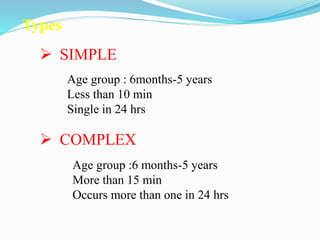
Types
 SIMPLE
 COMPLEX
Age group : 6months-5 years
Less than 10 min
Single in 24 hrs
Age group :6 months-5 years
More than 15 min
Occurs more than one in 24 hrs
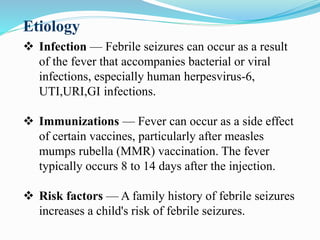
Etiology
 Infection — Febrile seizures can occur as a result
of the fever that accompanies bacterial or viral
infections, especially human herpesvirus-6,
UTI,URI,GI infections.
 Immunizations — Fever can occur as a side effect
of certain vaccines, particularly after measles
mumps rubella (MMR) vaccination. The fever
typically occurs 8 to 14 days after the injection.
 Risk factors — A family history of febrile seizures
increases a child's risk of febrile seizures.
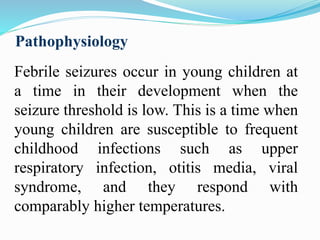
Pathophysiology
Febrile seizures occur in young children at
a time in their development when the
seizure threshold is low. This is a time when
young children are susceptible to frequent
childhood infections such as upper
respiratory infection, otitis media, viral
syndrome, and they respond with
comparably higher temperatures.
Preliminary studies in children appear to
support the hypothesis that the cytokine
network is activated and may have a role in
the pathogenesis of febrile seizures, but the
precise clinical and pathological significance
of these observations is not yet clear.
Animal studies suggest a possible role of
endogenous pyrogens, such as interleukin
1beta, that, by increasing neuronal
excitability, may link fever and seizure
activity.
Signs and Symptoms
Febrile seizures usually occur on the first day of illness, and in
some cases, the seizure is the first clue that the child is ill. Most
seizures occur when the temperature is higher than 102.2ºF
(39ºC).
 Simple — Simple febrile seizures are the most common.
Typically, the child loses consciousness and has a convulsion
or rhythmic twitching of the arms or legs. Most seizures do
not last more than one to two minutes, although they can last
up to 15 minutes. After the seizure, the child may be confused
or sleepy, but does not have arm or leg weakness.
 Complex — Complex febrile seizures are less common and
can last more than 15 minutes (or 30 minutes if in a series).
The child may have temporary weakness of an arm or a leg
after the seizure.
 Body Stiffness
 Limbs twitching
 Loss of consciousness
 Vomiting
 Foam at mouth
Demographic Details
Name : ABC Age : 1 yr 2 mnths Sex : F
I.P No : 37539 Dept. : Paediatrics Unit : A
D.O.A :31/10 /2016 D.O.D : 2/11/2016
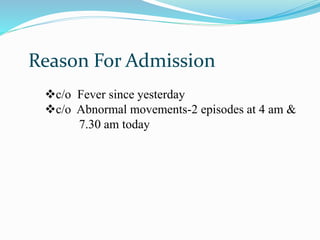
Reason For Admission
c/o Fever since yesterday
c/o Abnormal movements-2 episodes at 4 am &
7.30 am today
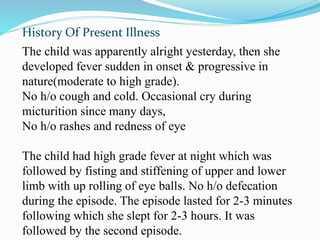
History Of Present Illness
The child was apparently alright yesterday, then she
developed fever sudden in onset & progressive in
nature(moderate to high grade).
No h/o cough and cold. Occasional cry during
micturition since many days,
No h/o rashes and redness of eye
The child had high grade fever at night which was
followed by fisting and stiffening of upper and lower
limb with up rolling of eye balls. No h/o defecation
during the episode. The episode lasted for 2-3 minutes
following which she slept for 2-3 hours. It was
followed by the second episode.
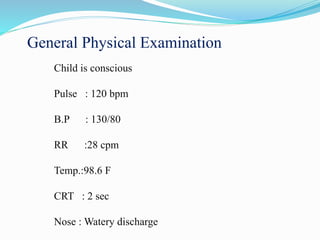
General Physical Examination
Child is conscious
Pulse : 120 bpm
B.P : 130/80
RR :28 cpm
Temp.:98.6 F
CRT : 2 sec
Nose : Watery discharge
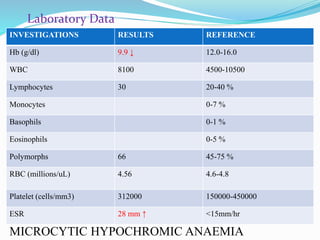
INVESTIGATIONS RESULTS REFERENCE
Hb (g/dl) 9.9 ↓ 12.0-16.0
WBC 8100 4500-10500
Lymphocytes 30 20-40 %
Monocytes 0-7 %
Basophils 0-1 %
Eosinophils 0-5 %
Polymorphs 66 45-75 %
RBC (millions/uL) 4.56 4.6-4.8
Platelet (cells/mm3) 312000 150000-450000
ESR 28 mm ↑ <15mm/hr
Laboratory Data
MICROCYTIC HYPOCHROMIC ANAEMIA
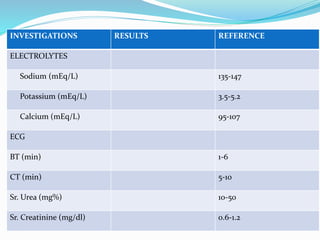
INVESTIGATIONS RESULTS REFERENCE
ELECTROLYTES
Sodium (mEq/L) 135-147
Potassium (mEq/L) 3.5-5.2
Calcium (mEq/L) 95-107
ECG
BT (min) 1-6
CT (min) 5-10
Sr. Urea (mg%) 10-50
Sr. Creatinine (mg/dl) 0.6-1.2
Provisional Diagnosis :
FEBRILE SEIZURES
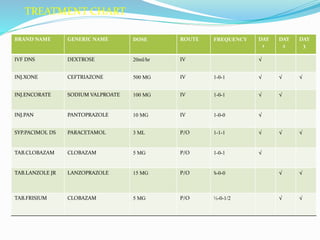
TREATMENT CHART
BRAND NAME GENERIC NAME DOSE ROUTE FREQUENCY DAY
1
DAY
2
DAY
3
IVF DNS DEXTROSE 20ml/hr IV √
INJ.XONE CEFTRIAZONE 500 MG IV 1-0-1 √ √ √
INJ.ENCORATE SODIUM VALPROATE 100 MG IV 1-0-1 √ √
INJ.PAN PANTOPRAZOLE 10 MG IV 1-0-0 √
SYP.PACIMOL DS PARACETAMOL 3 ML P/O 1-1-1 √ √ √
TAB.CLOBAZAM CLOBAZAM 5 MG P/O 1-0-1 √
TAB.LANZOLE JR LANZOPRAZOLE 15 MG P/O ¾-0-0 √ √
TAB.FRISIUM CLOBAZAM 5 MG P/O ½-0-1/2 √ √
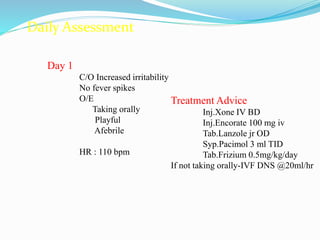
Daily Assessment
Day 1
C/O Increased irritability
No fever spikes
O/E
Taking orally
Playful
Afebrile
HR : 110 bpm
Treatment Advice
Inj.Xone IV BD
Inj.Encorate 100 mg iv
Tab.Lanzole jr OD
Syp.Pacimol 3 ml TID
Tab.Frizium 0.5mg/kg/day
If not taking orally-IVF DNS @20ml/hr
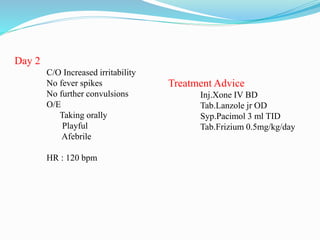
Day 2
C/O Increased irritability
No fever spikes
No further convulsions
O/E
Taking orally
Playful
Afebrile
HR : 120 bpm
Treatment Advice
Inj.Xone IV BD
Tab.Lanzole jr OD
Syp.Pacimol 3 ml TID
Tab.Frizium 0.5mg/kg/day
FINAL DIAGNOSIS
FEBRILE SEIZURES
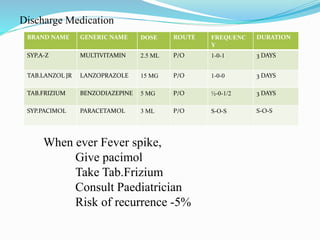
Discharge Medication
BRAND NAME GENERIC NAME DOSE ROUTE FREQUENC
Y
DURATION
SYP.A-Z MULTIVITAMIN 2.5 ML P/O 1-0-1 3 DAYS
TAB.LANZOL JR LANZOPRAZOLE 15 MG P/O 1-0-0 3 DAYS
TAB.FRIZIUM BENZODIAZEPINE 5 MG P/O ½-0-1/2 3 DAYS
SYP.PACIMOL PARACETAMOL 3 ML P/O S-O-S S-O-S
When ever Fever spike,
Give pacimol
Take Tab.Frizium
Consult Paediatrician
Risk of recurrence -5%
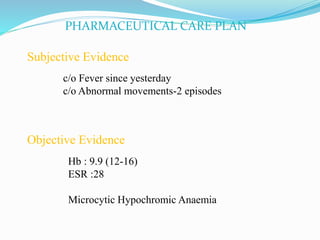
PHARMACEUTICAL CARE PLAN
Subjective Evidence
c/o Fever since yesterday
c/o Abnormal movements-2 episodes
Objective Evidence
Hb : 9.9 (12-16)
ESR :28
Microcytic Hypochromic Anaemia
Assessment
Based on the Subjective and Objective evidences ,
it is assessed that the patient is suffering from
FEBRILE SEIZURES
Plan
Treatment Goals
 To reduce Fever
 To reduce seizure episode
 To prevent recurrence of disease
 Fever reduced
 No recurrence were seen
Patient Counselling
About disease
A febrile seizure, also known as a fever fit
or febrile convulsion, is a seizure associated
with a high body temperature but without
any serious underlying health issue. They
most commonly occur in children between
the ages of 6 months and 5 years.
About Drugs
Continuous therapy with Valproate
decreases the occurrence of subsequent
febrile seizures
Oral diazepam can reduce the risk of
subsequent febrile seizures
Life Style Modification
 Place your child on a surface where
he/she won’t fall.
 Stay close to watch and comfort your
child
 Remove hard or sharp objects near
your child
 Maintain hygienic surroundings
 Avoid use of tight clothes
Febrile seizures

Febrile seizures

  • 1.
    BASIL WILSON 13Q0408 PHARM DIVth yr CASE PRESENTATION ON
  • 2.
    Definition A febrile seizure,also known as a fever fit or febrile convulsion, is a seizure associated with a high body temperature but without any serious underlying health issue. They most commonly occur in children between the ages of 6 months and 5 years.
  • 3.
    Types  SIMPLE  COMPLEX Agegroup : 6months-5 years Less than 10 min Single in 24 hrs Age group :6 months-5 years More than 15 min Occurs more than one in 24 hrs
  • 4.
    Etiology  Infection —Febrile seizures can occur as a result of the fever that accompanies bacterial or viral infections, especially human herpesvirus-6, UTI,URI,GI infections.  Immunizations — Fever can occur as a side effect of certain vaccines, particularly after measles mumps rubella (MMR) vaccination. The fever typically occurs 8 to 14 days after the injection.  Risk factors — A family history of febrile seizures increases a child's risk of febrile seizures.
  • 5.
    Pathophysiology Febrile seizures occurin young children at a time in their development when the seizure threshold is low. This is a time when young children are susceptible to frequent childhood infections such as upper respiratory infection, otitis media, viral syndrome, and they respond with comparably higher temperatures.
  • 6.
    Preliminary studies inchildren appear to support the hypothesis that the cytokine network is activated and may have a role in the pathogenesis of febrile seizures, but the precise clinical and pathological significance of these observations is not yet clear. Animal studies suggest a possible role of endogenous pyrogens, such as interleukin 1beta, that, by increasing neuronal excitability, may link fever and seizure activity.
  • 7.
    Signs and Symptoms Febrileseizures usually occur on the first day of illness, and in some cases, the seizure is the first clue that the child is ill. Most seizures occur when the temperature is higher than 102.2ºF (39ºC).  Simple — Simple febrile seizures are the most common. Typically, the child loses consciousness and has a convulsion or rhythmic twitching of the arms or legs. Most seizures do not last more than one to two minutes, although they can last up to 15 minutes. After the seizure, the child may be confused or sleepy, but does not have arm or leg weakness.  Complex — Complex febrile seizures are less common and can last more than 15 minutes (or 30 minutes if in a series). The child may have temporary weakness of an arm or a leg after the seizure.
  • 8.
     Body Stiffness Limbs twitching  Loss of consciousness  Vomiting  Foam at mouth
  • 9.
    Demographic Details Name :ABC Age : 1 yr 2 mnths Sex : F I.P No : 37539 Dept. : Paediatrics Unit : A D.O.A :31/10 /2016 D.O.D : 2/11/2016
  • 10.
    Reason For Admission c/oFever since yesterday c/o Abnormal movements-2 episodes at 4 am & 7.30 am today
  • 11.
    History Of PresentIllness The child was apparently alright yesterday, then she developed fever sudden in onset & progressive in nature(moderate to high grade). No h/o cough and cold. Occasional cry during micturition since many days, No h/o rashes and redness of eye The child had high grade fever at night which was followed by fisting and stiffening of upper and lower limb with up rolling of eye balls. No h/o defecation during the episode. The episode lasted for 2-3 minutes following which she slept for 2-3 hours. It was followed by the second episode.
  • 12.
    General Physical Examination Childis conscious Pulse : 120 bpm B.P : 130/80 RR :28 cpm Temp.:98.6 F CRT : 2 sec Nose : Watery discharge
  • 13.
    INVESTIGATIONS RESULTS REFERENCE Hb(g/dl) 9.9 ↓ 12.0-16.0 WBC 8100 4500-10500 Lymphocytes 30 20-40 % Monocytes 0-7 % Basophils 0-1 % Eosinophils 0-5 % Polymorphs 66 45-75 % RBC (millions/uL) 4.56 4.6-4.8 Platelet (cells/mm3) 312000 150000-450000 ESR 28 mm ↑ <15mm/hr Laboratory Data MICROCYTIC HYPOCHROMIC ANAEMIA
  • 14.
    INVESTIGATIONS RESULTS REFERENCE ELECTROLYTES Sodium(mEq/L) 135-147 Potassium (mEq/L) 3.5-5.2 Calcium (mEq/L) 95-107 ECG BT (min) 1-6 CT (min) 5-10 Sr. Urea (mg%) 10-50 Sr. Creatinine (mg/dl) 0.6-1.2
  • 15.
  • 16.
    TREATMENT CHART BRAND NAMEGENERIC NAME DOSE ROUTE FREQUENCY DAY 1 DAY 2 DAY 3 IVF DNS DEXTROSE 20ml/hr IV √ INJ.XONE CEFTRIAZONE 500 MG IV 1-0-1 √ √ √ INJ.ENCORATE SODIUM VALPROATE 100 MG IV 1-0-1 √ √ INJ.PAN PANTOPRAZOLE 10 MG IV 1-0-0 √ SYP.PACIMOL DS PARACETAMOL 3 ML P/O 1-1-1 √ √ √ TAB.CLOBAZAM CLOBAZAM 5 MG P/O 1-0-1 √ TAB.LANZOLE JR LANZOPRAZOLE 15 MG P/O ¾-0-0 √ √ TAB.FRISIUM CLOBAZAM 5 MG P/O ½-0-1/2 √ √
  • 17.
    Daily Assessment Day 1 C/OIncreased irritability No fever spikes O/E Taking orally Playful Afebrile HR : 110 bpm Treatment Advice Inj.Xone IV BD Inj.Encorate 100 mg iv Tab.Lanzole jr OD Syp.Pacimol 3 ml TID Tab.Frizium 0.5mg/kg/day If not taking orally-IVF DNS @20ml/hr
  • 18.
    Day 2 C/O Increasedirritability No fever spikes No further convulsions O/E Taking orally Playful Afebrile HR : 120 bpm Treatment Advice Inj.Xone IV BD Tab.Lanzole jr OD Syp.Pacimol 3 ml TID Tab.Frizium 0.5mg/kg/day
  • 19.
  • 20.
    Discharge Medication BRAND NAMEGENERIC NAME DOSE ROUTE FREQUENC Y DURATION SYP.A-Z MULTIVITAMIN 2.5 ML P/O 1-0-1 3 DAYS TAB.LANZOL JR LANZOPRAZOLE 15 MG P/O 1-0-0 3 DAYS TAB.FRIZIUM BENZODIAZEPINE 5 MG P/O ½-0-1/2 3 DAYS SYP.PACIMOL PARACETAMOL 3 ML P/O S-O-S S-O-S When ever Fever spike, Give pacimol Take Tab.Frizium Consult Paediatrician Risk of recurrence -5%
  • 21.
    PHARMACEUTICAL CARE PLAN SubjectiveEvidence c/o Fever since yesterday c/o Abnormal movements-2 episodes Objective Evidence Hb : 9.9 (12-16) ESR :28 Microcytic Hypochromic Anaemia
  • 22.
    Assessment Based on theSubjective and Objective evidences , it is assessed that the patient is suffering from FEBRILE SEIZURES
  • 23.
    Plan Treatment Goals  Toreduce Fever  To reduce seizure episode  To prevent recurrence of disease
  • 24.
     Fever reduced No recurrence were seen
  • 25.
    Patient Counselling About disease Afebrile seizure, also known as a fever fit or febrile convulsion, is a seizure associated with a high body temperature but without any serious underlying health issue. They most commonly occur in children between the ages of 6 months and 5 years.
  • 26.
    About Drugs Continuous therapywith Valproate decreases the occurrence of subsequent febrile seizures Oral diazepam can reduce the risk of subsequent febrile seizures
  • 27.
    Life Style Modification Place your child on a surface where he/she won’t fall.  Stay close to watch and comfort your child  Remove hard or sharp objects near your child  Maintain hygienic surroundings  Avoid use of tight clothes