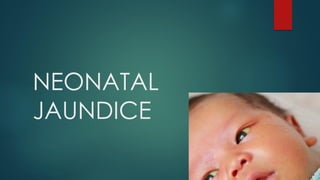
NEONATAL
JAUNDICE
Questions
 1. What is neonatal jaundice ?
 2. What causes NJ?
 3. How do you identify a baby with NJ?
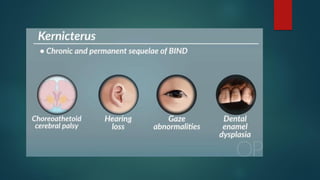
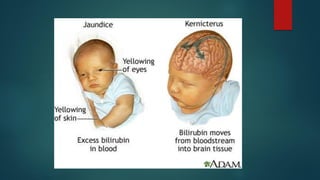
 4.What are some complications of NJ?
 5. What tests can you conduct to confirm NJ?
 6. What are precautions taken in phototherapy ?
 7.What are the types of phototherapy?
 8. What are complications of phototherapy ?
What is the Neonatal Jaundice?
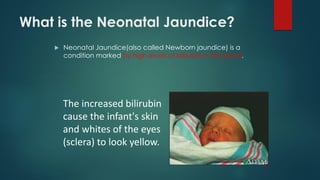
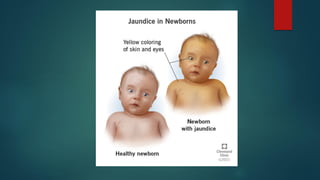
 Neonatal Jaundice(also called Newborn jaundice) is a
condition marked by high levels of bilirubin in the blood.
The increased bilirubin
cause the infant's skin
and whites of the eyes
(sclera) to look yellow.
Neonatal Jaundice
ļ‚žVisible form of bilirubinemia
›Adult sclera >2mg / dl
›Newborn skin >5 mg / dl
ļ‚žOccurs in 60% of term and 80% of preterm
neonates
ļ‚žHowever, significant jaundice occurs in
6 % of term babies
Teaching Aids:
Special characteristic in neonates
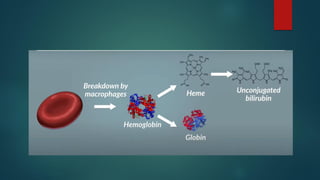
• 1.More billirubin produced
• Much more Hemolysis
• The life-length of hemolysis(70~80)
Special characteristic in neonates
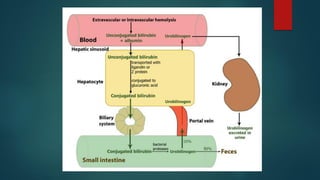
• 2.The low capability of albumin
on unconjugated billirubin
transportation
• acid intoxication
• Less albumin in neonates
Special characteristic in neonates
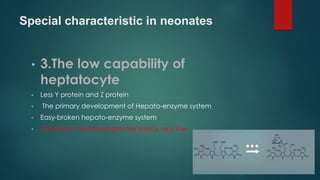
• 3.The low capability of
heptatocyte
• Less Y protein and Z protein
• The primary development of Hepato-enzyme system
• Easy-broken hepato-enzyme system
• After-born, the blood glucose level is very low.
Special characteristic in neonates
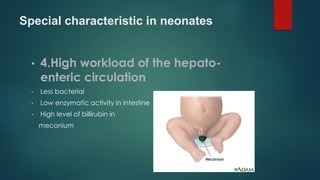
• 4.High workload of the hepato-
enteric circulation
• Less bacterial
• Low enzymatic activity in intestine
• High level of billirubin in
meconium
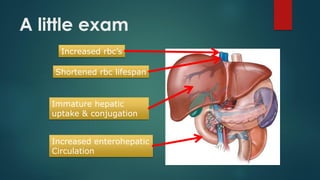
A little exam
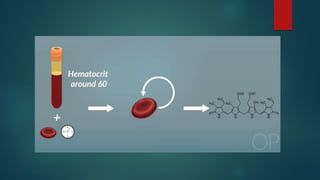
Increased rbc’s
Shortened rbc lifespan
Immature hepatic
uptake & conjugation
Increased enterohepatic
Circulation
Physiological jaundice
Characteristics
ļ‚žAppears after 24 hours
ļ‚žMaximum intensity by 4th-5th day in term &
7th day in preterm
ļ‚žSerum level less than 15 mg / dl
ļ‚žClinically not detectable after 14 days
ļ‚žDisappears without any treatment
Note: Baby should, however, be watched for
worsening of jaundice
Teaching Aids:
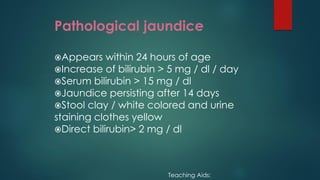
Pathological jaundice
ļ‚žAppears within 24 hours of age
ļ‚žIncrease of bilirubin > 5 mg / dl / day
ļ‚žSerum bilirubin > 15 mg / dl
ļ‚žJaundice persisting after 14 days
ļ‚žStool clay / white colored and urine
staining clothes yellow
ļ‚žDirect bilirubin> 2 mg / dl
Teaching Aids:
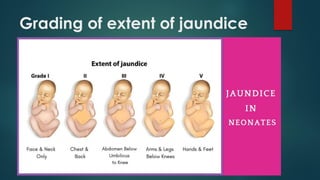
Grading of extent of jaundice
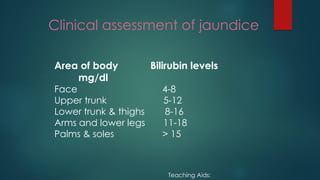
Clinical assessment of jaundice
Area of body Bilirubin levels
mg/dl
Face 4-8
Upper trunk 5-12
Lower trunk & thighs 8-16
Arms and lower legs 11-18
Palms & soles > 15
Teaching Aids:
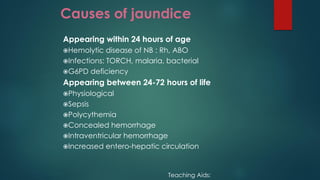
Causes of jaundice
Appearing within 24 hours of age
ļ‚žHemolytic disease of NB : Rh, ABO
ļ‚žInfections: TORCH, malaria, bacterial
ļ‚žG6PD deficiency
Appearing between 24-72 hours of life
ļ‚žPhysiological
ļ‚žSepsis
ļ‚žPolycythemia
ļ‚žConcealed hemorrhage
ļ‚žIntraventricular hemorrhage
ļ‚žIncreased entero-hepatic circulation
Teaching Aids:
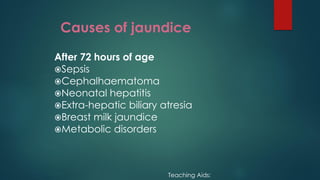
Causes of jaundice
After 72 hours of age
ļ‚žSepsis
ļ‚žCephalhaematoma
ļ‚žNeonatal hepatitis
ļ‚žExtra-hepatic biliary atresia
ļ‚žBreast milk jaundice
ļ‚žMetabolic disorders
Teaching Aids:
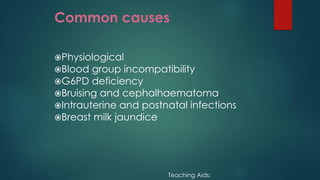
Common causes
ļ‚žPhysiological
ļ‚žBlood group incompatibility
ļ‚žG6PD deficiency
ļ‚žBruising and cephalhaematoma
ļ‚žIntrauterine and postnatal infections
ļ‚žBreast milk jaundice
Teaching Aids:
Approach to jaundiced baby
o birth weight
o gestation and postnatal age
o Assess clinical condition (well or ill)
physiological or pathological
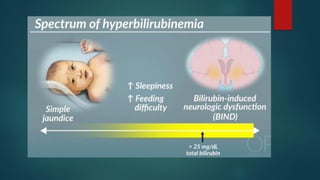
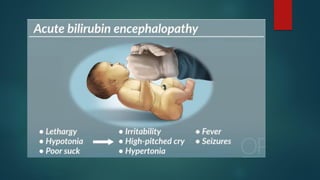
o Look for evidence of kernicterus* in deeply
jaundiced NB
o *Lethargy and poor feeding, poor or absent
Moro's, opisthotonus or convulsions
Teaching Aids:
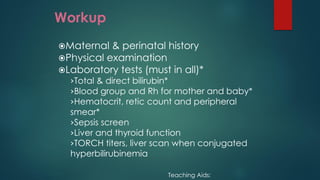
Workup
ļ‚žMaternal & perinatal history
ļ‚žPhysical examination
ļ‚žLaboratory tests (must in all)*
›Total & direct bilirubin*
›Blood group and Rh for mother and baby*
›Hematocrit, retic count and peripheral
smear*
›Sepsis screen
›Liver and thyroid function
›TORCH titers, liver scan when conjugated
hyperbilirubinemia
Teaching Aids:
Management
ļ‚žRationale: reduce level of serum bilirubin
and prevent bilirubin toxicity
ļ‚žPrevention of hyperbilirubinemia: early
feeds, adequate hydration
ļ‚žReduction of bilirubin levels:
phototherapy, exchange transfusion, drugs
Teaching Aids:
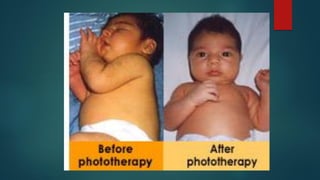
Phototherapy
 The effect of light on jaundice in neonates, and the ability of light to
decrease serum bilirubin levels, was first described by Cremer et al in
1958
 A commonly used rule of thumb in the NICU is to start phototherapy
when the total serum bilirubin level is greater than 5 times the birth
weight.
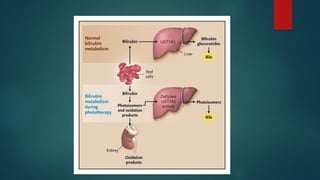
Principle of phototherapy
Native bilirubin Photo isomers of bilirubin
Insoluble Soluble
450-460nm
of light
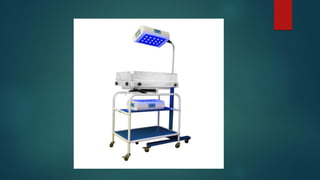
Phototherapy equipment
ļ‚žWhite light tubes 6-8*/ 4 blue light tubes
ļ‚žCradle or incubator
ļ‚žEye shades
*May use 150 W halogen bulb
Teaching Aids:
Phototherapy
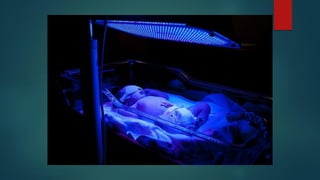
Technique
ļ‚žPerform hand wash
ļ‚žPlace baby naked in cradle or incubator
ļ‚žFix eye shades
ļ‚žKeep baby at least 45 cm from lights, if
using closer monitor temperature of baby
ļ‚žStart phototherapy
Teaching Aids:
Phototherapy
ļ‚žFrequent extra breast feeding every 2
hourly
ļ‚žTurn baby after each feed
ļ‚žTemperature record 2 to 4 hourly
ļ‚žWeight record- daily
ļ‚žMonitor urine frequency
ļ‚žMonitor bilirubin level
Teaching Aids:
Key point in the practical
execution of phototherapy
1-The infant should be naked except for diaper
, eye to be covered
2- distance between the skin and light source .
3-when used spotlight , the infant is placed in
centre .
4- routinely add 10-15% extra fluid .
5- timing of follow -up S.B testing must be
individualized.
Side effects of phototherapy
ļ‚žIncreased insensible water loss
ļ‚žLoose stools
ļ‚žSkin rash
ļ‚žBronze baby syndrome
ļ‚žHyperthermia
ļ‚žUpsets maternal baby interaction
ļ‚žMay result in hypocalcemia
Teaching Aids:
Choice of blood for exchange
blood transfusion
ļ‚žABO incompatibility
›Use O blood of same Rh type, ideal O cells
suspended in AB plasma
ļ‚žRh isoimmunization
›Emergency 0 -ve blood
Ideal 0 -ve suspended in AB plasma or
baby's blood group but Rh -ve
ļ‚žOther situations
›Baby's blood group
Teaching Aids:
DRUGS
 Phenobarbitone- increases y&z ligandin receptors-induces liver
enzymes-increases conjugation
 Metalloporphyrins- tin&zinc-inhibits heme oxygenase
 IVIG- inhibits heamolysis
 Oral agar agar &cholestyramine- decreases entero hepatic
circulation
 Albumin infusions-increases bilirubin binding
Prolonged indirect jaundice
Causes
ļ‚žCrigler Najjar syndrome
ļ‚žBreast milk jaundice
ļ‚žHypothyroidism
ļ‚žPyloric stenosis
ļ‚žOngoing hemolysis, malaria
Teaching Aids:
N
J
-
4
6
Conjugated hyperbilirubinemia
Suspect
ļ‚žHigh colored urine
ļ‚žWhite or clay colored stool
Caution
Always refer to hospital for investigations so
that biliary atresia or metabolic disorders can
be diagnosed and managed early
Teaching Aids:
Conjugated hyperbilirubinemia
Causes
ļ‚žIdiopathic neonatal hepatitis
ļ‚žInfections -Hepatitis B, TORCH, sepsis
ļ‚žBiliary atresia, choledochal cyst
ļ‚žMetabolic -Galactosemia, tyrosinemia,
hypothyroidism
ļ‚žTotal parenteral nutrition
Teaching Aids:
THANK YOU

NEONATAL JAUNDICE PPT.pdf

  • 1.
  • 2.
    Questions  1. Whatis neonatal jaundice ?  2. What causes NJ?  3. How do you identify a baby with NJ?  4.What are some complications of NJ?  5. What tests can you conduct to confirm NJ?  6. What are precautions taken in phototherapy ?  7.What are the types of phototherapy?  8. What are complications of phototherapy ?
  • 3.
    What is theNeonatal Jaundice?  Neonatal Jaundice(also called Newborn jaundice) is a condition marked by high levels of bilirubin in the blood. The increased bilirubin cause the infant's skin and whites of the eyes (sclera) to look yellow.
  • 5.
    Neonatal Jaundice ļ‚žVisible formof bilirubinemia ›Adult sclera >2mg / dl ›Newborn skin >5 mg / dl ļ‚žOccurs in 60% of term and 80% of preterm neonates ļ‚žHowever, significant jaundice occurs in 6 % of term babies Teaching Aids:
  • 13.
    Special characteristic inneonates • 1.More billirubin produced • Much more Hemolysis • The life-length of hemolysis(70~80)
  • 15.
    Special characteristic inneonates • 2.The low capability of albumin on unconjugated billirubin transportation • acid intoxication • Less albumin in neonates
  • 16.
    Special characteristic inneonates • 3.The low capability of heptatocyte • Less Y protein and Z protein • The primary development of Hepato-enzyme system • Easy-broken hepato-enzyme system • After-born, the blood glucose level is very low.
  • 17.
    Special characteristic inneonates • 4.High workload of the hepato- enteric circulation • Less bacterial • Low enzymatic activity in intestine • High level of billirubin in meconium
  • 19.
    A little exam Increasedrbc’s Shortened rbc lifespan Immature hepatic uptake & conjugation Increased enterohepatic Circulation
  • 20.
    Physiological jaundice Characteristics ļ‚žAppears after24 hours ļ‚žMaximum intensity by 4th-5th day in term & 7th day in preterm ļ‚žSerum level less than 15 mg / dl ļ‚žClinically not detectable after 14 days ļ‚žDisappears without any treatment Note: Baby should, however, be watched for worsening of jaundice Teaching Aids:
  • 21.
    Pathological jaundice ļ‚žAppears within24 hours of age ļ‚žIncrease of bilirubin > 5 mg / dl / day ļ‚žSerum bilirubin > 15 mg / dl ļ‚žJaundice persisting after 14 days ļ‚žStool clay / white colored and urine staining clothes yellow ļ‚žDirect bilirubin> 2 mg / dl Teaching Aids:
  • 22.
    Grading of extentof jaundice
  • 23.
    Clinical assessment ofjaundice Area of body Bilirubin levels mg/dl Face 4-8 Upper trunk 5-12 Lower trunk & thighs 8-16 Arms and lower legs 11-18 Palms & soles > 15 Teaching Aids:
  • 24.
    Causes of jaundice Appearingwithin 24 hours of age ļ‚žHemolytic disease of NB : Rh, ABO ļ‚žInfections: TORCH, malaria, bacterial ļ‚žG6PD deficiency Appearing between 24-72 hours of life ļ‚žPhysiological ļ‚žSepsis ļ‚žPolycythemia ļ‚žConcealed hemorrhage ļ‚žIntraventricular hemorrhage ļ‚žIncreased entero-hepatic circulation Teaching Aids:
  • 25.
    Causes of jaundice After72 hours of age ļ‚žSepsis ļ‚žCephalhaematoma ļ‚žNeonatal hepatitis ļ‚žExtra-hepatic biliary atresia ļ‚žBreast milk jaundice ļ‚žMetabolic disorders Teaching Aids:
  • 26.
    Common causes ļ‚žPhysiological ļ‚žBlood groupincompatibility ļ‚žG6PD deficiency ļ‚žBruising and cephalhaematoma ļ‚žIntrauterine and postnatal infections ļ‚žBreast milk jaundice Teaching Aids:
  • 27.
    Approach to jaundicedbaby o birth weight o gestation and postnatal age o Assess clinical condition (well or ill) physiological or pathological o Look for evidence of kernicterus* in deeply jaundiced NB o *Lethargy and poor feeding, poor or absent Moro's, opisthotonus or convulsions Teaching Aids:
  • 28.
    Workup ļ‚žMaternal & perinatalhistory ļ‚žPhysical examination ļ‚žLaboratory tests (must in all)* ›Total & direct bilirubin* ›Blood group and Rh for mother and baby* ›Hematocrit, retic count and peripheral smear* ›Sepsis screen ›Liver and thyroid function ›TORCH titers, liver scan when conjugated hyperbilirubinemia Teaching Aids:
  • 31.
    Management ļ‚žRationale: reduce levelof serum bilirubin and prevent bilirubin toxicity ļ‚žPrevention of hyperbilirubinemia: early feeds, adequate hydration ļ‚žReduction of bilirubin levels: phototherapy, exchange transfusion, drugs Teaching Aids:
  • 32.
    Phototherapy  The effectof light on jaundice in neonates, and the ability of light to decrease serum bilirubin levels, was first described by Cremer et al in 1958  A commonly used rule of thumb in the NICU is to start phototherapy when the total serum bilirubin level is greater than 5 times the birth weight.
  • 33.
    Principle of phototherapy Nativebilirubin Photo isomers of bilirubin Insoluble Soluble 450-460nm of light
  • 38.
    Phototherapy equipment ļ‚žWhite lighttubes 6-8*/ 4 blue light tubes ļ‚žCradle or incubator ļ‚žEye shades *May use 150 W halogen bulb Teaching Aids:
  • 39.
    Phototherapy Technique ļ‚žPerform hand wash ļ‚žPlacebaby naked in cradle or incubator ļ‚žFix eye shades ļ‚žKeep baby at least 45 cm from lights, if using closer monitor temperature of baby ļ‚žStart phototherapy Teaching Aids:
  • 40.
    Phototherapy ļ‚žFrequent extra breastfeeding every 2 hourly ļ‚žTurn baby after each feed ļ‚žTemperature record 2 to 4 hourly ļ‚žWeight record- daily ļ‚žMonitor urine frequency ļ‚žMonitor bilirubin level Teaching Aids:
  • 41.
    Key point inthe practical execution of phototherapy 1-The infant should be naked except for diaper , eye to be covered 2- distance between the skin and light source . 3-when used spotlight , the infant is placed in centre . 4- routinely add 10-15% extra fluid . 5- timing of follow -up S.B testing must be individualized.
  • 43.
    Side effects ofphototherapy ļ‚žIncreased insensible water loss ļ‚žLoose stools ļ‚žSkin rash ļ‚žBronze baby syndrome ļ‚žHyperthermia ļ‚žUpsets maternal baby interaction ļ‚žMay result in hypocalcemia Teaching Aids:
  • 44.
    Choice of bloodfor exchange blood transfusion ļ‚žABO incompatibility ›Use O blood of same Rh type, ideal O cells suspended in AB plasma ļ‚žRh isoimmunization ›Emergency 0 -ve blood Ideal 0 -ve suspended in AB plasma or baby's blood group but Rh -ve ļ‚žOther situations ›Baby's blood group Teaching Aids:
  • 45.
    DRUGS  Phenobarbitone- increasesy&z ligandin receptors-induces liver enzymes-increases conjugation  Metalloporphyrins- tin&zinc-inhibits heme oxygenase  IVIG- inhibits heamolysis  Oral agar agar &cholestyramine- decreases entero hepatic circulation  Albumin infusions-increases bilirubin binding
  • 46.
    Prolonged indirect jaundice Causes ļ‚žCriglerNajjar syndrome ļ‚žBreast milk jaundice ļ‚žHypothyroidism ļ‚žPyloric stenosis ļ‚žOngoing hemolysis, malaria Teaching Aids: N J - 4 6
  • 47.
    Conjugated hyperbilirubinemia Suspect ļ‚žHigh coloredurine ļ‚žWhite or clay colored stool Caution Always refer to hospital for investigations so that biliary atresia or metabolic disorders can be diagnosed and managed early Teaching Aids:
  • 48.
    Conjugated hyperbilirubinemia Causes ļ‚žIdiopathic neonatalhepatitis ļ‚žInfections -Hepatitis B, TORCH, sepsis ļ‚žBiliary atresia, choledochal cyst ļ‚žMetabolic -Galactosemia, tyrosinemia, hypothyroidism ļ‚žTotal parenteral nutrition Teaching Aids:
  • 49.