Neonatal jaundice
Neonatal Jaundice
• Learning Objectives:
• Define hyperbilirubinemia.
• Differentiate between physiological and
  pathological jaundice.
• State causes of hyperbilirubinemia.
• Discuss the pathophysiology of
  hyperbilirubinemia.
• Describe the most dangerous complication
  of hyperbilirubinemia.
• List the three elements of therapeutic
  management.
• Design plan of care for baby has
  hyperbilirubinemia.                     NJ -
Neonatal Jaundice
            (Hyperbilirubinemia)

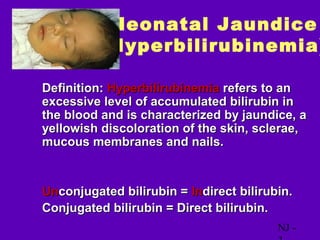
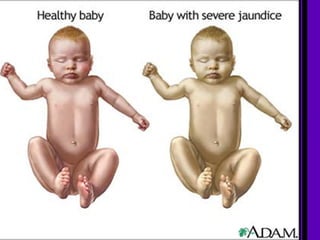
• Definition: Hyperbilirubinemia refers to an
  excessive level of accumulated bilirubin in
  the blood and is characterized by jaundice, a
  yellowish discoloration of the skin, sclerae,
  mucous membranes and nails.


• Unconjugated bilirubin = Indirect bilirubin.
• Conjugated bilirubin = Direct bilirubin.
                                           NJ -
NJ -
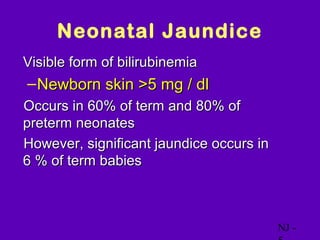
Neonatal Jaundice
• Visible form of bilirubinemia
  – Newborn skin >5 mg / dl
Occurs in 60% of term and 80% of
 preterm neonates
However, significant jaundice occurs in
 6 % of term babies


                                           NJ -
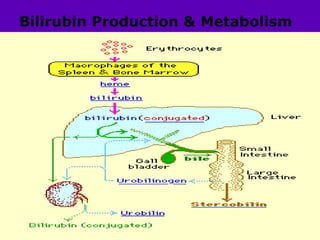
Bilirubin Production & Metabolism


                               NJ -
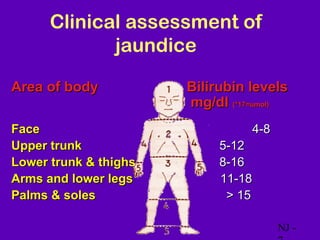
Clinical assessment of
             jaundice

Area of body           Bilirubin levels
                       mg/dl (*17=umol)
Face                             4-8
Upper trunk                 5-12
Lower trunk & thighs        8-16
Arms and lower legs         11-18
Palms & soles                > 15

                                       NJ -
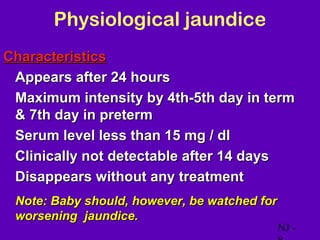
Physiological jaundice
Characteristics
• Appears after 24 hours
• Maximum intensity by 4th-5th day in term
  & 7th day in preterm
• Serum level less than 15 mg / dl
• Clinically not detectable after 14 days
• Disappears without any treatment
 Note: Baby should, however, be watched for
 worsening jaundice.
                                              NJ -
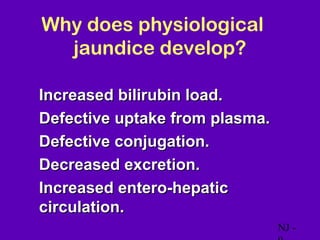
Why does physiological
      jaundice develop?

•   Increased bilirubin load.
•   Defective uptake from plasma.
•   Defective conjugation.
•   Decreased excretion.
•   Increased entero-hepatic
    circulation.
                                    NJ -
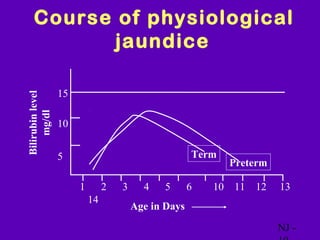
Course of physiological
           jaundice

                  15
Bilirubin level
     mg/dl


                  10


                  5                                   Term
                                                               Preterm

                       1        2   3     4    5      6   10   11   12   13
                           14
                                        Age in Days

                                                                         NJ -
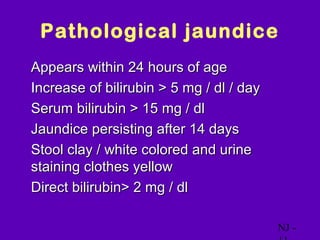
Pathological jaundice
• Appears within 24 hours of age
• Increase of bilirubin > 5 mg / dl / day
• Serum bilirubin > 15 mg / dl
• Jaundice persisting after 14 days
• Stool clay / white colored and urine
  staining clothes yellow
• Direct bilirubin> 2 mg / dl


                                            NJ -
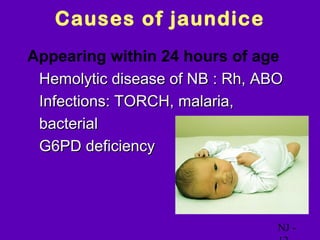
Causes of jaundice
Appearing within 24 hours of age
• Hemolytic disease of NB : Rh, ABO
• Infections: TORCH, malaria,
  bacterial
• G6PD deficiency


                                  NJ -
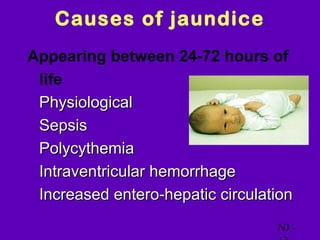
Causes of jaundice
Appearing between 24-72 hours of
  life
• Physiological
• Sepsis
• Polycythemia
• Intraventricular hemorrhage
• Increased entero-hepatic circulation

                                   NJ -
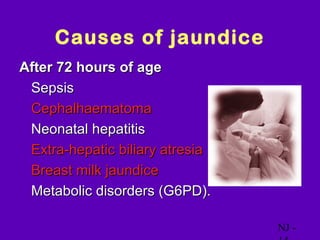
Causes of jaundice
After 72 hours of age
• Sepsis
• Cephalhaematoma
• Neonatal hepatitis
• Extra-hepatic biliary atresia
• Breast milk jaundice
• Metabolic disorders (G6PD).

                                  NJ -
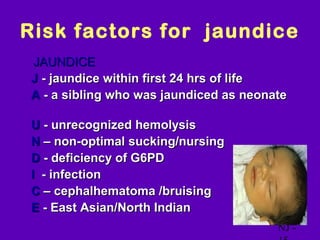
Risk factors for jaundice
  JAUNDICE
• J - jaundice within first 24 hrs of life
• A - a sibling who was jaundiced as neonate

•   U - unrecognized hemolysis
•   N – non-optimal sucking/nursing
•   D - deficiency of G6PD
•   I - infection
•   C – cephalhematoma /bruising
•   E - East Asian/North Indian
                                          NJ -
Diagnostic evaluation:

• Normal values of unconjugated B. are
  0.2 to 1.4 mg/dL.
• Investigate the cause of jaundice.


                                       NJ -
Therapeutic Management
• Purposes: reduce level of serum bilirubin
  and prevent bilirubin toxicity
• Prevention of hyperbilirubinemia: early
  feeds, adequate hydration
• Reduction of bilirubin levels: phototherapy,
  exchange transfusion,
• Drugs Use of Phenobarbital promote
  liver enzymes and protein synthesis.

                                          NJ -
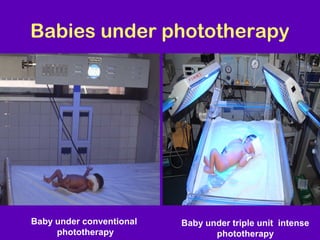
Babies under phototherapy


Baby under conventional   Baby under triple unit intense
     phototherapy                phototherapy
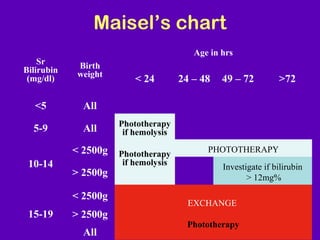
Maisel’s chart
                                          Age in hrs
    Sr       Birth
Bilirubin    weight
 (mg/dl)                  < 24        24 – 48    49 – 72         >72

   <5         All
                      Phototherapy
  5-9         All      if hemolysis

            < 2500g   Phototherapy           PHOTOTHERAPY
 10-14                 if hemolysis              Investigate if bilirubin
            > 2500g                                     > 12mg%

            < 2500g
                                        EXCHANGE
 15-19      > 2500g                   Consider Exchange
                                        Phototherapy
              All
Prognosis
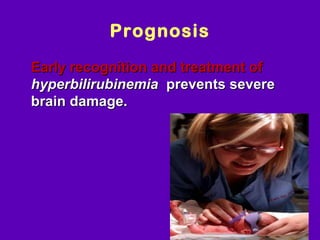
• Early recognition and treatment of
 hyperbilirubinemia prevents severe
 brain damage.


                                       NJ -
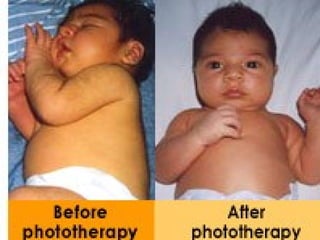
phototherapy
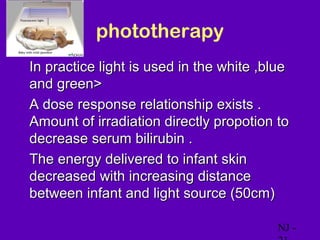
• In practice light is used in the white ,blue
  and green>
• A dose response relationship exists .
  Amount of irradiation directly propotion to
  decrease serum bilirubin .
• The energy delivered to infant skin
  decreased with increasing distance
  between infant and light source (50cm)

                                            NJ -
phototherapy
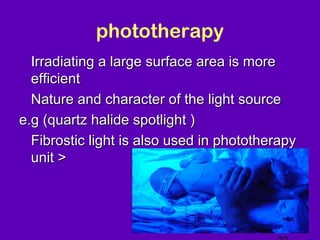
• Irradiating a large surface area is more
  efficient
• Nature and character of the light source
e.g (quartz halide spotlight )
• Fibrostic light is also used in phototherapy
  unit >


                                             NJ -
Key point in the practical
  execution of phototherapy
1- The infant should be naked except for
  diaper , eye to be covered
2- distance between the skin and light
  source .
3-when used spotlight , the infant is placed
  in centre .
4- routinely add 10-15% extra fluid .
5- timing of follow -up S.B testing must be
  indevedualized.
                                          NJ -
Adverse effect of photo
          therapy
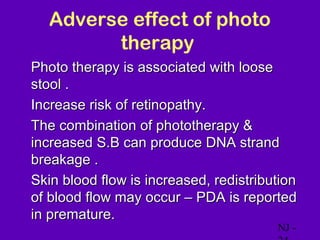
• Photo therapy is associated with loose
  stool .
• Increase risk of retinopathy.
• The combination of phototherapy &
  increased S.B can produce DNA strand
  breakage .
• Skin blood flow is increased, redistribution
  of blood flow may occur – PDA is reported
  in premature.
                                           NJ -
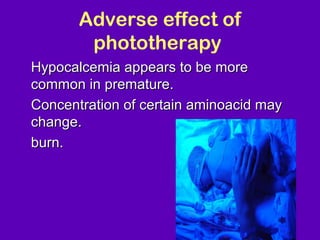
Adverse effect of
          phototherapy
• Hypocalcemia appears to be more
  common in premature.
• Concentration of certain aminoacid may
  change.
• burn.


                                       NJ -
NJ -
Nursing considerations of
        Hyperbilirubinemia
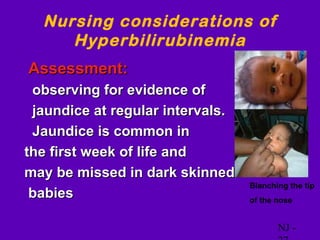
•   Assessment:
 observing for evidence of
  jaundice at regular intervals.
 Jaundice is common in
 the first week of life and
 may be missed in dark skinned
                                   Blanching the tip
  babies                           of the nose


                                          NJ -
Approach to jaundiced
        baby
• Ascertain birth weight, gestation and
  postnatal age
• Ask when jaundice was first noticed
• Assess clinical condition (well or ill)
• Decide whether jaundice is physiological or
  pathological
• Look for evidence of kernicterus* in deeply
  jaundiced NB

*Lethargyand poor feeding, poor or absent Moro's, or
  convulsions

                                               NJ -
Nursing diagnosis
• See the high risk infant plan of care.
 Plus:
 Body T., risk for imbalanced T. related
 to use of phototherapy.
 Fluid volume, risk for deficient related
 to phototherapy.
 Interrupted family process related to
 situational crisis, re hospitalization for
 the therapy.

                                           NJ -
The goals of planning

• Infant will receive appropriate therapy if
  needed to reduce serum bilirubin
  levels.
o Infant will experience no complications
  from therapy.
o Family will receive emotional support.
o Family will be prepared for home
  phototherapy (if prescribed).

                                        NJ -
QUESTIONS?


             NJ -
Reference


1- Dr. Nahed Al-Nagger
2- manual of neonatal
 &pediatric intensive
   nursing course

Jaundice neonatal

  • 1.
  • 2.
    Neonatal Jaundice • LearningObjectives: • Define hyperbilirubinemia. • Differentiate between physiological and pathological jaundice. • State causes of hyperbilirubinemia. • Discuss the pathophysiology of hyperbilirubinemia. • Describe the most dangerous complication of hyperbilirubinemia. • List the three elements of therapeutic management. • Design plan of care for baby has hyperbilirubinemia. NJ -
  • 3.
    Neonatal Jaundice (Hyperbilirubinemia) • Definition: Hyperbilirubinemia refers to an excessive level of accumulated bilirubin in the blood and is characterized by jaundice, a yellowish discoloration of the skin, sclerae, mucous membranes and nails. • Unconjugated bilirubin = Indirect bilirubin. • Conjugated bilirubin = Direct bilirubin. NJ -
  • 4.
  • 5.
    Neonatal Jaundice • Visibleform of bilirubinemia – Newborn skin >5 mg / dl Occurs in 60% of term and 80% of preterm neonates However, significant jaundice occurs in 6 % of term babies NJ -
  • 6.
    Bilirubin Production &Metabolism NJ -
  • 7.
    Clinical assessment of jaundice Area of body Bilirubin levels mg/dl (*17=umol) Face 4-8 Upper trunk 5-12 Lower trunk & thighs 8-16 Arms and lower legs 11-18 Palms & soles > 15 NJ -
  • 8.
    Physiological jaundice Characteristics • Appearsafter 24 hours • Maximum intensity by 4th-5th day in term & 7th day in preterm • Serum level less than 15 mg / dl • Clinically not detectable after 14 days • Disappears without any treatment Note: Baby should, however, be watched for worsening jaundice. NJ -
  • 9.
    Why does physiological jaundice develop? • Increased bilirubin load. • Defective uptake from plasma. • Defective conjugation. • Decreased excretion. • Increased entero-hepatic circulation. NJ -
  • 10.
    Course of physiological jaundice 15 Bilirubin level mg/dl 10 5 Term Preterm 1 2 3 4 5 6 10 11 12 13 14 Age in Days NJ -
  • 11.
    Pathological jaundice • Appearswithin 24 hours of age • Increase of bilirubin > 5 mg / dl / day • Serum bilirubin > 15 mg / dl • Jaundice persisting after 14 days • Stool clay / white colored and urine staining clothes yellow • Direct bilirubin> 2 mg / dl NJ -
  • 12.
    Causes of jaundice Appearingwithin 24 hours of age • Hemolytic disease of NB : Rh, ABO • Infections: TORCH, malaria, bacterial • G6PD deficiency NJ -
  • 13.
    Causes of jaundice Appearingbetween 24-72 hours of life • Physiological • Sepsis • Polycythemia • Intraventricular hemorrhage • Increased entero-hepatic circulation NJ -
  • 14.
    Causes of jaundice After72 hours of age • Sepsis • Cephalhaematoma • Neonatal hepatitis • Extra-hepatic biliary atresia • Breast milk jaundice • Metabolic disorders (G6PD). NJ -
  • 15.
    Risk factors forjaundice JAUNDICE • J - jaundice within first 24 hrs of life • A - a sibling who was jaundiced as neonate • U - unrecognized hemolysis • N – non-optimal sucking/nursing • D - deficiency of G6PD • I - infection • C – cephalhematoma /bruising • E - East Asian/North Indian NJ -
  • 16.
    Diagnostic evaluation: • Normalvalues of unconjugated B. are 0.2 to 1.4 mg/dL. • Investigate the cause of jaundice. NJ -
  • 17.
    Therapeutic Management • Purposes:reduce level of serum bilirubin and prevent bilirubin toxicity • Prevention of hyperbilirubinemia: early feeds, adequate hydration • Reduction of bilirubin levels: phototherapy, exchange transfusion, • Drugs Use of Phenobarbital promote liver enzymes and protein synthesis. NJ -
  • 18.
    Babies under phototherapy Babyunder conventional Baby under triple unit intense phototherapy phototherapy
  • 19.
    Maisel’s chart Age in hrs Sr Birth Bilirubin weight (mg/dl) < 24 24 – 48 49 – 72 >72 <5 All Phototherapy 5-9 All if hemolysis < 2500g Phototherapy PHOTOTHERAPY 10-14 if hemolysis Investigate if bilirubin > 2500g > 12mg% < 2500g EXCHANGE 15-19 > 2500g Consider Exchange Phototherapy All
  • 20.
    Prognosis • Early recognitionand treatment of hyperbilirubinemia prevents severe brain damage. NJ -
  • 21.
    phototherapy • In practicelight is used in the white ,blue and green> • A dose response relationship exists . Amount of irradiation directly propotion to decrease serum bilirubin . • The energy delivered to infant skin decreased with increasing distance between infant and light source (50cm) NJ -
  • 22.
    phototherapy • Irradiating alarge surface area is more efficient • Nature and character of the light source e.g (quartz halide spotlight ) • Fibrostic light is also used in phototherapy unit > NJ -
  • 23.
    Key point inthe practical execution of phototherapy 1- The infant should be naked except for diaper , eye to be covered 2- distance between the skin and light source . 3-when used spotlight , the infant is placed in centre . 4- routinely add 10-15% extra fluid . 5- timing of follow -up S.B testing must be indevedualized. NJ -
  • 24.
    Adverse effect ofphoto therapy • Photo therapy is associated with loose stool . • Increase risk of retinopathy. • The combination of phototherapy & increased S.B can produce DNA strand breakage . • Skin blood flow is increased, redistribution of blood flow may occur – PDA is reported in premature. NJ -
  • 25.
    Adverse effect of phototherapy • Hypocalcemia appears to be more common in premature. • Concentration of certain aminoacid may change. • burn. NJ -
  • 26.
  • 27.
    Nursing considerations of Hyperbilirubinemia • Assessment:  observing for evidence of jaundice at regular intervals.  Jaundice is common in the first week of life and may be missed in dark skinned Blanching the tip babies of the nose NJ -
  • 28.
    Approach to jaundiced baby • Ascertain birth weight, gestation and postnatal age • Ask when jaundice was first noticed • Assess clinical condition (well or ill) • Decide whether jaundice is physiological or pathological • Look for evidence of kernicterus* in deeply jaundiced NB *Lethargyand poor feeding, poor or absent Moro's, or convulsions NJ -
  • 29.
    Nursing diagnosis • Seethe high risk infant plan of care. Plus:  Body T., risk for imbalanced T. related to use of phototherapy.  Fluid volume, risk for deficient related to phototherapy.  Interrupted family process related to situational crisis, re hospitalization for the therapy. NJ -
  • 30.
    The goals ofplanning • Infant will receive appropriate therapy if needed to reduce serum bilirubin levels. o Infant will experience no complications from therapy. o Family will receive emotional support. o Family will be prepared for home phototherapy (if prescribed). NJ -
  • 31.
  • 32.
    Reference 1- Dr. NahedAl-Nagger 2- manual of neonatal &pediatric intensive nursing course