Neonatal Jaundice
Islamic University
Nursing College
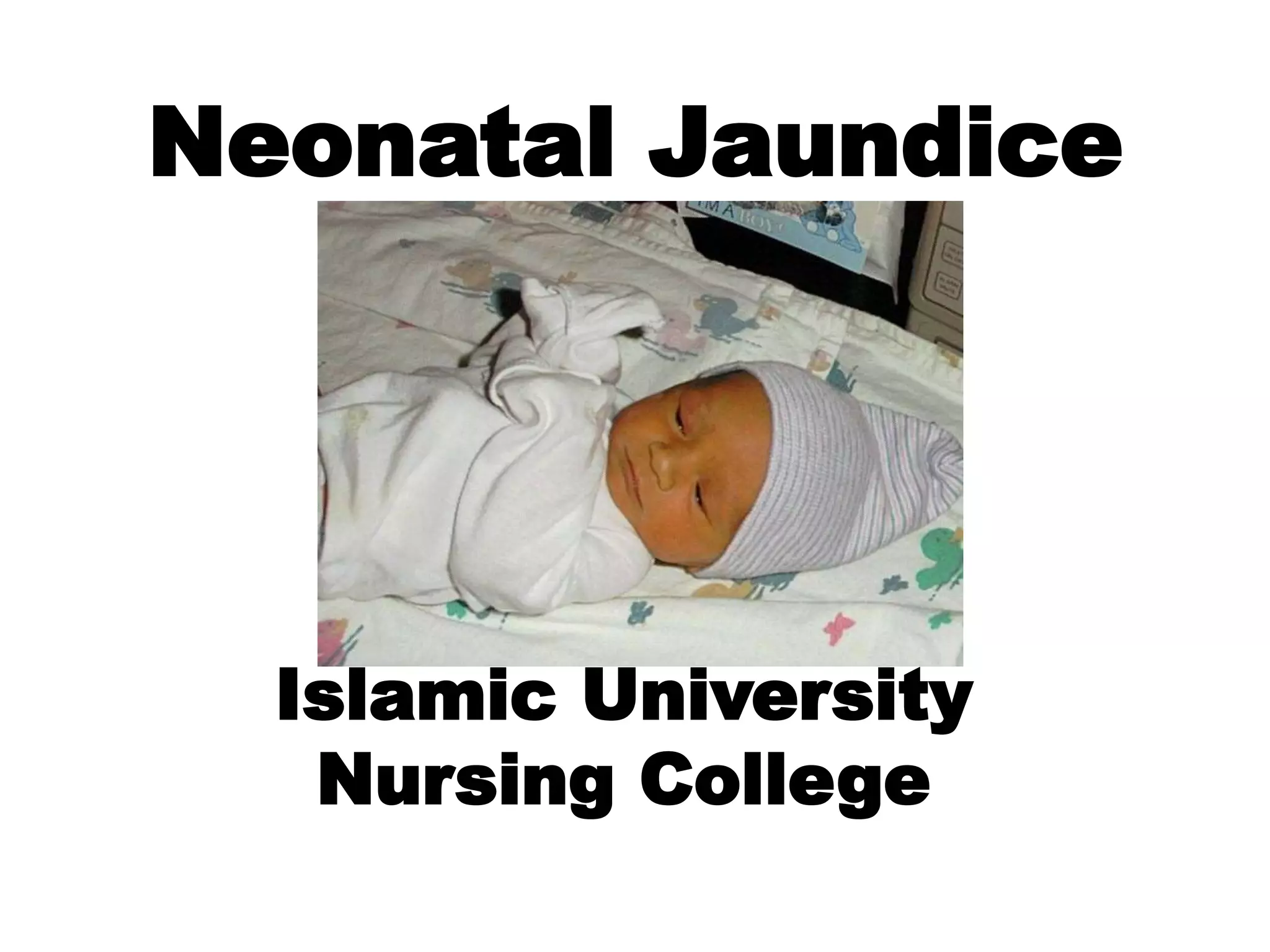
Neonatal Jaundice
(Hyperbilirubinemia)
• Definition: Hyperbilirubinemia refers to an excessive
level of accumulated bilirubin in the blood and is
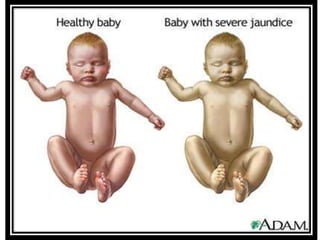
characterized by jaundice, a yellowish discoloration of
the skin, sclerae, mucous membranes and nails.
• Unconjugated bilirubin = Indirect bilirubin.
• Conjugated bilirubin = Direct bilirubin.
NJ - 3
Neonatal Jaundice
• Visible form of bilirubinemia
–Newborn skin >5 mg / dl
• Occurs in 50-60% of term and 80% of preterm
neonates
• However, significant jaundice occurs in 6 %
of term babies.
• Immature liver to conjugate bilirubin from the
destroyed RBCs
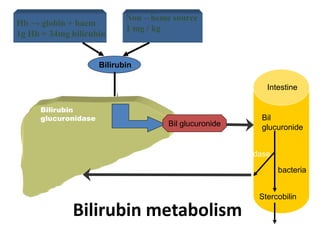
Bilirubin metabolism
Hb → globin + haem
1g Hb = 34mg bilirubin
Non – heme source
1 mg / kg
Bilirubin
glucuronidase
Bilirubin
Bilirubin
Ligandin
(Y - acceptor)
Bil glucuronide
Intestine
Bil
glucuronide
Stercobilin
bacteria
β glucuronidase
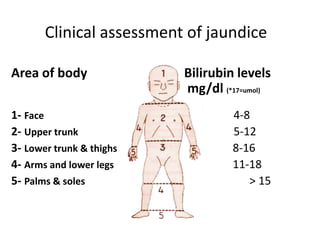
Clinical assessment of jaundice
Area of body Bilirubin levels
mg/dl (*17=umol)
1- Face 4-8
2- Upper trunk 5-12
3- Lower trunk & thighs 8-16
4- Arms and lower legs 11-18
5- Palms & soles > 15
Physiological jaundice
Characteristics
• Appears after 24 hours of birth.
• Maximum intensity by 4th-5th day in term &
7th day in preterm.
• Serum level less than 15 mg/dl.
• Clinically not detectable after 14 days.
• Disappears without any treatment
Note: Baby should, however, be watched for worsening
jaundice.
Why does physiological jaundice
develop?
• Increased bilirubin load.
• Defective uptake from plasma.
• Defective conjugation.
• Decreased excretion.
• Increased entero-hepatic circulation.
Pathological jaundice
• Appears within 24 hours of age.
• Increase of bilirubin > 5 mg/dl/day.
• Serum bilirubin > 15 mg/dl.
• Jaundice persisting after 14 days.
• Stool clay/white colored and urine staining
clothes yellow.
• Direct bilirubin > 2 mg/dl.
Causes of jaundice
Appearing within 24 hours of age
• Hemolytic disease of NB: Rh, ABO
• Infections: TORCH, malaria, bacterial
• G6PD deficiency.
• T – Toxoplasmosis / Toxoplasma gondii
• O – Other infections
• R – Rubella
• C – Cytomegalovirus
• H – Herpes simplex virus or neonatal herpes simplex
Causes of jaundice
Appearing between 24-72 hours of life
• Physiological
• Sepsis
• Polycythemia
• Intraventricular hemorrhage
• Increased entero-hepatic circulation
Causes of jaundice
After 72 hours of age
• Sepsis
• Cephalhaematoma
• Neonatal hepatitis
• Extra-hepatic biliary atresia
• Breast milk jaundice
• Metabolic disorders (G6PD).
Risk factors for jaundice
JAUNDICE
• J - jaundice within first 24 hrs of life
• A - a sibling who was jaundiced as neonate
• U - unrecognized hemolysis
• N – non-optimal sucking/nursing
• D - deficiency of G6PD
• I - infection
• C – cephalhematoma /bruising
• E - East Asian/North Indian
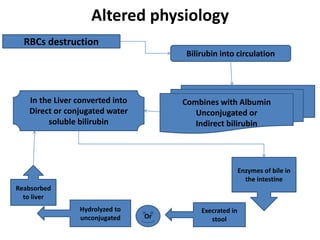
Altered physiology
RBCs destruction
Bilirubin into circulation
Combines with Albumin
Unconjugated or
Indirect bilirubin
In the Liver converted into
Direct or conjugated water
soluble bilirubin
Enzymes of bile in
the intestine
Execrated in
stool
Or
Hydrolyzed to
unconjugated
Reabsorbed
to liver
Diagnostic evaluation:
• Normal values of unconjugated B. are 0.2 to
1.4 mg/dL.
• Investigate the cause of jaundice.
• Mother blood Rh.
Therapeutic Management
• Purposes: reduce level of serum bilirubin and
prevent bilirubin toxicity
• Prevention of hyperbilirubinemia: early feeds,
adequate hydration
• Reduction of bilirubin levels: phototherapy,
exchange transfusion,
• Drugs Use of Phenobarbital promote liver
enzymes and protein synthesis.
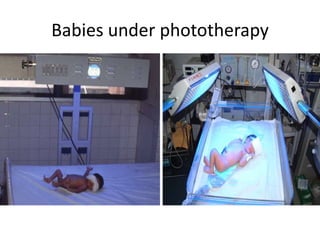
Babies under phototherapy
Baby under conventional
phototherapy
Baby under triple unit intense
phototherapy
Prognosis
• Early recognition and treatment of
hyperbilirubinemia prevents severe brain
damage.
Nursing considerations of Hyperbilirubinemia
• Assessment:
 observing for evidence of
jaundice at regular intervals.
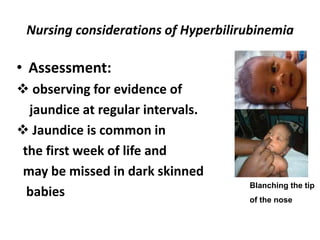
 Jaundice is common in
the first week of life and
may be missed in dark skinned
babies
Blanching the tip
of the nose
Approach to jaundiced baby
• Ascertain birth weight, gestation and postnatal age
• Ask when jaundice was first noticed
• Assess clinical condition (well or ill)
• Decide whether jaundice is physiological or
pathological
• Look for evidence of kernicterus* in deeply
jaundiced NB
*Lethargy and poor feeding, poor or absent Moro's, or
convulsions
Nursing diagnosis
• See the high risk infant plan of care. Plus:
 Body Temp., risk for imbalanced Temp.
related to use of phototherapy.
 Fluid volume, risk for deficient related to
phototherapy.
 Interrupted family process related to
situational crisis, re hospitalization for the
therapy.
The goals of planning
• Infant will receive appropriate therapy if
needed to reduce serum bilirubin levels.
o Infant will experience no complications from
therapy.
o Family will receive emotional support.
o Family will be prepared for home
phototherapy (if prescribed).
Nursing intervention
• Distance of light should be 45-60cm.
• Cover eyes.
• Turning infant every 2 h.
• Avoid hyperthermia. Monitor temp every 2-4h.
• Adequate fluid orally or IV.
NJ - 23
QUESTIONS?

jaundice-neonatal-11.ppt

  • 1.
  • 2.
    Neonatal Jaundice (Hyperbilirubinemia) • Definition:Hyperbilirubinemia refers to an excessive level of accumulated bilirubin in the blood and is characterized by jaundice, a yellowish discoloration of the skin, sclerae, mucous membranes and nails. • Unconjugated bilirubin = Indirect bilirubin. • Conjugated bilirubin = Direct bilirubin.
  • 3.
  • 4.
    Neonatal Jaundice • Visibleform of bilirubinemia –Newborn skin >5 mg / dl • Occurs in 50-60% of term and 80% of preterm neonates • However, significant jaundice occurs in 6 % of term babies. • Immature liver to conjugate bilirubin from the destroyed RBCs
  • 5.
    Bilirubin metabolism Hb →globin + haem 1g Hb = 34mg bilirubin Non – heme source 1 mg / kg Bilirubin glucuronidase Bilirubin Bilirubin Ligandin (Y - acceptor) Bil glucuronide Intestine Bil glucuronide Stercobilin bacteria β glucuronidase
  • 6.
    Clinical assessment ofjaundice Area of body Bilirubin levels mg/dl (*17=umol) 1- Face 4-8 2- Upper trunk 5-12 3- Lower trunk & thighs 8-16 4- Arms and lower legs 11-18 5- Palms & soles > 15
  • 7.
    Physiological jaundice Characteristics • Appearsafter 24 hours of birth. • Maximum intensity by 4th-5th day in term & 7th day in preterm. • Serum level less than 15 mg/dl. • Clinically not detectable after 14 days. • Disappears without any treatment Note: Baby should, however, be watched for worsening jaundice.
  • 8.
    Why does physiologicaljaundice develop? • Increased bilirubin load. • Defective uptake from plasma. • Defective conjugation. • Decreased excretion. • Increased entero-hepatic circulation.
  • 9.
    Pathological jaundice • Appearswithin 24 hours of age. • Increase of bilirubin > 5 mg/dl/day. • Serum bilirubin > 15 mg/dl. • Jaundice persisting after 14 days. • Stool clay/white colored and urine staining clothes yellow. • Direct bilirubin > 2 mg/dl.
  • 10.
    Causes of jaundice Appearingwithin 24 hours of age • Hemolytic disease of NB: Rh, ABO • Infections: TORCH, malaria, bacterial • G6PD deficiency. • T – Toxoplasmosis / Toxoplasma gondii • O – Other infections • R – Rubella • C – Cytomegalovirus • H – Herpes simplex virus or neonatal herpes simplex
  • 11.
    Causes of jaundice Appearingbetween 24-72 hours of life • Physiological • Sepsis • Polycythemia • Intraventricular hemorrhage • Increased entero-hepatic circulation
  • 12.
    Causes of jaundice After72 hours of age • Sepsis • Cephalhaematoma • Neonatal hepatitis • Extra-hepatic biliary atresia • Breast milk jaundice • Metabolic disorders (G6PD).
  • 13.
    Risk factors forjaundice JAUNDICE • J - jaundice within first 24 hrs of life • A - a sibling who was jaundiced as neonate • U - unrecognized hemolysis • N – non-optimal sucking/nursing • D - deficiency of G6PD • I - infection • C – cephalhematoma /bruising • E - East Asian/North Indian
  • 14.
    Altered physiology RBCs destruction Bilirubininto circulation Combines with Albumin Unconjugated or Indirect bilirubin In the Liver converted into Direct or conjugated water soluble bilirubin Enzymes of bile in the intestine Execrated in stool Or Hydrolyzed to unconjugated Reabsorbed to liver
  • 15.
    Diagnostic evaluation: • Normalvalues of unconjugated B. are 0.2 to 1.4 mg/dL. • Investigate the cause of jaundice. • Mother blood Rh.
  • 16.
    Therapeutic Management • Purposes:reduce level of serum bilirubin and prevent bilirubin toxicity • Prevention of hyperbilirubinemia: early feeds, adequate hydration • Reduction of bilirubin levels: phototherapy, exchange transfusion, • Drugs Use of Phenobarbital promote liver enzymes and protein synthesis.
  • 17.
    Babies under phototherapy Babyunder conventional phototherapy Baby under triple unit intense phototherapy
  • 18.
    Prognosis • Early recognitionand treatment of hyperbilirubinemia prevents severe brain damage.
  • 19.
    Nursing considerations ofHyperbilirubinemia • Assessment:  observing for evidence of jaundice at regular intervals.  Jaundice is common in the first week of life and may be missed in dark skinned babies Blanching the tip of the nose
  • 20.
    Approach to jaundicedbaby • Ascertain birth weight, gestation and postnatal age • Ask when jaundice was first noticed • Assess clinical condition (well or ill) • Decide whether jaundice is physiological or pathological • Look for evidence of kernicterus* in deeply jaundiced NB *Lethargy and poor feeding, poor or absent Moro's, or convulsions
  • 21.
    Nursing diagnosis • Seethe high risk infant plan of care. Plus:  Body Temp., risk for imbalanced Temp. related to use of phototherapy.  Fluid volume, risk for deficient related to phototherapy.  Interrupted family process related to situational crisis, re hospitalization for the therapy.
  • 22.
    The goals ofplanning • Infant will receive appropriate therapy if needed to reduce serum bilirubin levels. o Infant will experience no complications from therapy. o Family will receive emotional support. o Family will be prepared for home phototherapy (if prescribed).
  • 23.
    Nursing intervention • Distanceof light should be 45-60cm. • Cover eyes. • Turning infant every 2 h. • Avoid hyperthermia. Monitor temp every 2-4h. • Adequate fluid orally or IV. NJ - 23
  • 24.