The Phylum
Nematomorpha
Nematomorpha
Etymology: from the Greek word
“Nema” for thread
“Morphe” for shape or form
GENERAL DESCRIPTION
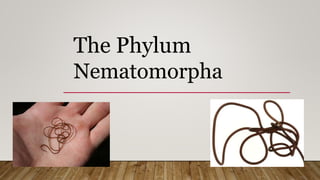
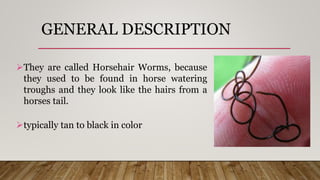
They are called Horsehair Worms, because
they used to be found in horse watering
troughs and they look like the hairs from a
horses tail.
typically tan to black in color
GENERAL DESCRIPTION
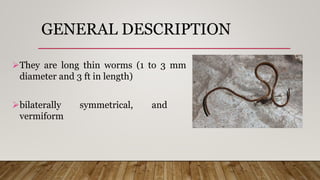
They are long thin worms (1 to 3 mm
diameter and 3 ft in length)
bilaterally symmetrical, and
vermiform
GENERAL DESCRIPTION
Body possesses in a cuticle and
longitudinal muscles.
Has an intra-epidermal nervous
system with an anterior nerve ring.
GENERAL DESCRIPTION
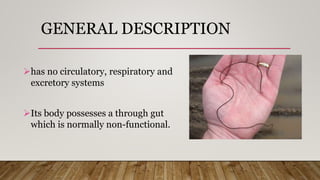
has no circulatory, respiratory and
excretory systems
Its body possesses a through gut
which is normally non-functional.
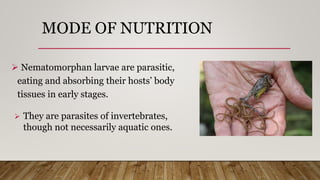
 Nematomorphan larvae are parasitic,
eating and absorbing their hosts’ body
tissues in early stages.
MODE OF NUTRITION
 They are parasites of invertebrates,
though not necessarily aquatic ones.
MODE OF NUTRITION
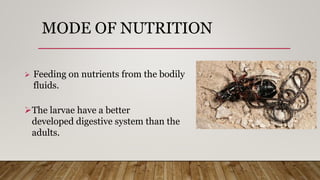
 Feeding on nutrients from the bodily
fluids.
The larvae have a better
developed digestive system than the
adults.
Nematomorphans are dioecious and
reproduce sexually
REPRODUCTION
 Males have one or two testes which
open to cloaca via sperm duct
REPRODUCTION
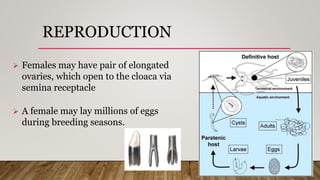
 Females may have pair of elongated
ovaries, which open to the cloaca via
semina receptacle
 A female may lay millions of eggs
during breeding seasons.
Longitudinal muscles (no circular)
underlie cuticle. Move with
characteristic s-shaped movements.
LOCOMOTION
HABITAT
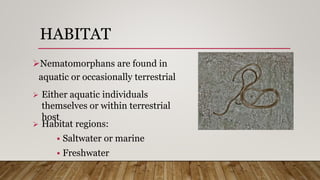
Nematomorphans are found in
aquatic or occasionally terrestrial
 Either aquatic individuals
themselves or within terrestrial
host
 Habitat regions:
 Saltwater or marine
 Freshwater
CLASSIFICATION
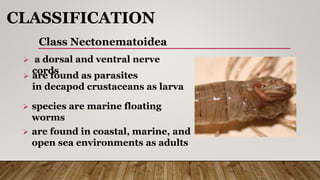
Class Nectonematoidea
 species are marine floating
worms
 are found in coastal, marine, and
open sea environments as adults
 are found as parasites
in decapod crustaceans as larva
 a dorsal and ventral nerve
cords
CLASSIFICATION
Class Nectonematoidea
 Cuticle possesses swimming bristles
 They are known from the waters of
Indonesia, Japan, New Zealand, the
Northern Atlantic, and the Mediterranean.
 parasitize marine invertebrates
 Single reproductive gland (as an
ovary or testes) that produces
gametes only.
CLASSIFICATION
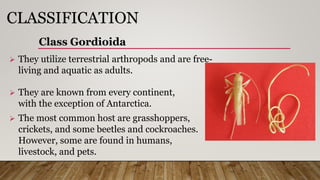
Class Gordioida
 A dorsal and ventral nerve cords.
 Generally called hair worms.
 Only a ventral nerve cord.
 Are found in freshwater, most commonly
along the banks of ponds and streams,
and some are semi-aquatic and live in
damp soil.
CLASSIFICATION
Class Gordioida
 They are known from every continent,
with the exception of Antarctica.
 The most common host are grasshoppers,
crickets, and some beetles and cockroaches.
However, some are found in humans,
livestock, and pets.
 They utilize terrestrial arthropods and are free-
living and aquatic as adults.

PHYLUM NEMATOMORPHA

  • 1.
  • 2.
    Nematomorpha Etymology: from theGreek word “Nema” for thread “Morphe” for shape or form
  • 3.
    GENERAL DESCRIPTION They arecalled Horsehair Worms, because they used to be found in horse watering troughs and they look like the hairs from a horses tail. typically tan to black in color
  • 4.
    GENERAL DESCRIPTION They arelong thin worms (1 to 3 mm diameter and 3 ft in length) bilaterally symmetrical, and vermiform
  • 5.
    GENERAL DESCRIPTION Body possessesin a cuticle and longitudinal muscles. Has an intra-epidermal nervous system with an anterior nerve ring.
  • 6.
    GENERAL DESCRIPTION has nocirculatory, respiratory and excretory systems Its body possesses a through gut which is normally non-functional.
  • 7.
     Nematomorphan larvaeare parasitic, eating and absorbing their hosts’ body tissues in early stages. MODE OF NUTRITION  They are parasites of invertebrates, though not necessarily aquatic ones.
  • 8.
    MODE OF NUTRITION Feeding on nutrients from the bodily fluids. The larvae have a better developed digestive system than the adults.
  • 9.
    Nematomorphans are dioeciousand reproduce sexually REPRODUCTION  Males have one or two testes which open to cloaca via sperm duct
  • 10.
    REPRODUCTION  Females mayhave pair of elongated ovaries, which open to the cloaca via semina receptacle  A female may lay millions of eggs during breeding seasons.
  • 11.
    Longitudinal muscles (nocircular) underlie cuticle. Move with characteristic s-shaped movements. LOCOMOTION
  • 12.
    HABITAT Nematomorphans are foundin aquatic or occasionally terrestrial  Either aquatic individuals themselves or within terrestrial host  Habitat regions:  Saltwater or marine  Freshwater
  • 13.
    CLASSIFICATION Class Nectonematoidea  speciesare marine floating worms  are found in coastal, marine, and open sea environments as adults  are found as parasites in decapod crustaceans as larva  a dorsal and ventral nerve cords
  • 14.
    CLASSIFICATION Class Nectonematoidea  Cuticlepossesses swimming bristles  They are known from the waters of Indonesia, Japan, New Zealand, the Northern Atlantic, and the Mediterranean.  parasitize marine invertebrates  Single reproductive gland (as an ovary or testes) that produces gametes only.
  • 15.
    CLASSIFICATION Class Gordioida  Adorsal and ventral nerve cords.  Generally called hair worms.  Only a ventral nerve cord.  Are found in freshwater, most commonly along the banks of ponds and streams, and some are semi-aquatic and live in damp soil.
  • 16.
    CLASSIFICATION Class Gordioida  Theyare known from every continent, with the exception of Antarctica.  The most common host are grasshoppers, crickets, and some beetles and cockroaches. However, some are found in humans, livestock, and pets.  They utilize terrestrial arthropods and are free- living and aquatic as adults.